
Hawaii Abortion Laws: Viability Limit, Pills, and Costs

Abortion is legal in Hawaii. State law lets you choose an abortion before the fetus is viable, and after that point if the termination is necessary to protect your life or health. There is no fixed week limit, no waiting period, and no residency requirement.
The rule sits in Haw. Rev. Stat. § 453-16, which says the State “shall not deny or interfere with” a pregnant person’s right to obtain an abortion. The rest of this article covers where the line falls, who can provide care, how pills and telehealth fit in, what it costs, and how to find an appointment on each island.
What Is the Law on Abortion in Hawaii?
Section 453-16 defines “abortion” as the intentional termination of the pregnancy of a nonviable fetus. A nonviable fetus is one without a reasonable likelihood of sustained survival outside the uterus. Subsection (b) then protects two choices: obtaining an abortion, and terminating a pregnancy when necessary to protect the life or health of the pregnant person.
That second clause is what keeps care available after viability. It covers “health” as well as “life,” which is broader than the life-only exceptions in many other states.
Subsection (c) lets a hospital or an individual decline to take part in an abortion without liability. A refusal does not take away your legal right, but it can affect which provider you end up seeing.
How Far Along Can You Get an Abortion in Hawaii?
You can get an abortion until the fetus is viable, which the statute ties to medical judgment rather than a number of weeks. Viability is a clinical call made by your provider based on the particular pregnancy, so two people at the same gestational age can get different answers.
Individual clinics set their own practical cutoffs for procedures, and those are often earlier than the legal line. Ask any abortion provider you contact what the latest gestational age is that they offer. After viability, a physician can still terminate a pregnancy if it is necessary to protect your life or health.
No Criminal Penalty Remains in the Statute
Earlier versions of § 453-16 made it a crime to perform an abortion outside the listed conditions, with a fine of up to $1,000, up to five years in prison, or both. That penalty language is gone from the current section, which was rewritten by Act 2 of 2023.
How Hawaii Got Here: Five Dates That Matter
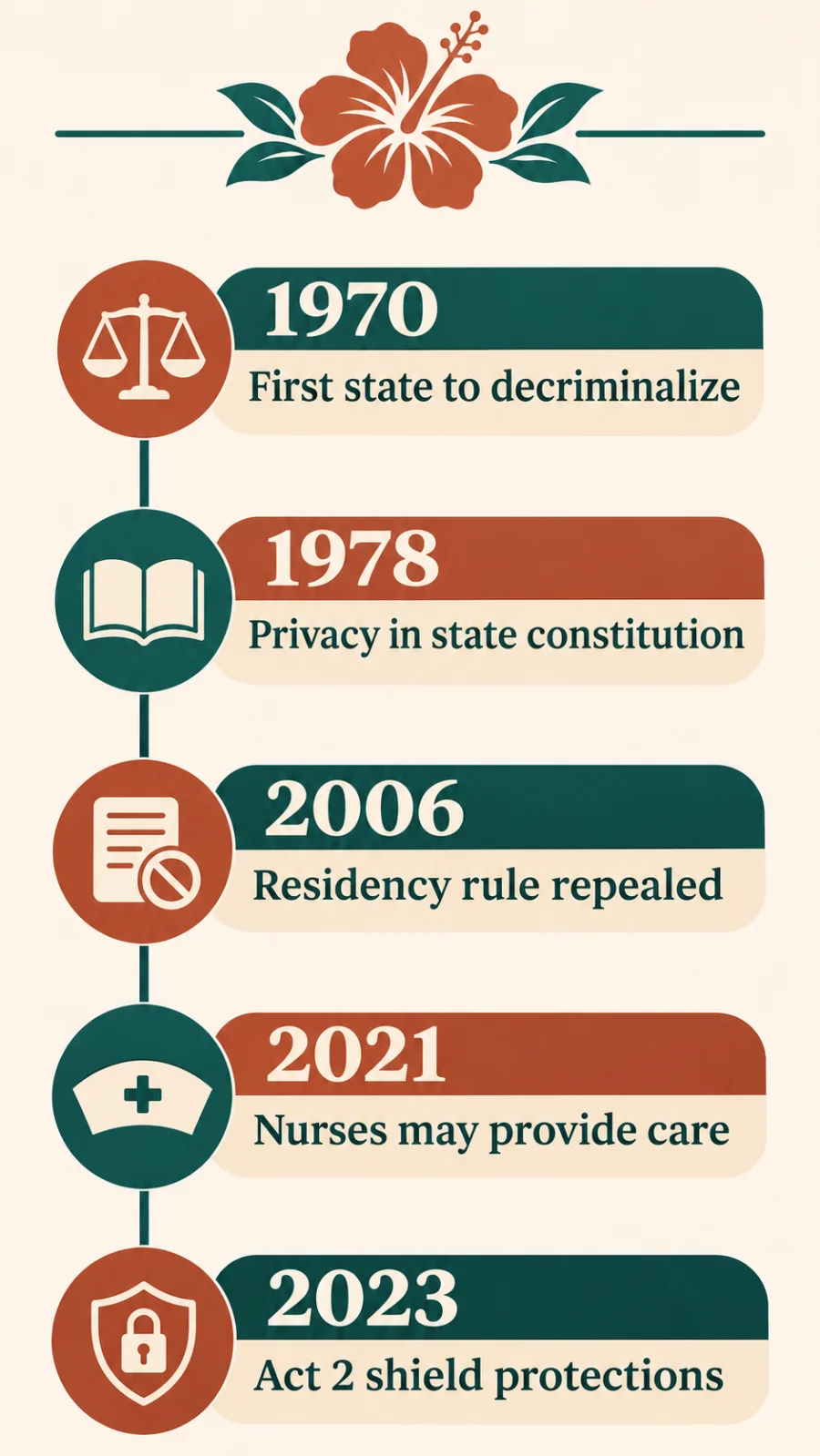
Hawaii was the first state to decriminalize abortion, with Act 1 of the 1970 session laws, three years before Roe v. Wade. The state has kept widening protection since then.
| Year | Change | Effect |
|---|---|---|
| 1970 | Act 1 | First state to decriminalize abortion |
| 1978 | Constitutional amendment | Art. I, § 6 expressly protects privacy, including the decision to bear a child or obtain an abortion |
| 2006 | Act 35 | Wrote the right into statute and repealed a 90-day residency requirement |
| 2021 | Act 3 | Allowed advanced practice registered nurses to provide medication and aspiration abortion care |
| 2023 | Act 2 (SB 1) | Added physician assistants, dropped the facility requirement, and added shield protections |
The 2023 law was signed by Gov. Josh Green, a physician, on March 22, 2023. The governor’s announcement describes it as expanding access and protecting Hawaii providers from legal action tied to lawful reproductive care.
Who Can Get an Abortion in Hawaii?
Anyone who is pregnant and seeking an abortion can, and you do not have to live in Hawaii. The 90-day residency rule was repealed by Act 35 in 2006, and the statute’s language is now gender-neutral, referring to a “pregnant person.”
Minors are covered too. Honolulu Civil Beat reported that Act 2 changed the definition of “medical care and services” to include surgical abortion, clarifying that a minor does not need parental consent. If a minor needs care, a clinic can explain how that applies to them.
Hawaii has no mandatory counseling script and no required waiting period before an abortion.
Who Is Allowed to Provide Abortion Care?
Section 453-16(a) names physicians and physician assistants, and a separate statute, § 457-8.7, covers advanced practice registered nurses. The scope differs by license.
| Provider | What they can provide | Limit |
|---|---|---|
| Physician or osteopathic physician | Abortion care, medication or procedural | Viability rules above |
| Physician assistant | Medication or aspiration abortion | First trimester |
| Advanced practice registered nurse (APRN) | Medication or aspiration abortion | First trimester; needs prescriptive authority and must stay within practice specialty |
Before Act 2, the statute required abortions to be performed in a licensed hospital, clinic, or physician’s office. The enacted bill repealed that location requirement, which opened the door to pills prescribed by telehealth and taken at home.
Is the Abortion Pill Legal in Hawaii?
Yes. Medication abortion, the combination of mifepristone and misoprostol, is legal in Hawaii, and providers licensed in the state can prescribe it. The standard FDA-labeled use runs through 10 weeks, counted from the first day of your last menstrual period, so confirm your dating with the provider.
Honolulu Civil Beat reported in September 2026 that pills have become the most common way to end a pregnancy in the state, largely because of neighbor island geography.
Can You Get Abortion Pills by Mail or Use Them at Home?
Yes. After an online or phone consultation, a licensed provider can prescribe the pills and have them mailed or sent to a pharmacy, and you take them at home. Hawaii’s 2023 repeal of the facility requirement is what makes this lawful here.
Federal policy is a separate layer that Hawaii cannot control. The federal health secretary has asked the FDA to review mifepristone data, and a case in Louisiana challenges the FDA’s approval of telehealth prescribing. A ruling there or a change in FDA rules could affect how pills are prescribed even though state law allows it.
The state is preparing for that. In 2023 the Department of Health partnered with Kapiolani Medical Center for Women and Children to hold a one-year mifepristone supply. A 2026 Senate resolution says the department aims to keep a three-year supply, and that its current stock expires in 2029.
Where Can You Get an Abortion in Hawaii?
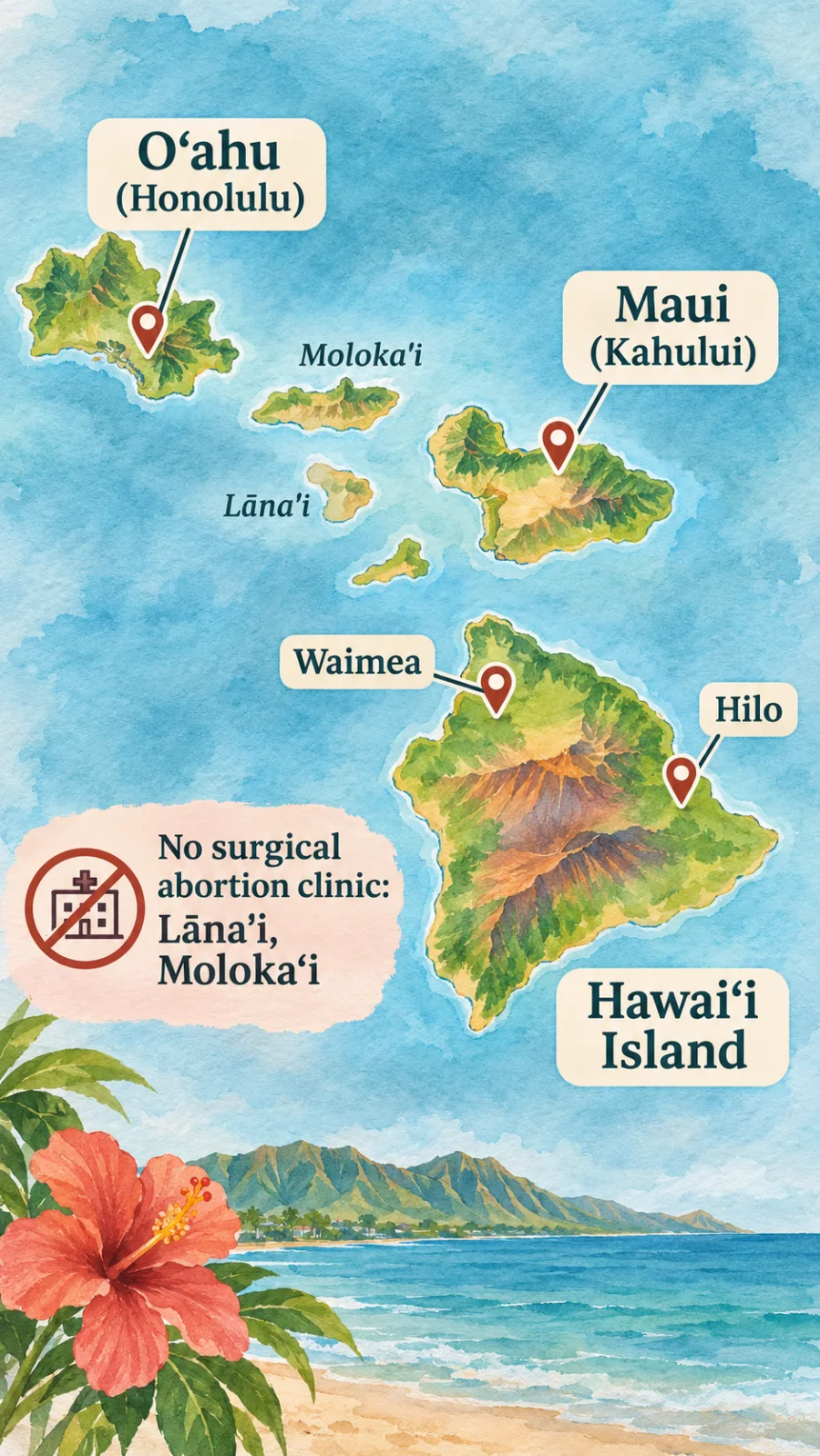
In-person procedures are concentrated on a few islands. Civil Beat reporting in August 2025 listed Queen’s Medical Center and Planned Parenthood in Honolulu on Oʻahu, Planned Parenthood in Kahului on Maui, and University Women’s Health in Hilo and North Hawaiʻi Community Hospital in Waimea on Hawaiʻi Island.
Later reporting counts only three in-clinic locations statewide, so the lists differ. Call before you travel and ask whether they perform the procedure you need at your stage of pregnancy. The Hawaiʻi Abortion Collective publishes a statewide guide to services.
Lānaʻi and Molokaʻi have no clinics that offer surgical abortion. Residents there, and on Kauaʻi, usually choose between telehealth pills and flying to another island.
How Much Does an Abortion Cost in Hawaii?
The price depends on the method, how far along you are, and whether insurance pays. Hawaii does not set a flat fee, and clinics and telehealth services price differently, so ask for the total before you book.
If you are uninsured or paying yourself, federal rules give you the right to request a Good Faith Estimate of the cost in advance. Ask for it in writing.
Will Medicaid Cover an Abortion in Hawaii?
Yes. Under Med-QUEST memo FFS 24-10, dated December 30, 2024, Hawaii Medicaid covers induced abortion with 100 percent state funds. Coverage runs up to fetal viability, and neither medical justification nor prior authorization is required.
Because the state pays without federal money, coverage is not limited to the federal Hyde Amendment exceptions of rape, incest, or life endangerment. Providers bill these claims directly to Medicaid fee-for-service rather than to your QUEST Integration health plan.
Can You Get Help Paying for an Abortion?
Yes, from several places. Many private plans in Hawaii cover abortion, and KFF’s state tracking shows no state restriction on private plans or the health insurance marketplace. Check your plan’s cost sharing first.
Reporting indicates Med-QUEST can also help coordinate transportation to another island when there is no provider on yours. Clinics can usually tell you about financial assistance or abortion funds, and the Hawaiʻi Abortion Collective guide is a good starting point for travel help.
Does Hawaii Protect Out-of-State Patients and Providers?
Yes. Act 2 added what are often called shield protections for people who travel to Hawaii from states with bans, and for the providers who treat them. As summarized in the bill’s legislative description, it:
- bars health care entities from disclosing reproductive health care information, with limited exceptions;
- prohibits subpoenas tied to out-of-state or interstate proceedings over care that was legal in Hawaii;
- requires the governor to deny extradition demands for conduct that would not also be a crime in Hawaii.
Those protections reach legal care delivered in Hawaii. They cannot stop another state from pursuing its own residents, so anyone coming from a restrictive state may want legal advice about their home state’s rules.
Which State Has the Loosest Abortion Laws?
No official ranking exists, and the answer depends on what you measure. Several states, including Oregon, Colorado and New Mexico, set no gestational limit at all, while Hawaii draws its line at viability with a life-or-health exception afterward. Hawaii stands out for its history as the first state to decriminalize abortion, its broad provider list, and Medicaid coverage with no prior authorization.
Frequently Asked Questions
Can you get an abortion in Hawaii?
Yes. Section 453-16 protects the right to an abortion, and in-clinic and telehealth care are both available. Federal litigation over mifepristone is the main thing that could change how pills are prescribed.
How late can you get an abortion in Hawaii?
Until viability under the statute, which is a medical determination rather than a set week. After viability, a termination is lawful if it is necessary to protect the patient’s life or health.
Do I need to live in Hawaii to get an abortion?
No. The 90-day residency requirement was repealed in 2006.
Can a nurse or physician assistant provide an abortion?
Yes, for the first trimester. Advanced practice registered nurses and physician assistants may provide medication or aspiration abortion care, and physicians may provide care beyond that stage within the viability rules.
Does Medicaid pay for an abortion in Hawaii?
Yes, up to viability, with state funds and no prior authorization or medical justification required.
Curious about abortion laws in other states?
Rules vary widely, from no gestational limit to near-total bans. Check your own state’s statute or a neutral tracker such as the Guttmacher Institute before relying on a summary.
References
- Hawaii State Legislature, Haw. Rev. Stat. § 453-16, intentional termination of pregnancy
- Hawaii State Legislature, S.B. 1 (2023), enacted as Act 2, reproductive health care
- Hawaii Department of Human Services, Med-QUEST Memo FFS 24-10, induced abortion claims
- Hawaii State Senate, S.R. 44 (2026), mifepristone supply
- Office of the Governor of Hawaii, bill signing release for Act 1 and Act 2 (March 22, 2023)
- Honolulu Civil Beat, reporting on abortion provider locations and the abortion pill
- KFF, Hawaii abortion policies, insurance and Medicaid coverage