
Kentucky Abortion Ban: Legal Challenges and Recent Changes

Kentucky bans abortion at every stage of pregnancy. Under KRS 311.772, the only exceptions are a physician’s judgment that a procedure is needed to prevent death or serious risk of death from a physical condition, and the specific situations listed in KRS 311.723, such as ectopic pregnancy, molar pregnancy and miscarriage emergencies. There is no exception for rape or incest.
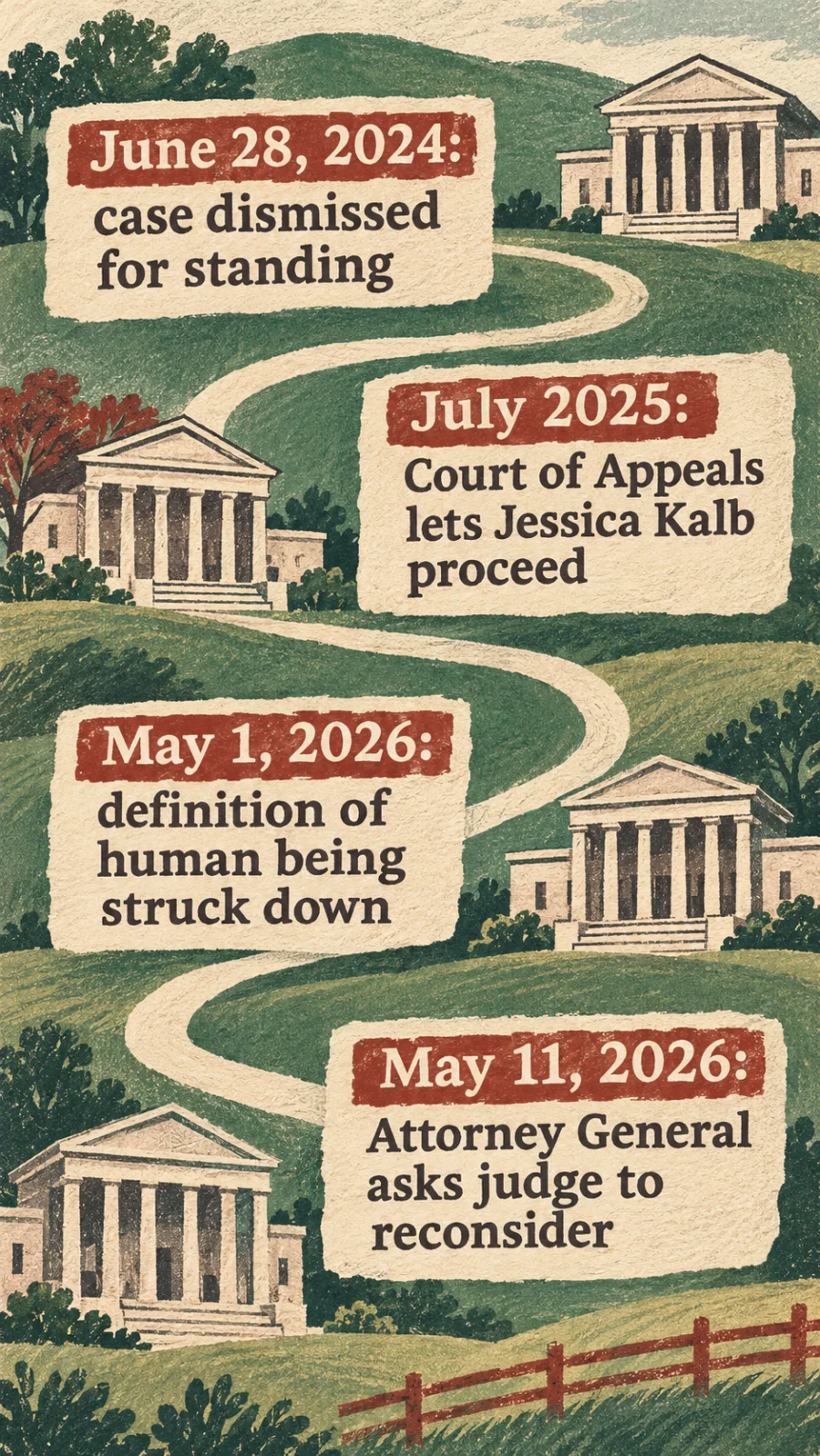
A provider who breaks the law commits a Class D felony, which carries 1 to 5 years in prison. The statute bars criminal punishment of the pregnant woman herself. On May 1, 2026, a Jefferson Circuit Court judge struck down the law’s definitions of “human being” as unconstitutionally vague in an IVF case, but he did not block enforcement of the ban.
What the Human Life Protection Act Prohibits
Kentucky’s ban is a “trigger law” passed in 2019 (2019 Ky. Acts ch. 152) that was written to take effect if the U.S. Supreme Court reversed Roe v. Wade. That happened on June 24, 2022. A trial court blocked the ban on June 30, 2022, a state appeals court reinstated it on August 1, and the Kentucky Supreme Court declined to lift it on August 18.
The statute makes it a crime to knowingly do either of two things with the specific intent of ending the life of an unborn human being:
- Administer, prescribe, procure for, or sell to a pregnant woman any medicine, drug or other substance.
- Use an instrument or procedure on a pregnant woman.
The law reaches back to fertilization, which KRS 311.772(1)(a) defines as the moment a sperm penetrates the outer layer of the egg. Contraception is protected. Subsection (6) allows birth control that is used before a pregnancy can be detected by conventional medical testing, and KRS 311.723(3) separately says nothing in the chapter bars birth control methods.

Medical Exceptions After House Bill 90
House Bill 90 rewrote the exceptions in 2025. Governor Andy Beshear vetoed it on March 25, 2025, and the General Assembly overrode the veto on March 27 (House 77 to 20, Senate 31 to 7). It took effect the same day as 2025 Ky. Acts ch. 121, titled the Love Them Both Act of 2025, and it also contained a separate birth-center licensing section.
Supporters said the bill clarified when doctors may act. Beshear said it created an exhaustive list that is silent on any emergency not named, and doctors who spoke to the Kentucky Lantern said the new wording confused them more than the old law. Those two readings have not been tested in a published court decision.
The key change is vocabulary. KRS 311.723 now lists what a physician may do under the heading of actions that require separating a pregnant woman from her unborn child, rather than calling them abortions. A physician may act, based on reasonable medical judgment, in these situations:
| Situation | KRS 311.723(1) | What the text says |
|---|---|---|
| Saving the unborn child | (a) | A procedure meant to save life or preserve health of the unborn child |
| Miscarriage emergencies | (b), (c) | Lifesaving miscarriage management, plus sepsis or hemorrhage from a miscarriage |
| Fetal death | (d) | Removal of a dead child, documented with an ultrasound showing no cardiac activity when it should be present |
| Ectopic pregnancy | (e), (f) | Surgical removal, or methotrexate or similar medication |
| Molar pregnancy | (g) | Removal of a molar pregnancy |
| Threat to the mother | (h) | Preventing death or substantial risk of death from a physical condition, or serious, permanent impairment of a life-sustaining organ |
The life-threat exception covers physical conditions only. It also requires the physician to make reasonable medical efforts to preserve both the mother and the unborn child.
Paperwork the Physician Must Complete
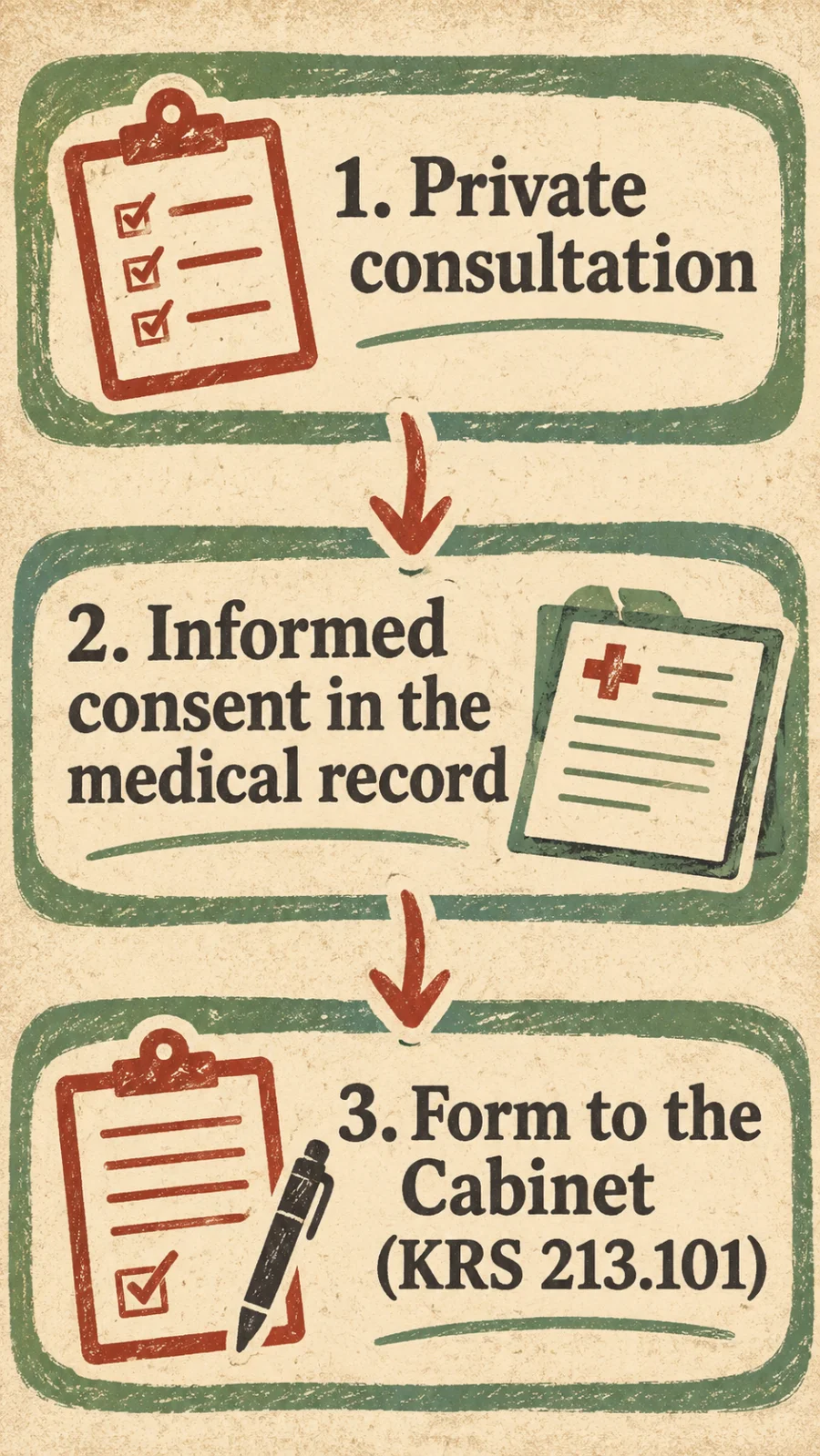
KRS 311.723(2) requires a private consultation, informed consent documented in the medical record and acknowledged in writing by the patient, and a form prescribed by the Cabinet for Health and Family Services under KRS 213.101 that explains the physician’s medical judgment. In a medical emergency, the physician may delay the consultation and consent steps and must finish the documentation promptly once the emergency ends.
The Attorney General’s October 26, 2022 advisory adds that the ban is not violated when treatment accidentally or unintentionally causes the death of an unborn child, a point now written into KRS 311.772(4)(b). An advisory is guidance, not a court ruling, and a county prosecutor is not bound by it.
No Exceptions for Rape, Incest or Fatal Fetal Anomalies
Kentucky law has no exception for pregnancy caused by rape or incest, and none for a fetal diagnosis incompatible with life. A pregnancy from rape can be ended only if it separately meets one of the medical conditions above.
Lawmakers have declined to change that. Senator David Yates filed SB 99, known as Hadley’s Law, in 2025 to add exceptions for rape, incest and nonviable pregnancies, and it never received a committee hearing. In 2026, House Bill 831 proposed exceptions for rape, incest and lethal fetal anomalies and died in committee.
Who Can Be Charged: Providers, Not Patients
The penalty is a Class D felony, which carries 1 to 5 years in prison under KRS 532.060 and a fine of $1,000 to $10,000 under KRS 534.030. KRS 311.772(5) says nothing in the section can be read to subject the pregnant woman to a criminal conviction or penalty.
That protection has been tested once in a reported case. After a Wolfe County woman was arrested on December 31, 2025, for taking abortion medication she ordered online, a grand jury indicted her on four charges. The next day the Commonwealth’s Attorney dismissed the fetal homicide charge, citing KRS 507A.010(3), which bars prosecuting a pregnant woman for causing the death of her own unborn child. Spectrum News reported it as the first known arrest since the ban took effect.
The case shows the limit of the shield. Charges for concealing the birth of an infant, abuse of a corpse and tampering with physical evidence were not covered by the abortion statute and stayed in the case.
The statute’s verbs are administer, prescribe, procure for and sell. It does not name people who give a ride or money, so a prosecutor would have to rely on Kentucky’s general complicity law, KRS 502.020. If you are in that position, speak with a criminal defense attorney before talking to investigators.
Abortion Pills and Telehealth
Prescribing or selling abortion medication to a pregnant woman with the intent to end the pregnancy falls under KRS 311.772(3). Kentucky also banned mailing abortion pills in 2022. The pregnant woman who takes the pills faces no penalty under the abortion statute.
The Attorney General announced an investigation in January 2026 into organizations suspected of mailing or delivering pills into Kentucky, including advertisements for Mayday Health placed at gas stations.
House Bill 646
Representative Nancy Tate filed House Bill 646 on February 13, 2026. It would have classified abortion-inducing drugs as controlled substances, made importing them a felony and let people harmed by a pill sue distributors, prescribers and manufacturers. It carved out pregnant women from possession charges. It did not receive a hearing and died when the session ended.
The 2026 Legislative Session
The 2026 session adjourned April 15 with all seven abortion bills dead in committee, three that would have tightened the law and four that would have loosened it.
| Bill | What it would have done | Outcome |
|---|---|---|
| HB 646 | Treat abortion pills as controlled substances, felony for importing them | No hearing |
| HB 714 | Prenatal Equal Protection Act, allowing homicide prosecution for abortion | Died in committee |
| HB 784 | Remove abortion as an exception in prosecutions for deaths of unborn children | Died in committee |
| HB 22 | Repeal the ban | Died in committee |
| HB 23 | Protect people who assist with out-of-state abortion care | Died in committee |
| HB 831 | Exceptions for rape, incest and lethal fetal anomaly | Died in committee |
| HB 476 | Constitutional amendment on reproductive freedom | Died in committee |
Voters have weighed in once. In November 2022, Kentucky voters rejected Amendment 2, which would have written into the state constitution that it protects no right to abortion, by roughly 52 percent to 48 percent. The vote did not repeal the ban. The General Assembly’s next regular session convenes in January 2027.
The May 2026 Ruling on “Human Being” and IVF
On May 1, 2026, Jefferson Circuit Judge Brian Edwards declared the statutes’ definitions of “human being” void for vagueness, as Louisville Public Media reported. He found that the abortion statutes contain conflicting, intertwined definitions of human being, fetus and unborn child. He rejected the plaintiff’s religious freedom claim, calling the ban a religiously neutral burden on anyone of any faith pursuing IVF.
The ruling did not include an injunction, so KRS 311.772(3) can be enforced as before. Edwards wrote that only the General Assembly can resolve the confusion and called Attorney General advisory opinions non-binding.
How the Case Got Here
Jessica Kalb, who has nine frozen embryos, sued in October 2022 with two other Jewish women who said the ban restricted IVF. Edwards dismissed the case in June 2024 for lack of standing. A Court of Appeals panel let only Kalb proceed in July 2025, and she was the sole plaintiff when the case returned to Edwards for new arguments.
Why an IVF patient and not a clinic? In February 2023, the Kentucky Supreme Court held in Cameron v. EMW Women’s Surgical Center that abortion providers lack third-party standing to challenge the bans for their patients. Individual patients must now bring the claims.
What Comes Next
Attorney General Russell Coleman filed a motion on May 11 asking Edwards to reconsider, calling the ruling a “manifest error of law” and arguing the ban does not apply to IVF or the disposal of unused embryos. Kalb’s lawyers also asked for a revised ruling, as the Kentucky Lantern reported, seeking a decision that addresses their religious freedom arguments.
The Attorney General’s office says IVF is fully legal in Kentucky. Edwards found that a patient has no binding assurance a prosecutor will agree. If you are starting or continuing IVF, ask your clinic how it handles unused embryos.
Traveling Out of State for an Abortion
Kentucky does not penalize a woman for traveling to another state for legal care. Illinois, Ohio and Virginia border Kentucky and permit abortion, though each sets its own limits that you should confirm with a clinic before booking.
House Bill 23, which would have added explicit state protection for people who help Kentuckians travel for care, died in committee in 2026. The KRS 311.772 offenses cover conduct inside Kentucky, such as prescribing, selling or performing a procedure, and the statute does not mention travel.

Emergency Care Under the Ban
If you have bleeding, signs of infection or severe pain during pregnancy, go to the nearest emergency room. KRS 311.723(1)(b) through (h) authorize treatment for miscarriage emergencies, sepsis, hemorrhage, ectopic pregnancy and any physical condition that creates a substantial risk of death.
Whether a hospital acts quickly depends on how its physicians read the 2025 wording. Because the physician must record the basis for that judgment on a Cabinet form, hospitals tend to involve their legal and ethics teams, which can add time. If you or a family member is turned away, ask for the treating physician and the hospital’s patient advocate in writing.
Minors and Parental Consent
KRS 311.732 requires informed written consent from a minor and one parent or legal guardian before an abortion, unless the minor is emancipated or has a court order. A minor can petition a Circuit or District Court for self-consent, and the court form (AOC-261.1) provides for a hearing within 72 hours, including weekends and holidays. These proceedings are confidential.
The consent rules matter only for the narrow medical situations the ban allows. They do not create an exception for rape or incest.
Frequently Asked Questions
Is abortion completely illegal in Kentucky?
Almost. KRS 311.772 bans it at every stage, with exceptions only for the medical situations in KRS 311.723 and for preventing death, substantial risk of death, or serious, permanent organ impairment from a physical condition.
Can a pregnant woman be charged for having an abortion?
Not under the abortion statute. KRS 311.772(5) bars it, and a prosecutor dropped a fetal homicide charge against a Wolfe County woman in January 2026 under KRS 507A.010(3). Other charges, such as abuse of a corpse, can apply.
What is the penalty for a doctor who performs an illegal abortion?
A Class D felony, with 1 to 5 years in prison under KRS 532.060 and a $1,000 to $10,000 fine under KRS 534.030.
Are abortion pills legal in Kentucky?
No. Prescribing or selling them to a pregnant woman to end a pregnancy violates KRS 311.772, and mailing them into the state has been illegal since 2022. The woman who takes them faces no penalty under that statute.
Is IVF legal in Kentucky after the May 2026 ruling?
The Attorney General says IVF is fully legal. The judge struck the definitions of “human being” but did not enjoin the ban, and motions asking him to revise the ruling are pending.
Can I travel to another state for an abortion?
Yes. Kentucky law does not penalize travel, but the rules in the destination state, including gestational limits, apply to you there.
References
- Kentucky General Assembly, KRS 311.772, Human Life Protection Act
- Kentucky General Assembly, KRS 311.723, physician actions separating a pregnant woman from her unborn child
- Kentucky Attorney General, Second Advisory on the Human Life Protection Act, October 26, 2022
- Kentucky Court of Justice, AOC-261.1, Order Granting Abortion (self-consent by a minor, KRS 311.732)
- Louisville Public Media, news report on the May 1, 2026 Jefferson Circuit Court ruling
- Kentucky Lantern, news report on motions filed after the May 2026 ruling
- Kentucky Today, news roundup of abortion bills in the 2026 session
- Kentucky Lantern, news report on the House Bill 90 veto override, March 27, 2025