
Louisiana’s Total Abortion Ban Explained

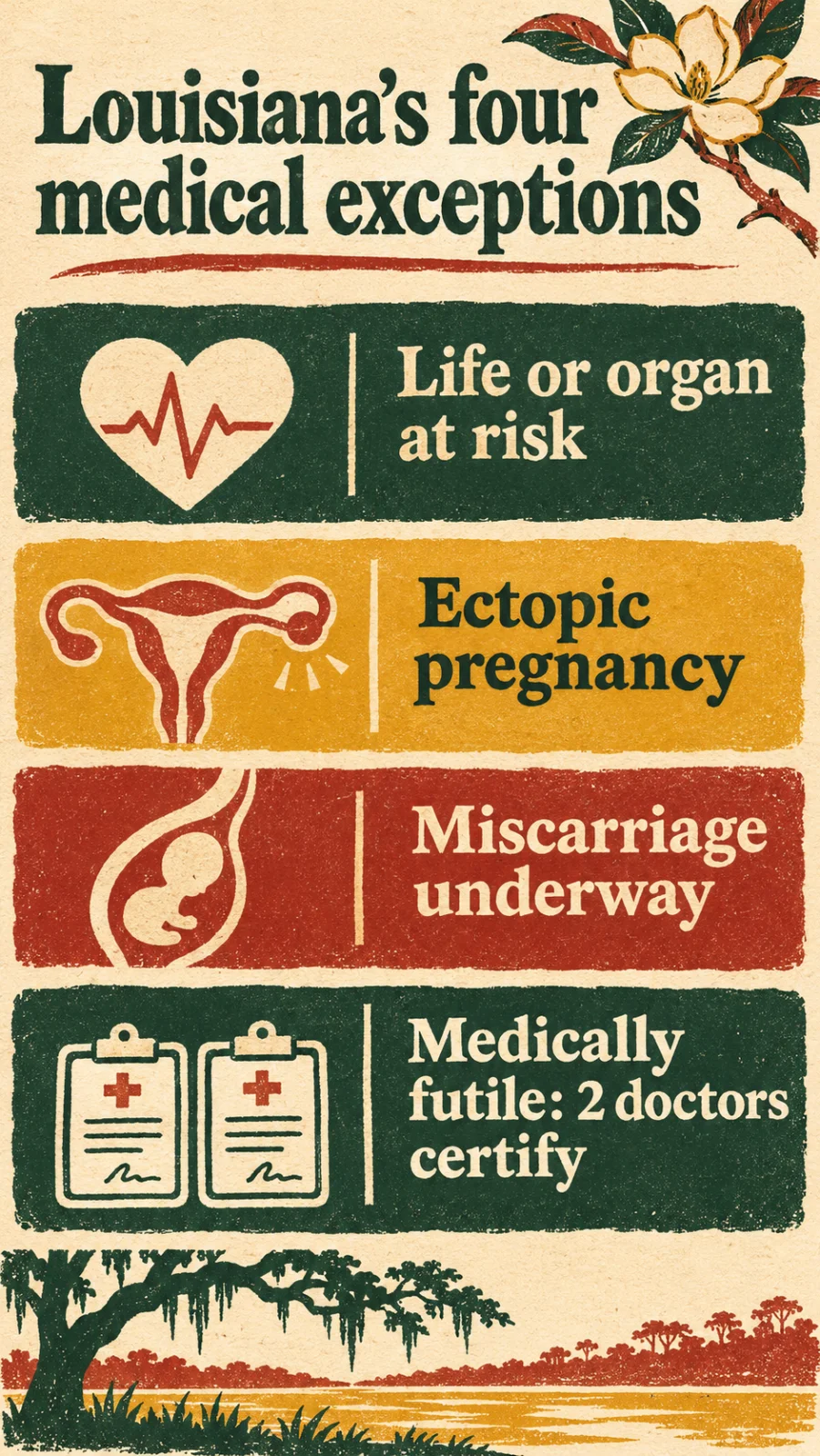
Louisiana bans abortion at every stage of pregnancy. La. R.S. 40:1061 allows it only to prevent death or serious permanent damage to a life-sustaining organ, and a separate statute exempts ectopic pregnancy treatment, miscarriage management and pregnancies deemed medically futile. There is no exception for rape or incest, which is why the ban is often called total even though the statute contains a few narrow carve-outs.
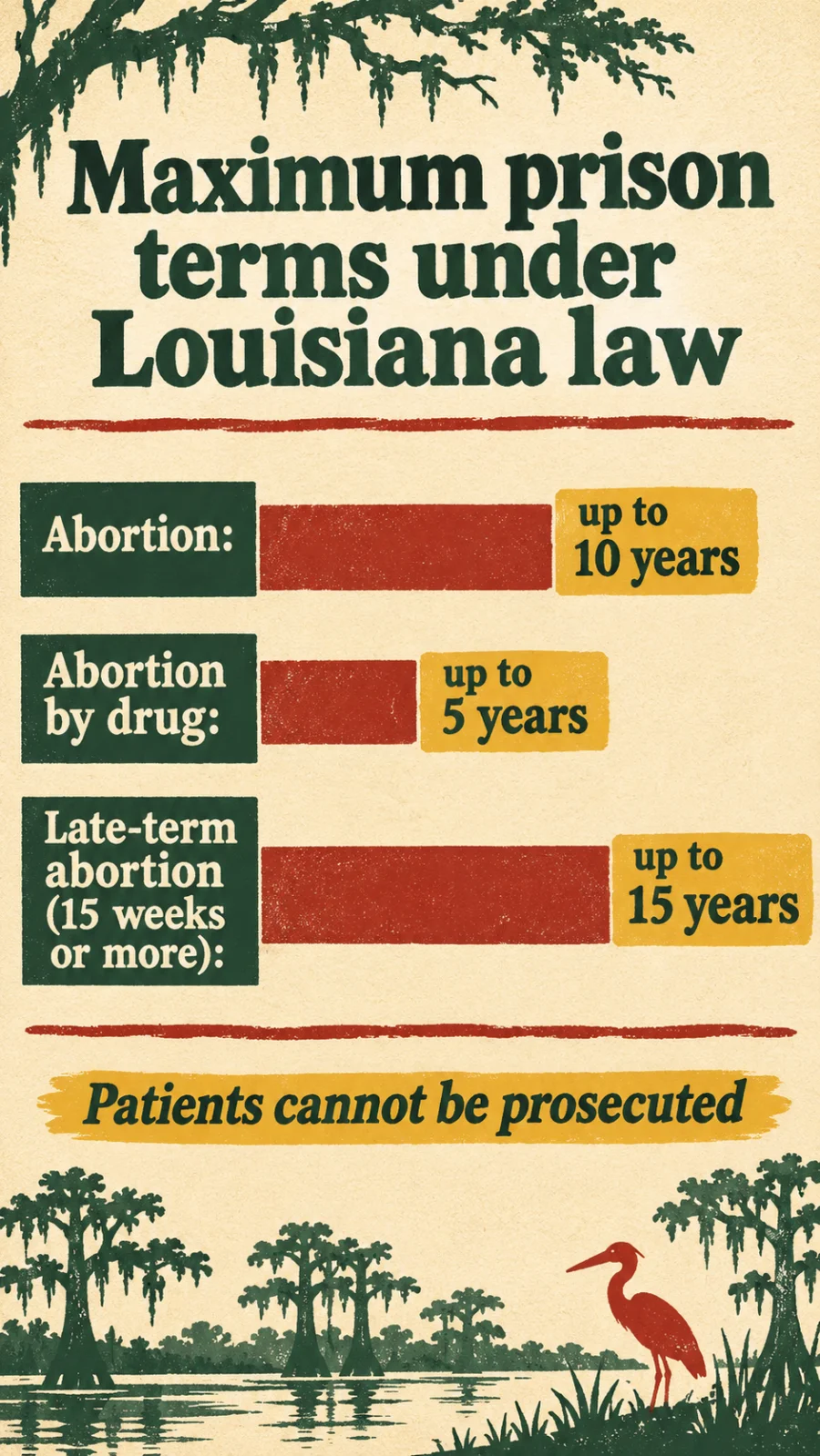
The people who face prison are the ones who provide abortion, not the patient. Under La. R.S. 14:87.7, performing an abortion carries 1 to 10 years at hard labor and a fine of $10,000 to $100,000, and R.S. 40:1061(H) says a pregnant woman cannot be criminally convicted for her own abortion.
How Louisiana Got Its Ban
The ban began as a trigger law, meaning a statute written to take effect only after a future event. Louisiana passed it as Act 467 of 2006, with language that activated it upon any U.S. Supreme Court decision overruling Roe v. Wade. That event came on June 24, 2022, when the Court decided Dobbs v. Jackson Women’s Health Organization.
The statute is named the Human Life Protection Act (R.S. 40:1061(J)). During the 2022 session the legislature added the criminal provisions through Acts 545 and 548, and Act 548 took effect August 1, 2022.
The ban has no gestational limit. It covers any “clinically diagnosable pregnancy,” which the law defines as one a blood or urine hCG test or an ultrasound can verify. Contraception used before that point is carved out, as long as it is used according to the manufacturer’s instructions (R.S. 40:1061(E)).
When Abortion Is Allowed: The Exceptions
Louisiana recognizes four medical situations. Most of them sit in the definition section, R.S. 14:87.1, which lists acts that legally do not count as an “abortion” when a physician performs them.
| Situation | What the law requires | Statute |
|---|---|---|
| Life or organ at risk | A physician judges the procedure necessary to prevent death, substantial risk of death, or serious permanent impairment of a life-sustaining organ, caused by a physical condition. The physician must make reasonable efforts to save both lives. | R.S. 40:1061(F); 14:87.1(1)(b)(v) |
| Ectopic pregnancy | Surgical removal, or treatment with methotrexate | R.S. 14:87.1(1)(b)(iii)-(iv) |
| Miscarriage underway | A written diagnosis in the medical record, with the ultrasound results, that the pregnancy is ending | R.S. 14:87.1(1)(b)(ii) |
| Medically futile pregnancy | Two physicians certify a profound anomaly incompatible with life after birth. The procedure takes place in a licensed hospital or ambulatory surgical center, and an abortion report is filed. | R.S. 14:87.1(1)(b)(vi), (19) |
Mental health does not count. The statute’s emergency definitions cover physical conditions only and expressly exclude emotional, psychological and mental conditions (R.S. 14:87.1(18), (26)).
The medically futile exception is the one doctors disagree about. The statute tells the Louisiana Department of Health to publish an “exclusive list” of qualifying conditions, and the department’s abortion page reproduces the statute’s wording. The Attorney General’s office has taken the position that two doctors can certify a condition that falls outside the list. Physicians who face felony charges for guessing wrong have little reason to rely on that reading.
Rape and Incest: Why There Is No Exception
Louisiana law contains no exception for rape or incest, and the legislature has declined to add one. In 2025, HB 215 would have exempted pregnancies resulting from rape of a victim under 17, and the House committee rejected it 3 to 9 in June. In 2026, HB 261 proposed an exception for pregnancies resulting from rape under R.S. 14:41 through 14:43, and the House Administration of Criminal Justice Committee voted it down in May.
Similar proposals also failed in committee in 2024. None of the bills would have created an incest exception by name.
Penalties for Providers
The penalty depends on how the abortion was carried out and how far along the pregnancy was. In Louisiana, “at hard labor” is the standard wording for a felony prison sentence.
| Offense | Penalty | Statute |
|---|---|---|
| Abortion | 1 to 10 years and $10,000 to $100,000 | R.S. 14:87.7(C) |
| Late-term abortion (15 weeks or more) | 1 to 15 years and $20,000 to $200,000 | R.S. 14:87.8 |
| Abortion by abortion-inducing drug | 1 to 5 years, a fine of $5,000 to $50,000, or both | R.S. 14:87.9(B)(1) |
| Drug abortion causing death or serious bodily injury | 5 to 10 years, a fine of $10,000 to $75,000, or both | R.S. 14:87.9(B)(2) |
| Same, when the patient is under 18 | 15 to 50 years, a fine of $15,000 to $100,000, or both | R.S. 14:87.9(B)(3) |
Gestational age is counted from the first day of the last menstrual period (R.S. 14:87.1(13)), so “15 weeks” arrives earlier than many people expect.
The patient is protected in two places. R.S. 40:1061(H) bars criminal conviction of the pregnant mother, and R.S. 14:87.9 lists a woman possessing or taking an abortion-inducing drug for herself among the acts that are not a crime.
Abortion Pills Are Controlled Substances
Mifepristone and misoprostol are Schedule IV controlled substances in Louisiana. Governor Jeff Landry signed SB 276 on May 24, 2024, and the changes took effect October 1, 2024 as Act 246.
The law still lets pharmacies fill prescriptions written for other medical uses, such as miscarriage care or ulcers. The prescriber has to write a diagnosis or diagnosis code on the prescription showing a purpose other than causing an abortion (R.S. 14:87.9(C)(6)). A prescription with no diagnosis is the paperwork gap that exposes a pharmacist or prescriber to scrutiny.
SB 276 also created the crime of coerced criminal abortion by means of fraud (R.S. 14:87.6.1), aimed at people who secretly give a pregnant woman an abortion-inducing drug. It carries 5 to 10 years and a fine of $10,000 to $75,000, and the penalty rises to 10 to 20 years when the pregnancy is past three months.
Out-of-State Telehealth Doctors and Shield Laws
Louisiana has charged doctors in other states who mail abortion pills to patients there. A grand jury indicted New York physician Margaret Carpenter in January 2025 for criminal abortion by means of abortion-inducing drugs. Governor Landry signed an extradition warrant, and New York Governor Kathy Hochul refused to honor it, citing New York’s shield law.
In January 2026, Attorney General Liz Murrill obtained an indictment of California doctor Remy Coeytaux in St. Tammany Parish on the same type of charge, and Louisiana sought his extradition. California officials pushed back, so this case tests California’s shield law the way the Carpenter case tested New York’s.
Eight states have shield laws that protect providers regardless of where the patient lives: California, New York, Colorado, Maine, Massachusetts, Rhode Island, Vermont and Washington. Those laws limit what Louisiana can compel from a provider in a shield state, though they do not change Louisiana law for anyone inside Louisiana. People comparing options in the region can also check Mississippi abortion laws before making plans.
Civil Lawsuits Under the 2025 “Abortion Drug Dealers” Act
Since August 1, 2025, a woman who has an abortion can sue the person who provided it. R.S. 9:2800.12, enacted as Act 383 of 2025, gives the mother, and only the mother, a cause of action against anyone who knowingly performs or “substantially facilitates” an abortion. Substantially facilitating includes prescribing, dispensing, selling or coordinating the sale of an abortion-inducing drug to a person in Louisiana.
The damages are not small. The law sets statutory damages of at least $100,000 for providing abortion-inducing drugs, on top of general and special damages, exemplary damages in some cases, court costs and attorney fees.
The statute bars suits against the woman herself, against a Louisiana-licensed healthcare provider, and against a Louisiana-licensed pharmacist or pharmacy acting within Board of Pharmacy regulations. The plaintiff can use a pseudonym and ask the court to close proceedings.
The filing window runs five years from the date the woman discovers the damage, with an outer limit of ten years from the abortion. Say an abortion takes place March 1, 2027, and she discovers the damage September 1, 2027. The five-year window closes September 1, 2032, while the ten-year limit would not arrive until March 1, 2037, so the five-year window controls.
The Federal Case Over Mailing Mifepristone
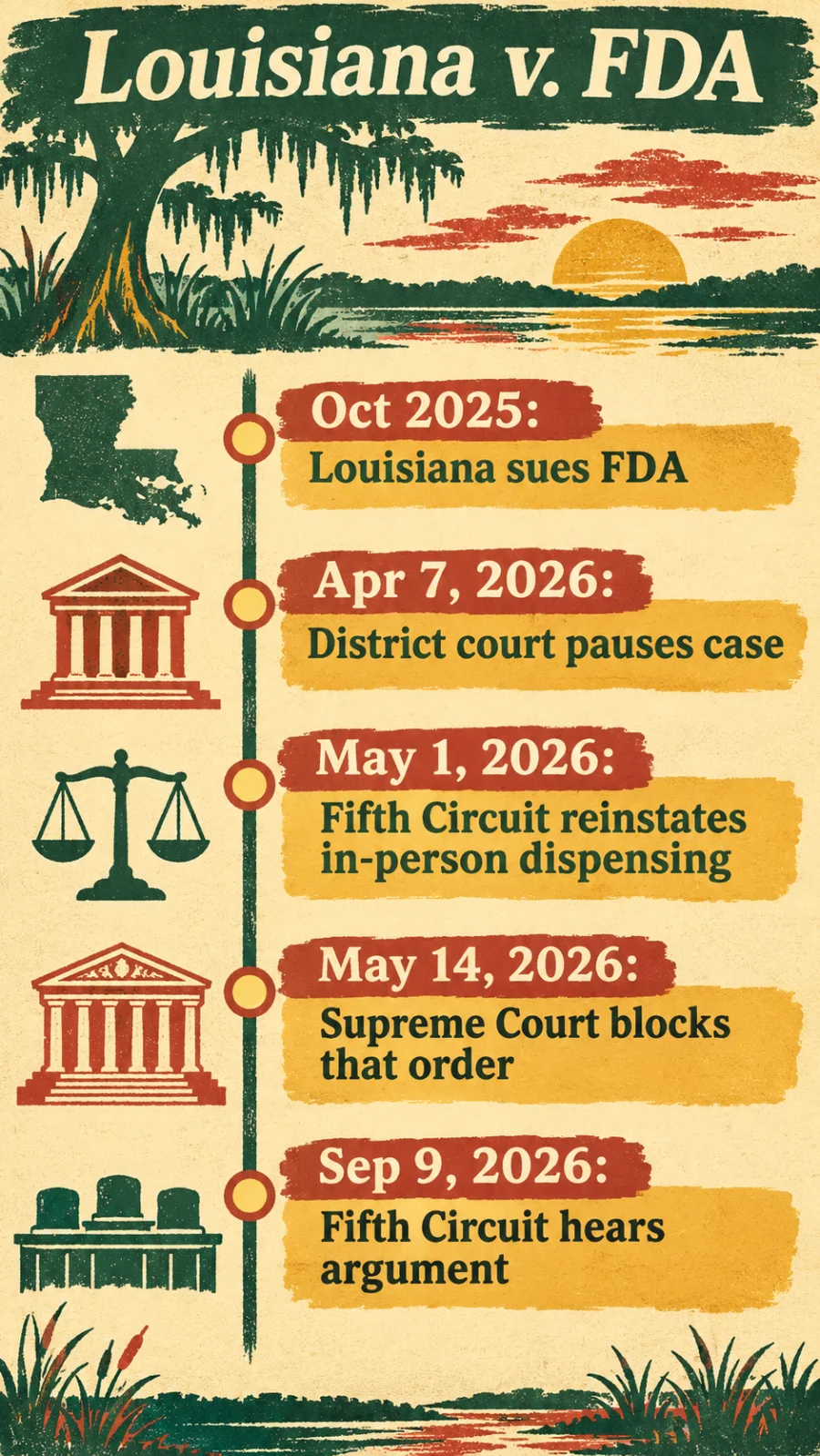
Louisiana is the plaintiff in a federal lawsuit that could end mail and pharmacy delivery of mifepristone nationwide. The state sued the FDA in October 2025, asking a court to undo the agency’s 2023 decision removing the in-person dispensing requirement. A federal judge in Louisiana declined to stay that rule on April 7, 2026, and instead paused the case while the FDA finishes its own safety review.
Louisiana appealed, and on May 1, 2026, a Fifth Circuit panel granted the stay and reinstated in-person dispensing nationwide, finding in its published opinion that Louisiana has standing to sue. Justice Alito issued an administrative stay on May 4, and on May 14 the Supreme Court blocked the Fifth Circuit’s order while the case continues, which restored mail and pharmacy access.
A new three-judge Fifth Circuit panel heard argument on September 9, 2026. The judges spent most of the session on standing, meaning whether Louisiana can show the FDA’s rule injures the state. The federal case does not change Louisiana’s own ban: providing pills for an abortion is a crime under R.S. 14:87.9 whatever FDA rules say.
Rules for Minors
An unemancipated minor needs a parent’s or guardian’s notarized consent, plus a copy of the parent’s valid government ID, before a doctor may perform an abortion (R.S. 40:1061.14). The alternative is a judicial bypass, where a court reviews the request and can authorize the procedure without parental consent. The minor has to meet this requirement even when she falls under one of the medical exceptions.
Someone who falsely claims to be the parent or guardian to get around the requirement commits a separate offense under R.S. 40:1061.14.1. Providers face the harshest tier of the drug-abortion statute when a patient under 18 is seriously injured or dies, as the penalty table above shows.
Where Louisiana Residents Go for Care
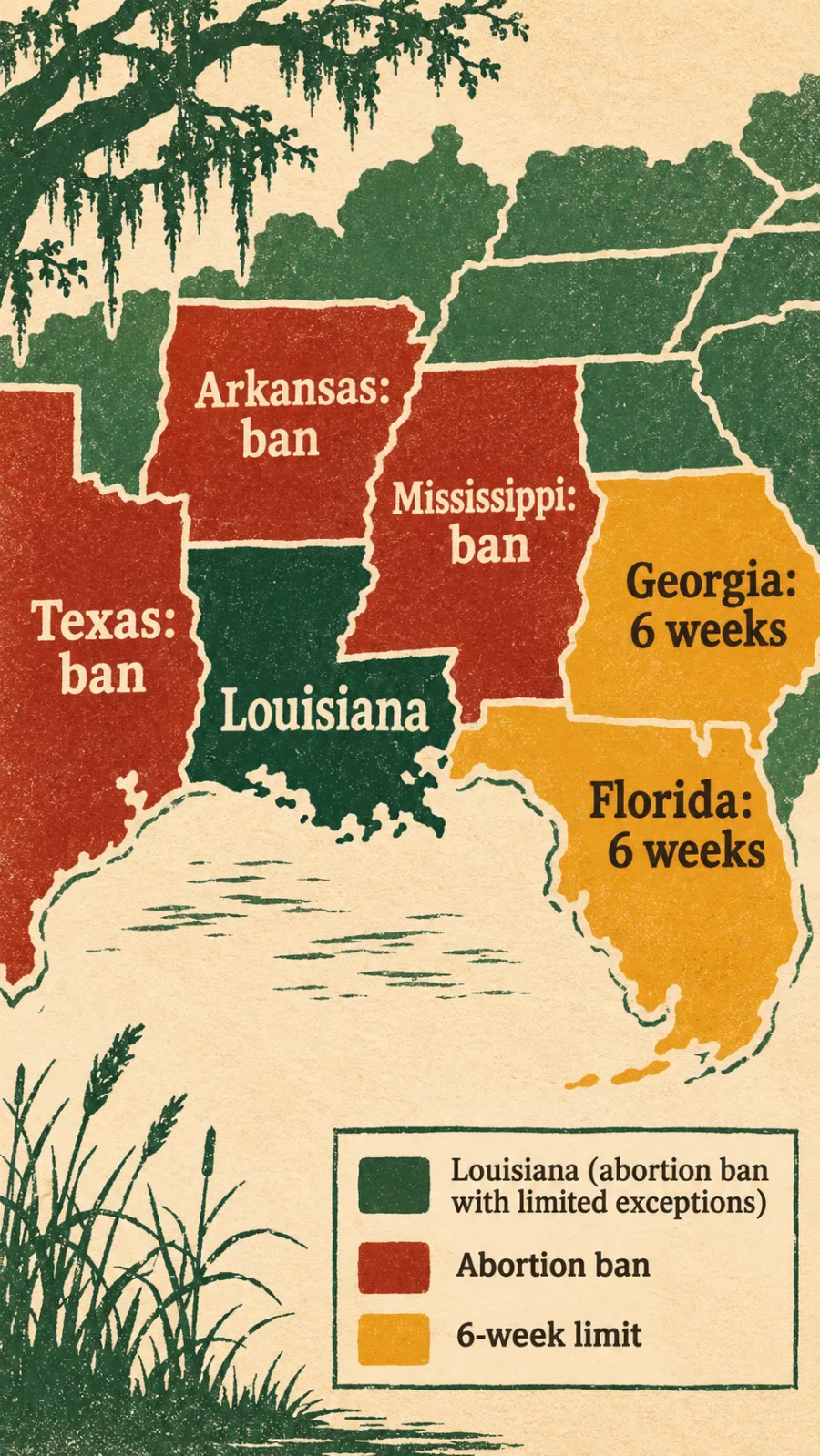
All three states that border Louisiana ban abortion: Texas, Arkansas and Mississippi. KFF’s state tracker lists Florida and Georgia as six-week states, which leaves patients traveling farther to states such as Illinois, New Mexico or Colorado. Gestational limits and exceptions vary widely, as our breakdown of Arkansas abortion laws shows.
The criminal provisions described above regulate people who perform or provide abortions, and the statutes covered here do not make a patient’s trip out of state an offense. Federal Medicaid rules limit abortion funding to narrow cases, and R.S. 40:1061(B) ties Louisiana’s Medicaid spending to those limits, so most patients pay for travel and care themselves.
The National Abortion Federation Hotline, 1-800-772-9100, connects callers with referrals and financial assistance.
If You Need Emergency or Pregnancy Care
Go to a hospital emergency room for heavy bleeding, severe pain or signs of an ectopic pregnancy. The Attorney General’s office has said Louisiana law should not be read to require hospital or emergency room staff to refuse emergency care for a miscarriage or ectopic pregnancy.
If a doctor hesitates, ask which exception they are weighing and whether a second physician or the hospital’s ethics or legal team can review your case. The written diagnosis and ultrasound documentation the miscarriage exception requires is the paperwork that lets a doctor treat without fear of prosecution.
Frequently Asked Questions
Is abortion completely illegal in Louisiana?
Almost completely. It is allowed only to prevent death or serious permanent organ damage, and ectopic pregnancy treatment, miscarriage management and medically futile pregnancies are carved out of the definition of abortion.
Can a woman be arrested or sued for having an abortion in Louisiana?
No. R.S. 40:1061(H) bars criminal conviction of the pregnant woman, and R.S. 9:2800.12 prohibits civil suits against her under the 2025 law.
Are abortion pills legal in Louisiana?
Mifepristone and misoprostol are legal with a valid prescription for a non-abortion purpose, with a diagnosis written on it. Providing them to cause an abortion is a felony under R.S. 14:87.9.
Does the ban apply to miscarriages and ectopic pregnancies?
No. R.S. 14:87.1 excludes ectopic pregnancy removal and methotrexate treatment, and it excludes miscarriage management when the diagnosis and ultrasound results are documented in the chart.
Is there an exception for rape or incest?
No. The legislature rejected bills to add rape exceptions in 2024, 2025 and 2026.
Can I travel out of state for an abortion?
Nothing in the Louisiana statutes covered here penalizes a patient for traveling. The criminal provisions target the people who perform or provide the abortion.
References
- Louisiana State Legislature, La. R.S. 40:1061, Human Life Protection Act
- Louisiana State Legislature, La. R.S. 14:87.7, Abortion
- Louisiana State Legislature, La. R.S. 14:87.8, Late term abortion
- Louisiana State Legislature, La. R.S. 14:87.9, Criminal abortion by means of abortion-inducing drugs
- Louisiana State Legislature, La. R.S. 14:87.1, Definitions
- Louisiana State Legislature, La. R.S. 9:2800.12, Liability for unlawful termination of a pregnancy (Act 383 of 2025)
- Louisiana State Legislature, 2026 Regular Session HB 261, exceptions for rape
- Louisiana Department of Health, Abortion statutes and medically futile conditions
- Louisiana Governor’s Office, SB 276 signing announcement
- Louisiana Attorney General, Statement Regarding Louisiana Abortion Laws
- U.S. Court of Appeals for the Fifth Circuit, Louisiana v. FDA, No. 26-30203, published opinion
- SCOTUSblog (news), Supreme Court order in Louisiana v. FDA
- Louisiana Illuminator (news), Louisiana indicts California doctor for 2023 medication abortion
- KFF, Abortion in the United States Dashboard, state ban and gestational limit status