
Nebraska’s 12-Week Abortion Limit: What You Need to Know

Nebraska bans abortion once the pregnancy reaches 12 weeks of gestational age, counted from the first day of the last menstrual period. The ban is in Neb. Rev. Stat. § 71-6915, and it has three exceptions: a medical emergency, pregnancy from sexual assault, and pregnancy from incest.
Voters added a second layer in November 2024. The state constitution now protects unborn children from abortion in the second and third trimesters, with the same medical emergency, sexual assault and incest exceptions. The patient is never the one who faces liability under these laws. Physicians do.
What the 12-Week Law Says
When the ban starts
Section 71-6915(2) makes it unlawful for a physician to perform an abortion when the probable gestational age is “twelve or more weeks.” That means the cutoff is 12 weeks and zero days, not “after 12 weeks.” An abortion at 11 weeks and 6 days is inside the legal window.
Gestational age is measured from the first day of the woman’s last menstrual period, per the definition in § 71-6914. Before any abortion, the physician must determine gestational age using standard medical practice and record the method, date, time and result in the medical record.
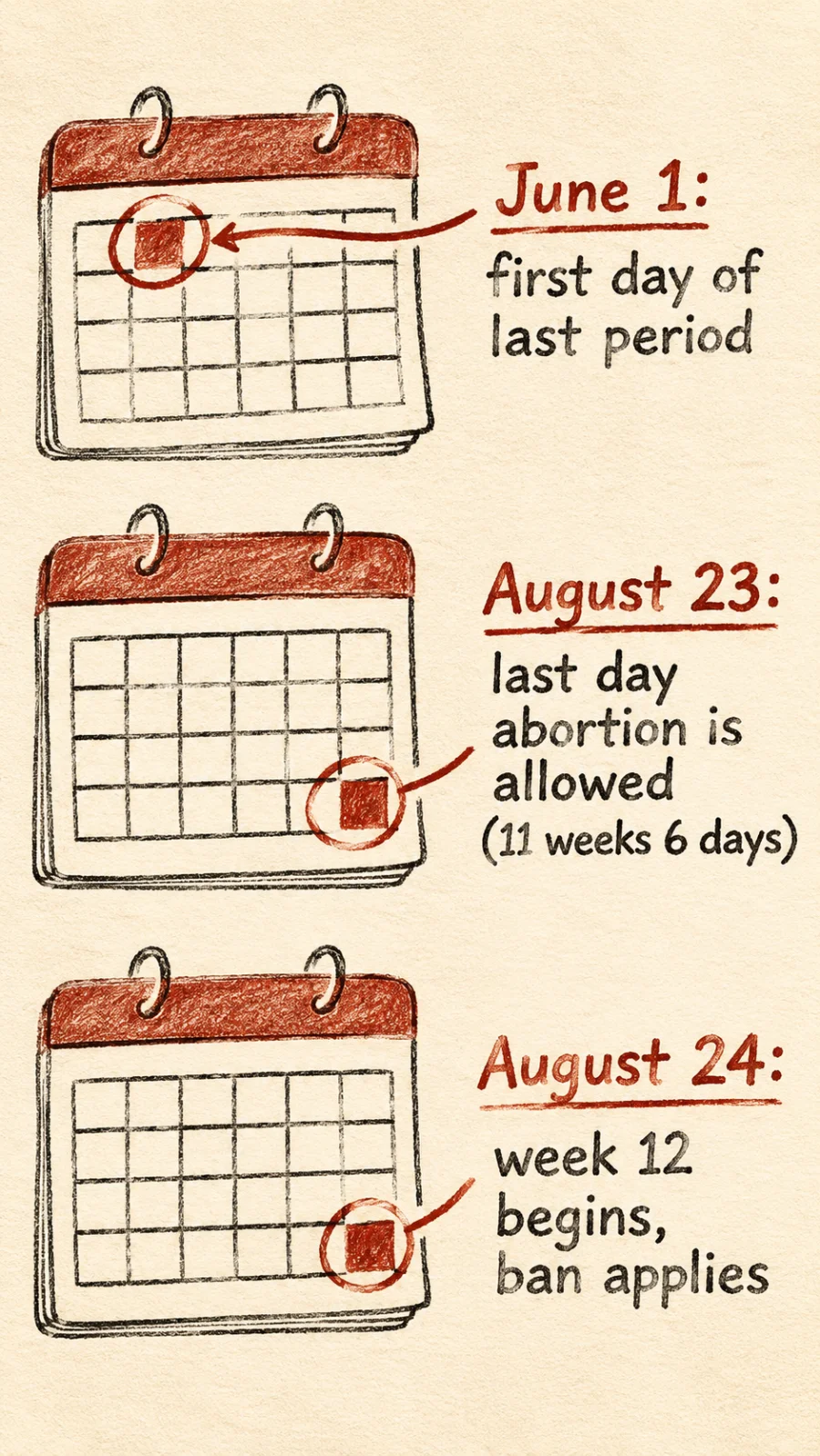
Say your last period began June 1. Twelve weeks and zero days falls on August 24, so August 23 is the last day the abortion can lawfully be performed. A physician’s dating by ultrasound can shift that date by several days in either direction, and the physician’s determination is the one that counts.
Where the law came from
The 12-week ban was added to LB 574 and took effect in May 2023, after a six-week bill (LB 626) fell one vote short in the Legislature. Planned Parenthood sued, arguing LB 574 combined abortion and gender-altering care for minors in one bill, which Nebraska’s single-subject rule forbids.
The Nebraska Supreme Court rejected that argument on July 26, 2024, in Planned Parenthood of the Heartland, Inc. v. Hilgers, No. S-23-0644, 317 Neb. 217. The opinion notes that before the law passed, Planned Parenthood provided abortions through 16 weeks and 6 days, and roughly one-third of those procedures happened after 12 weeks.
The three exceptions
A medical emergency is a condition that, in reasonable medical judgment, makes ending the pregnancy necessary to avert the woman’s death, or where delay would create a serious risk of substantial and irreversible damage to a major bodily function. Under § 71-6914, a claim that the woman will harm herself does not qualify.
The physician must certify in writing why the exception applies and place that certification in the medical record (§ 71-6916). For sexual assault or incest, the certification must also state that the physician met the duties in § 28-902. These paperwork duties fall on the physician, not the patient.
How the Constitution, the 12-Week Law and Older Statutes Fit Together
Nebraska has three overlapping limits, each from a different year. The strictest one that applies to a given pregnancy controls.
| Limit | Source | Exceptions listed |
|---|---|---|
| Barred at 12 weeks gestational age (from last period) | § 71-6915 (2023, LB 574) | Medical emergency, sexual assault, incest |
| Barred at 20 weeks postfertilization | § 28-3,106 (2010, LB 1103) | Death or serious irreversible impairment of the woman; saving the unborn child’s life |
| Second and third trimesters protected | Neb. Const. art. I, § 31 (2024, Initiative 434) | Medical emergency, sexual assault, incest |
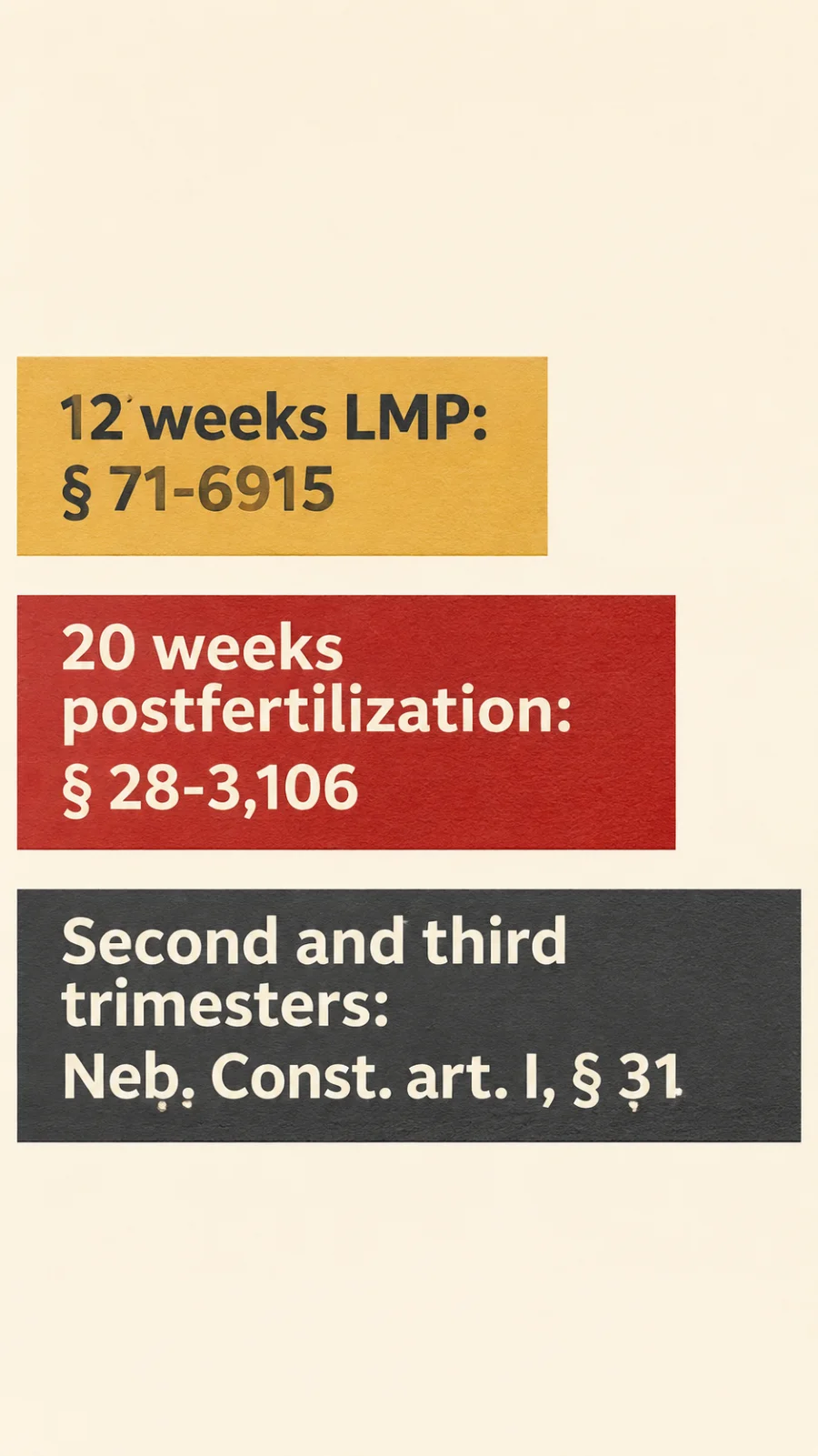
The constitutional text, Neb. Const. art. I, § 31, says nothing about the first trimester. The 12-week limit therefore rests on the 2023 statute, not on the constitution. Voters did not “lock in” 12 weeks. They set a floor that the Legislature’s stricter statute sits on top of.
The 20-week statute, § 28-3,106, lists only two exceptions: preserving the woman’s life or preventing serious irreversible impairment, and preserving the unborn child’s life. It does not mention sexual assault or incest. It predates the 2024 amendment, and the statutes do not spell out how that gap plays out in a late-pregnancy case involving rape or incest.
The dilation and evacuation ban
Nebraska also bans dismemberment abortion, the common name for dilation and evacuation (D&E), a second-trimester method. Gov. Pete Ricketts signed LB 814 on August 15, 2020. Under § 28-347, performing one is a Class IV felony unless a medical emergency requires it. The 12-week ban makes this law matter mainly in emergency, rape and incest cases.
Counseling, Waiting Period and Consent Before an Abortion
Nebraska requires informed consent, with timed steps, under Neb. Rev. Stat. § 28-327, last amended in 2024 (LB 932). The 24-hour wait is part of it, and in a medical emergency these steps do not apply.
- At least 24 hours before: the physician, referring physician or a trained nurse or physician assistant gives procedure-specific risks, the probable gestational age, the risks of carrying to term, and a statement that you cannot be forced to have an abortion. This step can be done by phone.
- At least 24 hours before: you are told the physician’s name, that medical assistance may cover prenatal and childbirth care, and that the father is liable for child support. State health department materials must be given 24 hours ahead, or mailed by certified mail at least 72 hours ahead.
- At least 1 hour before: if an ultrasound is used, the images must be displayed so you can look or not, and you can ask questions about them.
- At least 1 hour before: a qualified professional evaluates whether you feel pressured or coerced and records the result in your permanent record.
- Before the procedure: you sign a written certification that the information was given.
The waiting period does not depend on how certain you are. Because the clock runs from the time the information is given, a phone call the day before can satisfy it.
Penalties: Who Is Liable and Who Is Not
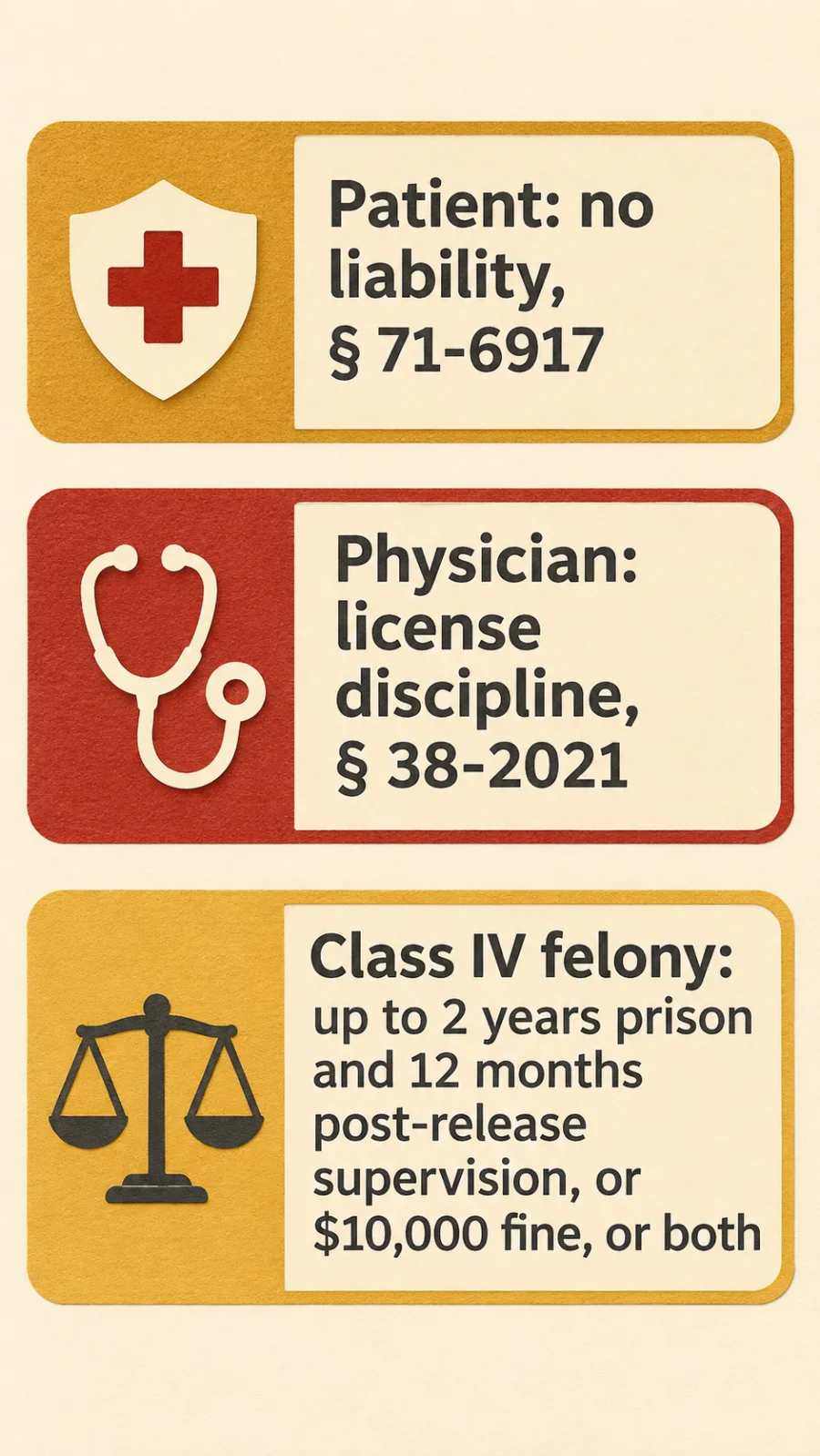
The patient is protected by statute. Section 71-6917 says a woman on whom an abortion is performed is not liable for violating the 12-week law. The D&E ban (§ 28-347) and the physician-presence rule (§ 28-335) say the same.
For physicians, the consequence of a 12-week violation is licensing discipline. Section 38-2021 lists violating the Preborn Child Protection Act as unprofessional conduct under the Uniform Credentialing Act, as it does for violating the 20-week law. The 12-week statutes themselves contain no separate criminal penalty.
Criminal penalties come from other sections:
- A person who is not a licensed physician and performs an abortion commits a Class IV felony (§ 28-335(1)).
- A physician who knowingly or recklessly performs or prescribes without being physically in the same room commits a Class IV felony (§ 28-335(2)).
- Performing a D&E abortion outside a medical emergency is a Class IV felony (§ 28-347).
A Class IV felony carries up to two years in prison and 12 months of post-release supervision, a $10,000 fine, or both (§ 28-105). The D&E ban also allows civil suits for damages and injunctions by the woman and, in some cases, a spouse or parent.
Abortion Pills, Telehealth and the Federal Court Fight
Nebraska requires the physician who prescribes or uses the means of abortion to be “physically present in the same room” as the patient. That rule, in § 28-335(2), has applied to medication abortion since 2011 (LB 521), so a Nebraska provider cannot prescribe abortion pills by telehealth.
Federal rules point the other way. The FDA’s 2023 rule lets mifepristone be prescribed by telehealth and mailed. Louisiana sued the FDA over that rule, and on May 1, 2026, a Fifth Circuit panel stayed it nationwide. The manufacturers went straight to the U.S. Supreme Court.
On May 14, 2026, the Court granted the stay in Danco Laboratories, LLC v. Louisiana, No. 25A1207. The Fifth Circuit’s order is paused until that court decides the appeal and any certiorari petition is resolved. Justices Thomas and Alito dissented. The order leaves misoprostol rules untouched.
Nebraska Attorney General Mike Hilgers led a 23-state brief backing Louisiana. He argued the federal rule lets doctors elsewhere “openly flout Nebraska law,” and that mifepristone should reach Nebraska patients only through in-person prescribing and administration.
The statutes shield the patient but not the prescriber, and whether Nebraska can reach an out-of-state prescriber is a contested legal question. Anyone weighing pills ordered from outside the state should talk to a lawyer first, and the Repro Legal Helpline offers free, confidential advice.
Minors: Parental Consent and Judicial Bypass
A person under 18 needs notarized written consent from herself and from one parent or a legal guardian before an abortion, under § 71-6902. The requirement does not apply in a medical emergency or when a court waives it. Adults need no one’s permission.
The court waiver, called judicial bypass, is in § 71-6903. A judge must authorize the abortion if the minor shows by clear and convincing evidence that she is sufficiently mature and well-informed, that a parent or guardian abused or neglected her, or that going without consent is in her best interest.
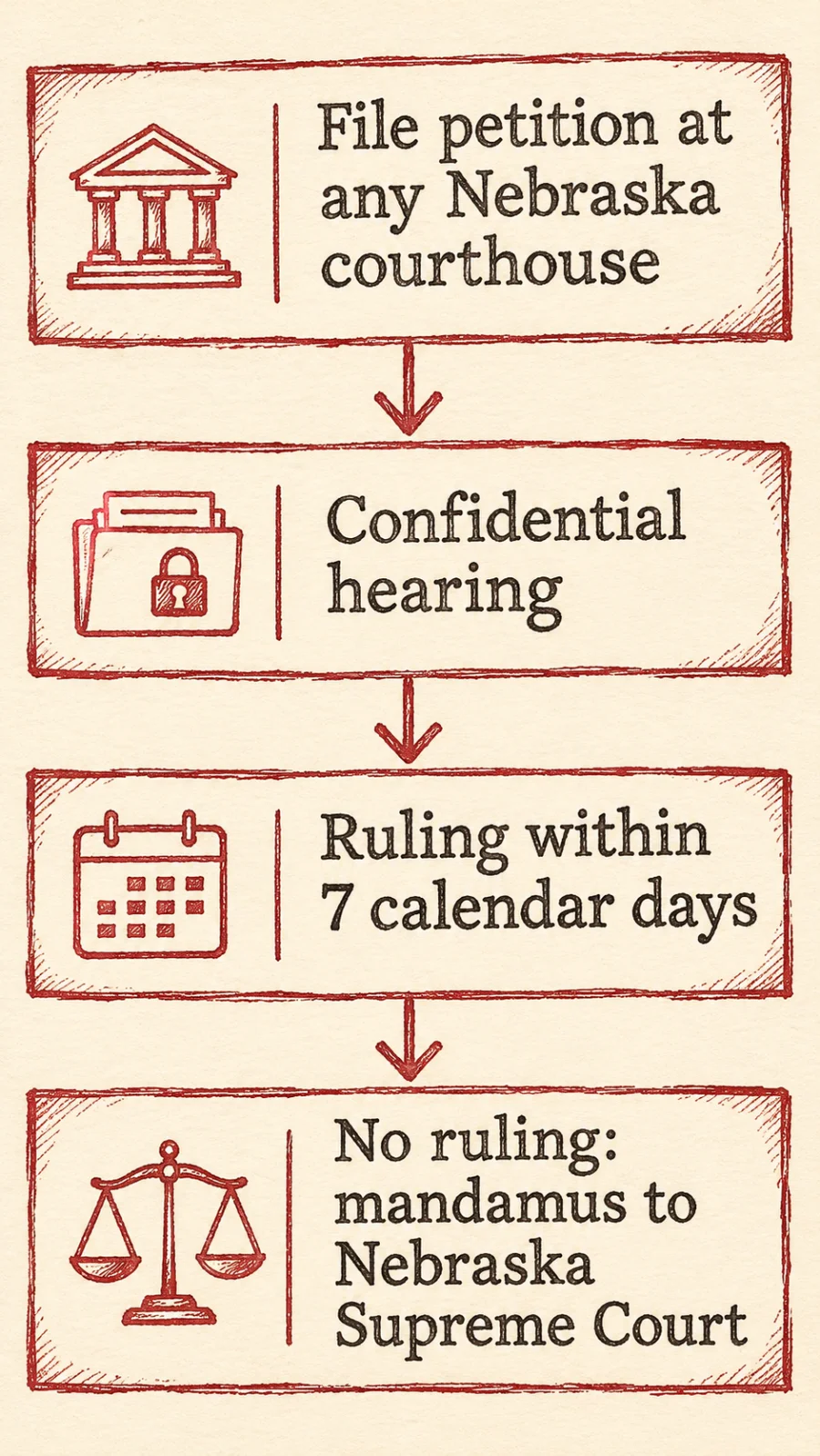
- File a petition at any Nebraska courthouse, in any county, in person or by mail. Email filings are not accepted. The forms, including petition JC 14:7, are on the Nebraska Judicial Branch waiver page.
- Proceedings are confidential and sealed, and the minor can file under initials or a pseudonym.
- She can ask for a court-appointed lawyer, and the county pays the fee.
- The court must rule within seven calendar days of filing.
- If it does not, she can ask the Nebraska Supreme Court for a writ of mandamus, which must issue within three days if cause exists.
The statute puts the burden of proof on the minor, so preparing early helps. A minor who travels to another state is governed by that state’s parental involvement rules.
Traveling Out of State for Care
None of the Nebraska provisions above restricts a patient from traveling to another state for an abortion. The 12-week statute, the constitutional amendment and the D&E ban all regulate what happens in Nebraska and what physicians do. Timing rules, waiting periods and consent steps are set by the state where the procedure takes place.
What Changed in the Legislature and on the Ballot in 2025 and 2026
Several efforts to tighten the law failed. LB 669, which would have required screening for coercion and abuse, fell short at its first cloture vote on February 4, 2026, according to the Nebraska Examiner. LB 512, the Chemical Abortion Safety Protocol Act, would have required in-person visits before and after medication abortion. It was indefinitely postponed on April 17, 2026.
Bills that do not pass die when the two-year session ends, so either idea would need a new bill. The six-week “heartbeat” bill (LB 626) also failed in 2023.
No abortion measure appeared on Nebraska’s November 3, 2026, ballot. Choose Life Now, which wanted to add fetal personhood and a total ban to the constitution, did not submit signatures by the July 2 deadline. A constitutional amendment needs signatures from 10% of registered voters, including 5% in at least 38 of the state’s 93 counties.
Where to Get Help
A licensed physician can date the pregnancy and explain your timeline, which matters because the 12-week cutoff is a date, not a range. In Nebraska the clock for counseling runs from the time the information is given.
Minors can start with the Nebraska Judicial Branch waiver page above or the clerk at any courthouse. For legal questions about pills, travel or privacy, the Repro Legal Helpline gives free confidential guidance, and a Nebraska attorney can speak to specifics.
Frequently Asked Questions
Is abortion legal in Nebraska?
Yes, until the pregnancy reaches 12 weeks of gestational age counted from the last menstrual period. After that it is allowed only for a medical emergency, sexual assault or incest.
Can a patient be prosecuted for having an abortion in Nebraska?
No. Section 71-6917 exempts the woman from liability under the 12-week law, and the D&E and physician-presence statutes contain the same protection. Penalties fall on physicians and others who perform abortions unlawfully.
Do minors need a parent’s permission?
Generally yes. A minor needs notarized consent from herself and one parent or guardian, unless a judge grants a waiver or there is a medical emergency.
Can I get abortion pills by telehealth in Nebraska?
Not from a Nebraska provider. State law requires the prescribing physician to be physically in the same room. Federal rules currently allow mifepristone by telehealth nationwide under a Supreme Court stay, but how that interacts with Nebraska law is contested.
Did voters put the 12-week limit in the constitution?
No. The 2024 amendment protects unborn children from abortion in the second and third trimesters. The 12-week limit comes from the 2023 statute.
Is there an abortion question on the 2026 Nebraska ballot?
No. The only 2026 abortion petition, a total-ban measure, missed the July 2 signature deadline.
References
- Nebraska Legislature, Neb. Rev. Stat. § 71-6915, abortion at twelve weeks and exceptions
- Nebraska Legislature, Neb. Rev. Stat. § 71-6914, definitions under the Preborn Child Protection Act
- Nebraska Legislature, Neb. Const. art. I, § 31, protection of unborn children from abortion
- Nebraska Legislature, Neb. Rev. Stat. § 28-327, informed consent and waiting period
- Nebraska Legislature, Neb. Rev. Stat. § 28-335, physician presence and non-physician abortion
- Nebraska Legislature, Neb. Rev. Stat. § 28-3,106, 20-week prohibition and exceptions
- Nebraska Legislature, Neb. Rev. Stat. § 38-2021, unprofessional conduct
- Nebraska Legislature, Neb. Rev. Stat. § 28-105, Class IV felony penalties
- Nebraska Legislature, Neb. Rev. Stat. § 71-6903, judicial waiver of parental consent
- Nebraska Judicial Branch, Waiver of Parental Consent for Abortion for Minors, forms and filing instructions
- Nebraska Supreme Court, Planned Parenthood of the Heartland, Inc. v. Hilgers, No. S-23-0644
- Supreme Court of the United States, Danco Laboratories, LLC v. Louisiana, No. 25A1207, docket
- Nebraska Legislature, LB 814 (2020), dismemberment abortion ban, slip law
- Nebraska Legislature, LB 512, Chemical Abortion Safety Protocol Act, bill page
- Nebraska Examiner (news report), LB 669 cloture vote, February 4, 2026
- Nebraska Examiner (news report), total-ban initiative misses signature deadline, July 6, 2026