
Oklahoma Abortion Ban: What’s Prohibited and What’s Not

Abortion is illegal in Oklahoma at every stage of pregnancy unless a physician determines the pregnancy will endanger the woman’s life. There is no exception for rape, incest, or a fatal fetal diagnosis.
The main ban is 21 O.S. § 861, a felony statute dating to 1910. A 2026 law, House Bill 1168, adds a separate felony for delivering abortion pills. Patients are not the target of either law, and traveling out of state to get care is legal.
What Oklahoma Law Prohibits
Section 861 makes it a crime to administer or prescribe anything, use an instrument, or “advise or procure” a woman to take a drug, with intent to cause a miscarriage, unless that is necessary to preserve her life.
The law was never repealed. It sat unenforceable under Roe v. Wade and became enforceable again when the U.S. Supreme Court decided Dobbs on June 24, 2022.
The Oklahoma Attorney General’s September 12, 2025 guidance memo to physicians reads the statute broadly. Attempts count, and so does advising someone to obtain an abortion, even if no abortion happens or it happens outside Oklahoma. The memo is guidance, not a binding court ruling.
Several other abortion laws passed in 2022 and 2023, and the Oklahoma Supreme Court struck down some of them. Which statute applies depends on the facts, so the penalties below come from more than one source.
Penalties for Doctors and Anyone Who Helps
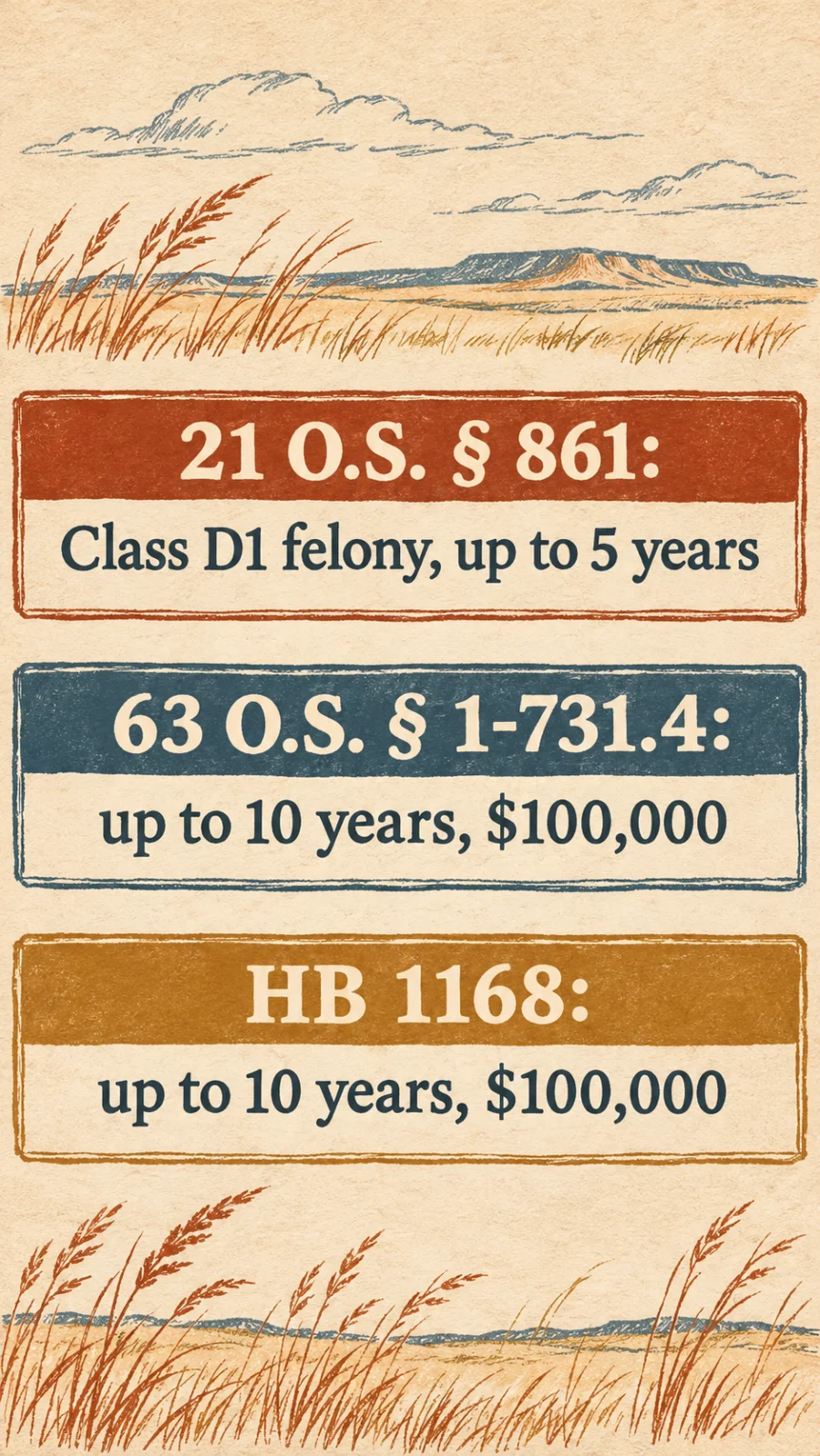
Performing an abortion is a felony. Since January 1, 2026, § 861 classifies it as a Class D1 felony (Laws 2025, c. 486, § 388), and 21 O.S. § 20N sets the sentence for that class.
Before 2026, § 861 carried two to five years in prison. The Class D1 range now tops out at five years, with no stated two-year minimum for a first offense.
| Law | What it covers | Maximum penalty |
|---|---|---|
| 21 O.S. § 861 | Performing, prescribing for, or advising an abortion | Class D1 felony: up to 5 years |
| 21 O.S. § 861 with prior convictions | Same offense after earlier Class C or D convictions | 1 to 7 years, or 2 to 10 years with a more serious record |
| 63 O.S. § 1-731.4 | Performing or attempting an abortion outside a narrow “medical emergency” | Up to 10 years and $100,000 |
| HB 1168 (2026) | Delivering abortion pills for an unlawful abortion | Up to 10 years and $100,000 |
One caution on the third row. The Oklahoma Supreme Court held in March 2023 that the emergency exception in 63 O.S. § 1-731.4 was too narrow. The life-saving standard from that ruling controls, and the Attorney General’s 2025 memo treats § 861 as the operative ban.
Conviction can also cost a doctor a medical license. A person convicted of a D1 felony with no prior record must serve at least 20% of the sentence before release.
The Life-Saving Exception
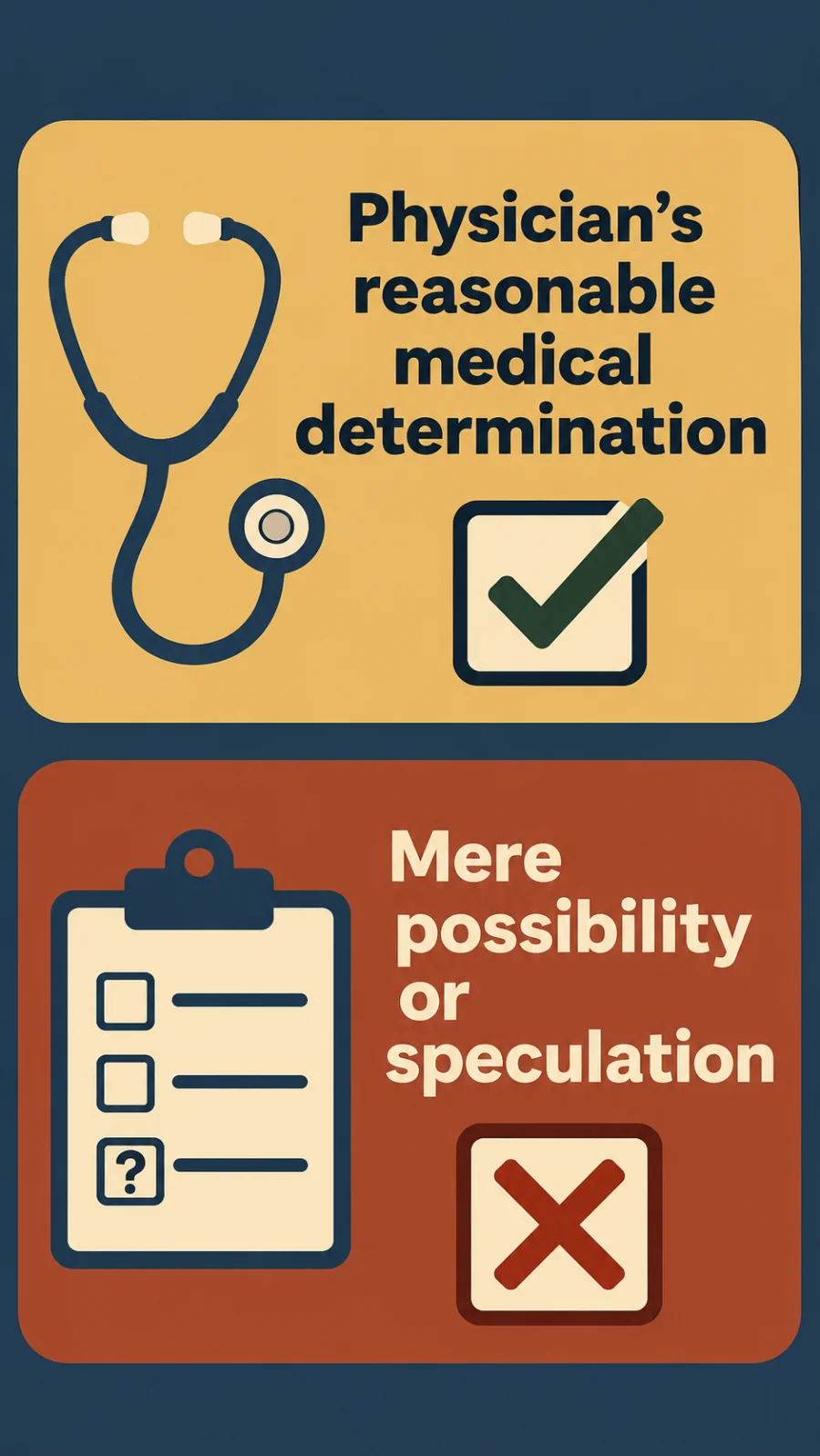
The only exception is when a physician determines to a reasonable degree of medical certainty or probability that continuing the pregnancy will endanger the woman’s life. The Oklahoma Supreme Court set that standard in Oklahoma Call for Reproductive Justice v. Drummond, 2023 OK 24, decided March 21, 2023, by a 5-4 vote.
The danger can come from the pregnancy itself or from a medical condition the woman has or is likely to develop during the pregnancy. Absolute certainty is not required, but mere possibility or speculation is not enough.
A doctor does not have to wait for an emergency. The court said treatment can begin when a harmful condition is known or probable to occur, so a patient need not be septic or close to death first.
The Attorney General’s memo adds a limit. Physicians may rely on reasonable medical judgment, but not to offer elective abortions they falsely describe as life-saving.
Doctors and hospital lawyers have not always applied the standard generously. A lawsuit filed in September 2026 says providers have waited for patients to develop infections or other complications before acting, because they fear prosecution.
Ectopic Pregnancy, Miscarriage, IVF and Contraception
Treating an ectopic pregnancy or a miscarriage is not an abortion under Oklahoma law. 63 O.S. § 1-757.2 says removing an ectopic pregnancy, or removing an unborn child who has already died, falls outside the definition.
The Attorney General’s memo tells physicians to manage a miscarriage “as soon as is medically necessary,” including by dilation and curettage (D&C), without waiting for an emergency. It also says a prescription drug used to treat a maternal illness, such as chemotherapy, is not an abortion.
Contraception is not covered by the ban, and the memo says Oklahoma law does not expressly bar IVF. It does flag one exception: selective reduction of a multiple pregnancy is treated as an abortion unless the mother’s life is in danger.
Rape, Incest and Fatal Fetal Diagnoses
Oklahoma has no exception for pregnancies caused by rape or incest, and none for fetal abnormalities. The Attorney General’s memo says a physician cannot provide an abortion solely because of rape, sexual assault, or incest, and it points doctors to mandatory reporting laws for those cases (10A O.S. § 1-2-101 for patients under 18, 22 O.S. § 40.3A for adults).
The memo also addresses fatal diagnoses. It says an abortion is not allowed if the child can survive to birth without endangering the mother, even if the child is highly likely to die soon after.
That reading is now being tested in court. In September 2026, the Center for Reproductive Rights filed suit in Oklahoma County District Court for three mothers and two OB-GYNs, asking that the bans not apply to fatal fetal diagnoses.
Attorney General Gentner Drummond and the other defendants moved to dismiss on October 30, 2026. They argue the 2023 Supreme Court ruling recognizes only a right to preserve the woman’s life, and that any broader exception is a question for the Legislature or voters.
The 2026 Abortion Pill Law (HB 1168)
House Bill 1168 makes it a felony to deliver, or possess with intent to deliver, an abortion-inducing drug to someone who plans to use it for an unlawful abortion. It covers mifepristone, misoprostol and methotrexate.
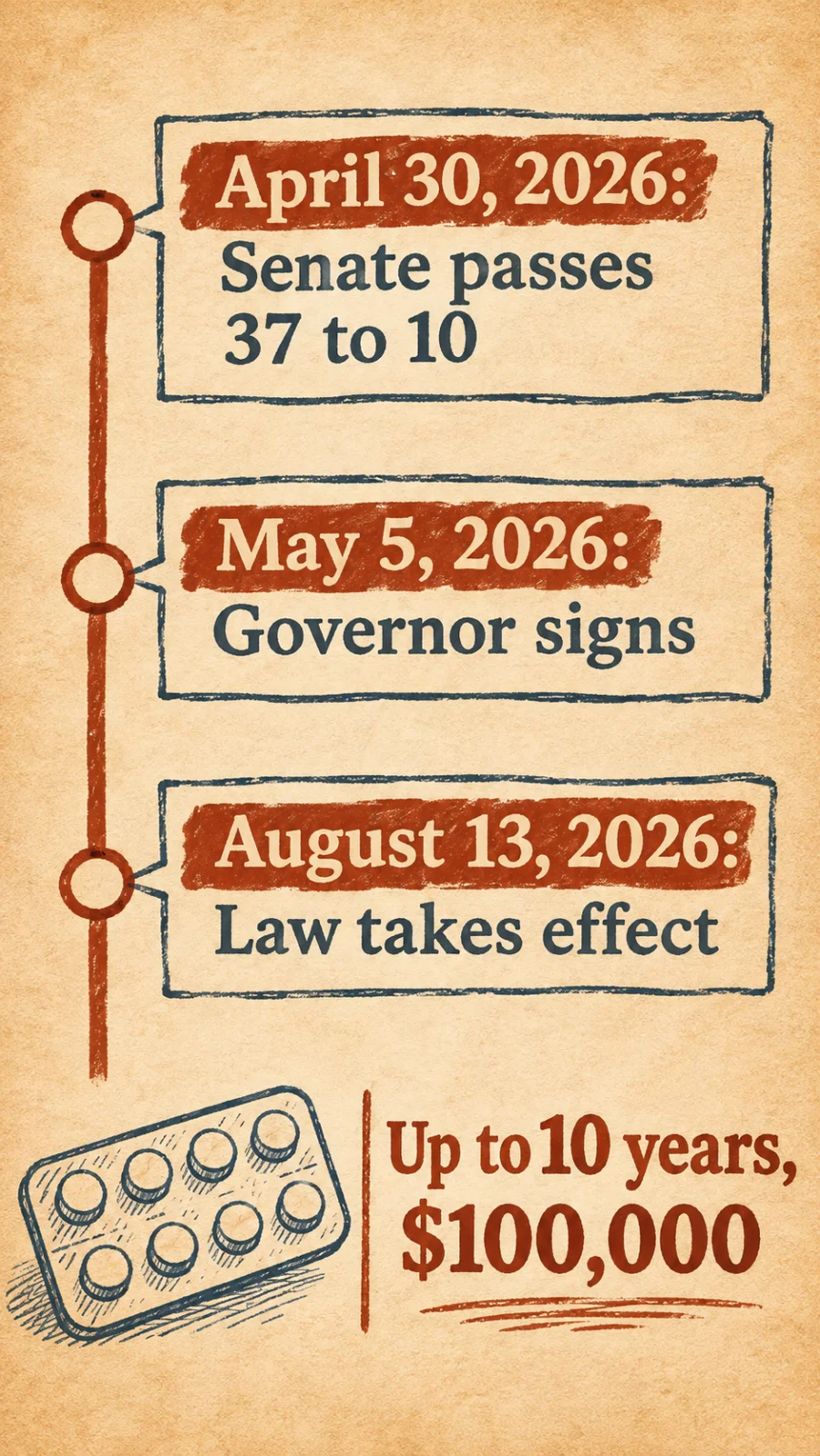
The Senate passed it 37 to 10 on April 30, 2026, Governor Kevin Stitt signed it on May 5, and it took effect August 13, 2026. A conviction carries a fine up to $100,000, up to 10 years in prison, or both.
The law does not reach a pregnant person who obtains pills for herself. It also exempts pharmacists, manufacturers and distributors handling the drugs for lawful medical purposes, and drugs prescribed for other uses such as treating an ectopic pregnancy or a miscarriage. Contraception and IVF are excluded.
Supporters say the law is aimed at people shipping pills into the state. Critics say the wording is vague. Tulsa law professor Janet Levit told StateImpact Oklahoma that “possession with intent to deliver” could cover a spouse or parent who obtains pills for a family member, and the Attorney General’s office said it was still studying the law’s provisions.
Levit also said the new law changes little on its own, because § 861 already criminalized prescribing and administering these drugs. Whether it changes behavior depends on how prosecutors use it.
Do Private Citizens Get to Sue Under Oklahoma Law?
Not under the two Texas-style laws Oklahoma passed in 2022. Senate Bill 1503 and House Bill 4327 let private citizens bring civil suits, and the Oklahoma Supreme Court struck both down on May 31, 2023, in Oklahoma Call for Reproductive Justice v. State, 2023 OK 60.
The court ruled by 6-3 that their medical-emergency exceptions were too narrow under the 2023 Drummond decision. Earlier versions of this topic describe lawsuits of up to $10,000 per violation, but those laws are not enforceable.
On November 14, 2023, the court also blocked three other restrictions: the OB-GYN certification requirement, the admitting-privileges rule for medication abortion, and the 72-hour waiting period with ultrasound mandate (2023 OK 111).
Can a Patient Be Prosecuted?
Oklahoma’s abortion statutes are aimed at providers and helpers. The 2022 law, 63 O.S. § 1-731.4, says it does not authorize charging a woman with a crime in the death of her own unborn child, and the Attorney General’s Opinion 2023-12 concluded that the law does not make it a crime for a pregnant woman to seek or self-induce an abortion.
Other statutes have been used in pregnancy cases. A report by the nonprofit Pregnancy Justice found at least 222 criminal cases in Oklahoma tied to pregnancies and births in the three years after June 2022, according to Oklahoma Voice. Most involved live births, and the group links many to a 2020 Court of Criminal Appeals ruling that treats a fetus as a child under the child neglect statute.
Three of the Oklahoma cases involved allegations about obtaining, attempting or researching an abortion, according to the same report. That is a small number, but it shows the abortion statutes are not the only route to prosecution.
Can You Travel Out of State for an Abortion?
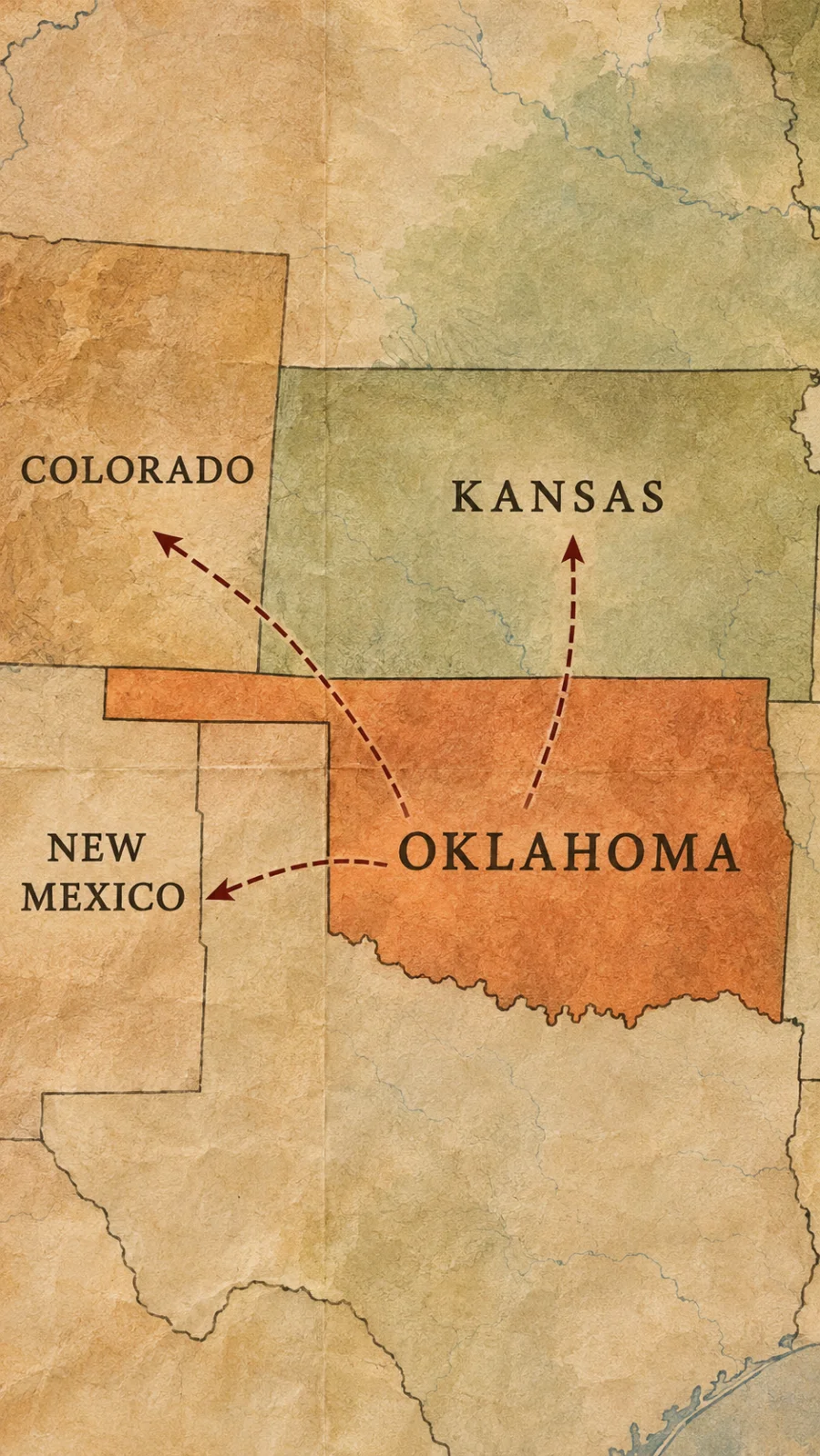
Yes. You have a constitutional right to travel between states, and abortion is legal in neighboring Kansas, Colorado and New Mexico, each with its own gestational limits that you should confirm with the clinic.
The caution is for people who help. The Attorney General’s memo says § 861 can be violated when someone “advises” a woman with intent to procure an abortion, even if the procedure happens outside Oklahoma. That is the Attorney General’s reading of the statute, and no court has ruled on whether it reaches a friend or relative who drives or pays.
Some critics of HB 1168 also say a person who brings back a second dose of a medication prescribed in another state could face questions under the new law. Supporters respond that the law targets delivery to someone planning an unlawful abortion. Nothing in the bill text resolves that disagreement.
Where to Get Legal and Practical Help
The Repro Legal Helpline (1-844-868-2812) offers free legal advice on abortion-related questions, including whether helping someone could expose you to charges.
Abortionfinder.org lists providers in other states, and plancpills.org gives information about medication abortion. Repro46 is an Oklahoma nonprofit that educates residents on reproductive health care under the state’s ban.
A doctor can explain whether a medical condition meets the life-saving standard. If a hospital refuses care for a miscarriage or an ectopic pregnancy, ask to speak with the hospital’s legal counsel and cite the Attorney General’s memo.
Frequently Asked Questions
Is abortion completely illegal in Oklahoma?
Almost. The only exception is when a physician determines to a reasonable degree of medical certainty or probability that the pregnancy will endanger the woman’s life. There are no exceptions for rape, incest, or fetal abnormalities.
Can I be arrested for having an abortion in Oklahoma?
The abortion statutes target providers and people who help, not the patient, and the Attorney General’s Opinion 2023-12 says the pregnant woman is not punishable. Separate statutes, such as child neglect, have been used in other pregnancy-related cases.
Are abortion pills illegal in Oklahoma?
Delivering them for an unlawful abortion is a felony under HB 1168, effective August 13, 2026, with up to 10 years in prison and a $100,000 fine. The law excludes a woman obtaining pills for herself and drugs prescribed for other medical uses.
Can doctors treat a miscarriage or an ectopic pregnancy?
Yes. Under 63 O.S. § 1-757.2, removing an ectopic pregnancy or an unborn child who has already died is not an abortion.
What is the penalty for a doctor who performs an abortion?
Section 861 is a Class D1 felony with up to five years in prison. Other statutes and HB 1168 carry up to 10 years and $100,000, and a doctor can also lose a license.
Can I travel to another state for an abortion?
Yes, the right to travel is constitutionally protected. The Attorney General’s memo warns that advising someone to obtain an abortion can violate § 861 even if it happens out of state, though no court has addressed that point.
References
- Oklahoma Attorney General, Guidance for Oklahoma Physicians, September 12, 2025
- Oklahoma Statutes, Title 21, § 861, Procuring an abortion
- Oklahoma Statutes, Title 21, § 20N, Class D1 offenses
- Oklahoma Statutes, Title 63, § 1-731.4, Abortion prohibited, exception, penalties
- Oklahoma Supreme Court, Oklahoma Call for Reproductive Justice v. Drummond, 2023 OK 24
- Oklahoma Supreme Court, Oklahoma Call for Reproductive Justice v. State, 2023 OK 60
- Oklahoma Supreme Court, Oklahoma Call for Reproductive Justice v. Drummond, 2023 OK 111
- Oklahoma Attorney General, Opinion 2023-12, Prosecution of pregnant women
- Oklahoma Legislature, House Bill 1168, 2026 session
- Oklahoma House of Representatives, Felony trafficking of abortion pills becomes law, August 13, 2026
- KGOU, StateImpact Oklahoma (news), Oklahoma law creates new penalties for abortion pill distribution
- KGOU, StateImpact Oklahoma (news), Oklahoma leaders seek dismissal of lawsuit challenging state abortion bans
- Oklahoma Voice (news), Hundreds of pregnancy-related prosecutions in Oklahoma, report finds