
Utah Abortion Laws: What’s Legal, What’s Not, What’s Changing

Abortion is legal in Utah before the unborn child reaches 18 weeks gestational age, counted from the first day of the last menstrual period. A near-total ban passed in 2020 (SB 174) is blocked by a court injunction, so it cannot be enforced. A required 72-hour waiting period, a physician-only rule, and a clinic-or-hospital rule apply to every abortion.
The legal fight over that blocked ban is not finished, and in 2026 it got tangled up in a separate dispute over a new three-judge court. This guide covers the rules as they are written in the Utah Code, what the courts have done, and what you would need to do to get care.
Is Abortion Legal in Utah? Two Laws, One in Force
Yes, through 18 weeks. Utah has two abortion laws on the books at once, and only one of them can be enforced.
The 18-week limit sits in Utah Code § 76-7-302. The 2020 trigger ban sits in a separate section, § 76-7a-201, and a court order keeps it from taking effect.
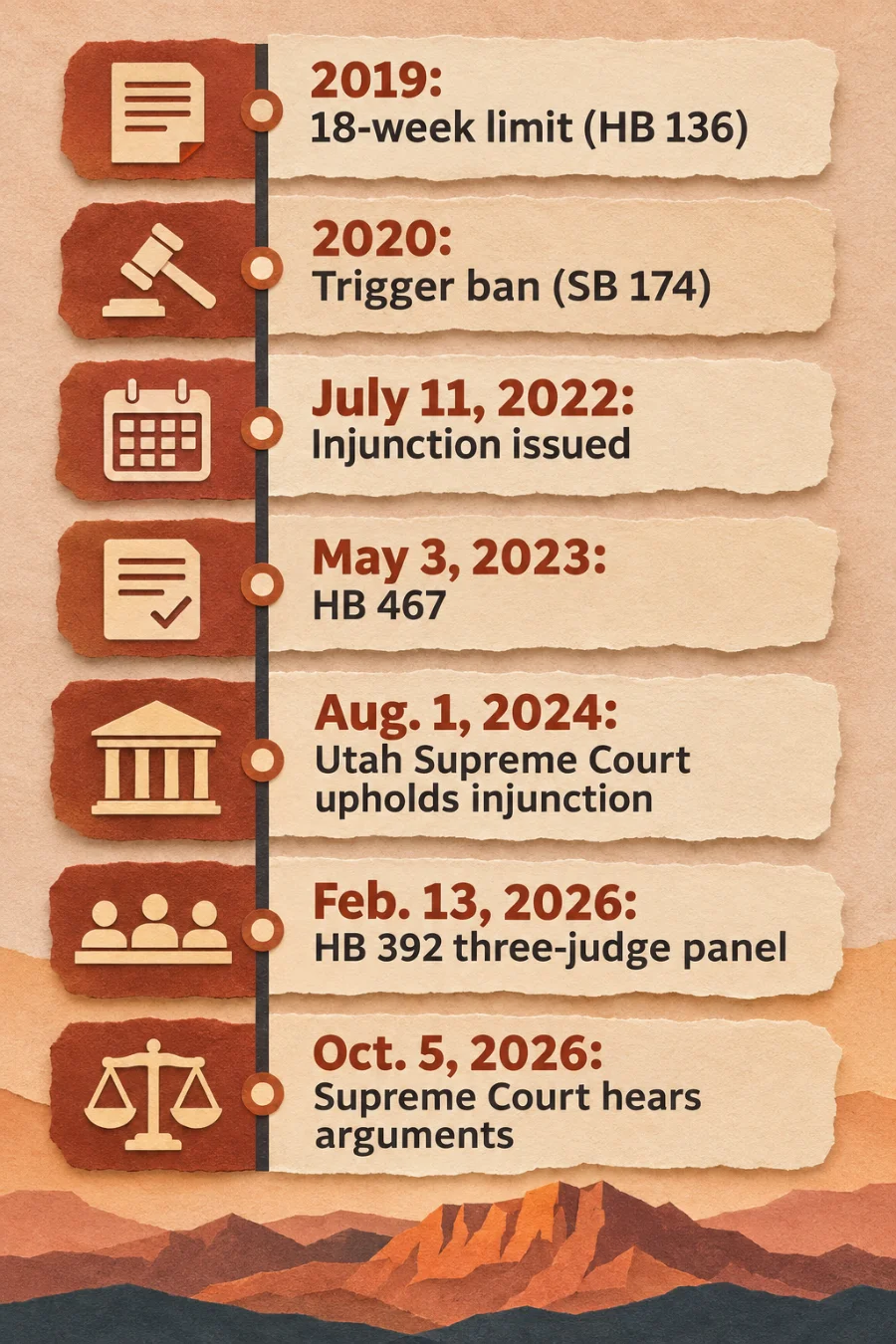
How Utah got here
| Date | What happened |
|---|---|
| 2019 | Legislature passes an 18-week limit (HB 136) |
| 2020 | Legislature passes the trigger ban (SB 174) |
| June 2022 | Roe v. Wade is overturned and the trigger ban briefly takes effect |
| July 11, 2022 | A Salt Lake County district court issues a preliminary injunction against the ban |
| May 3, 2023 | HB 467 moves the 18-week limit into § 76-7-302 |
| Aug. 1, 2024 | Utah Supreme Court upholds the injunction, 4-1 |
| Feb. 13, 2026 | HB 392 creates a three-judge panel for challenges to state laws |
| Oct. 5, 2026 | Utah Supreme Court hears arguments on that panel |
The 18-Week Limit and How It Is Counted
Utah measures the 18 weeks from the first day of the patient’s last menstrual period, not from conception. That means the cutoff arrives about four months into the pregnancy by the calendar, and about two weeks earlier than a count from conception would suggest.
The limit applies to everyone who is physically in Utah, including people who live in other states. Only a physician may perform an abortion, so nurse practitioners and midwives cannot, although some of them may deliver parts of the consent process described below.
Utah also bars an abortion sought solely because of a Down syndrome diagnosis, under § 76-7-302.4.
Exceptions: What Changes Before and After 18 Weeks
The exceptions in § 76-7-302 split in two, and the old rule of thumb that rape and incest cases are allowed after 18 weeks is wrong. Since HB 467 took effect on May 3, 2023, the rape, incest, and under-14 provisions apply only before 18 weeks. After 18 weeks, the only exceptions are medical.
After 18 weeks
An abortion is allowed if it is necessary to avert the woman’s death or a serious physical risk of substantial impairment of a major bodily function. It is also allowed if two physicians who practice maternal fetal medicine concur, in writing in the medical record, that the fetus has an abnormality incompatible with life. In that case the physician must tell the woman, verbally and in writing, that perinatal hospice and palliative care are available as an alternative.
Before 18 weeks, for rape, incest, or a child under 14
These cases do not change the 18-week cutoff, but they change what the physician must do. For rape or incest, the physician must verify that the incident was reported to law enforcement before performing the abortion. For a pregnant child under 14, the physician must comply with the child abuse reporting rules in Utah Code § 80-2-602.
The physician must also keep a record of how the verification was done and report it to the Utah Department of Health and Human Services.
What Is the Trigger Ban, and Why Is It Blocked?
SB 174 is a 2020 law written to take effect if Roe v. Wade was overturned. It makes performing an abortion a second-degree felony in nearly every case, with exceptions for rape and incest reported to law enforcement, serious risk to the woman’s life or health, and fetal conditions incompatible with life.
The ban became enforceable for a few days after the U.S. Supreme Court’s Dobbs decision in June 2022. Planned Parenthood Association of Utah sued, arguing that the Utah Constitution protects abortion access, and a district court blocked the law with a temporary order and then a preliminary injunction on July 11, 2022.
On August 1, 2024, the Utah Supreme Court voted 4-1 to leave that injunction in place. The justices did not decide whether the ban is constitutional. They ruled only that the lower court was right to block it while the lawsuit continues.
A related 2023 law, HB 467, would have effectively barred abortion clinics from operating by limiting abortions to licensed hospitals. It was blocked as part of the same lawsuit, which is why clinics can still provide abortions.
The 2026 Fight Over the Three-Judge Panel
The trigger ban lawsuit has stalled because of a dispute over which court gets to decide it. In February 2026, the legislature passed HB 392 and SJR 5, and Governor Spencer Cox signed HB 392 on February 13. Together they let the state move certain civil cases against it to a randomly selected three-judge district court panel.
The state moved to send Planned Parenthood’s case to that panel, and the panel canceled the April 16 trial. Planned Parenthood Association of Utah asked the Utah Supreme Court to block the transfer, arguing that the legislature changed the rules just as the case neared its end.
The Utah Supreme Court heard arguments on October 5, 2026, in that case and two others, including a redistricting lawsuit. Justice John Nielsen recused himself from the Planned Parenthood matter in September, and 2nd District Judge Joseph Bean sat in his place. The state’s attorney, Erin Middleton, argued the legislature acted within its authority.
A second law, HB 366, adds a backup: if a court strikes down the panel, a separate Constitutional Court with exclusive jurisdiction over such challenges would be created. Whatever the justices decide, the 18-week limit stays the operating rule until a court lifts the injunction on SB 174.

The 72-Hour Wait and Consent Steps
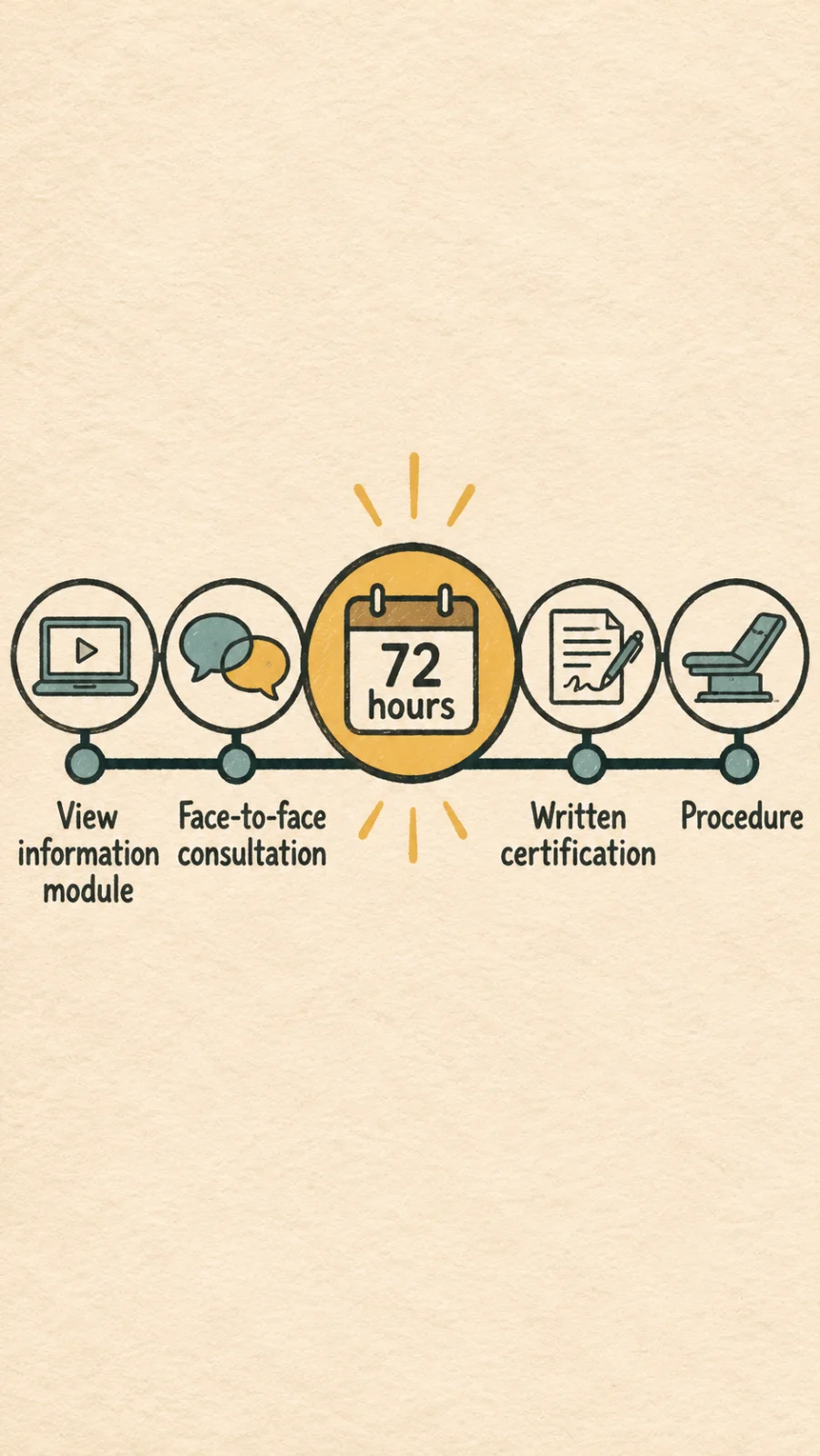
Utah requires voluntary, informed written consent, and the consent process must start at least 72 hours before the abortion. The sequence is set out in Utah Code § 76-7-305.
- A clinic or hospital staff member, physician, nurse, nurse practitioner, certified nurse midwife, genetic counselor, or physician’s assistant presents the state’s information module.
- You view the entire module, and the staff member documents that you did.
- After that, a clinician gives you a face-to-face consultation, which can happen anywhere in Utah. It covers the procedure, the risks and alternatives, the gestational age, the risks of carrying to term, and your right to view an ultrasound at no cost.
- You receive the website address for the state’s printed material and a form about disposition of the fetal remains.
- The physician who will perform the abortion obtains your written certification that you received this information.
The 72 hours run from the information module, so viewing it early shortens the total time between your first contact and the procedure.
The physician is not in violation if the abortion was necessary to avert death or serious physical risk, if the pregnancy resulted from rape or incest, or if the patient was 14 or younger. A separate carve-out covers certain cases of ruptured membranes with infection.
Where Abortion Is Provided in Utah
Utah allows abortions only in an abortion clinic or a hospital, unless a medical emergency requires another location (§ 76-7-302(3)). A physician must perform the abortion.
Planned Parenthood Association of Utah runs the clinics that offer most abortion care. Its Metro Health Center in Salt Lake City lists in-clinic abortion services, and its health center pages list medication abortion by appointment through 11 weeks. People traveling from a state with a ban are told to book an in-clinic appointment at the Metro Health Center. If you live far from the Wasatch Front, plan for travel and for the waiting period.
The state’s consent rules require a face-to-face consultation, so Utah patients should expect to attend at least one in-person visit before the procedure. Coverage is also limited by state law, so ask the clinic about cost and insurance before you book.
Rules for Minors
A physician may not perform an abortion on a minor unless a parent or guardian gives informed written consent, a juvenile court authorizes the minor to consent on her own, or a medical emergency leaves no time to obtain either. The minor chooses between the first two routes. These requirements come from Utah Code § 76-7-304.5.
To use the court route, the minor files a petition with the juvenile court. The hearing is closed to the public. The court must authorize the abortion if it finds, by a preponderance of the evidence, that the minor gave informed consent and is mature enough to do so, or that an abortion would be in her best interest.
The Judicial Council writes rules to keep these proceedings confidential and to expedite hearings and appeals.
Penalties Under Utah Law
Utah’s penalties are aimed at physicians and facilities, not at the patient. Utah Code § 76-7-314 sets the criminal grades, and § 76-7-305(7) adds licensing consequences.
| Violation | Consequence | Source |
|---|---|---|
| Most violations of the abortion statutes, including the consent steps | Class A misdemeanor | § 76-7-314(4) |
| Listed violations such as §§ 76-7-307 to -312 and § 76-7-326 | Third-degree felony | § 76-7-314(1), (2) |
| Consent-rule violation by a physician | Unprofessional conduct, license suspension or revocation | § 76-7-305(7) |
| Violation at a health care facility | Department may act against the facility | § 76-7-314(7) |
| Performing an abortion under SB 174, if it ever takes effect | Second-degree felony | § 76-7a-201 |
Under Utah’s general sentencing statutes, a class A misdemeanor carries up to 364 days in jail and a fine up to $2,500. A third-degree felony carries up to five years and a fine up to $5,000, and a second-degree felony carries one to 15 years and a fine up to $10,000 (Utah Code §§ 76-3-203, 76-3-204, 76-3-301).
The Department of Health and Human Services must report a physician’s violation to the Medical Licensing Board, and anyone with knowledge of a violation may report it as well.
Traveling Out of State for an Abortion
The abortion statutes cited in this guide contain no offense for traveling to another state for care. Patients from Utah commonly travel to neighboring states, and an out-of-state clinic follows its own state’s rules, including its own gestational limits and waiting periods.
If you plan to travel, check that state’s consent and waiting-period requirements with the clinic before you go, since they differ from Utah’s.
What to Do If You Need an Abortion in Utah
Call a clinic first, because the 72-hour clock and the 18-week limit are what set your timeline. Planned Parenthood Association of Utah schedules abortion appointments at 1-800-230-PLAN, and the Metro Health Center in Salt Lake City takes calls at 801-257-6789.
Ask the clinic to start the information module as early as possible and to tell you which visits must be in person. Confirm the gestational age at which your preferred method is offered, since medication abortion is offered through a shorter window than in-clinic care.
If you are under 18, ask the clinic whether you will use parental consent or a juvenile court petition. If the pregnancy resulted from rape or incest, ask what the physician will need to verify about the report to law enforcement.
Frequently Asked Questions
Is abortion legal in Utah?
Yes, before the unborn child reaches 18 weeks gestational age, counted from the last menstrual period. After 18 weeks it is allowed only to avert death or serious physical impairment, or for a fetal abnormality incompatible with life confirmed by two maternal fetal medicine physicians.
Is Utah’s abortion ban in effect?
No. SB 174, the 2020 trigger ban, is blocked by a preliminary injunction issued on July 11, 2022. The Utah Supreme Court left the injunction in place on August 1, 2024.
How long is the waiting period?
72 hours. The clock runs from the point you view the state’s information module, and a face-to-face consultation and written certification must also happen before the procedure.
Does a minor need a parent’s permission?
Yes, unless a juvenile court authorizes her to consent on her own. A parent or guardian must give informed written consent, and a medical emergency is the only other exception.
Are there exceptions for rape or incest?
Yes, but only before 18 weeks. For rape or incest the physician must verify the incident was reported to law enforcement, and a pregnant child under 14 is also covered before 18 weeks.
Can a patient be prosecuted under Utah’s abortion laws?
The penalty provisions in § 76-7-314 are written around physician and facility conduct. A doctor who violates them faces criminal charges and license discipline.
References
- Utah State Legislature, Utah Code § 76-7-302, Circumstances under which abortion authorized
- Utah State Legislature, Utah Code § 76-7-305, Informed consent requirements and 72-hour wait
- Utah State Legislature, Utah Code § 76-7-304.5, Consent required for abortions performed on minors
- Utah State Legislature, Utah Code § 76-7-314, Violations of abortion laws and classifications
- Utah State Legislature, S.B. 174 (2020), Abortion trigger ban
- Utah State Legislature, H.B. 467 (2023), Abortion amendments
- KUER (news), Passes and fails in Utah’s 2026 legislative session, HB 392 and SJR 5
- Utah News Dispatch (news), Utah Supreme Court hears arguments on the three-judge panel, Oct. 5, 2026
- Planned Parenthood Association of Utah, Metro Health Center abortion services