
West Virginia Abortion Law: What Changed and What’s Still Contested

West Virginia bans abortion unless a licensed medical professional determines, in reasonable medical judgment, that the fetus is nonviable, the pregnancy is ectopic, or a medical emergency exists. Pregnancies caused by reported sexual assault or incest have narrower exceptions: the first 8 weeks for adults and the first 14 weeks for minors and incapacitated adults. These rules come from the Unborn Child Protection Act, W. Va. Code § 16-2R, enacted in September 2022.
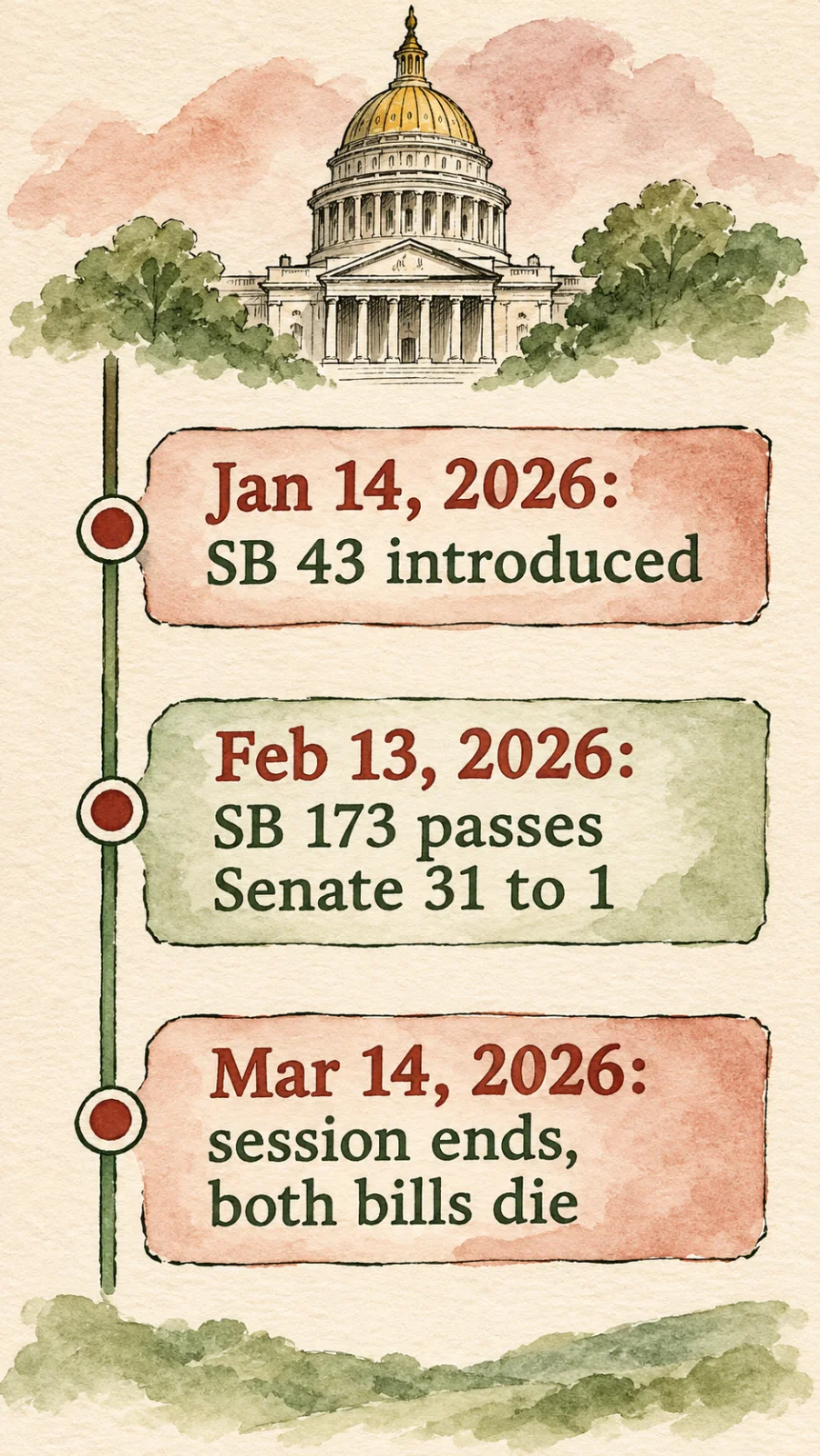
Two 2026 bills would have changed that law. Senate Bill 43 would have removed the rape and incest exceptions, and Senate Bill 173 would have made it a felony to mail abortion pills into the state. Neither became law.
Which Abortions Are Legal in West Virginia?
Only three medical situations qualify without any further conditions. Under W. Va. Code § 16-2R-3(a), an abortion may not be performed or attempted unless a licensed medical professional finds that the embryo or fetus is nonviable, the pregnancy is ectopic, or a medical emergency exists.
The Act defines each term, and the definitions are narrower than many summaries suggest. Section 16-2R-2 says “nonviable” means a lethal anomaly that makes life outside the uterus impossible. “Ectopic” covers a fertilized egg developing outside the uterus, or in a part of the uterus where it cannot survive, including cervical, cornual, and cesarean scar implantations.
A “medical emergency” means a condition that requires an abortion to avert serious risk of death or serious risk of substantial, life-threatening physical impairment of a major bodily function. The definition expressly excludes psychological or emotional conditions, and a patient’s claim that she may harm herself does not qualify.

Rape and Incest Exceptions: Adults, Minors, and the 48-Hour Rule
Adults can obtain an abortion for rape or incest only in the first 8 weeks, and only after reporting the crime. Minors and incompetent or incapacitated adults get 14 weeks and have a second way to qualify. Both groups must complete the required step at least 48 hours before the abortion.
| Patient | Window | Required at least 48 hours before |
|---|---|---|
| Adult | First 8 weeks of pregnancy | Report to a law enforcement agency with jurisdiction, and give the report to the provider |
| Minor, or incompetent or incapacitated adult | First 14 weeks of pregnancy | Either a law enforcement report, or medical treatment for the assault, incest, or a related injury |
The treatment route has a catch. The professional or hospital that provided that treatment may not perform the abortion, so the patient needs a different provider. When a report involves a minor, the agency that receives it must pass it to the Child Abuse and Neglect Investigations Unit of the West Virginia State Police within 48 hours.
Other conditions apply to every abortion. The provider must hold West Virginia hospital privileges, and a surgical abortion under these exceptions must take place in a hospital licensed by the state. The partial-birth abortion procedure is not allowed.
The statute does not explain how the 8 and 14 weeks are counted. “Pregnancy” is defined in § 16-2R-2 as the period after a fertilized egg implants in the uterus, so the treating provider is the person to ask how a given timeline is measured.
Rules for Minors: Parental Notice and the Court Waiver
A minor who is not married or emancipated triggers a parental notice requirement under § 16-2R-5. For the medical exceptions, the provider must notify a parent, guardian, or custodian within 48 hours after the abortion. For the rape and incest exception for minors, notice must be given before, and 48 hours must pass after it is delivered.
A minor who objects can petition the circuit court in her home county for a waiver. The petition is filed under seal and needs only her age and education level, her county, and a short statement of why she wants the waiver. No filing fee is charged.
The court must hold a hearing by the next judicial day and issue a written order within 24 hours. It must waive notice if it finds the minor mature and informed enough to decide alone, or that notice would not be in her best interest. The minor is entitled to appointed counsel if she cannot afford one, and she may appeal a denial confidentially to the Supreme Court of Appeals.
The statute asks the Supreme Court of Appeals to supply form petitions and instructions to circuit clerks. A minor can ask the clerk of her county’s circuit court for them.

What the Law Does Not Count as an Abortion
Treatment for miscarriage, stillbirth, and several other situations falls outside the ban. Section 16-2R-4 excludes a miscarriage, an intrauterine fetal demise or stillbirth, in vitro fertilization, and medical treatment by a licensed professional that unintentionally injures or ends the life of an embryo or fetus.
The Act defines a miscarriage as the loss of an embryo or fetus before the 20th week, and a stillbirth as a loss after the 19th week. It also excludes contraceptives, and it does not prevent prescribing them to a patient who is not known to be pregnant. Ectopic pregnancies are handled separately, as one of the three exceptions in § 16-2R-3(a).
Penalties: Who Faces Prison and Who Loses a License
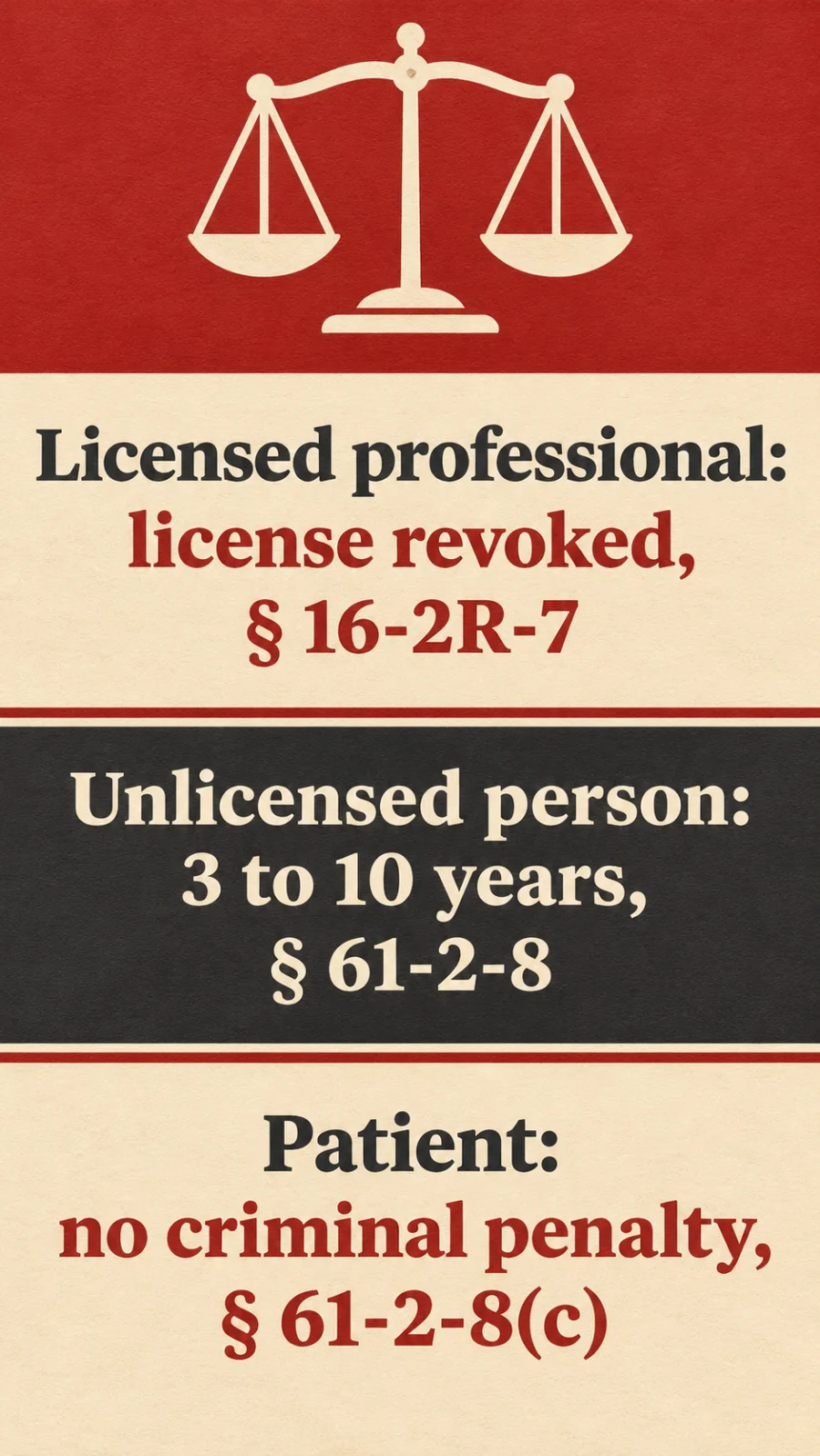
The penalty depends on whether the person who performs the abortion holds a medical license. A licensed medical professional who knowingly and willfully performs an abortion with the intent to violate § 16-2R-3 faces disciplinary action, and the licensing board must revoke the license under § 16-2R-7.
The felony in § 61-2-8 reaches a different group. It applies to any person other than a licensed medical professional who knowingly and willfully performs, induces, or attempts an abortion. It also covers a former professional whose license was revoked under § 16-2R-7 and who performs another abortion afterward.
The sentence is not less than 3 and not more than 10 years in a state correctional facility. Subsection (c) bars criminal liability for the pregnant patient, whether as a principal, accessory, accomplice, conspirator, or aider and abettor. Penalties and enforcement are not the same everywhere; our breakdown of Virginia abortion laws shows how another state handles them.
| Person | Consequence | Statute |
|---|---|---|
| Licensed medical professional | Mandatory license revocation | § 16-2R-7 |
| Unlicensed person, or professional whose license was revoked | Felony, 3 to 10 years | § 61-2-8(a), (b) |
| Pregnant patient | No criminal penalty | § 61-2-8(c) |
Many summaries, including an earlier version of this article, say doctors face the 3 to 10 year felony. The text of § 61-2-8(a) says otherwise: its felony applies to people who are not licensed medical professionals, and licensed professionals answer to their boards.
Abortion Pills: The 2025 Fourth Circuit Ruling and the 2026 Mail Ban Bill
The state’s ban applies to medication abortion, and a federal appeals court upheld it. In GenBioPro, Inc. v. Raynes, No. 23-2194, decided July 15, 2025, a divided Fourth Circuit panel held 2 to 1 that federal drug-safety law does not preempt West Virginia’s ban as applied to mifepristone. Judge Wilkinson wrote the majority opinion, and Judge Benjamin dissented in part.
The ruling did not cover everything. A separate West Virginia restriction on prescribing mifepristone by telemedicine was not part of the appeal. The district court had ruled in August 2023 that federal rules preempted that provision.
Senate Bill 173 would have gone further. It aimed to stop out-of-state senders and prescribers by making it a felony, punishable by 3 to 10 years, for a non-medical professional to send an abortifacient by mail or courier to a person in West Virginia. Prescribers would have faced mandatory license revocation, and a pregnant woman who received pills could have sued the sender. To see how enforcement differs in another state, read our guide to North Carolina abortion laws.
The Senate passed SB 173 by a vote of 31 to 1 on February 13, 2026, according to the Legislature’s own summary. West Virginia Watch reported that the bill was still pending in the House Judiciary Committee when the session ended on March 14, 2026, so it did not become law. A similar bill in 2025, SB 85, passed the Senate 28 to 5 but did not clear the House, and neither bill’s language appears in § 16-2R-2.
Opponents argued SB 173 would hurt physician recruitment and raise Commerce Clause problems, and a senator said existing laws already cover rogue online pharmacies. Supporters said mailed pills undermine the state’s ban. Bills do not carry over between regular sessions, so lawmakers would have to file new ones.
Senate Bill 43 and the Fight Over the Rape and Incest Exceptions
SB 43 died in committee. Sen. Patricia Rucker introduced it on January 14, 2026, and it was referred to the Health and Human Resources Committee and then Judiciary, according to the Legislature’s bill status page. The page shows no action after that referral.
The bill would have struck subsections (b), (c), and (d) of § 16-2R-3, leaving only the nonviable, ectopic, and medical emergency exceptions plus the hospital privileges requirement. It followed a 2025 attempt, Senate Bill 51, which its sponsor Sen. Jay Taylor withdrew on February 19, 2025.
Both exceptions remain in § 16-2R-3 as quoted above. Sponsors of earlier versions argued that children conceived through rape or incest deserve legal protection. Critics said the change would leave survivors, including minors, with no legal option in the state.
Traveling to Another State for Care
West Virginia’s abortion statutes regulate abortions performed or induced in the state, and § 61-2-8(c) bars penalties for the patient. Nothing in the sections quoted above creates a penalty for a patient who travels elsewhere.
In his concurring opinion in Dobbs v. Jackson Women’s Health Organization, Justice Kavanaugh wrote that states may not bar residents from traveling to obtain an abortion in another state. That is a concurring view, not a holding of the Court.
Where to Turn for Help
The right first contact depends on the situation. A patient who needs the law enforcement report for the 8-week exception should start with the agency that has jurisdiction where the assault happened, because the report must exist 48 hours ahead.
A minor who wants to avoid parental notice can ask her county’s circuit clerk for the waiver petition and instructions, and she may request appointed counsel. Free legal helplines, including the Repro Legal Helpline, can answer questions about rights and options.
Providers who are unsure whether a case falls within § 16-2R-3(a) face license revocation if they guess wrong, so they should consult a health care attorney before acting.
Frequently Asked Questions
Is abortion legal in West Virginia?
Only in limited cases. It is allowed when a licensed professional finds the fetus nonviable, the pregnancy ectopic, or a medical emergency exists, and for reported rape or incest within 8 weeks for adults or 14 weeks for minors and incapacitated adults.
Can a patient be charged with a crime for having an abortion?
No. W. Va. Code § 61-2-8(c) says the section cannot be used to impose a criminal penalty on the pregnant patient as a principal, accessory, accomplice, conspirator, or aider and abettor.
What is the time limit for the rape and incest exception?
Adults have the first 8 weeks of pregnancy and must report to law enforcement at least 48 hours before. Minors and incompetent or incapacitated adults have the first 14 weeks and can qualify through a report or medical treatment.
Does a minor have to tell a parent?
Generally the provider must notify a parent, guardian, or custodian. A minor can ask the circuit court in her county to waive notice, and the court must rule within one judicial day for the hearing and 24 hours for the written order.
Did Senate Bill 43 or Senate Bill 173 become law?
No. SB 43 never left committee, and SB 173 passed the Senate 31 to 1 but was still in House Judiciary when the session ended on March 14, 2026.
Is treatment for a miscarriage or ectopic pregnancy illegal?
No. Section 16-2R-4 says a miscarriage, a stillbirth, and treatment that unintentionally ends a pregnancy are not abortions, and ectopic pregnancy is one of the three exceptions in § 16-2R-3(a).
References
- West Virginia Legislature, W. Va. Code § 16-2R-3, prohibition on abortion and exceptions
- West Virginia Legislature, W. Va. Code § 61-2-8, abortion penalty
- West Virginia Legislature, W. Va. Code § 16-2R-7, licensure action
- West Virginia Legislature, W. Va. Code § 16-2R-2, definitions
- West Virginia Legislature, W. Va. Code § 16-2R-4, procedures not considered abortion
- West Virginia Legislature, W. Va. Code § 16-2R-5, unemancipated minors and judicial waiver
- U.S. Court of Appeals for the Fourth Circuit, GenBioPro, Inc. v. Raynes, No. 23-2194, opinion of July 15, 2025
- West Virginia Legislature, Senate Bill 43 (2026 Regular Session), bill status and history
- West Virginia Legislature, Wrap Up: Abortion Pill Ban Clears Senate (Senate Bill 173)
- West Virginia Watch (news), end-of-session report noting SB 173 will not become law