
South Carolina Abortion Laws: What’s Legal in 2027

South Carolina bans abortion once a fetal heartbeat is detected, which usually means about six weeks of pregnancy counted from the first day of your last period. Exceptions exist for medical emergencies, fatal fetal anomalies, and rape or incest up to 12 weeks. A provider who breaks the ban commits a felony punishable by up to two years in prison and a $10,000 fine, and the pregnant patient cannot be prosecuted.
That has been the rule since May 25, 2023. Lawmakers have tried to tighten it this year, and a federal court just heard a challenge to the exceptions. Both are covered below.
The Six-Week Ban in Plain Terms
The ban is in South Carolina Code of Laws, § 44-41-630(B). It makes it a crime to perform or induce an abortion, with the specific intent of causing one, after the unborn child’s fetal heartbeat has been detected. The law defines “fetal heartbeat” as cardiac activity, meaning the steady rhythmic contraction of the fetal heart, inside the gestational sac.
Gestational age is counted from the first day of the last menstrual period, not from conception, and fertilization usually happens about two weeks after that date. That is why a person can be about six weeks along by the calendar while having missed only a couple of weeks of their cycle.
So is 10 weeks too late to get an abortion in South Carolina? In most cases, yes. Cardiac activity is usually visible on ultrasound by around six weeks, so at 10 weeks an abortion is legal only if one of the exceptions below applies. The rape and incest exception runs only through 12 weeks.
What “six weeks” legally means
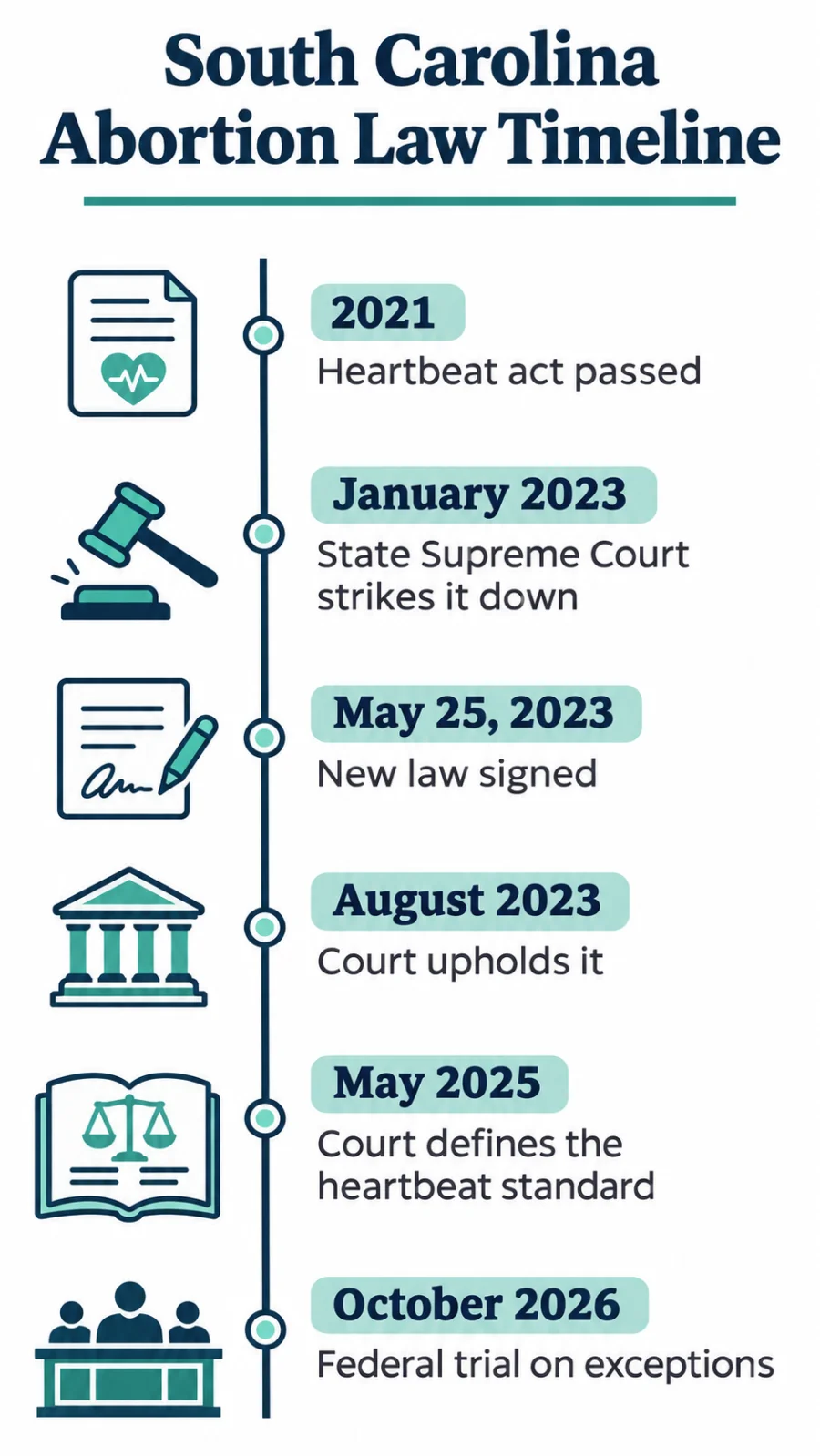
The statute never says “six weeks.” It says heartbeat detection, and that wording was the subject of a lawsuit. Planned Parenthood South Atlantic argued the heartbeat is not detectable until about nine weeks. In a May 14, 2025 decision, the state Supreme Court rejected that reading and sided with the state, holding that the biologically identifiable moment happens in most cases around six weeks. The court said it was not framing the holding as a number of weeks, which matters: the legal trigger is detection, not a calendar date.
How We Got Here
The state’s first heartbeat law passed in 2021. In January 2023 the South Carolina Supreme Court struck it down, ruling that the state constitution’s right to privacy covers abortion, in effect recognizing a state constitutional right. Since the U.S. Supreme Court overturned Roe v. Wade in 2022, abortion rights depend largely on state law and state constitutions, which is why that ruling mattered. The legislature then rewrote the law, and Governor Henry McMaster signed the new version, the South Carolina Fetal Heartbeat and Protection from Abortion Act, on May 25, 2023 (2023 Act No. 70, S.474).
In August 2023 the court, with a changed membership, upheld the new law 4 to 1. Before 2023, South Carolina allowed abortion until 20 weeks after fertilization under the 2016 Pain-Capable Unborn Child Protection Act. The ban changed that almost overnight.
Exceptions to the Ban
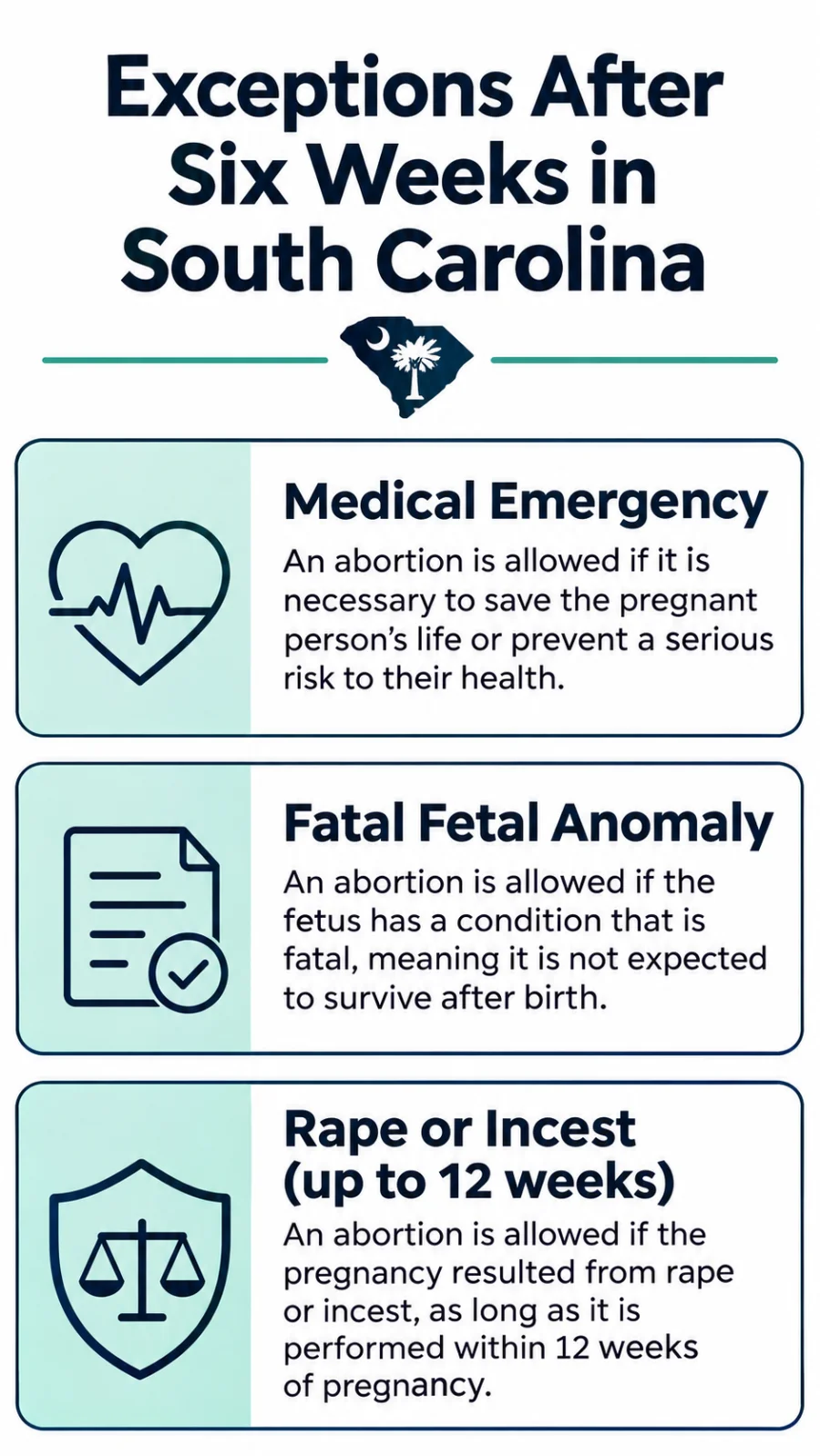
Three exceptions allow an abortion after a heartbeat is detected. Each comes with paperwork requirements that the physician has to meet, and a mistake in the paperwork is itself a felony.
| Exception | Condition | What the physician must do |
|---|---|---|
| Medical emergency or risk to the patient | Abortion needed to prevent death or serious risk of substantial, irreversible impairment of a major bodily function. Psychological or emotional conditions do not count. | Record the emergency, the condition and the medical rationale. Keep the notes at least 7 years (§ 44-41-640). |
| Fatal fetal anomaly | A profound, irremediable condition incompatible with sustaining life after birth. | Record the anomaly, its nature and the rationale. Keep the records at least 7 years (§ 44-41-660). |
| Rape or incest | Probable gestational age of 12 weeks or less. | Tell the patient beforehand, then report the allegation to the county sheriff within 24 hours, including her name and contact information (§ 44-41-650). |
The sheriff-reporting rule is the part most summaries skip. The law requires the physician to give the patient’s name and contact information to the sheriff, and the patient must be told this before the procedure.
Miscarriage care is not banned. The definition of abortion in § 44-41-610(1) excludes removing a dead unborn child, and § 44-41-640(C)(2) lists miscarriage, intrauterine fetal demise and ectopic pregnancy among the conditions presumed to qualify for the medical emergency exception. The harder cases are those where cardiac activity is still present. There the law requires the physician to make all reasonable efforts to save the unborn child, which can leave doctors hesitant in borderline situations.
Conditions the law presumes qualify
Under § 44-41-640(C)(2), eleven conditions are presumed to meet the health exception: molar pregnancy, partial molar pregnancy, blighted ovum, ectopic pregnancy, severe preeclampsia, HELLP syndrome, abruptio placentae, severe physical maternal trauma, uterine rupture, intrauterine fetal demise and miscarriage. The list is not exclusive, but anything off it leaves the doctor making a judgment call.
That judgment call is the heart of the current federal case. Even when a baby is alive in the womb, the physician must make all reasonable efforts to deliver and save it, as long as that does not endanger the patient’s life or physical health.
What the ban does not cover: contraception and IVF
The six-week ban applies only once a pregnancy exists. § 44-41-610(4) defines a contraceptive as a drug, device or chemical that prevents ovulation, conception or implantation, and § 44-41-640(E) says using or prescribing one according to its directions is not a violation. Birth control pills and other contraceptive methods, along with emergency contraception taken after sex to prevent pregnancy, remain legal in South Carolina.
In vitro fertilization is not mentioned anywhere in Chapter 41. The ban is tied to a “clinically diagnosable pregnancy,” which the law defines by the detectable presence of the pregnancy hormone hCG, so on its face it does not reach embryos created in a lab before transfer.
Penalties
The penalties fall on providers and others who perform or assist, not on the pregnant person. Section 44-41-670 says a woman on whom an abortion is performed in violation of the article cannot be criminally prosecuted and is not subject to any civil or criminal penalty.
| Violation | Penalty | Section |
|---|---|---|
| Abortion after a detected heartbeat, outside the exceptions | Felony: $10,000 fine, up to 2 years in prison, or both | § 44-41-630(B) |
| Botching exception paperwork or the sheriff report | Felony: up to $10,000 fine, up to 2 years, or both | §§ 44-41-640, 44-41-650, 44-41-660 |
| Facility that fails to keep required records | Fine of up to $50,000 | §§ 44-41-640(B)(4), 44-41-660(D) |
| Physician or licensed professional who intentionally, knowingly or recklessly violates the ban | License revocation by the licensing board | § 44-41-690 |
| Civil suit | Actual and punitive damages plus $10,000 in statutory damages per violation, filed within 3 years | § 44-41-680 |
Section 44-41-680 lets the patient, a parent or guardian of a patient under 18, a solicitor or the Attorney General bring suit. No damages or fees can be assessed against the patient, and no one can recover if the pregnancy resulted from their own criminal conduct.
Separately, § 44-41-80 makes it a felony, punishable by two to five years or a fine of up to $5,000, to provide an abortion outside what the chapter permits. And partial-birth abortion carries its own felony under § 44-41-85, with a fine of at least $5,000 or at least five years in prison.
Enforcement has been quiet so far. Reporting from the federal trial notes that no doctor has been charged under the law.
What Has to Happen Before an Abortion Takes Place
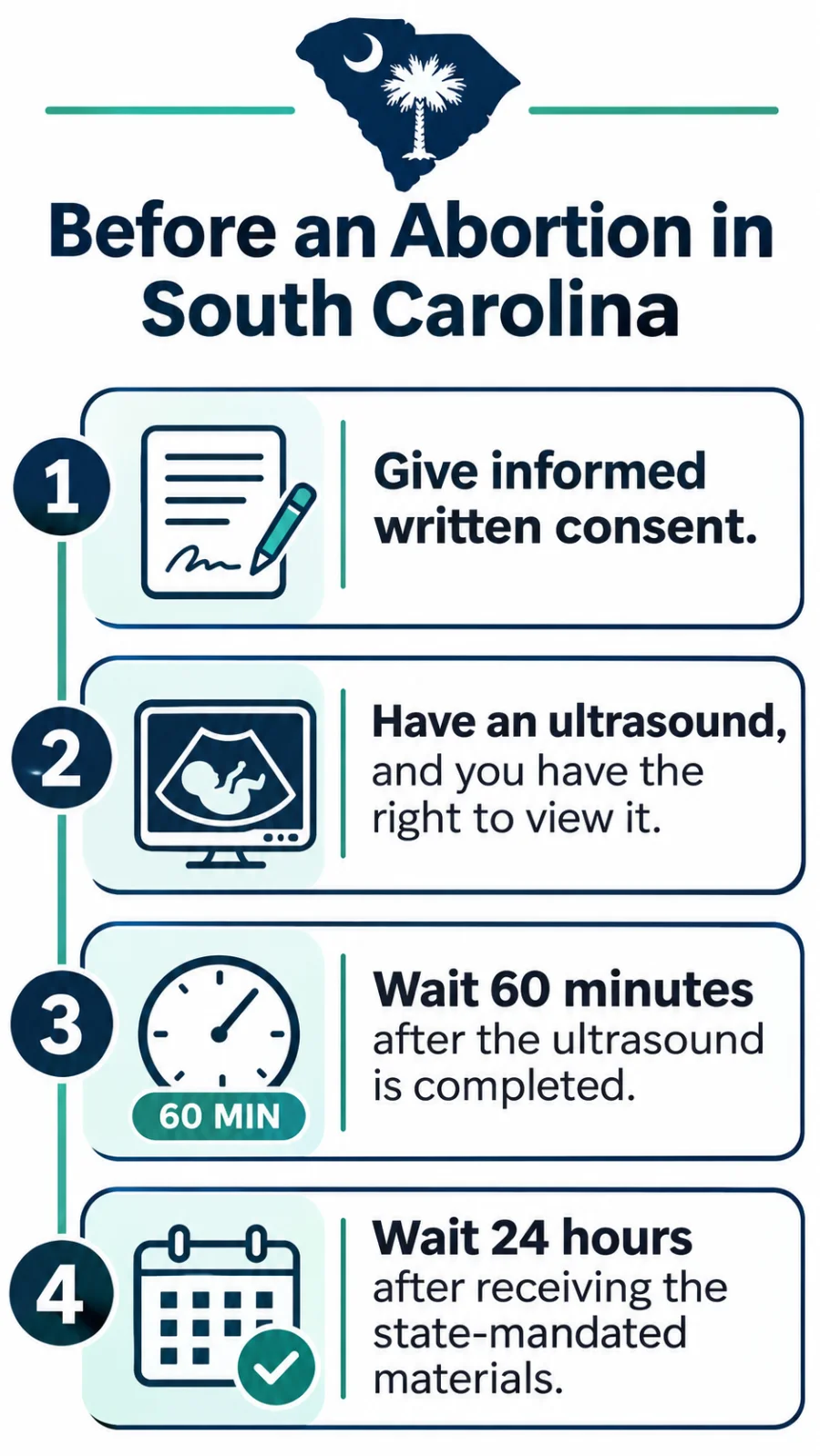
Even when an abortion is legal, South Carolina layers several requirements on top. Under § 44-41-330, before an abortion may be performed, the patient must give voluntary, informed written consent after being told, in person, about the procedure, its risks and the probable gestational age verified by ultrasound.
In practice there are three steps before any legal abortion: the patient receives the state’s written materials, has an ultrasound, and signs a written consent. Each step has its own waiting period, explained below, and minors face an extra step of parental consent or a court order.
The ultrasound and the two waiting periods
An ultrasound is required. The patient has the right to view the images and hear the heartbeat, and may decline by signing a form. After the ultrasound, at least 60 minutes must pass before the abortion.
Separately, no abortion may take place sooner than 24 hours after the patient receives the state’s written materials and certifies it. The 24-hour clock can be skipped if the clinic mails the materials, or the patient picks them up at a county health department, and she certifies in writing that she received them more than 24 hours before the appointment.
Here is a worked example. Say the patient receives the written materials at 10:00 a.m. Monday and has her ultrasound at 2:00 p.m. Monday. The earliest the procedure can happen is 10:00 a.m. Tuesday, since the 24-hour rule is the longer of the two. The 60-minute ultrasound wait only controls when the materials were already mailed in advance.
A performing physician who skips these steps commits a misdemeanor under § 44-41-350. First and second offenses carry fines of up to $1,000 with no jail time, and a third offense can mean up to three years or a $5,000 fine.
Minors Under 17
South Carolina defines a minor for this purpose as a female under 17. Under § 44-41-31, a minor needs written consent from a parent, legal guardian, grandparent or a person standing in loco parentis to the minor (in the parent’s place) for at least 60 days. Emancipated minors can consent alone.
A minor can instead petition a circuit or family court. The judge must rule within 72 hours of filing unless the minor asks for more time. Hearings are closed, records are sealed, and a minor who cannot afford the process does not have to pay. Court-appointed help is available through the Department of Social Services, and once the petition is filed the court must appoint a guardian ad litem for the minor, taking her preference into account (§ 44-41-32).
Abortion Pills and Telehealth
There are two methods. Medication abortion uses two drugs, mifepristone and misoprostol, and the FDA has approved it through 10 weeks of pregnancy. Procedural (in-clinic) abortion uses suction aspiration early in pregnancy and dilation and evacuation later. Inside South Carolina, either method is legal only before cardiac activity is detected or under one of the exceptions.
South Carolina law bans prescribing abortion pills through a telehealth visit, and the pills must be handed over in person even during the first six weeks, according to the SC Daily Gazette. In practice, South Carolinians can still reach telehealth providers licensed in other states that have shield laws, a point that has become the focus of the state’s most recent legislative push.
The federal picture is shifting. On May 1, 2026, the Fifth Circuit blocked the FDA rule that allowed mifepristone to be dispensed without an in-person visit, and the U.S. Supreme Court then issued a temporary stay that restored telehealth access. Check the current status of that case before relying on this paragraph, because it may have moved since.
Paying for an Abortion
South Carolina Medicaid covers abortion only in the narrow Hyde Amendment cases: danger to the patient’s life and cases of rape or incest. KFF reports that plans sold on the state’s health insurance marketplace are also barred from covering abortion, with limited exceptions. Section 44-41-90 also bars state funds from going to Planned Parenthood for abortion services.
Without coverage, the national median self-pay charge in 2023 was $563 for a medication abortion and $650 for a first-trimester procedural abortion, according to KFF, citing research from UCSF’s ANSIRH program. Prices vary by clinic, and travel, lodging and time off work add to the cost for anyone who has to leave the state. Abortion funds can help with both the procedure and travel.
What Changed in 2026
The Department of Public Health rename
2026 Act No. 146 (H.4189), effective May 15, 2026, replaced references to the Department of Health and Environmental Control with the Department of Public Health throughout Chapter 41. It did not change the substance of the abortion rules, but it does mean the agency that publishes the state’s informational materials and collects the abortion reports now goes by a different name.
Bills to go further
The legislature considered two attempts to tighten the law in 2026. The House passed a bill on February 3 that would make the abortion-inducing drugs mifepristone and misoprostol Schedule IV drugs, legal to possess only with a prescription, and would let family members sue out-of-state providers. And S. 1095, titled “Prohibit Abortions,” advanced out of the Senate Medical Affairs Committee in the final weeks of the session. As reported, the bill would remove the rape, incest and fatal anomaly exceptions and allow abortion only to save the patient’s life. Anti-abortion groups, which describe their cause as pro-life, backed both measures, while reproductive rights groups opposed them.
Neither measure appears to have become law, so the current abortion law is unchanged. The October 30, 2026 Guttmacher tracker still describes the state as banning abortion at six weeks with exceptions. Check the bill’s status page before assuming anything has changed.
The federal trial on the exceptions
A federal bench trial in Charleston ended October 30, 2026. It is a challenge brought by obstetrician-gynecologists, filed in January 2025, and it does not attack the ban itself. The doctors argue the health and fatal anomaly exceptions are too vague to apply safely. State data cited at trial showed 51 abortions after six weeks last year under the exceptions. No ruling had been reported as of this writing.
Where to Get Help or Information
Questions about a specific situation need a lawyer or a medical provider, because the exceptions turn on a doctor’s clinical judgment and on facts this article cannot assess. The full text of Chapter 41 is free on the legislature’s website, and the Department of Public Health publishes the written materials patients must receive before an abortion.
Anyone past the South Carolina limit has to travel out of state to obtain an abortion. North Carolina allows abortion through 12 weeks, Georgia uses a heartbeat limit similar to South Carolina’s, as does Florida since May 2024, and Virginia permits it through the second trimester. Because these rules keep changing, check a current state-by-state tracker such as Ballotpedia’s abortion regulations by state before making travel plans.
Anyone deciding whether to have an abortion should also know that crisis pregnancy centers, which often advertise free pregnancy tests and ultrasounds, generally do not provide abortions or refer patients to abortion providers. For broader reproductive health care, including contraception, county health departments and other clinics offer family planning services.
Frequently Asked Questions
Is abortion legal in South Carolina right now?
Yes, but only until a fetal heartbeat is detected, which usually happens around six weeks of pregnancy. After that it is legal only under the medical emergency, fatal fetal anomaly, and rape or incest exceptions.
Can a person be prosecuted for having an abortion in South Carolina?
No. Section 44-41-670 says a pregnant woman on whom an abortion is performed in violation of the article cannot be prosecuted and faces no civil or criminal penalty. The penalties apply to the people who perform or assist with it.
Is a D&C considered an abortion in South Carolina?
Not when it removes a pregnancy that has already ended. A D&C (dilation and curettage) is a procedure, and the law looks at its purpose. Under § 44-41-610(1), using any means “to remove a dead unborn child” is not an abortion, so a D&C after a miscarriage or fetal demise is legal at any stage. A D&C performed to end a pregnancy with detectable cardiac activity is an abortion and falls under the six-week ban and its exceptions.
Does the rape or incest exception have a time limit?
Yes. The probable gestational age must be 12 weeks or less, and the physician must report the allegation to the county sheriff within 24 hours of the procedure.
What is the penalty for a doctor who performs an illegal abortion?
A felony conviction carries up to two years in prison and a $10,000 fine. The physician also faces mandatory license revocation after due process and possible civil liability of $10,000 per violation plus damages.
Can a minor get an abortion without her parents in South Carolina?
A minor under 17 needs consent from a parent, guardian, grandparent or someone acting as a parent for 60 days, or she can ask a judge for permission. The court must rule within 72 hours unless the minor asks for more time.
Is the six-week ban going to change?
It could. A near-total ban passed a Senate committee in 2026 and a federal court is weighing a challenge to the exceptions, but the six-week law remained in force as of November 2026.
References
- South Carolina Legislature, S.C. Code of Laws Title 44, Chapter 41, Abortions (§§ 44-41-10 through 44-41-740)
- South Carolina Legislature, S. 1095, Prohibit Abortions (126th General Assembly, 2025-2026)
- South Carolina Legislature, S. 323, Total Abortion Ban (126th General Assembly, 2025-2026)
- FOX Carolina, S.C. Supreme Court Sides With State on Abortion Ban Around 6 Weeks (May 14, 2025)
- Pee Dee Edition, Federal Trial Tests Exceptions in SC Six-Week Abortion Ban (October 30, 2026)
- KFF, State Profiles for Women’s Health: South Carolina Abortion Policies
- Guttmacher Institute, Abortion Policies in South Carolina (current as of October 30, 2026)
- SC Daily Gazette, SC AG Weighs In on Abortion Medication (May 8, 2026)