
Arizona Divorce Laws: Filing, Property Split & Custody

Arizona is a no-fault divorce state, and the court calls the process a “dissolution of marriage.” One spouse must have lived in Arizona for 90 days before filing, the marriage must be “irretrievably broken,” and a judge cannot hold a hearing or trial until 60 days after the other spouse is served. Property is divided fairly but not always equally, and children are handled through legal decision-making and parenting time rather than “custody.”
This guide follows the Arizona statutes in the order a divorce actually unfolds: who can file, the timeline, costs, property, spousal maintenance, children and the paperwork you owe the other side.
Who Can File for Divorce in Arizona?
At least one spouse must have been domiciled in Arizona, or stationed here in the armed forces, for 90 days before the petition is filed. That rule is in A.R.S. § 25-312. Domicile means you live here and intend to stay, so a temporary stay does not count.
Arizona has no fault grounds for an ordinary marriage. The court only has to find that the marriage is irretrievably broken, meaning there is no reasonable prospect of reconciliation. If one spouse denies that, the judge can hold a hearing and continue the matter for up to 60 days before deciding.
Adultery, cruelty or abandonment do not change the property split. Under § 25-318 and § 25-319, the court divides property and decides maintenance without regard to marital misconduct.
Covenant marriages are different
If you and your spouse signed a covenant marriage declaration, § 25-312 requires one of the grounds in A.R.S. § 25-903. There are eight: adultery, a felony conviction with a death sentence or imprisonment, abandonment for at least one year, physical or sexual abuse or domestic violence, living apart for two years, living apart for one year after a legal separation decree, habitual drug or alcohol abuse, or the mutual agreement of both spouses.
Several of those grounds can be filed early and the case is paused until the waiting period is met. If you are not sure whether your marriage is a covenant marriage, check your marriage license paperwork before you draft a petition.
The Divorce Timeline: Filing, Service and the 60-Day Wait
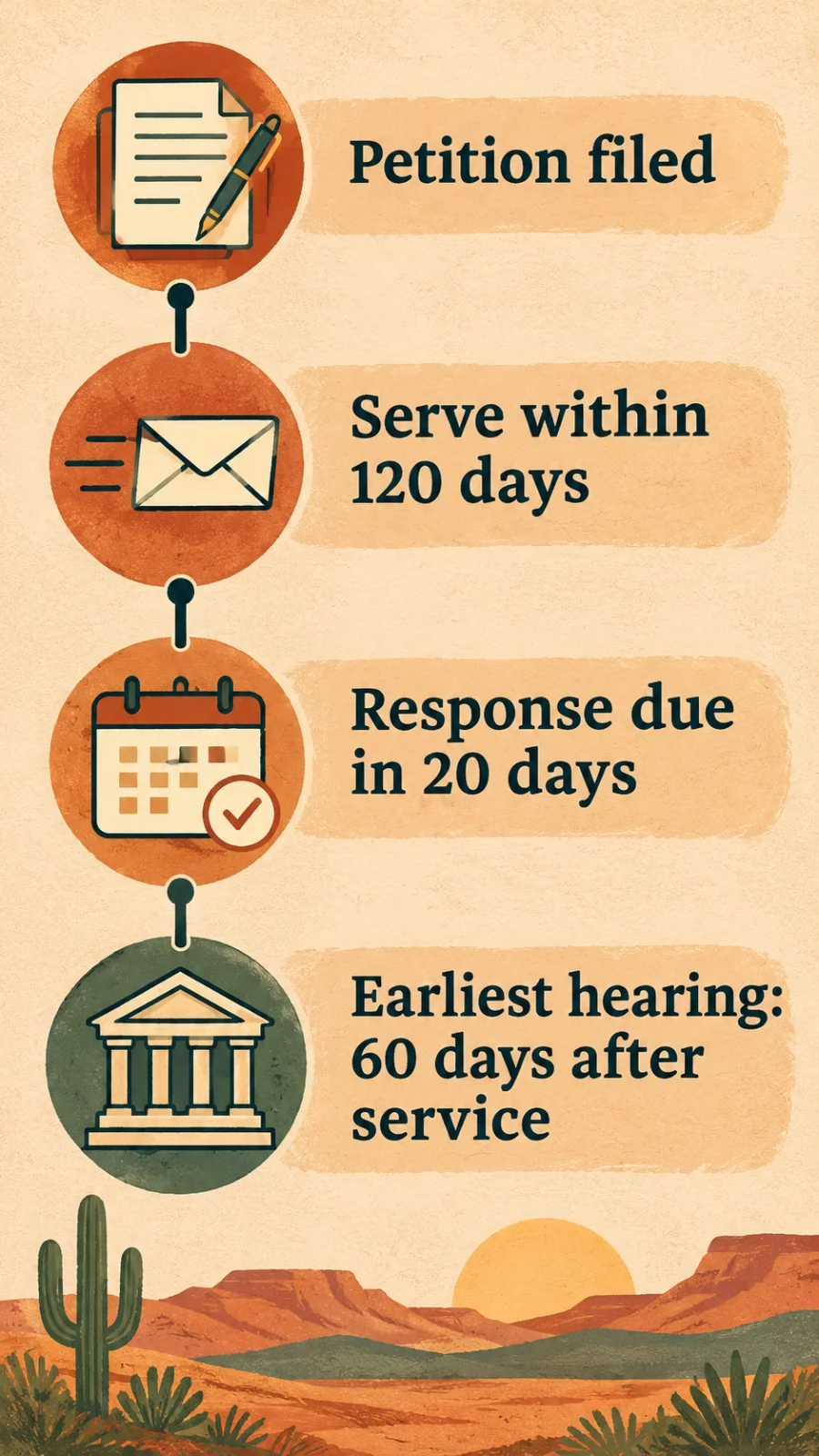
The earliest an Arizona judge can hear your case is 60 days after your spouse is served or accepts service. A.R.S. § 25-329 bars both hearings and trials, and any motion supported by affidavit, until that period ends. The 60 days run from service, not from the day you file.
Service is where many cases stall. Under Arizona Rule of Family Law Procedure 40(i), if the respondent is not served within 120 days of filing, the court must dismiss the case without prejudice or order that service be made within a set time.
| Step | Source | Deadline |
|---|---|---|
| Residency before filing | A.R.S. § 25-312(A)(1) | 90 days |
| Serve your spouse | Ariz. R. Fam. Law P. 40(i) | 120 days after filing |
| Spouse’s response | Ariz. R. Fam. Law P. 24.1 | 20 days if served in Arizona, 30 days outside |
| Earliest hearing or trial | A.R.S. § 25-329 | 60 days after service |
| Initial disclosure | Ariz. R. Fam. Law P. 49 | 40 days after the first responsive pleading |
Here is how those dates stack up in a hypothetical. Say you file on March 1 and your spouse is served in Arizona on March 10. The response is due March 30, the 60-day wait ends May 9, and if the response is filed on March 30, the Rule 49 disclosures are also due May 9. You would have until June 29 to complete service if it had not happened yet.
If your spouse never responds, you can ask the court for a default decree under Rule 44. The judge still reviews your proposed terms, so a default does not let you ask for anything you want.
A faster route: the summary consent decree
If you and your spouse settle every issue before anyone files, A.R.S. § 25-314.01 lets you file a combined petition and response. Formal service is waived, and the court cannot enter the decree sooner than 60 days after filing. Either spouse can withdraw before the decree is entered.
The fee is half of the combined petition and response fees plus county fees, so you pay once and pay less than two separate filings.
What It Costs to File
The Maricopa County Clerk of Superior Court charges $376 to file a petition for dissolution, with or without children. The responding spouse pays $287, and a summary consent decree costs $331.50 in total.
The statewide schedule on the Arizona Supreme Court’s fee page lists the petition at $261, and each county adds its own surcharges, so the number in Pima, Pinal or Yavapai County will differ. Ask your county clerk for the exact figure before you go.
If you cannot afford the fee, the clerk accepts an application to defer or waive court fees. It is filed with the petition rather than after it.
Automatic Orders That Apply Once the Case Starts
A preliminary injunction under A.R.S. § 25-315 binds both spouses without anyone asking for it. It applies to the petitioner when the petition is filed and to the respondent on service or actual notice, whichever comes first.
Neither spouse may sell, borrow against, hide or give away joint or community property without written consent or court permission. Ordinary business, necessities of life, court fees and reasonable attorney fees are exempt.
The order also bars harassing or threatening the other spouse or the children, and it prohibits taking a child out of Arizona without written consent or a court order. Health, dental, auto and disability coverage must stay in place. Violations can be enforced through contempt, and a violation of the conduct and custody restrictions can lead to arrest.
How Arizona Divides Property and Debt
Arizona is a community property state. A.R.S. § 25-318 lets each spouse keep their sole and separate property, while community property and jointly held property are divided “equitably,” which the statute describes as fair, not necessarily equal.
Separate property is generally what you owned before the marriage or received by gift or inheritance. Property acquired outside Arizona is treated as community property if it would have been community property had it been acquired here.
When community property stops accumulating
Serving the petition does not end the community by itself. Under A.R.S. § 25-211, property a spouse acquires after service is separate only if the case ends in a decree of dissolution, legal separation or annulment. If the case is dismissed, that property stays community.
Waste, fraud and unlisted assets
The court can account for excessive or abnormal spending, destruction, concealment or fraudulent transfer of community property. Property the decree does not mention becomes owned by both spouses as tenants in common, each with an undivided one-half interest, which is an easy way to end up co-owning a forgotten account with an ex.
Debts and creditors
A decree can assign a credit card or loan to one spouse, but § 25-318 requires the court to give notice that these orders bind only the spouses and not the creditor. The lender can still pursue the person whose name is on the account.
If a spouse fails to pay a debt the decree assigned, the other spouse must bring an enforcement action within two years after the debt should have been fully paid. The court can also place a lien on either spouse’s property to secure payment of an equalization amount, child support or maintenance.

Spousal Maintenance Under the 2025 Guidelines
Arizona uses the term spousal maintenance for alimony. A.R.S. § 25-319 sets a two-step test: first you must qualify, and then the Supreme Court’s guidelines set the amount and duration.
To qualify, the spouse asking must show one of five things:
- Not enough property, including property awarded in the divorce, to meet reasonable needs.
- Earning ability in the job market too low to be self-sufficient.
- Being the parent of a child whose age or condition means the parent should not have to work outside the home.
- A significant contribution to the other spouse’s education, training or career, or a significant sacrifice of their own income or career for the other spouse.
- A long marriage combined with an age that may prevent self-sufficient work.
Maintenance can last only as long and be only as large as needed for the recipient to become self-sufficient. The court must order the guideline amount unless it finds in writing that doing so would be inappropriate or unjust.
How long it lasts
The Supreme Court adopted revised guidelines on May 28, 2025 by Administrative Order 2025-101, effective September 1, 2025. They are used with the Spousal Maintenance Calculator, which is hosted on the Maricopa County Superior Court website and produces an amount range and a duration range.
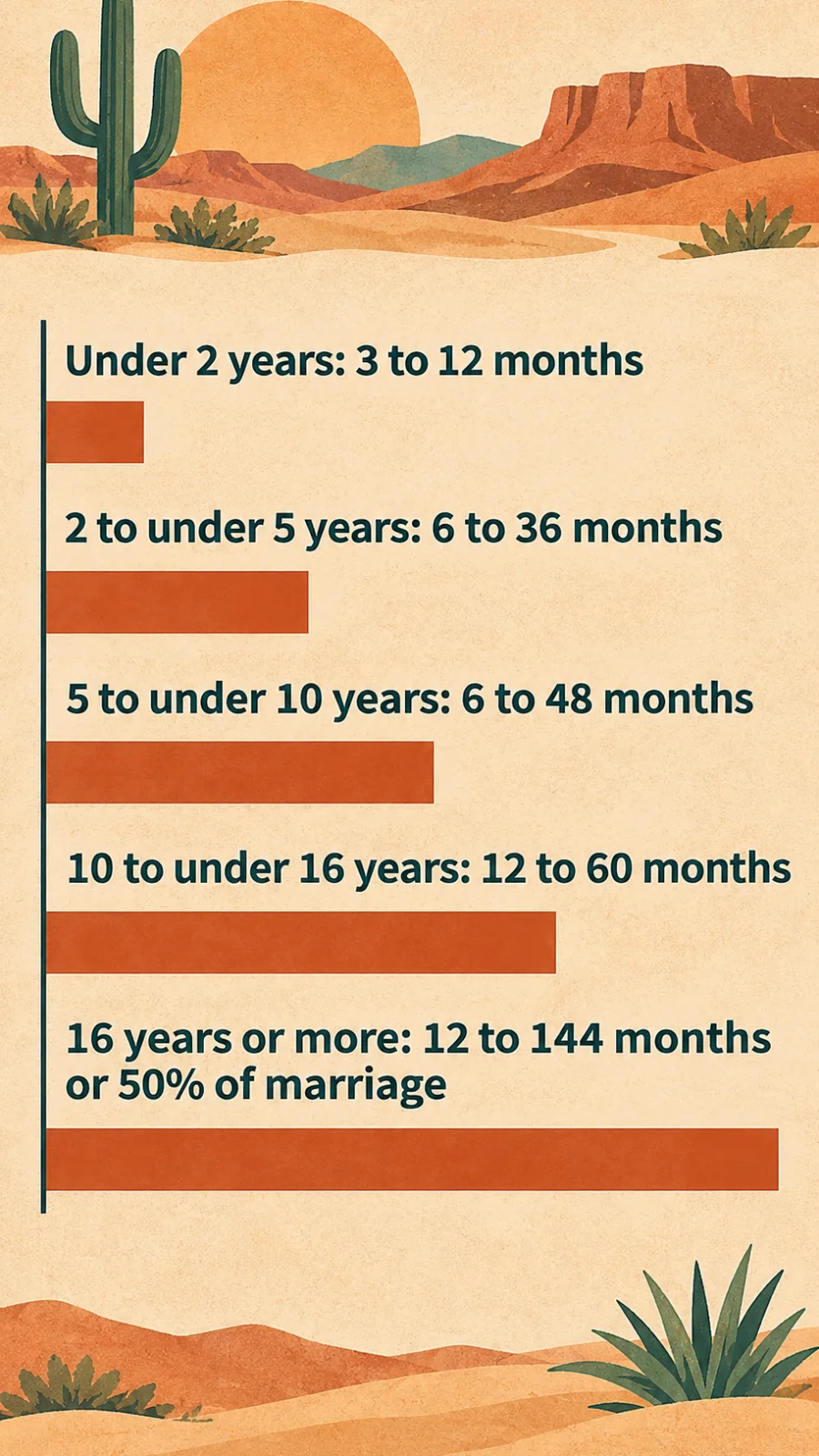
| Length of marriage | Standard duration range | Note |
|---|---|---|
| Under 2 years | 3 to 12 months | Guideline range |
| 2 to under 5 years | 6 to 36 months | Guideline range |
| 5 to under 10 years | 6 to 48 months | Guideline range |
| 10 to under 16 years | 12 to 60 months | Guideline range |
| 16 years or more | 12 months to 144 months, or 50% of the marriage if greater | Raised from 96 months in 2025 |
The “Rule of 65” applies when the spouse asking is at least 42, the marriage lasted at least 16 years, and age plus years of marriage equals 65 or more. A 45-year-old leaving a 20-year marriage meets all three. The court then has discretion beyond the standard range.
The 2025 guidelines apply to original petitions filed on or after September 24, 2022. For orders entered on or after September 1, 2025, the revised guidelines control.
The four-year cap that did not pass
Senate Bill 1049 in the 2026 session would have amended § 25-319 to bar maintenance longer than four years. It passed the Senate 16 to 11 on February 23, 2026, but the House third reading failed 28 to 29 on June 11, 2026. The statute contains no four-year cap, so the duration ranges above govern.
Legal Decision-Making and Parenting Time
Arizona does not use the word custody. The court decides legal decision-making, which covers education, health care and religious training, and parenting time, which is the schedule. Both are decided on the child’s best interests under A.R.S. § 25-403.
Arizona’s stated policy in A.R.S. § 25-103(B) is that, absent evidence to the contrary, a child benefits from substantial, frequent, meaningful and continuing parenting time with both parents. Joint legal decision-making does not necessarily mean equal parenting time.
What the judge weighs
Section 25-403 lists eleven factors. They include the child’s relationship with each parent and siblings, adjustment to home, school and community, the child’s wishes if mature enough, everyone’s mental and physical health, and whether domestic violence or child abuse has occurred.
One factor carries extra weight in negotiations: which parent is more likely to support the child’s frequent and meaningful contact with the other parent. A parent who protects a child from abuse in good faith is not penalized under that factor.
The parenting plan
If you cannot agree, each parent submits a proposed plan, and under § 25-403.02 the court adopts one that maximizes each parent’s time consistent with the child’s best interests. A plan must include the legal decision-making arrangement, a parenting-time schedule with holidays and school breaks, exchange procedures, a way to resolve disputes and changes, and how the parents will communicate.
The 2026 domestic violence change
The Alec and Lydia Act, Laws 2026, chapter 263 (HB 2995), was signed on June 22, 2026 as an emergency measure and took effect immediately. It rewrote § 25-403.03 and amended §§ 25-404 and 25-411.
A parent who committed domestic violence now faces a mandatory rebuttable presumption that giving that parent legal decision-making or parenting time is contrary to the child’s best interests. Domestic violence includes coercive control, and a claim needs only a preponderance of the evidence.
To get sole or joint legal decision-making or unsupervised parenting time, that parent must overcome the presumption by clear and convincing evidence. For supervised parenting time, the standard is a preponderance. A treatment certificate alone is not enough, and the presumption carries into later modification cases.

Child Support
Child support follows A.R.S. § 25-320 and the Arizona Child Support Guidelines, which apply to orders entered on or after January 1, 2022 and were revised September 21, 2022. The guidelines use an income shares model: both parents’ incomes are combined, a schedule gives a basic obligation, and the total is divided by income.
The guidelines convert the number of parenting days into a percentage using a Parenting Time Table, then subtract that credit from the basic obligation. More time with the child lowers the support figure, though near-equal time does not automatically cancel it. Costs for health insurance and child care are added to the calculation.
Disclosure, Parent Education and Wrapping Up
Both spouses must exchange financial and parenting information under Rule 49 within 40 days after the first responsive pleading, without waiting for the other side to ask. That includes a completed Affidavit of Financial Information, income proof, property and debt records and witness lists. Witnesses and experts generally must be named at least 60 days before trial.
When there are minor children, A.R.S. § 25-352 says the court “shall order the parties to complete an educational program” on the effects of divorce, unless it finds the class is not in the child’s best interests, a party already took a comparable one, or one is already enrolled. The judge sets the completion deadline.
Before you file, gather these
- Proof you have lived in Arizona for 90 days: lease, utility bill, driver license.
- The marriage date and place, and whether the marriage is a covenant marriage.
- Three years of tax returns and recent pay stubs for both spouses.
- Bank, retirement and investment statements, plus deeds and vehicle titles.
- Credit card and loan statements showing balances and whose name is on each.
- Each child’s birth date and a draft school-year parenting schedule.
Frequently Asked Questions
How long does a divorce take in Arizona?
No sooner than 60 days after your spouse is served, because A.R.S. § 25-329 bars any hearing or trial before then. An agreed case can finish soon after that, while a contested case with children or large assets takes longer.
Do I have to prove my spouse did something wrong?
No. For an ordinary marriage the court only needs to find the marriage is irretrievably broken. Covenant marriages require one of the eight grounds in § 25-903.
Is everything split 50/50?
Not necessarily. Community property is divided equitably, which means fairly but not always equally, and the court can account for waste, fraud or concealment of community assets.
Can I get spousal maintenance after a short marriage?
Possibly. You must meet one of the five eligibility conditions in § 25-319(A), and the 2025 guidelines allow 3 to 12 months for a marriage under two years, with longer ranges as the marriage gets longer.
Can I file in Arizona if my spouse lives in another state?
Yes, if you meet the 90-day Arizona domicile requirement in § 25-312. Your spouse then has 30 days to respond if served outside Arizona.
References
- Arizona Legislature, A.R.S. § 25-312, Dissolution of marriage; findings necessary
- Arizona Legislature, A.R.S. § 25-329, 60-day waiting period
- Arizona Legislature, A.R.S. § 25-903, Grounds for dissolving a covenant marriage
- Arizona Legislature, A.R.S. § 25-315, Preliminary injunction
- Arizona Legislature, A.R.S. § 25-211, Community property; effect of service of petition
- Arizona Legislature, A.R.S. § 25-319, Spousal maintenance; guidelines
- Arizona Legislature, A.R.S. § 25-403, Best interests factors
- Arizona Legislature, A.R.S. § 25-103, Purposes of Title 25 and parenting time policy
- Arizona Legislature, A.R.S. § 25-403.02, Parenting plans
- Arizona Legislature, A.R.S. § 25-314.01, Summary consent decree
- Arizona Legislature, A.R.S. § 25-352, Parent education program
- Arizona Legislature, Laws 2026, chapter 263 (HB 2995), domestic violence and parenting time
- Arizona Supreme Court, Spousal Maintenance Guidelines and Administrative Order 2025-101
- Arizona Supreme Court, Arizona Child Support Guidelines
- Maricopa County Clerk of Superior Court, Filing Fees