
Arizona Divorce Laws 2027: What to Know Before Filing

To file for divorce in Arizona, you or your spouse must have lived in the state, with the intent to stay, for at least 90 days, and a judge cannot sign the final decree until 60 days after your spouse is served. Arizona is a no-fault state: the only ground is that the marriage is “irretrievably broken,” unless you entered a covenant marriage.
Everything else, from who keeps the house to how long spousal maintenance lasts, follows from Title 25 of the Arizona Revised Statutes and a set of Supreme Court guidelines. Several of those rules changed in 2025 and 2026, and one more change takes effect January 1, 2027.
Who Can File for Divorce in Arizona?
You can file if either spouse has been domiciled in Arizona, or stationed here on military duty, for 90 days before the petition is filed. That requirement comes from A.R.S. § 25-312, which lists every finding a judge must make before granting a divorce.
Domicile means more than a mailing address. It means living here and intending to make Arizona your home. An Arizona driver’s license, a lease or deed, voter registration and utility bills all help show it. Only one spouse has to meet the 90-day rule, and your spouse can live in another state.
If you just moved here
Legal separation under A.R.S. § 25-313 has no 90-day requirement. A spouse who arrived last month can file for legal separation and later ask the court to convert it to a divorce once the 90 days have passed.
Children add a separate jurisdiction test
Arizona can only make custody orders if Arizona is the child’s “home state,” which generally means the child lived here for the six months before filing (A.R.S. §§ 25-1002 and 25-1031). A parent can meet the 90-day divorce rule and still be unable to get Arizona custody orders if the children moved here recently.
Grounds: No-Fault, With One Exception
For an ordinary marriage, you only need to say the marriage is irretrievably broken. You do not have to prove adultery, abandonment or anything else, and your spouse cannot block the divorce by refusing to agree.
If your spouse denies under oath that the marriage is broken, the judge can hold a hearing and continue the case for up to 60 more days, and can order a conciliation conference (A.R.S. § 25-314). After that, the divorce goes forward if the judge finds the marriage cannot be saved.
Either spouse can also ask the county conciliation court for help. Filing that petition pauses the divorce for 60 days (A.R.S. § 25-381.18).
Covenant marriages
Couples who signed a covenant marriage declaration under A.R.S. § 25-901 agreed to stricter rules. Under A.R.S. § 25-903, a court can dissolve a covenant marriage only on one of eight grounds:
- Adultery by the other spouse
- A felony conviction with a sentence of death or imprisonment
- The other spouse left the home at least one year before filing and refuses to return
- Physical or sexual abuse of you, a child or a relative living in the home, domestic violence, or emotional abuse
- Living apart continuously for at least two years before filing
- Living apart for at least one year after a legal separation decree
- Habitual drug or alcohol abuse
- Both spouses agree to the divorce
The last ground matters most in practice. If both of you want out, a covenant marriage ends almost the same way an ordinary one does.

Filing Fees and the Cheapest Route
The Maricopa County Clerk of Superior Court charges $376 to file a Petition for Dissolution of Marriage, with or without children, according to its published filing fee schedule. The spouse who responds pays a separate response fee of $287. Fees differ by county, so check your own county clerk if you live outside Maricopa.
A summary consent decree costs less. Under A.R.S. § 25-314.01, the filing fee is half of the combined petition and response fee, plus county add-on fees. Here is what that means in Maricopa County:
| Route | What gets paid | Total filing cost |
|---|---|---|
| Standard petition plus response | $376 + $287 | $663 |
| Summary consent decree | 50% of $663 | $331.50 |
| Savings | $663 − $331.50 | $331.50 |
If you cannot afford the fee, you can ask the court to defer or waive it. The Arizona Supreme Court’s fee waiver and deferral page has the application forms, and you file them along with your petition.
Four Ways an Arizona Divorce Ends
Most Arizona divorces end through one of four routes, and the route you pick decides your cost and timeline more than anything else.
Summary consent decree
This route is for spouses who have settled every issue before either one files. You file a single combined petition and response, and no formal service on your spouse is needed. You submit your written agreements and proposed decree with the filing or within 60 days, and the court cannot enter the decree until 60 days after filing. Either spouse can withdraw before the decree is signed.
Consent decree
One spouse files and serves the other, the two of you reach agreement, and both sign the decree before a notary or the clerk under Family Law Rule 45. No hearing is usually needed.
Default decree
If your spouse is served and does not respond, you can apply for default. Under Rule 44, the default becomes effective 10 days after you apply unless your spouse files a response in that window.
Trial
Any issue you cannot settle goes to a judge after both sides exchange the financial disclosures the rules require. Contested cases take the longest by far.
What changes January 1, 2027
At its August 25, 2026, rules agenda, the Arizona Supreme Court adopted order R-26-0008. It amends Family Law Rules 14, 45 and 45.1 and adds a new Rule 45.2 that extends the summary consent process to unmarried parents, effective January 1, 2027, according to the court’s digest of recent rule amendments. If you plan to file a summary consent petition in 2027, use the forms the court posts after that date.
Timeline From Filing to Final Decree
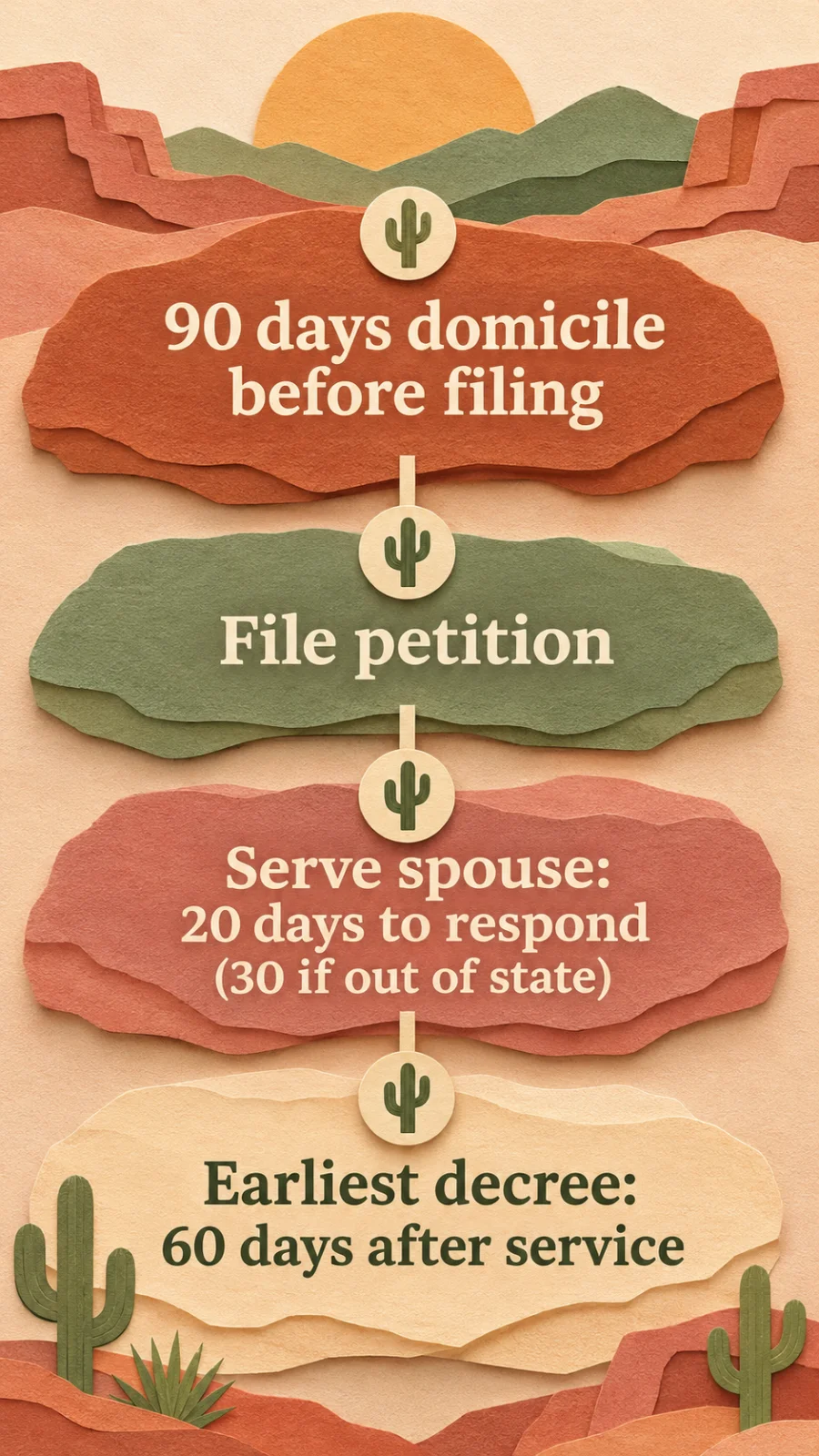
The fastest possible Arizona divorce takes 60 days from service, and many uncontested cases finish in roughly three to four months. This table shows the deadlines that set the pace:
| Step | Deadline or wait | Source |
|---|---|---|
| Domicile before filing | 90 days | A.R.S. § 25-312 |
| Response if served in Arizona | 20 days | Family Law Rule 24.1 |
| Response if served out of state | 30 days | Family Law Rule 24.1 |
| Default becomes effective | 10 days after application | Family Law Rule 44 |
| Earliest final decree | 60 days after service | A.R.S. § 25-329 |
| Continuance if marriage disputed | Up to 60 more days | A.R.S. § 25-314 |
Say you serve your spouse on February 2. The earliest a judge could sign the decree is April 3, sixty days later. Your divorce is final the day the decree is entered (A.R.S. § 25-325), and Arizona has no extra waiting period before you can remarry.
The preliminary injunction starts immediately
Filing triggers an automatic preliminary injunction under A.R.S. § 25-315. It binds you when you file and your spouse when served or on actual notice. While the case is open, neither of you can sell, hide or give away community property except for ordinary business, necessities and reasonable attorney fees. Neither of you can take a child out of Arizona without written consent or a court order, or drop the other spouse or children from health, auto or other insurance.
How Arizona Divides Property and Debt
Arizona is a community property state. Under A.R.S. § 25-211, most property either spouse acquires during the marriage belongs to both spouses equally. Gifts and inheritances are the exceptions, and so is property you owned before the marriage (A.R.S. § 25-213).
The court gives each spouse their separate property and divides community property “equitably, though not necessarily in kind, without regard to marital misconduct” under A.R.S. § 25-318. Arizona courts treat an equitable split as substantially equal in most cases.
When the community stops growing
Property you acquire after your spouse is served with the petition is not community property, but only if the case actually ends in a decree (A.R.S. § 25-211(A)(2)). If you reconcile and the case is dismissed, that exception disappears. Service also does not change the status of property you already own or property bought with community funds.
When misconduct does count
Infidelity does not affect the split. Spending does. Under § 25-318(C), the judge may consider excessive or abnormal spending, destruction, concealment or fraudulent transfer of community property. The judge may also consider damages and judgments from criminal conduct against the other spouse or a child.
Any property the decree leaves out becomes jointly owned as tenants in common, each with a one-half interest, from the date of the decree. A complete property list in your settlement avoids that problem.
Postnuptial agreements
H.B. 2861 (Laws 2026, chapter 26) added A.R.S. § 25-202.01, which defines postnuptial agreements and puts them on the same footing as prenuptial agreements, effective September 12, 2026. If you and your spouse signed an agreement during the marriage dividing property, raise it early in the case.
Spousal Maintenance Under the 2025 Guidelines
A spouse qualifies for spousal maintenance (Arizona’s term for alimony) only by showing one of five reasons in A.R.S. § 25-319(A):
- Not enough property, including the property awarded in the divorce, to meet reasonable needs
- Earning ability too low to be self-sufficient
- Caring for a child whose age or condition makes outside work inappropriate
- Significant contributions to the other spouse’s education or career, or giving up one’s own career for the other spouse
- A long marriage and an age that makes self-supporting work unlikely
Once a spouse qualifies, the amount and length come from the Arizona Spousal Maintenance Guidelines. The 2025 Guidelines, adopted by Administrative Order 2025-101, took effect September 1, 2025, and replaced the 2023 version. The statute requires maintenance only for the time and in the amount needed for the receiving spouse to become self-sufficient. The guideline amount applies unless the judge explains in writing why it would be inappropriate or unjust.
The Maricopa County Superior Court hosts the official Spousal Maintenance Calculator, which produces a dollar range and a duration range. The judge then picks a point within those ranges using the 13 factors in § 25-319(B), such as marriage length, each spouse’s earning ability and the marital standard of living. Misconduct is not one of them.
Maintenance ends on either spouse’s death or the recipient’s remarriage unless the decree says otherwise (A.R.S. § 25-327). If both spouses agree, the decree can make the terms non-modifiable under § 25-319(D).
Children: Legal Decision-Making, Parenting Time and Support
Arizona uses “legal decision-making” for what other states call legal custody, and “parenting time” for physical time with each parent. Judges decide both based on the child’s best interests under A.R.S. § 25-403. If you have minor children, you must submit a proposed parenting plan, and Arizona law lets counties require a parent information class (A.R.S. § 25-351).
The Alec and Lydia Act changed domestic violence cases
Governor Hobbs signed H.B. 2995, the Alec and Lydia Act, on June 22, 2026. It carried an emergency clause and took effect immediately. It rewrote A.R.S. § 25-403.03 and amended §§ 25-404 and 25-411.
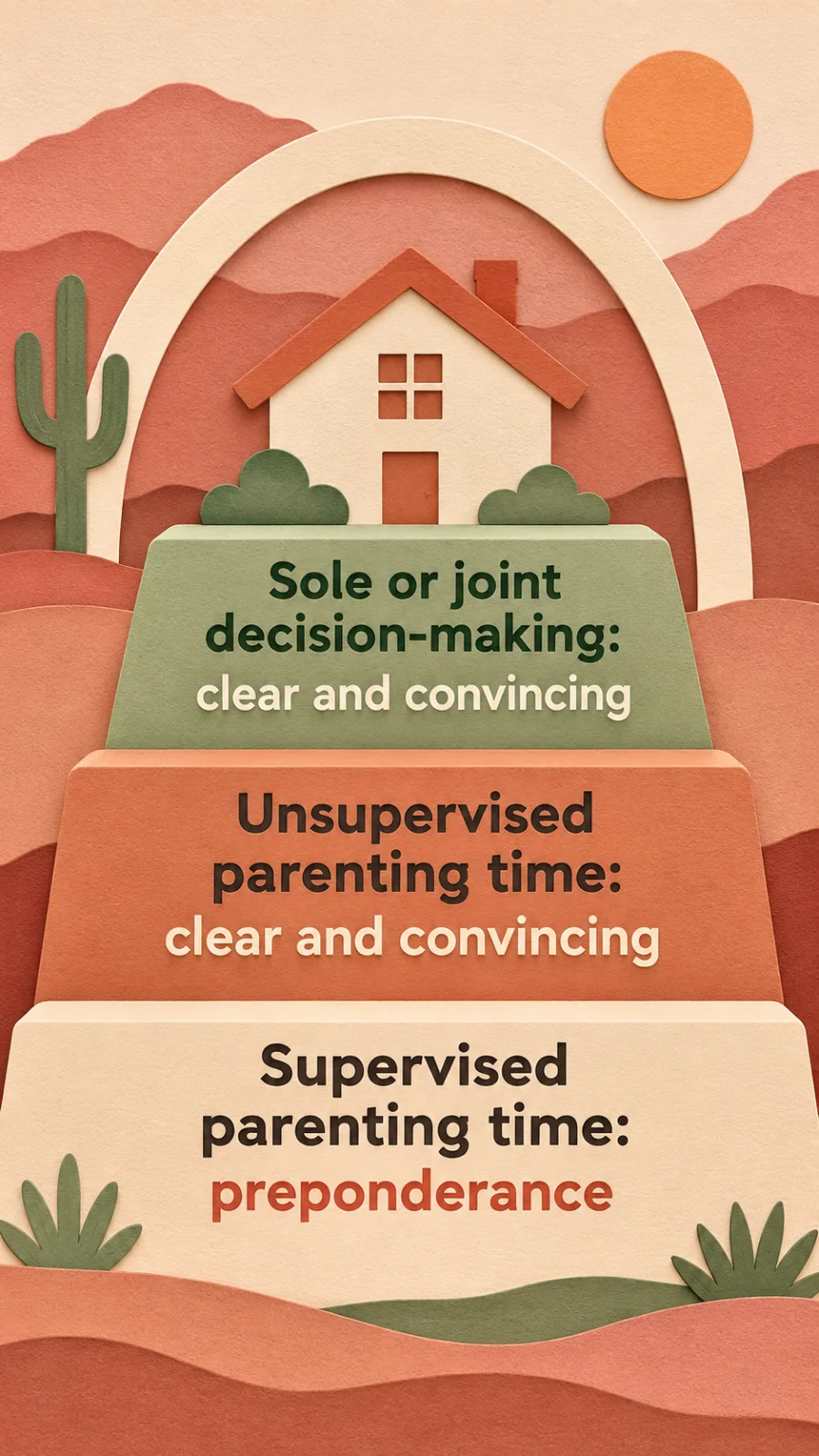
If the court finds that a parent committed domestic violence, a mandatory rebuttable presumption now applies: giving that parent legal decision-making or parenting time is contrary to the child’s best interests. Domestic violence is proven by a preponderance of the evidence, and corroboration is not required.
| What the abusive parent seeks | Proof needed to overcome the presumption |
|---|---|
| Sole or joint legal decision-making | Clear and convincing evidence |
| Unsupervised parenting time | Clear and convincing evidence |
| Supervised parenting time | Preponderance of the evidence |
The statute now defines coercive control, including financial control, isolation, stalking, tracking technology and abusive litigation. It also tells judges to disregard the fact that a child did not witness the violence or wants contact with the abusive parent. A certificate of completing a treatment program is not enough on its own to overcome the presumption.
Child support
Child support is calculated under the 2022 Arizona Child Support Guidelines (A.R.S. § 25-320), which use an income shares model: the court estimates what the parents would spend on the children together and splits it by each parent’s share of combined income. The Supreme Court’s review subcommittee, created by Administrative Order 2026-54, released draft revised guidelines for public comment from October 21 to November 21, 2026. The 2022 Guidelines apply until the Supreme Court adopts new ones.
What to Do Before You File
Start gathering records before you file, because the preliminary injunction limits what either of you can do with community property once the case begins. This checklist covers what Arizona courts expect:
- Confirm that one spouse has 90 days of Arizona domicile, and if you have children, that they have lived here six months.
- Find out whether you signed a covenant marriage declaration or a prenuptial or postnuptial agreement.
- Collect three years of tax returns, recent pay stubs, and statements for every bank, retirement and credit account.
- List all real estate, vehicles and debts, noting which ones existed before the marriage or came by gift or inheritance.
- Run both the Spousal Maintenance Calculator and the Child Support Calculator on the Arizona courts website if either applies.
- If you and your spouse agree on everything, consider the summary consent decree and save half the combined filing fee.
- Get the official forms from your county Superior Court’s self-service center or the Arizona Supreme Court’s family law forms page.
- If you fear for your safety, ask the court for an order of protection, which is separate from the divorce.
Frequently Asked Questions
Can my spouse stop me from getting a divorce in Arizona?
No, not in an ordinary marriage. Your spouse can deny that the marriage is broken, which can add up to 60 days and a conciliation conference, but the judge grants the divorce if the marriage cannot be saved.
How long does a divorce take in Arizona?
The earliest a judge can sign the decree is 60 days after your spouse is served, under A.R.S. § 25-329. Uncontested cases often finish in three to four months, while contested cases can take a year or more.
Do we have to be separated before filing?
No. Arizona does not require a separation period for an ordinary marriage. Covenant marriages are different: living apart for two years is one of the eight grounds, though mutual agreement is also a ground.
Does cheating affect property or alimony in Arizona?
No. Both property division and spousal maintenance are decided without regard to marital misconduct. Wasting or hiding community money is different, and the judge can account for it.
Can I go back to my maiden name?
Yes. Ask for it in your petition or response, and the judge can restore your former name in the decree under A.R.S. § 25-325.
How much does it cost to file for divorce in Maricopa County?
The petition costs $376 and the response costs $287. A summary consent decree, where both spouses file together after settling everything, costs $331.50 total.
References
- Arizona State Legislature, A.R.S. § 25-312, Dissolution of marriage; findings necessary
- Arizona State Legislature, A.R.S. § 25-314.01, Summary consent petition and decree
- Arizona State Legislature, A.R.S. § 25-318, Disposition of property
- Arizona State Legislature, A.R.S. § 25-403.03, Domestic violence and child abuse
- Arizona State Legislature, A.R.S. § 25-903, Dissolution of a covenant marriage
- Arizona Supreme Court, Rule Amendments from the August 25, 2026 Rules Agenda, R-26-0008
- Arizona Supreme Court, Arizona Spousal Maintenance Guidelines, Administrative Order 2025-101
- Arizona Supreme Court, 2022 Arizona Child Support Guidelines
- Maricopa County Clerk of Superior Court, Family Court Filing Fees
- Arizona Supreme Court, Court Filing Fee Waivers and Deferrals