
Arkansas Lemon Law: Common Questions Car Buyers Ask

Arkansas gives a new-car buyer a refund or a replacement vehicle when the manufacturer cannot fix a serious defect. The Arkansas New Motor Vehicle Quality Assurance Act, Ark. Code Ann. §§ 4-90-401 to 4-90-417, covers the first 24 months or 24,000 miles of ownership, whichever is later, and gives the manufacturer 40 days to repurchase or replace once a reasonable number of repairs has failed.
Most claims turn on three things: how many times the car has been in the shop, a certified letter you send to the manufacturer (not the dealer), and a dispute program you generally must use before you can sue. The sections below walk through each one with the numbers and deadlines from the statute and the Attorney General’s consumer guide.
Which Vehicles and Buyers Does the Arkansas Lemon Law Cover?
The Act protects the buyer or lessee of a new or previously untitled vehicle that is licensed, purchased or leased in Arkansas and designed to carry people or property on public roads. You must have titled and registered the vehicle. The Attorney General’s Consumer’s Guide to the Arkansas Lemon Law is the plain-language version of the statute, and it is the document dealers are supposed to hand you at purchase.
The coverage window: 24 months or 24,000 miles, whichever is later
Under Ark. Code Ann. § 4-90-403, the “motor vehicle quality assurance period” starts on the day the vehicle is first delivered to the consumer. It ends 24 months after that date or after the first 24,000 miles of use by the consumer, whichever comes later.
That wording works in your favor. Drive 30,000 miles in the first 10 months and you are still covered until month 24. Drive only 9,000 miles in two years and you are covered until you reach 24,000. Some summaries online say “whichever comes first,” which is the opposite of what the statute says.
The window is not a warranty extension. You must report the defect to the manufacturer, its agent or an authorized dealer during the period, and the defect must be a “nonconformity”: a condition that substantially impairs the vehicle’s use, market value or safety, or that breaches the manufacturer’s express warranty or the implied warranty of merchantability. Under § 4-90-405, the manufacturer must still make repairs for a defect reported inside the window even if the work happens after it closes.

Vehicles the law leaves out
Mopeds, motorcycles and the living quarters of motor homes are excluded. So are vehicles with a gross vehicle weight rating over 13,000 pounds, a limit raised from 10,000 pounds by Act 322 of 2009. Motor homes are exempt from the weight cap, so the chassis of a heavy motor home is covered. According to the Attorney General’s guide, a vehicle rated between 10,000 and 13,000 pounds loses coverage if it was substantially altered after the dealer sold it.
Leased, used and handed-down vehicles
Leases count if the lease runs one year or more and makes you responsible for repairs. A lessee who wins gets a refund of the lessee’s cost, and the lease ends without an early-termination penalty (§ 4-90-407).
A used car is not covered as a used car. But if the vehicle is sold to a second owner during the quality assurance period, the AG’s guide says it stays covered for the full remainder of that period, so a buyer who picks up a 14-month-old car with 11,000 miles still has the rest of the window. Outside the window, a used-car buyer is left with warranty claims under other laws, including the federal Magnuson-Moss Warranty Act, 15 U.S.C. § 2301 et seq.
When Does Arkansas Presume a Vehicle Is a Lemon?
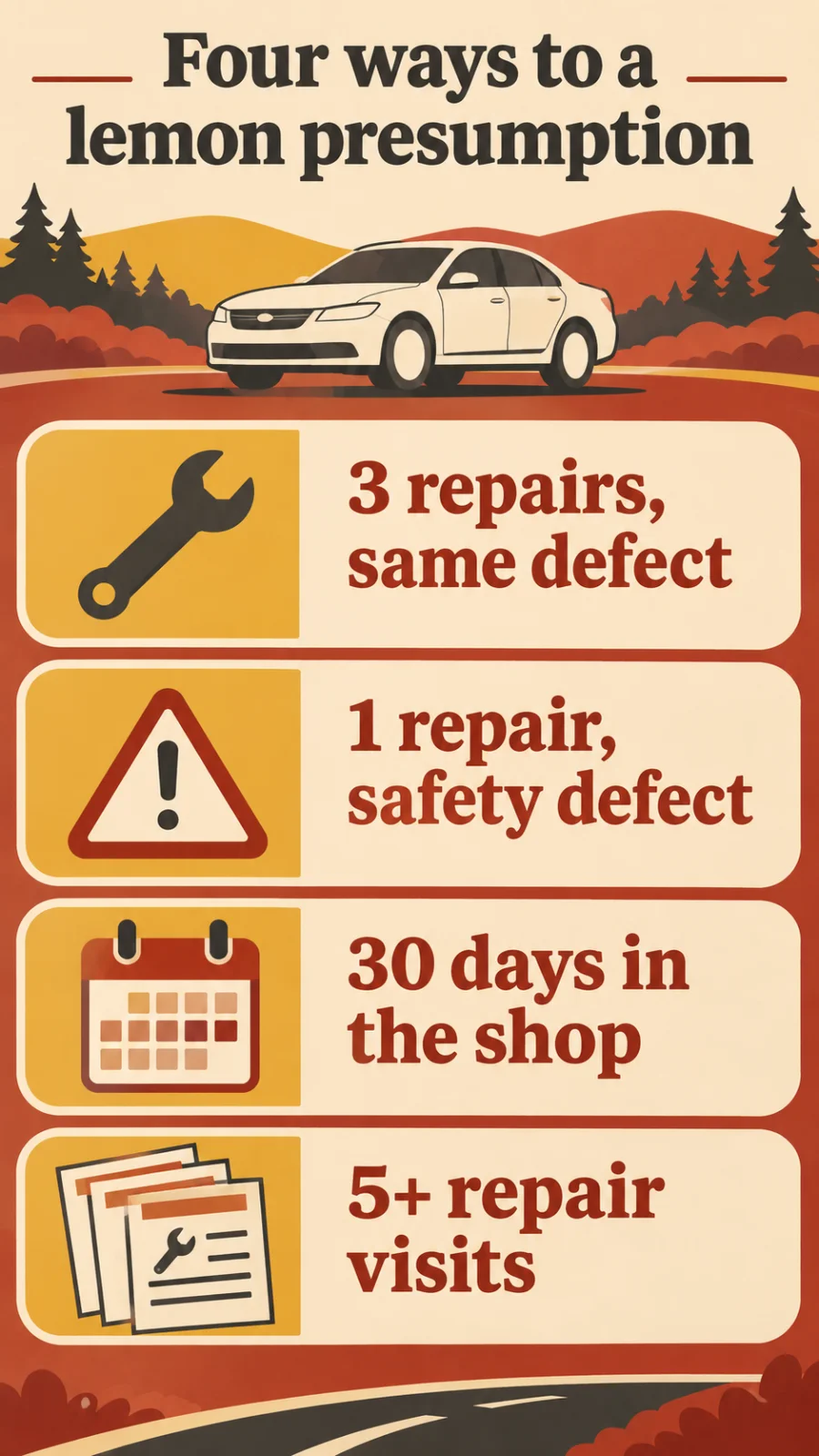
A vehicle is presumed to have had a reasonable number of repair attempts in any of four situations, listed in the AG’s guide and in § 4-90-410. Each one assumes the defect substantially impairs use, value or safety.
| Path | What has to happen | Final-repair letter first? |
|---|---|---|
| Same defect | Three failed repair attempts for the same nonconformity | Yes |
| Safety defect | One failed attempt on a defect likely to cause death or serious bodily injury | Yes |
| Days in the shop | 30 or more cumulative calendar days out of service for repairs | No |
| Many problems | Five or more separate repair attempts for defects that together substantially impair use and value | No |
The safety path is the unusual one. Arkansas lets you skip straight to a final attempt after a single failed repair of something like a steering or braking defect, rather than waiting for three tries.
What the manufacturer can argue back
These are presumptions, not guarantees. Under § 4-90-413 the manufacturer can defend by showing the defect does not substantially impair use, value or safety, that an accident, abuse, neglect or unauthorized modification caused it, or that you did not file the claim in good faith. A modification by someone other than the manufacturer, its agent or an authorized dealer is the one that sinks many claims, so keep aftermarket work off the part that is failing.
How Does the Final Repair Attempt Letter Work?
For the first two presumptions, you must send the manufacturer written notice by certified or registered mail that gives it one last chance to fix the car (§ 4-90-406(a)). Address it to the manufacturer, not the dealer, and keep the mailing receipt and a copy.
The manufacturer then has 10 days after receiving your notice to offer repair at a reasonably accessible facility, and 10 days after you deliver the vehicle to get it into conformity with the warranty. If it misses either deadline, the final-attempt requirement drops away and the law treats the repair attempts as reasonable. The statute calls that a nonrebuttable presumption, which means the manufacturer cannot argue otherwise.
One rule favors the buyer in a way most owners never learn. Under § 4-90-404, you only have to give the manufacturer notice if it first gave you the written statement of your rights at the time of sale or lease. Each failure to provide that statement exposes the manufacturer to a civil penalty of $25 to $1,000 payable to the State. The warranty or owner’s manual must also say that written notice is required before a refund or replacement, and the manufacturer must give you the address and phone number of its zone, district or regional office in Arkansas.
Repair orders decide how many attempts you have
Each time you bring the car in, the shop must hand you a written repair order that lists every complaint and all work done, including examination, parts and labor (§ 4-90-411). Under that section, each presentation of the vehicle for a reasonable opportunity to repair is a repair attempt for the complaints on that order. The AG’s guide adds that a good order shows the drop-off and pickup dates and the odometer readings, which is how you prove the 30-day count and the mileage for the offset.
A dealer cannot refuse to diagnose or repair the car to dodge liability. If the service writer says the problem “could not be duplicated,” make sure your complaint is still written on the order, because that visit can still count.
Motor home owners get two special rules in § 4-90-411(b)(1)(C). A visit to a facility the manufacturer has not authorized for warranty work does not count when two or more manufacturers built the motor home. And if you keep traveling and take the same defect to a second facility instead of waiting for the first to finish, the two visits count as one attempt.

Do You Have to Use the Informal Dispute Program Before Suing?
Usually yes. Under § 4-90-414, manufacturers selling in Arkansas must operate or take part in an informal dispute settlement program located in the state and certified by the Attorney General’s Consumer Protection Division. If you sue without using it, the refund and replacement remedies of § 4-90-406(b) do not apply unless the manufacturer agrees to let you go straight to court.
The AG’s guide lists two programs: BBB AUTO LINE, run by the Council of Better Business Bureaus at (800) 955-5100, and the National Center for Dispute Settlement (NCDS) at (800) 936-4303. Which one you use depends on the manufacturer. The BBB’s Arkansas program page asks for your VIN, make, model and year, a description of the problem and your current mileage.
The statute sets the ground rules for the proceeding:
- No fee may be charged to the consumer.
- Hearings are held in Arkansas unless you choose a documents-only or telephone review.
- Each side may bring an attorney, but you do not need one.
- You can ask for a three-member panel instead of a single arbitrator.
- If the manufacturer says a defect is within specifications, you can have a technical expert you choose and pay for examine the car before the hearing.
- The claim is generally scheduled, heard and decided within 40 days of the demand.
If you accept the decision, the manufacturer must be bound by it as well and has 30 days to carry it out. If you reject it, you may sue.
When a program’s own rules break the Act
The Arkansas Court of Appeals considered this in Ford Motor Co. v. Keatts, 2013 Ark. App. 575. Charles Keatts bought a 2008 Ford Explorer from a Little Rock dealer in August 2008 and sued in August 2010. Ford argued he had skipped the dispute program, but the court affirmed that Ford’s BBB AUTO LINE process did not comply with the Act. It offered replacement “from dealer inventory” without the consumer’s approval and did not give an unconditional right to choose a refund. Because the Act controls where the two conflict, Keatts could sue without exhausting the program. A jury found for him on both the Arkansas claim and the Magnuson-Moss claim.
| Step | Deadline | Where it comes from |
|---|---|---|
| Manufacturer offers a final repair | 10 days after it receives your notice | § 4-90-406(a)(2) |
| Manufacturer completes the repair | 10 days after you deliver the car | § 4-90-406(a)(2) |
| Dispute program decides your claim | 40 days from the demand | AG consumer guide |
| Manufacturer carries out an accepted decision | 30 days | § 4-90-414(b) |
| Manufacturer repurchases or replaces after failed repairs | 40 days | § 4-90-406(b)(1) |
| You file suit | 2 years from first reporting the defect | § 4-90-416 |

What Do You Get: A Refund or a Replacement?
You choose. Under § 4-90-406(b)(2), the consumer has an unconditional right to pick a refund over a replacement, and the manufacturer has 40 days to deliver either one. A replacement must be identical or reasonably equivalent to the original vehicle. If the manufacturer financed the original, it cannot require new financing that adds obligations beyond the old deal.
A refund includes the purchase price and the collateral charges you paid: sales tax, title and registration fees, finance charges that have been earned, trade-in credits, manufacturer-provided extended warranty charges and options added by the manufacturer or dealer. It also covers reasonable incidental costs like towing and rental cars while the vehicle was down for the defect (§§ 4-90-403 and 4-90-408). Loss of use, loss of income and personal-injury claims are not recoverable under the Act.
The mileage offset, with a worked number
The manufacturer may subtract a reasonable allowance for your use. The formula in § 4-90-406(b)(3) multiplies the price by the miles on the car when you first brought it in for the defect, then divides by 120,000.
Say you paid $38,000 and the odometer read 4,500 miles at the first repair visit. $38,000 × 4,500 ÷ 120,000 = $1,425. That is the use deduction. Because it is tied to the first repair visit, miles you put on the car after that do not raise it. The manufacturer may also deduct a reasonable amount for physical damage beyond normal wear.
You may keep driving the car until the manufacturer tenders the refund or a comparable replacement (§ 4-90-409), and you or your lender must give the manufacturer clear title and possession at the exchange. Refunds are paid to you and any lienholder of record as your interests appear, so a car loan is paid off first.
The Arkansas Department of Finance and Administration adds one detail on its New Car Lemon Law page: if a trade-in was applied to the defective vehicle, you can request a voucher, valid for six months, that reduces sales tax on a replacement vehicle.
How Long Do You Have to Sue, and Who Pays the Lawyer?
You must file within two years after you first report the nonconformity to the manufacturer, its agent or an authorized dealer (§ 4-90-416(a)). If you use the dispute program, the two years start when that proceeding begins instead (§ 4-90-416(b)). Counting from the first complaint, not the last repair, is where owners lose claims, because a car in the shop for 18 months can leave only six months to file.
A consumer who prevails recovers costs and expenses, including attorney’s fees based on the actual time reasonably spent (§ 4-90-415(c)). Courts check those bills. In Keatts, the plaintiff asked for $51,529 in fees and the trial court awarded $31,599 in fees and costs, and the Court of Appeals upheld the award. A violation of the Act is also a deceptive trade practice under Ark. Code Ann. § 4-88-101 et seq. (§ 4-90-417), and the Act does not limit other remedies you have under other laws.
What Must a Dealer Tell You About a Repurchased Lemon?
A returned lemon can be resold in Arkansas only with conditions. Under § 4-90-412, if a manufacturer took a vehicle back through a court judgment, an arbitration award or a voluntary agreement after a consumer pursued a lemon claim here or under another state’s law, it may not be resold unless the manufacturer provides the original express warranty for 12 months or 12,000 miles, whichever comes first. The next buyer must also sign a written disclosure stating the vehicle was returned because a defect was not cured within a reasonable time.
If you are buying used, ask directly whether the car was a manufacturer buyback and look for that signed disclosure.
Where Can You Get Help With a Claim?
The Attorney General’s Consumer Protection Division handles questions about the Act at (501) 682-2007 or (800) 482-8982, and by email at [email protected]. Complaints can be submitted through the Attorney General’s online complaint form. The AG’s office lists the NHTSA Auto Safety Hotline, (888) 327-4236, for safety defects.
Before you send anything, gather these:
- The purchase or lease contract and the date of original delivery.
- Every repair order, with drop-off and pickup dates and odometer readings.
- A running log of each call or email to the dealer and manufacturer.
- The certified mail receipt and a copy of your final repair attempt letter.
- The warranty booklet, including its dispute-program notice.
Frequently Asked Questions
Does the Arkansas lemon law cover used cars?
Not as a category. It covers new or previously untitled vehicles, and a second owner is covered only for the rest of the original quality assurance period. After that window, a used-car buyer generally relies on warranty law, including the federal Magnuson-Moss Warranty Act.
Do I need a lawyer to file an Arkansas lemon law claim?
No. The dispute program hearing allows you to present testimony and documents with or without an attorney. If you later sue and win, the statute lets the court award attorney’s fees.
Who is responsible, the dealer or the manufacturer?
The manufacturer owes the refund or replacement. The statute treats a franchised dealer as the manufacturer’s authorized service agent, so repair visits at the dealer count, but your final repair attempt letter goes to the manufacturer.
Can I keep driving the car while my claim is pending?
Yes. Section 4-90-409 lets you keep using the vehicle until the manufacturer tenders a full refund or a comparable replacement.
How is the refund calculated?
You receive the price and collateral charges, minus a use offset of the price multiplied by the miles at your first repair visit, divided by 120,000. Reasonable towing and rental costs are added back.
What if the manufacturer ignores my final repair letter?
If it misses the 10-day deadline to offer a repair or the 10-day deadline to complete it, the statute treats the repair attempts as reasonable and the final-attempt requirement no longer applies.
References
- Arkansas Attorney General, A Consumer’s Guide to the Arkansas Lemon Law (Act 297 of 1993)
- Arkansas Court of Appeals, Ford Motor Co. v. Keatts, 2013 Ark. App. 575, No. CV-12-988
- Arkansas Code § 4-90-411, diagnosis or repair and documentation (New Motor Vehicle Quality Assurance Act)
- Arkansas Code § 4-90-416, time limitation for commencement of action
- Arkansas Department of Finance and Administration, New Car Lemon Law
- BBB AUTO LINE, Arkansas Lemon Law Program Summary
- Arkansas Attorney General, Automobile Additional Resources