
Colorado Lemon Law: Repair Limits, Refunds and Buybacks
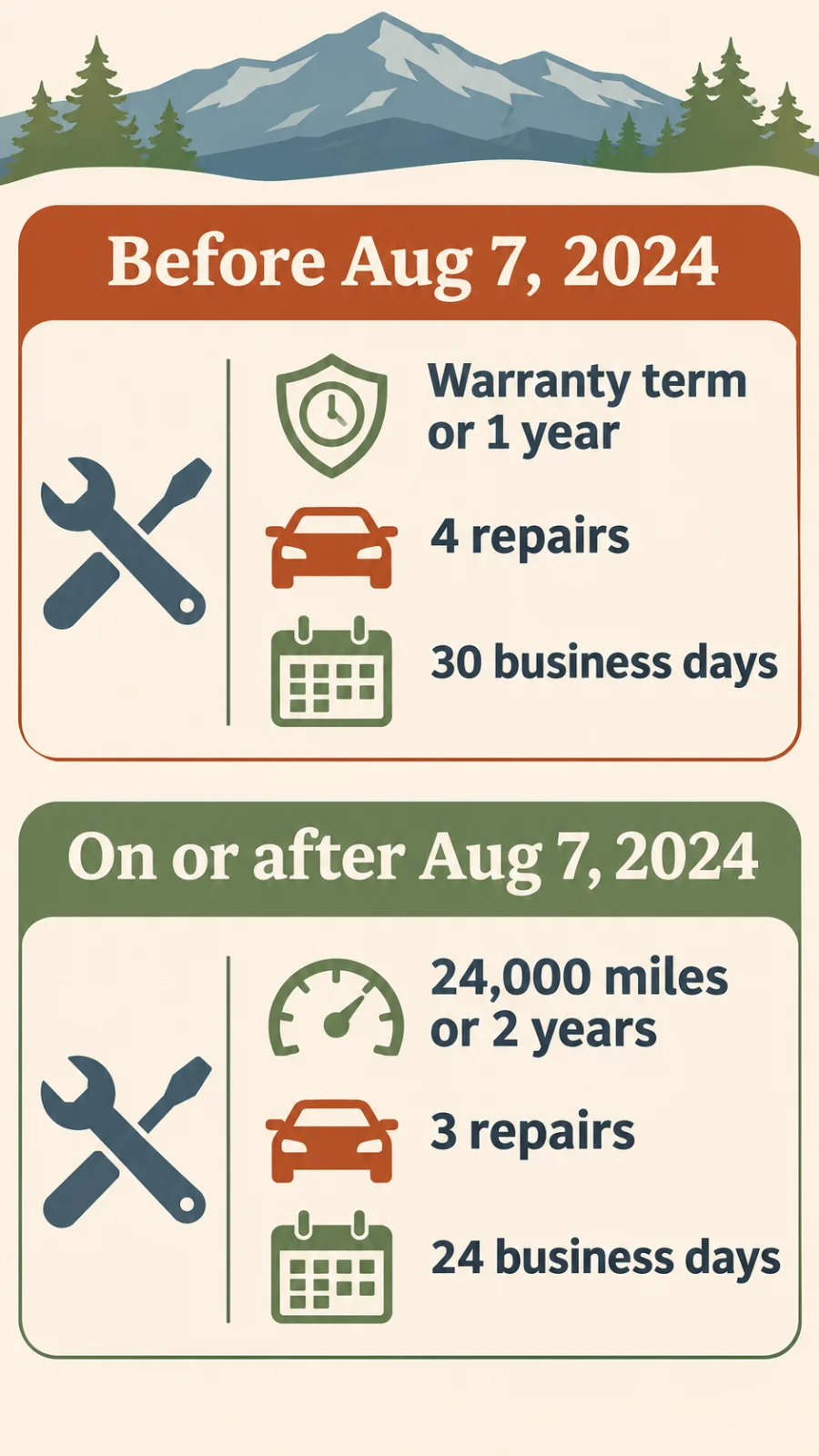
Colorado’s lemon law requires a manufacturer to refund or replace a new vehicle it cannot fix after a reasonable number of repair attempts. For vehicles sold or leased on or after August 7, 2024, that number is presumed reached after three failed repairs of the same defect, two for a safety defect, or 24 business days in the shop, all within two years or 24,000 miles of delivery, whichever comes first.
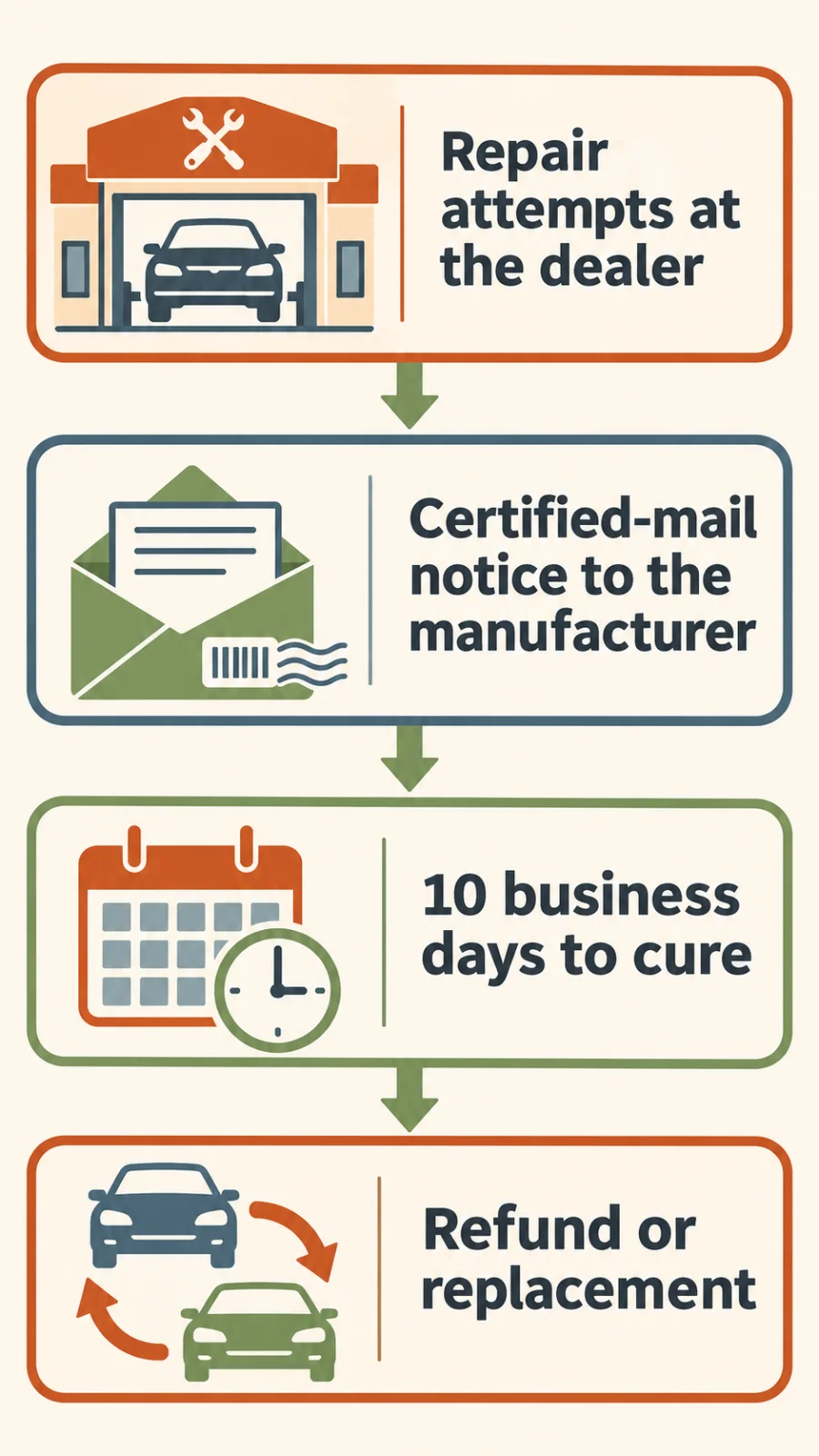
The presumption only works if you first send the manufacturer written notice by certified mail and give it 10 business days to fix the problem. The rules come from C.R.S. §§ 42-10-101 to 42-10-110, as rewritten by Senate Bill 24-192, which the governor signed June 6, 2024.
Which Vehicles and Buyers Does the Colorado Lemon Law Cover?
The law covers new passenger vehicles, pickups and vans sold to a consumer in Colorado. Under § 42-10-101(2), a covered “motor vehicle” is self-propelled, designed primarily for public highways, and carries no more than ten people. Motor homes and vehicles built to run on three or fewer wheels are excluded.

Who counts as a “consumer”
A consumer is the purchaser, other than someone buying for resale, of a vehicle used for personal, family or household purposes. The definition also reaches a person who receives the vehicle by transfer during the manufacturer’s express warranty, and anyone else entitled to enforce that warranty.
SB 24-192 removed the word “normally” from the definition of consumer. The Attorney General’s August 6, 2024 public advisory reads that change as covering some small-business vehicles used for both business and personal purposes.
Used cars
Used vehicles are outside the lemon law. Section 42-10-110(1) says the article does not apply to a used motor vehicle, with one exception: the buyback disclosure and inspection rules covered later in this article. Section 42-10-110(2) also exempts licensed used motor vehicle dealers.
There is a gap in the text. A transferee during the warranty is a “consumer,” yet used vehicles are excluded, and the statute does not say how those two provisions fit together for a second owner. The first retail buyer of a new vehicle is clearly covered.
Leased vehicles
Whether leases are covered is unsettled. The act applies to vehicles “sold or leased” on or after August 7, 2024, and the allowance formula refers to “lessee cost.” But the definition of motor vehicle still says “sold to a consumer,” and a court has not resolved the mismatch.
What Changed on August 7, 2024?
The rules depend on when the vehicle was sold or leased. SB 24-192 applies only to vehicles sold or leased on or after August 7, 2024, so an older vehicle stays under the previous, tougher numbers.
| Rule | Sold before Aug. 7, 2024 | Sold or leased on or after Aug. 7, 2024 |
|---|---|---|
| Coverage window | Warranty term or 1 year, whichever is earlier | 24,000 miles or 2 years, whichever is earlier |
| Repairs of the same defect | 4 | 3 (2 for a safety defect) |
| Days out of service | 30 business days | 24 business days |
| Manufacturer’s final repair chance | No set number of days | 10 business days |
| Deadline to sue | Earlier of 6 months after warranty ends or 1 year after delivery | Earlier of 6 months after warranty ends or 30 months after delivery |
| Use allowance on a refund | No formula | Statutory formula over 100,000 |
When Does a New Car Count as a Lemon in Colorado?
A vehicle is presumed to be a lemon when the manufacturer has had a reasonable number of tries and the defect remains. Under § 42-10-103(2)(a), that presumption arises on any one of three triggers, each measured inside the 24,000-mile or two-year window.
| Trigger | What must happen | Section |
|---|---|---|
| Same defect | Repaired 3 or more times and still exists | § 42-10-103(2)(a)(I) |
| Time in the shop | Out of service for repair a combined 24 or more business days | § 42-10-103(2)(a)(II) |
| Safety defect | 2 or more repair attempts and still exists | § 42-10-103(2)(a)(III) |
Business days exclude weekends, so 24 of them is a little under five calendar weeks, and the days can be spread across several visits. The defect must also substantially impair the vehicle’s use, market value or safety, because the lack of that impairment is a defense under § 42-10-104(1)(a).
What is a safety-based nonconformity?
A nonconformity is a defect or condition that does not match the warranty. Under § 42-10-101(2.5), it is safety-based if it is likely to cause death or serious bodily injury when the vehicle is driven, or if it creates a risk of fire or explosion. Failing brakes or a fuel leak fit; a rattling dashboard does not.
Delays that extend the clock
The warranty term and the two-year and 24-business-day periods are extended when repair services are unavailable because of war, invasion, strike, fire, flood or another natural disaster, under § 42-10-103(2)(b). A defect you report inside the window must still be repaired even if the work happens after the window closes, under § 42-10-102.
The Certified-Mail Notice and the 10-Business-Day Cure Period
The presumption applies against a manufacturer only if it received prior written notice by certified mail from you or on your behalf. Under § 42-10-103(2)(c), the notice must say that repairs were attempted under § 42-10-102 and the defect still exists.
Once the manufacturer receives the letter, it has 10 business days to fix the problem. That final chance counts as one repair attempt toward the three-repair and two-repair triggers.
Dealers must put a form in every owner’s manual that gives the manufacturer’s name and business address and states the certified-mail requirement, under § 42-10-103(2)(d). Use that address. A letter to the dealer does not satisfy the statute.
Refund or Replacement: What You Actually Get
The manufacturer chooses the remedy. Under § 42-10-103(1), it can replace the vehicle with a comparable one or take the vehicle back and refund the full purchase price, including sales tax, license fees, registration fees and similar governmental charges, minus a reasonable allowance for your use. The refund is paid to you and any lienholder as their interests appear.
How the use allowance is calculated
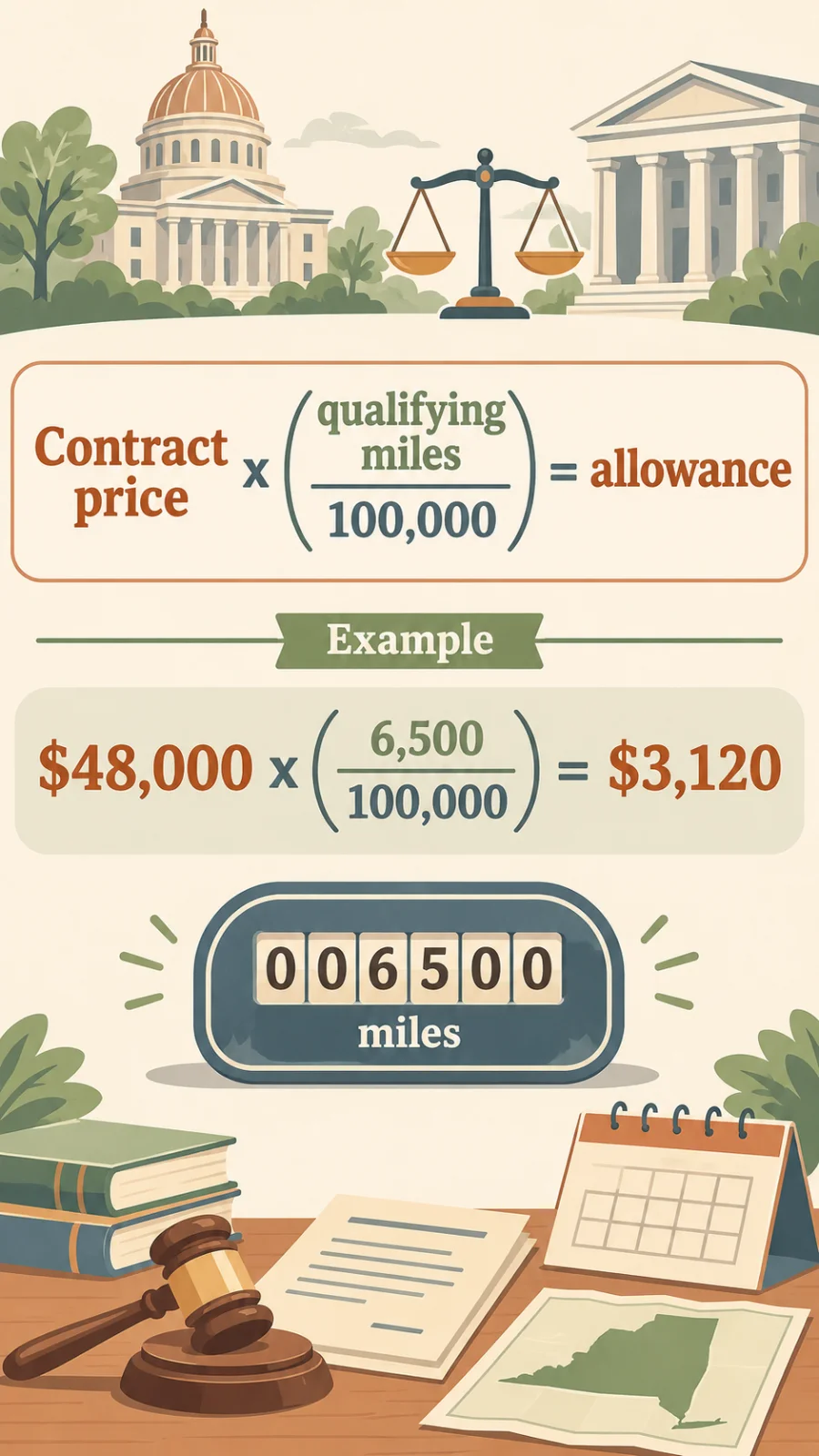
The allowance equals the total contract price (or lessee cost) multiplied by a fraction with 100,000 as the denominator. The numerator is the miles you drove before first presenting the vehicle for the defect, plus the miles driven in later periods when the vehicle was not out of service for repair.
Take a hypothetical $48,000 total contract price. You drive 5,200 miles before the first repair visit and 1,300 more miles between later visits, for 6,500 qualifying miles. That is 6,500 divided by 100,000, or 0.065, and 0.065 times $48,000 is a $3,120 allowance deducted from the refund.
Manufacturer Dispute Programs and the Filing Deadline
If the manufacturer runs an informal dispute program that substantially complies with 16 C.F.R. Part 703, you must use it before the refund or replacement remedy applies. Section 42-10-106 says so directly. The owner’s manual or warranty booklet usually names the program.
Under § 42-10-107, a lawsuit must start within 30 months after original delivery, or six months after the warranty term expires, whichever is earlier. The clock pauses while you are in the dispute program and while the vehicle is unavailable because it is being repaired.
Attorney fees run both ways
Section 42-10-103(3) says the court “shall award reasonable attorney fees to the prevailing side.” That means a winning consumer recovers fees, and a manufacturer that wins can ask for its fees too. SB 24-192 left this sentence untouched, so weigh the strength of your repair records before filing.
What Happens to Manufacturers and Dealers
SB 24-192 added § 44-20-121(1)(d), which lets the state deny, suspend or revoke a manufacturer’s or distributor’s license for failing to comply with the lemon law. The act sets no per-violation dollar penalty.
Dealers are mostly shielded from the manufacturer. Under § 42-10-105, the article does not make an authorized dealer liable to the manufacturer, except where the dealer’s poor vehicle preparation, option installation or repair would have prevented or cured the defect. The same section preserves your rights against the seller, lessor or lienholder and any other state or federal remedy.
Lemon Law Buyback Vehicles: Rules for Used-Car Buyers
A “lemon law buyback vehicle” is one a manufacturer, its agent or its authorized dealer repurchased or took back because it could not be brought into warranty conformity. Before reselling one in Colorado, the seller must notify the Department of Revenue, attach a decal reading “Lemon Law Buyback” to the driver’s door B-pillar, and apply for a buyback-branded title, under § 42-10-109(1). The seller cannot remove the decal, and any seller who knows or should know the history must disclose it clearly before the sale.
Under § 42-10-108, a dealer selling a buyback to a non-reseller must either let the buyer’s third-party agent inspect it first or give a seven-day free-look period with a refund of all money paid, less shipping costs. The dealer must disclose that right in writing before purchase.
The title wording starts later than the decal. Section 42-6-107(1)(a)(III) makes “Lemon Law Buyback” the title brand on and after January 1, 2027, a date the legislature’s final fiscal note confirms. The decal and disclosure duties took effect August 7, 2024.
Other Remedies and Where to Complain
The lemon law does not replace your other rights. Section 42-10-105 preserves remedies under any other state or federal law, and the federal Magnuson-Moss Warranty Act (15 U.S.C. § 2301 et seq.) offers a separate route for breach of a written warranty, including for vehicles outside the lemon law.
The Attorney General asks anyone who believes they bought a defective vehicle to file a complaint through the Attorney General’s complaint page. The Consumer Protection Section’s phone line is 1-800-222-4444, and its mailing address is 1300 Broadway, 9th Floor, Denver, CO 80203.
What to Do If You Think Your Vehicle Is a Lemon
- Describe the defect in writing at every service visit and keep each repair order, including the dates the vehicle was in and out of the shop.
- Count same-defect repairs and total business days out of service against the triggers in the table above.
- Find the manufacturer’s address on the form in your owner’s manual and send the certified-mail notice, keeping the receipt.
- Allow 10 business days after the manufacturer receives the letter for its final repair attempt.
- If the manufacturer has a Part 703 dispute program, file with it before suing.
- Calendar the deadline: 30 months from delivery, or six months after the warranty expires, whichever is earlier.
Frequently Asked Questions
Does the Colorado lemon law cover used cars?
No. Section 42-10-110 excludes used motor vehicles, except that the buyback decal, disclosure, inspection and free-look rules in §§ 42-10-108 and 42-10-109 do apply to them. A used car still under factory warranty may have federal Magnuson-Moss protection.
How many repair attempts make a car a lemon in Colorado?
For vehicles sold or leased on or after August 7, 2024, three attempts on the same defect, or two for a safety-based defect, create the presumption. For older vehicles the number is four.
Do I get a refund or a replacement?
The manufacturer picks. Section 42-10-103(1) lets it replace the vehicle with a comparable one or refund the purchase price, taxes and fees, minus the use allowance.
How long do I have to file a lemon law claim?
You must sue within 30 months after original delivery, or six months after the warranty term expires, whichever is earlier. The period pauses during a manufacturer dispute program and while the vehicle is out for repair.
What happens if I lose my case?
You may owe the manufacturer’s reasonable attorney fees. Section 42-10-103(3) awards fees to the prevailing side, whichever side that is.
Can I sue the dealer instead of the manufacturer?
The lemon law remedy runs against the manufacturer. Section 42-10-105 keeps your other rights against the seller, lessor or lienholder intact, so a separate claim against the dealer is not barred.
References
- Colorado General Assembly, Colorado Revised Statutes Title 42, Article 10 (§§ 42-10-101 to 42-10-110) and § 42-6-107
- Colorado General Assembly, Senate Bill 24-192, 2024 Session Laws ch. 450, Motor Vehicle Lemon Law
- Colorado Department of Law, Attorney General Public Advisory on Colorado’s Updated Vehicle Lemon Law, August 6, 2024
- Colorado Legislative Council Staff, Final Fiscal Note for SB 24-192, Motor Vehicle Lemon Law
- Colorado Department of Law, Attorney General Consumer Complaint Page
- Colorado Attorney General, StopFraudColorado Consumer Protection Contact Information