
Delaware Abortion Laws: Rights, Limits and Protections

Abortion is legal in Delaware before viability. After viability it is allowed only when a physician decides, in good faith medical judgment, that it is needed to protect the patient’s life or health, or when a fetal anomaly makes survival outside the uterus unlikely without extraordinary medical measures. The rule is in 24 Del. C. § 1790, enacted in 2017, and the U.S. Supreme Court’s 2022 Dobbs decision did not change it.
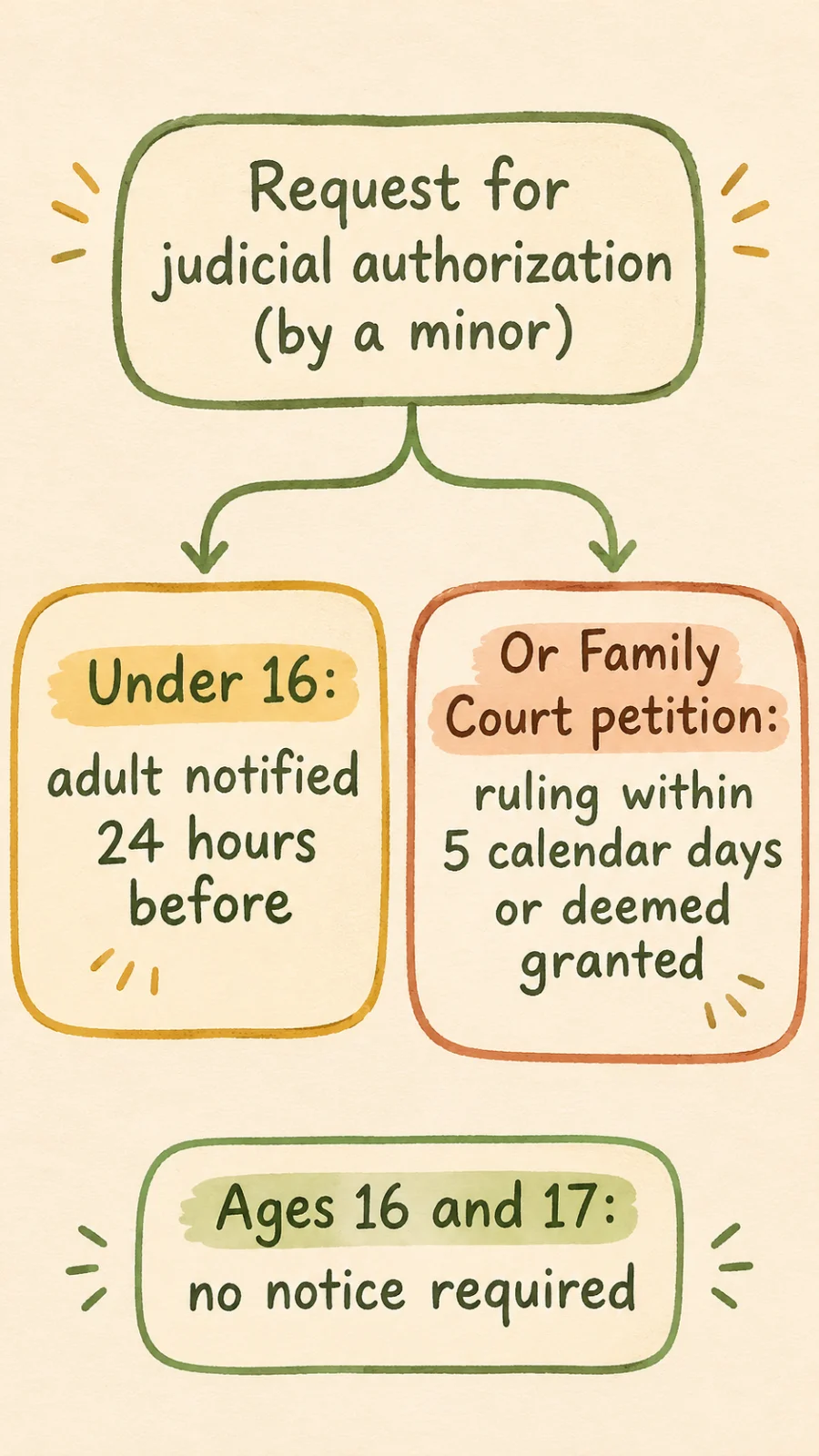
Adults face no waiting period, no residency requirement and no state-mandated counseling visit. Patients under 16 must have a parent, guardian, grandparent or licensed mental health professional notified at least 24 hours ahead, though a Family Court judge can waive that.
What Does Delaware Law Say About Abortion Before and After Viability?
Delaware permits abortion until viability, and the legislature chose not to put a week count in the statute. After viability the law narrows to two exceptions, both of which turn on a physician’s judgment.
Before viability
Section 1790(a) says authorized clinicians may terminate, assist in terminating, or attempt to terminate a pregnancy before viability. The statute lists no reason the patient must give and no trimester limit. Delaware’s Department of Justice describes the 2017 law as protecting access until viability, as determined by a medical professional.
After viability
Under § 1790(b), a physician may not terminate a pregnancy after viability except by birth, unless one of two things is true. Either the termination is necessary to protect the woman’s life or health in the physician’s good faith medical judgment, or there is a fetal anomaly with no reasonable likelihood the fetus will survive outside the uterus without extraordinary medical measures.
The health exception is not limited to physical health, and the statute does not define it more narrowly. That wording is a deliberate choice, since it leaves the call to the treating physician.
Who decides what “viability” means?
No Delaware statute defines viability or assigns it a gestational age. Viability is commonly described as around 24 weeks, but the legal line is the physician’s clinical determination for that pregnancy. This is one detail many summaries get wrong when they state a flat 24-week ban.
How Delaware got here
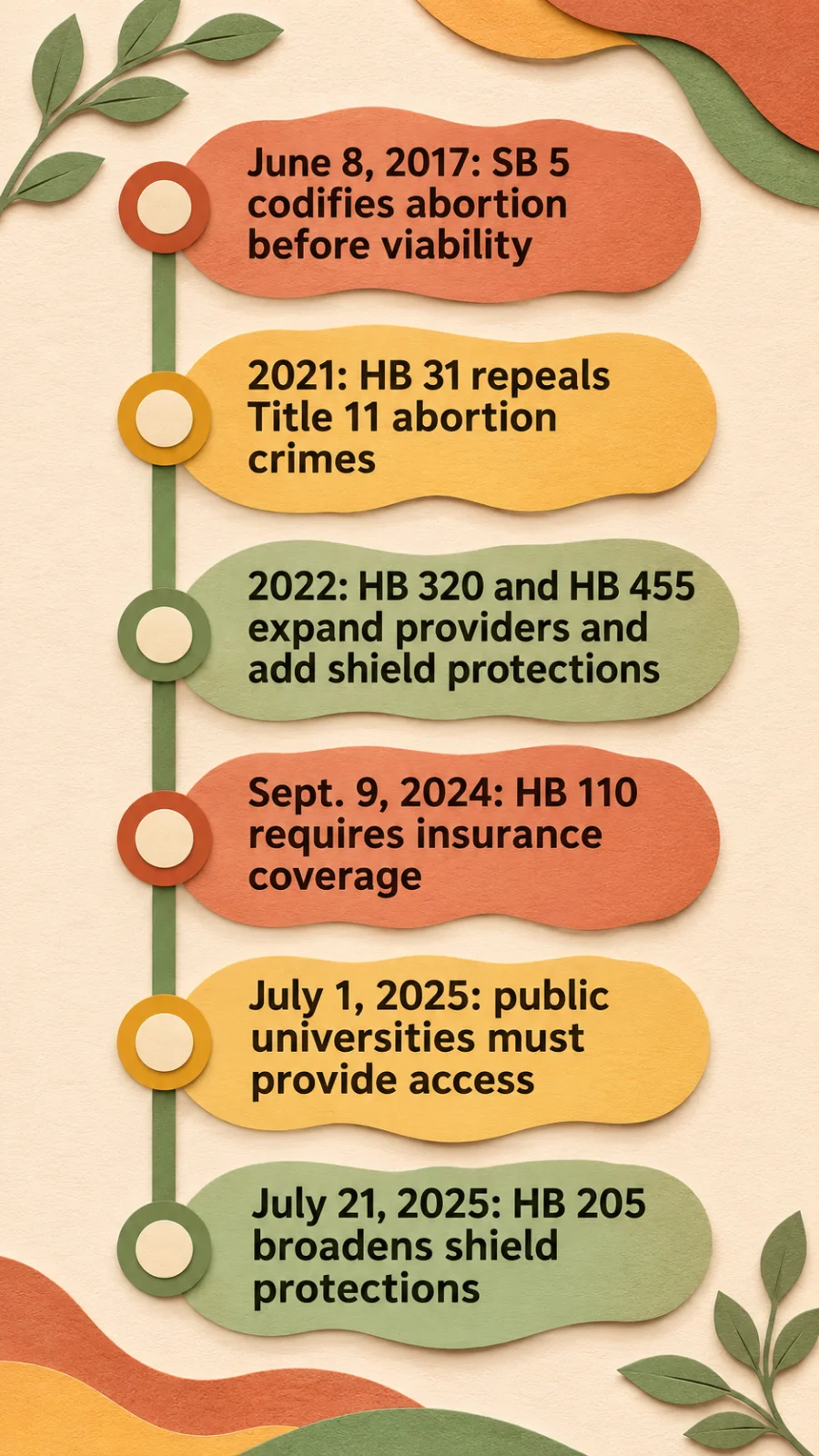
The current framework was built in layers between 2017 and 2025.
Who Can Perform an Abortion in Delaware?
Physicians, physician associates working under a collaborative agreement, certified nurse midwives and certified nurse practitioners can all provide abortion care in Delaware. The scope grew in 2022, when House Bill 320 (83 Del. Laws ch. 298) let physician associates and advanced practice registered nurses prescribe medication abortion, and House Bill 455 extended procedural abortion to advanced practice clinicians.
| Clinician | Abortion care allowed | Condition in § 1790 |
|---|---|---|
| Physician | Medication and procedural | None beyond licensure; the only after-viability provider |
| Physician associate | Medication and procedural before viability | Collaborative agreement with an appropriately trained physician |
| Certified nurse midwife or certified nurse practitioner | Medication and procedural before viability | Shown knowledge and competency, including training or certification approved by the Board of Nursing |
| Advanced practice registered nurse | Prescribing mifepristone and misoprostol | Section 1790(c) |
The reason for the change was geography. Sponsors said they wanted care in underserved areas, where physicians are scarce, to be available from clinicians who already prescribe most other medications.
What Delaware Does Not Require
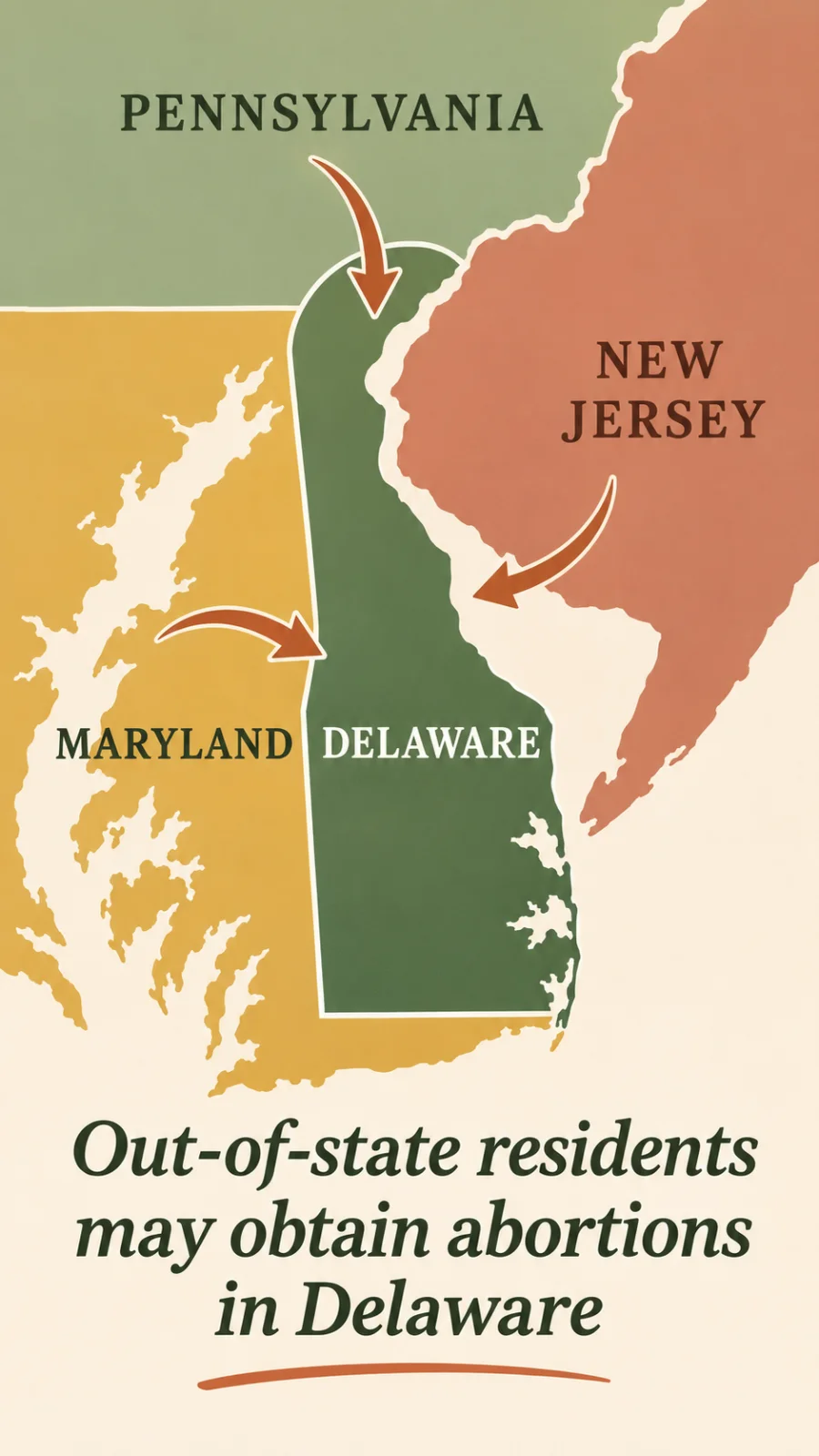
Delaware has no waiting period, residency rule or statutory consent script for adult patients. Senate Substitute 1 for Senate Bill 5, approved June 8, 2017, repealed § 1793 (residency) and § 1794 (written consent and a 24-hour wait before the procedure). Out-of-state residents may obtain an abortion in Delaware on the same terms as Delawareans.
Delaware also repealed its last pre-Roe criminal provisions. House Bill 31 in 2021 removed abortion-specific crimes from Title 11, including sections 651 through 654, which had treated abortion differently from other medical procedures.
Abortion for Minors: The Under-16 Notice Rule
A patient under 16 must have an adult notified at least 24 hours before an abortion, but no parent has to consent. Patients who are 16 or 17 need no notification at all. The rules sit in the Parental Notice of Abortion Act, 24 Del. C. §§ 1780 to 1789B.
Who can receive the notice
Under § 1783, notice can go to one or both parents, a grandparent, the minor’s legal guardian, or a licensed mental health professional who is not employed by or contracted with the abortion provider. If the person notified is not a parent or guardian, they must explain the options of adoption, abortion and carrying to term. They must also agree that a waiver of parental notice is in the minor’s best interest.
A minor who is married, or who has been freed from her parents’ care and control by court order or otherwise, is emancipated and outside the Act.
The court bypass
A minor can petition the Family Court in any county instead. The application must be written, signed and notarized. A judge must grant it if the minor is mature and well-informed enough to decide alone, or if a waiver is in her best interest.
If the court does not rule within 5 calendar days, the application is treated as granted. The minor pays no court fees, proceedings are confidential, and a denied petition can be appealed to the Delaware Supreme Court within 2 days, with free appointed counsel.
Exceptions and penalties
The notice and waiver steps do not apply in a medical emergency, which § 1782 defines as a condition that requires an immediate abortion to avert death, or where delay creates a serious risk of substantial and irreversible impairment of a major bodily function. A provider who knowingly skips the Act’s requirements when performing an abortion on a minor commits a class A misdemeanor, which in Delaware carries up to one year in prison. Rules for minors are set state by state; our guide to Pennsylvania abortion laws explains how they work there.
Prosecutors must prove beyond a reasonable doubt that the provider lacked a good faith belief that notice was given. Minors who need a judge’s order can also reach ReproLegalHelpline.org, which the Department of Justice lists for that purpose.
Conscience Rights and the Born-Alive Rule
No clinician or hospital can be forced to take part in an abortion. Section 1791 bars civil liability or discipline for refusing to perform or assist, and it says hospitals and their governing boards cannot be required to permit terminations on their premises. For a wider view of the region, you can also read our guide to New Jersey abortion laws.
Section 1795 covers the rare case where an abortion attempt results in a live birth. Everyone involved must give the child the same skill, care and diligence owed to any child born alive, and a knowing violation is a class A misdemeanor.
How Does Insurance Cover Abortion in Delaware?
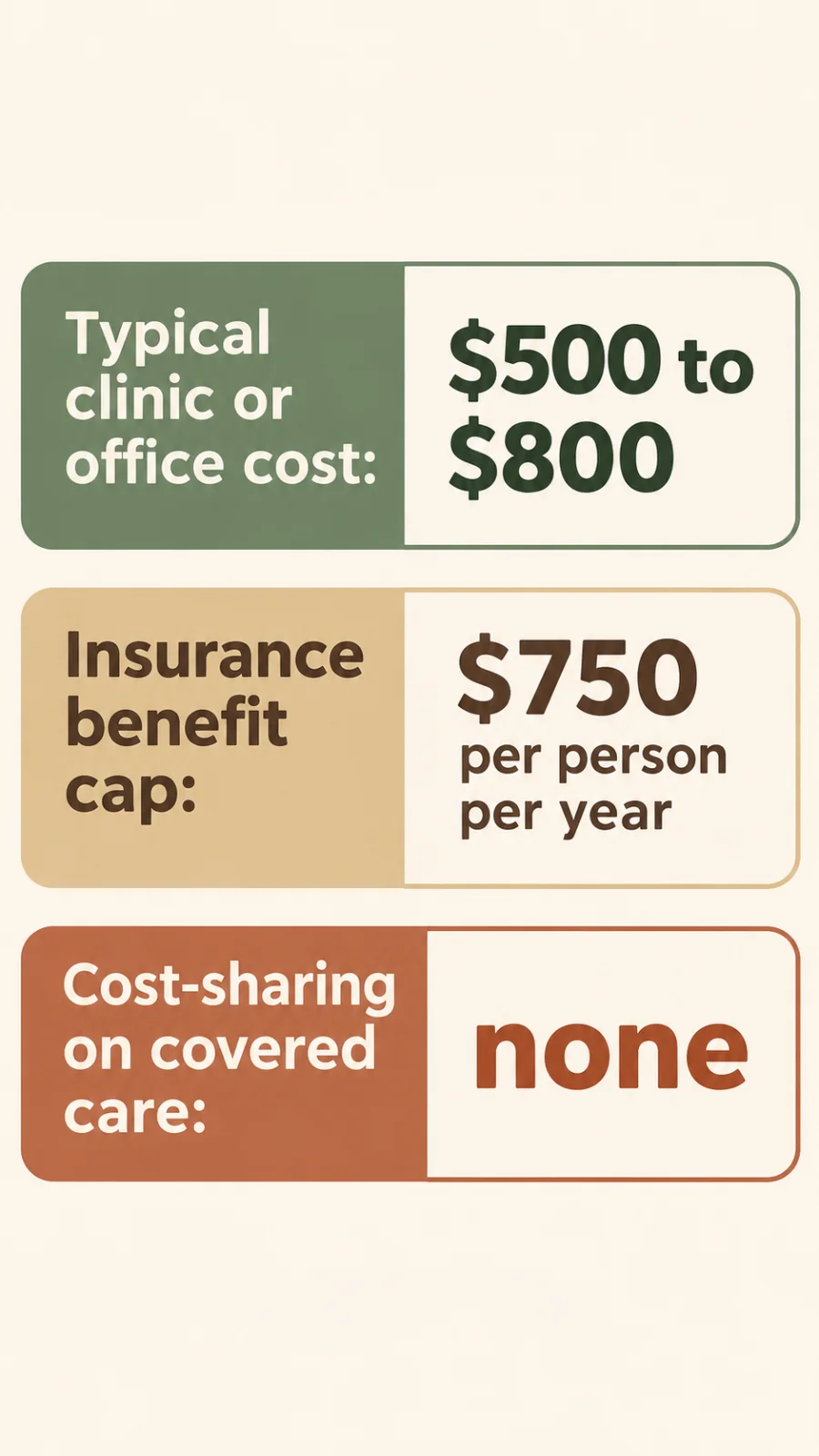
Delaware Medicaid, the state employee health plan and most private insurance must cover abortion care up to $750 per person per year, with no deductible, coinsurance or copay. The mandate comes from House Substitute 2 for House Bill 110, signed September 9, 2024.
The Department of Justice puts typical clinic or office costs at $500 to $800, which is why the $750 benefit is meant to cover most procedures. Surgery center or hospital operating room care can cost more.
When each part took effect
The start dates differ by coverage type, and the Department of Justice’s summary lumps them together. The bill itself sets two dates.
| Coverage | Effective | Cost-sharing |
|---|---|---|
| Medicaid | January 1, 2025 | None; capped at $750 per person per year |
| State employee plan | January 1, 2025 | None; covers the full scope of services the law permits |
| Private individual and group plans | Policies issued, renewed or altered after December 31, 2025 | None, except high-deductible and catastrophic plans where it would cost them their federal status |
For Medicaid, federal funds are used where federal law allows and state funds cover the rest. Private plans may limit the benefit to $750 per covered person per year.
A worked example of the $750 cap
Say your private plan was issued in 2026 and the clinic bills $900 for a procedure. The plan pays up to $750 with no deductible or copay, and you may owe the remaining $150 unless your plan covers more. A $600 medication abortion would be covered in full. This is a hypothetical, and your plan documents control.
Religious employers
A religious employer can obtain an exclusion from its insurance carrier if the mandate conflicts with its bona fide religious beliefs and practices. Even then, the plan must cover abortion care when the covered person’s life or health is at risk.
Students at Delaware’s public universities have a separate protection. Senate Substitute 1 for Senate Bill 301 (2024) requires them to provide access to medication for termination of pregnancy and to emergency contraception starting July 1, 2025. Private colleges set their own policies.
Delaware’s Shield Laws for Patients and Providers
Delaware refuses to apply other states’ abortion-related lawsuits and criminal processes against people who provide or help someone obtain care that is legal in Delaware. The protections are in 10 Del. C. §§ 3926A, 3928 and 3929, enacted through House Bill 455 on June 29, 2022, and broadened by House Bill 205 on July 21, 2025.
- Records: Under § 3926A, a provider cannot disclose patient communications or examination information about reproductive health services in a civil action without written authorization. Narrow exceptions cover malpractice suits by the patient, licensing board investigations and abuse investigations.
- Out-of-state lawsuits: Section 3928 declares another state’s civil-liability law for these acts contrary to Delaware public policy, so Delaware courts will not apply it or enforce process based on it. Criminal process is allowed only if the underlying conduct is also a crime in Delaware.
- Clawback: Section 3929 lets someone hit with an out-of-state judgment sue the party who brought or enforced it, and recover the judgment amount, defense costs and attorneys’ fees.
House Bill 205 passed the House 29 to 11 and extended these protections beyond abortion to any health care service that is lawful in Delaware, including fertility treatment and gender-affirming care. The Department of Justice also says Delaware will not extradite people with warrants for obtaining or providing abortions, and will not honor subpoenas for abortion patients’ medical records.
Is the Right to Abortion in the Delaware Constitution?
No. Delaware’s abortion rights rest on statute, not the constitution. A proposed amendment, Senate Substitute 1 for Senate Bill 5, passed the Senate 15 to 6 on March 11, 2025, one vote above the two-thirds it needed.
According to Delaware news coverage, the House did not vote on it before the General Assembly’s session ended June 30, 2026. Constitutional amendments here need two-thirds of each chamber in two consecutive General Assemblies, with no governor’s signature and no public referendum, so a new bill would have to start the process over.
The practical consequence is that a future legislature could change the statute with ordinary majorities, which is the reason supporters sought the amendment.
Where to Get Help in Delaware
The fastest legal resource is the Attorney General’s Abortion Legal Helpline, at (302) 992-8096 or toll-free at (877) 312-2366. You leave a message with a phone number, an attorney calls back, and you do not have to give your name.
- Call the helpline for legal questions, including about travel to Delaware or helping someone else.
- Use abortionfinder.org or ineedana.com to find a provider.
- Ask the clinic about your insurance benefit and any amount above $750 before the visit.
- For money, lodging, transportation or childcare, contact the First State Abortion Fund at (302) 491-9429. Planned Parenthood of Delaware says it will not turn away patients who cannot pay.
Frequently Asked Questions
Is there a week limit on abortion in Delaware?
There is no fixed number of weeks. Abortion is allowed until viability, which a medical professional determines, and afterward only to protect the patient’s life or health or for a lethal fetal anomaly.
Does a 17-year-old need parental permission in Delaware?
No. Patients who are 16 or 17 do not have to notify a parent or guardian. Even for patients under 16, the law requires notice, not consent.
Can I come to Delaware for an abortion if I live in another state?
Yes. Delaware repealed its residency requirement in 2017, and out-of-state residents may obtain an abortion here. The state’s shield laws also protect providers and people who help patients travel.
Is there a waiting period in Delaware?
No. The 24-hour waiting period and written consent provision in § 1794 were repealed in 2017. The only 24-hour rule today applies to notice for patients under 16.
Can a hospital or doctor in Delaware refuse to perform an abortion?
Yes. Under § 1791, no clinician can be required to participate and no hospital must allow abortions on its premises, without civil liability or discipline for refusing.
Will insurance pay for an abortion in Delaware?
Medicaid, the state employee plan and most private plans must cover up to $750 per person per year without a deductible or copay. Private plans fall under the mandate once a policy is issued, renewed or altered after December 31, 2025.
References
- Delaware Code, 24 Del. C. ch. 17, subch. IX, §§ 1790 to 1795, termination of human pregnancy
- Delaware Code, 24 Del. C. ch. 17, subch. VIII, §§ 1780 to 1789B, Parental Notice of Abortion Act
- Delaware Code, 24 Del. C. § 1702, definition of reproductive health services
- Delaware Code, 10 Del. C. §§ 3926A, 3928 and 3929, reproductive health records and out-of-state actions
- Delaware General Assembly, Laws of Delaware vol. 81, ch. 35 (SS 1 for SB 5, approved June 8, 2017)
- Delaware General Assembly, Laws of Delaware vol. 83, ch. 298 (HB 320, prescribing termination medications)
- Delaware General Assembly, HS 2 for HB 110, termination of pregnancy coverage
- Delaware General Assembly, HB 205, healthcare services protections
- Delaware General Assembly, SB 5, proposed amendment on reproductive freedom
- Delaware Department of Justice, Know Your Rights: Abortion
- Delaware Department of Justice, AG’s Abortion Legal Helpline
- The Dialog (news), report on SB 5 House outcome on June 30, 2026