
Florida Divorce Laws: Residency, Property, Alimony and Kids

Florida is a no-fault divorce state. One spouse must have lived in Florida for six months before filing (Fla. Stat. § 61.021), the only ordinary ground is that the marriage is irretrievably broken, and a judge cannot sign the final judgment until at least 20 days after the petition is filed (§ 61.19).
Three rules shape the money and the children. Marital property starts from an equal split, permanent alimony no longer exists for new cases, and courts begin with a rebuttable presumption that equal time-sharing is best for a child.
Who Can File for Divorce in Florida?
Anyone can file if at least one spouse has lived in Florida for the six months before the petition is filed. Both spouses do not need to live here, and the other spouse does not need to agree to the divorce.
How do you prove six months of residency?
Under § 61.052, residency can be corroborated with a Florida driver license, a voter registration card, a Florida ID card, or testimony or an affidavit from a third person who knows you lived here. The affidavit most people use is Family Law Form 12.902(i). If neither spouse meets the six months, the court cannot grant the divorce, and the petition has to be refiled once the time has run.
What are the legal grounds?
There are two. The first is that the marriage is irretrievably broken. The second is mental incapacity of one spouse, which requires an adjudication of incapacity under § 744.331 that has lasted at least three years.
Fault is not a ground, and you do not have to prove anything about your spouse’s behavior. Fault can still appear in two places: a court may consider a spouse’s adultery and its economic impact when deciding alimony (§ 61.08(1)(a)), and wasting marital money can shift the property split, as explained below.
The Florida Divorce Timeline: Deadlines in Order
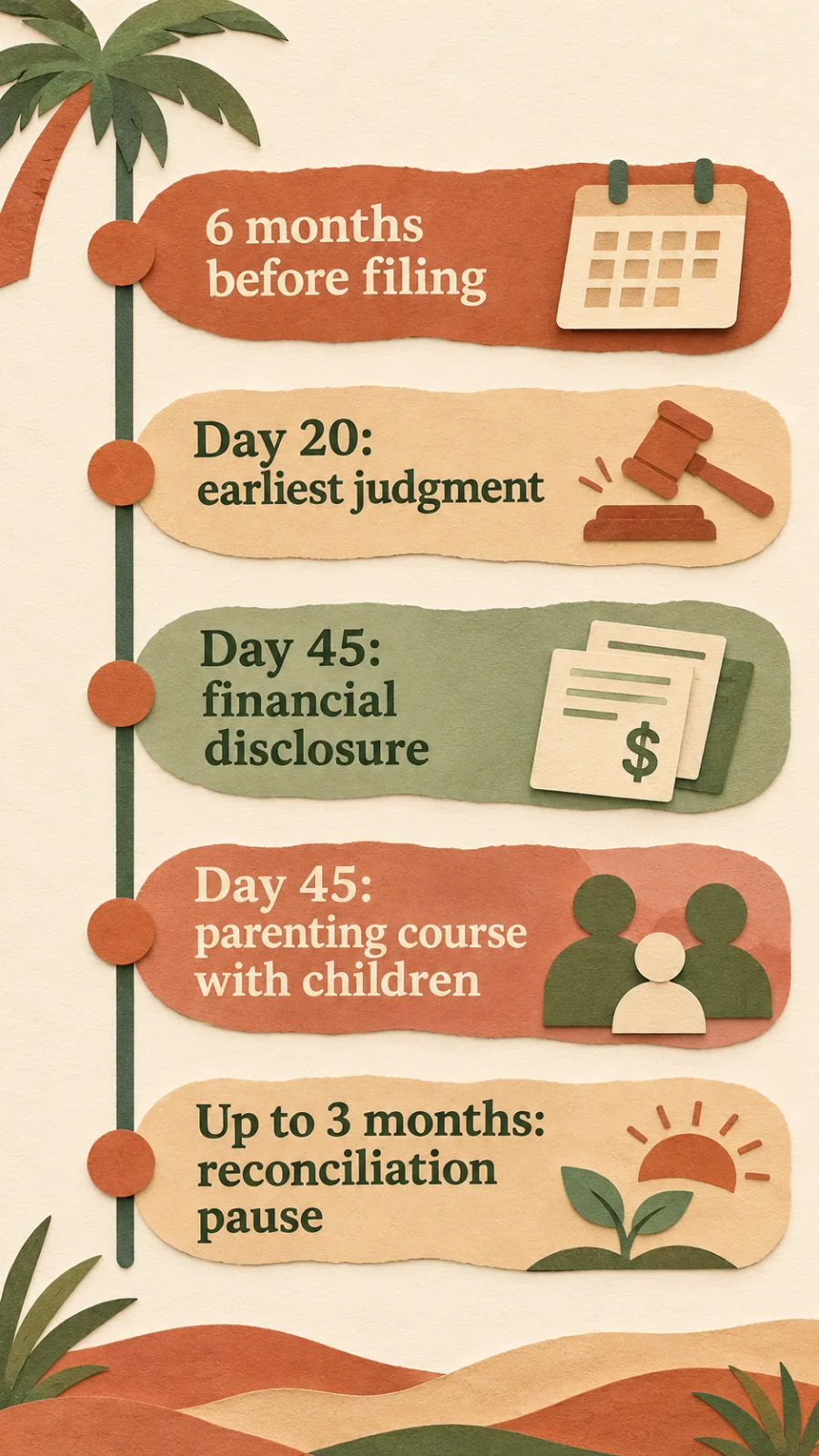
The clock starts at filing, and several deadlines run at once. The table collects the ones that apply to most cases.
| Step | Deadline | Authority |
|---|---|---|
| Residency before filing | 6 months | § 61.021 |
| Mandatory financial disclosure | 45 days after service of the initial pleading | Fla. Fam. L. R. P. 12.285 |
| Parenting course (cases with children) | Petitioner: 45 days after filing. Other spouse: 45 days after service | § 61.21(5) |
| Earliest possible final judgment | 20 days after filing | § 61.19 |
| Court-ordered pause to try reconciliation | Up to 3 months, with a minor child or if the marriage is denied as broken | § 61.052(2)(b) |
What the 20-day wait does and does not mean
The 20-day delay in § 61.19 is a floor, not an estimate. The court may enter judgment sooner only if it finds that waiting would cause injustice. A case with disputed property or children usually runs far longer because of the 45-day disclosure exchange, mediation and hearings.
Financial disclosure and the affidavit
Each spouse must serve a sworn financial affidavit with supporting documents. Form 12.902(b) is the short form for a party whose gross annual income is under $50,000. Form 12.902(c) is the long form for everyone else.
Mediation and the parenting course
When parental responsibility, time-sharing or child support is contested, the court may refer the parties to mediation under § 61.183. The referral is discretionary. Parents must also complete a Parent Education and Family Stabilization Course of at least four hours before final judgment, though a court can excuse it for good cause.
Simplified dissolution
Spouses who agree on everything can use the simplified track under Family Law Rule 12.105 and Form 12.901(a). The usual conditions are no minor or dependent children, no pregnancy, all property and debts already divided, no alimony sought, and both spouses willing to appear together at the final hearing. Mandatory disclosure does not apply to simplified cases.
How Florida Divides Property
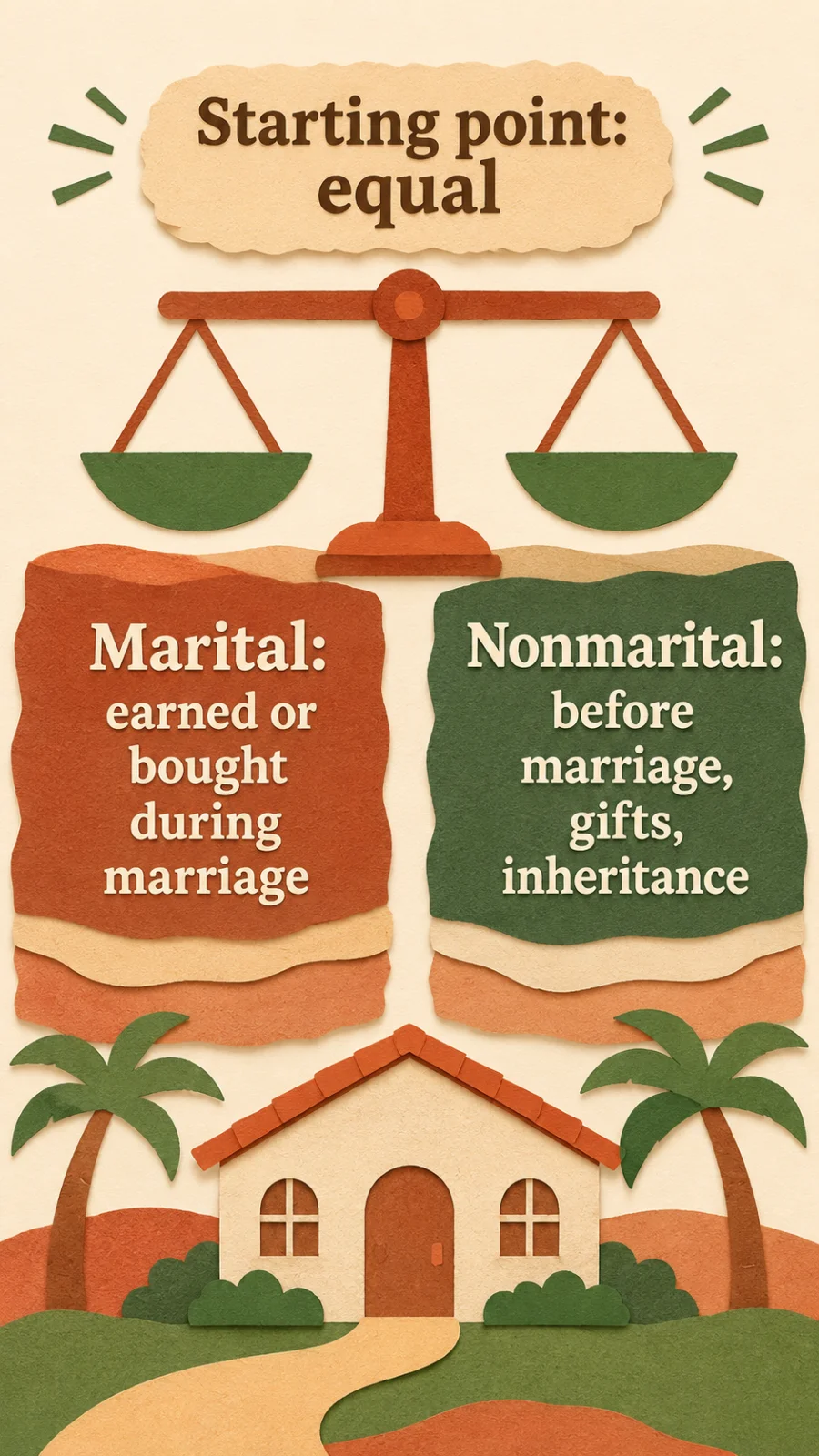
Florida uses equitable distribution, and § 61.075 tells the judge to begin with the premise that the distribution should be equal.
The judge can depart from 50/50 after weighing listed factors, so equal is the starting point and not a guarantee.
Marital versus nonmarital property
Marital assets generally include what either spouse acquired during the marriage, retirement benefits earned during the marriage, and the growth of nonmarital assets caused by marital money or effort. Nonmarital assets include property owned before the marriage, gifts and inheritances from third parties, and income from nonmarital property that was kept separate. Anything acquired during the marriage is presumed marital until a spouse proves otherwise.
Factors that move the split
The statute lists ten factors, (1)(a) through (j). They include each spouse’s contributions, including homemaking and child care, the length of the marriage, interrupted careers, one spouse’s support of the other’s education, keeping a business intact, and whether the marital home should go to the parent with the children.
One factor has a hard time window. Intentional waste or dissipation of marital assets counts if it happened after filing or within two years before it. The cutoff for identifying marital property is the earliest of a valid separation agreement date or the filing of the petition.
The 2024 amendment
Chapter 2024-237 (HB 521) took effect July 1, 2024. It changed how a marital interest in a closely held business is measured, excluding personal goodwill, and it added a writing requirement for interspousal gifts of real property made after that date. Business owners and anyone who retitled a home in a spouse’s name should read the current text of § 61.075(6) closely.
Alimony After the 2023 Reform
Florida courts cannot award permanent alimony in cases governed by the 2023 amendment. CS/SB 1416 (chapter 2023-315) was signed June 30, 2023 and took effect July 1, 2023, rewriting § 61.08. Alimony now requires proof of actual need by the person asking and ability to pay by the other spouse, and the court must make written findings.
The four types of alimony
| Type | Limit | Can it be changed? |
|---|---|---|
| Temporary | During the case | By the court as the case proceeds |
| Bridge-the-gap | 2 years maximum | No, amount and length are fixed |
| Rehabilitative | 5 years maximum, tied to a specific plan | Yes, for substantial change, noncompliance or early completion |
| Durational | Capped by marriage length (below) | Amount yes; length generally no |
How long durational alimony can last
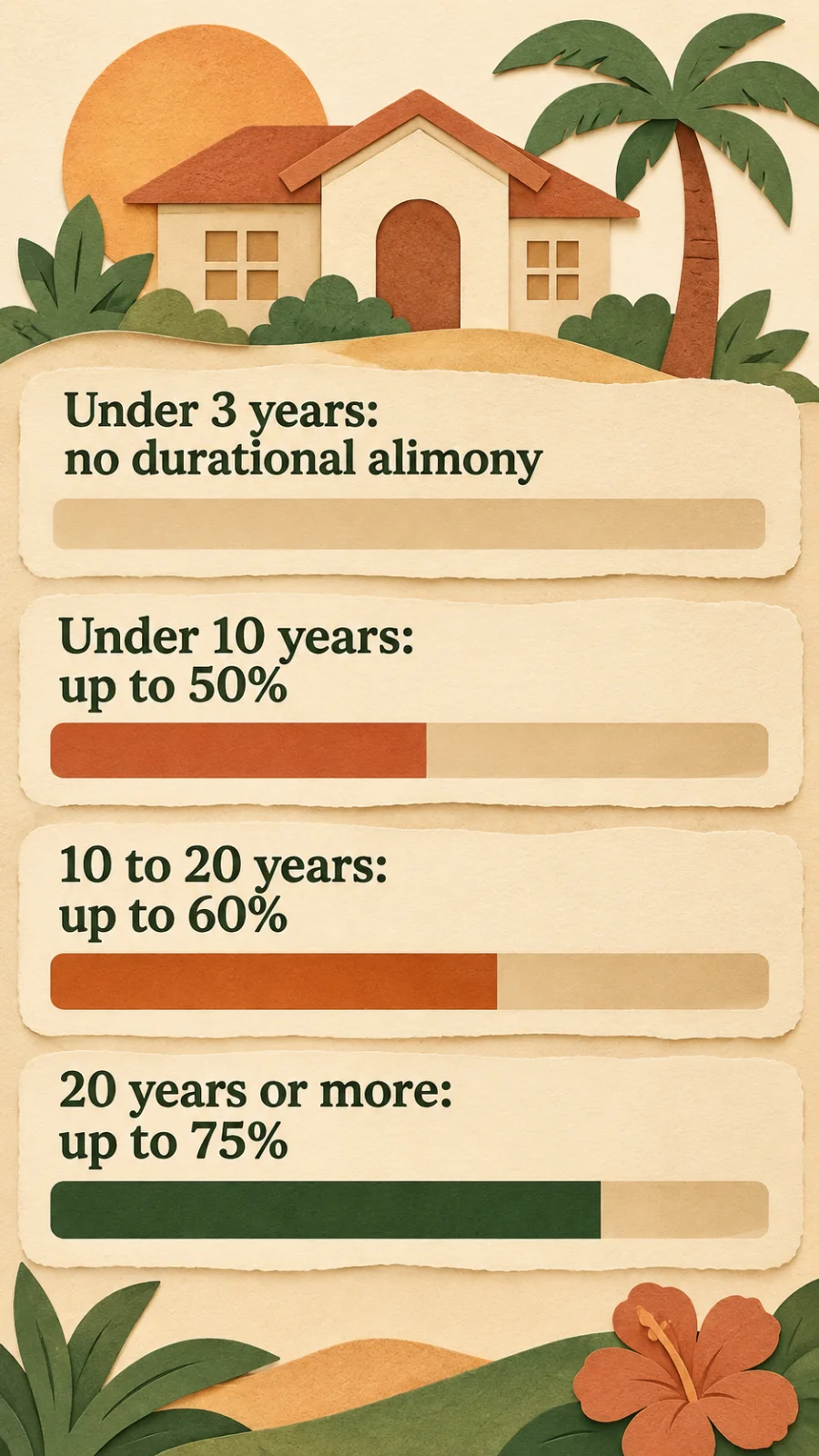
Marriage length runs from the wedding date to the date the divorce petition was filed. Durational alimony is not available after a marriage shorter than three years.
| Marriage length | Category | Maximum term |
|---|---|---|
| Under 3 years | Short-term | No durational alimony |
| 3 to under 10 years | Short-term | 50% of marriage length |
| 10 to 20 years | Moderate-term | 60% of marriage length |
| 20 years or more | Long-term | 75% of marriage length |
A court can extend the term only in exceptional circumstances and only on clear and convincing evidence. It must weigh age and employability, financial resources, disability, and caring for a disabled child of the marriage.
A worked example of the amount cap
The monthly amount cannot exceed the recipient’s reasonable need or 35% of the difference between the spouses’ net incomes, whichever is less. Say a couple was married 15 years, the payor nets $6,000 a month and the recipient nets $2,000.
The difference is $4,000, and 35% of that is $1,400. If the recipient’s reasonable need is $1,900, the award tops out at $1,400. The term tops out at 60% of 15 years, which is 9 years. Net income follows § 61.30(2) and (3). Section 61.08(9) also bars an award that leaves the payor with significantly less net income than the recipient, absent written findings of exceptional circumstances.
Ending or reducing alimony later
Under § 61.14(1), a court must reduce or terminate alimony when it finds the recipient is in a supportive relationship with an unrelated person. The paying spouse carries the first burden and must show the relationship existed within 365 days before the petition was filed.
The same section allows reduction or termination when the payor reaches normal Social Security retirement age or the customary retirement age for the profession and has taken measurable steps to retire or has retired. A petition can be filed in anticipation of retirement, but no more than six months before it.
Which version of the law applies to older cases?
Section 61.08(11) applies the amendment to initial petitions “pending or filed on or after July 1, 2023.” The Florida appellate courts disagree on what pending means.
The First District held in Stockdale v. Stockdale, 409 So. 3d 163 (Fla. 1st DCA 2025), that a petition is pending until the trial court renders final judgment. The Fifth District agreed in Secrist v. Secrist, 421 So. 3d 781 (Fla. 5th DCA 2025), where the judge had announced rulings orally the day before the effective date but had not signed a written judgment. The Fourth District held in Alfonso v. Alfonso, 426 So. 3d 478 (Fla. 4th DCA 2025), that a judgment entered June 30, 2023 was governed by the old statute even though rehearing was pending, and the Sixth District followed that line in Gaul v. Gaul (Fla. 6th DCA 2026).
The Second District reads pending more broadly. In Woodward v. Woodward (Fla. 2d DCA Jan. 22, 2025), it held that a petition stays pending while an appeal of a February 2023 judgment is open, so the amended statute applied on remand. If your judgment predates July 1, 2023, the district where your case sits can decide which statute governs.
Children: Parenting Plans, Time-Sharing and Child Support
Every divorce with minor children needs a court-approved parenting plan. Under § 61.13(2)(b), the plan must describe how daily tasks are shared, set a time-sharing schedule, assign responsibility for health care and school, set communication methods, and name exchange locations unless the parents agree otherwise in writing.
The equal time-sharing presumption
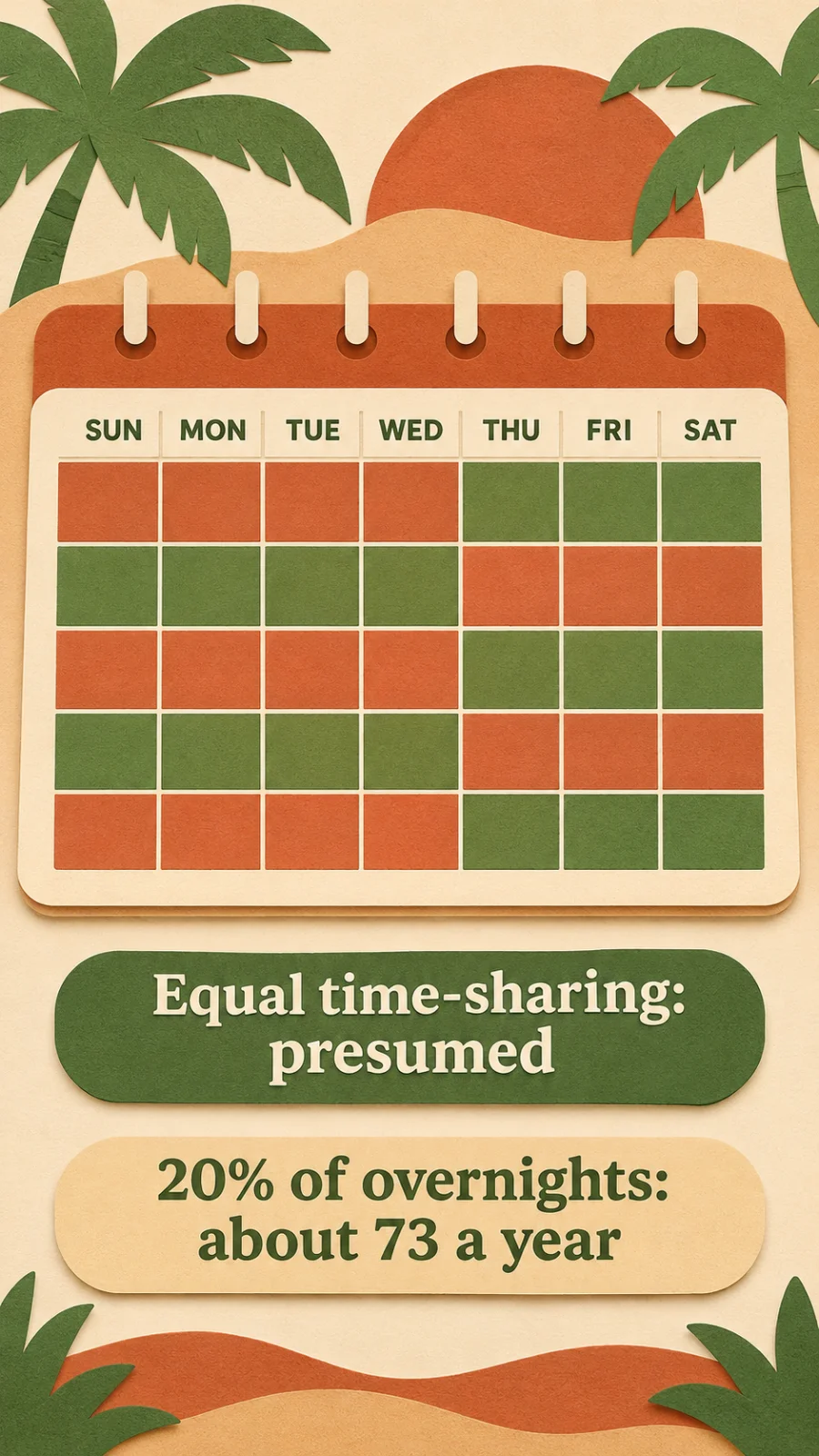
Since July 1, 2023, § 61.13(2)(c)1 creates a rebuttable presumption that equal time-sharing is in the child’s best interests. HB 1301 (chapter 2023-301) created it, and the Legislature approved it alongside the alimony bill. The parent opposing it must prove by a preponderance of the evidence that equal time is not in the child’s best interests.
The presumption does not apply where the parents agree to a schedule the court approves. Parental responsibility is shared by default, and a court can order sole responsibility if shared responsibility would be detrimental to the child. Certain convictions trigger a presumption of detriment.
How child support is calculated
The guideline amount in § 61.30 is presumptively correct. A court may vary it by up to 5% in either direction, and a larger change requires a written finding that the guideline amount would be unjust or inappropriate. Support generally runs until 18, or until 19 for a child still in high school who is expected to graduate before then.
A parent who exercises at least 20% of overnights, about 73 of 365, qualifies for the shared-parenting adjustment. Income can be imputed to a parent who is voluntarily unemployed or underemployed. A parent who gives no usable income information is presumed to earn the Census median for year-round full-time workers.
Changing a parenting plan later
Modifying a plan or time-sharing schedule requires a substantial and material change of circumstances and a finding that the change serves the child’s best interests. A 2026 bill, CS/SB 1128, would have given certain time-sharing hearings calendar priority. It died in the Senate Appropriations Committee on March 13, 2026, and § 61.13 was not changed by it.
Where to File and What to Do First
File in the circuit court clerk’s office in the county where either spouse lives. Florida publishes Supreme Court approved family law forms, and the correct petition depends on your facts: Form 12.901(b)(1) for a divorce with minor children, 12.901(b)(2) for property but no children, and 12.901(b)(3) for neither. Clerk fees run about $400 and vary by county, and the other spouse must be formally served.
- Confirm six months of Florida residency and gather a driver license, voter card or witness affidavit.
- Pick the petition form that matches your children and property facts.
- Complete Form 12.902(b) if your gross income is under $50,000, or 12.902(c) if it is not.
- Calendar the 45-day disclosure deadline from the day of service.
- If you have children, sign up for the parenting course within 45 days of filing or service.
Frequently Asked Questions
How long does a divorce take in Florida?
The earliest a judge can sign a final judgment is after 20 days have passed since filing. Contested cases take longer because of the 45-day disclosure exchange, mediation and court hearings.
Do I need a lawyer to get divorced in Florida?
No statute requires one, and the Supreme Court approved forms are written for people filing on their own. A lawyer is worth considering when property, a business, alimony or time-sharing is disputed.
Does Florida split everything 50/50?
Not necessarily. Section 61.075 starts from an equal division of marital property, and the judge can depart from it after weighing the statutory factors.
Can I still get permanent alimony in Florida?
Not in cases governed by the 2023 amendment. Permanent alimony awarded in a judgment entered before July 1, 2023 can exist, and the appellate districts disagree about cases that were pending around that date.
Does cheating affect a Florida divorce?
Adultery is not a ground, but a court may consider it and its economic impact when deciding alimony. Spending marital money on an affair can also count as dissipation in the property split.
Can my spouse stop the divorce by refusing to sign?
No. If one spouse denies the marriage is broken and there is a minor child, the court may pause the case for up to three months, but it must grant the divorce once it finds the marriage irretrievably broken.
References
- Florida Legislature, Fla. Stat. § 61.021, Residence requirements
- Florida Legislature, Fla. Stat. § 61.052, Dissolution of marriage
- Florida Legislature, Fla. Stat. § 61.08, Alimony
- Florida Legislature, Fla. Stat. § 61.14, Enforcement and modification of support, maintenance, or alimony agreements or orders
- Florida Legislature, Fla. Stat. § 61.075, Equitable distribution of marital assets and liabilities
- Florida Legislature, Fla. Stat. § 61.13, Support of children; parenting and time-sharing
- Florida Legislature, Fla. Stat. § 61.30, Child support guidelines
- Florida Legislature, Fla. Stat. § 61.19, Entry of judgment of dissolution of marriage, delay period
- Florida Legislature, Fla. Stat. § 61.21, Parenting course authorized
- Florida Legislature, Fla. Stat. § 61.183, Mediation of certain contested issues
- Florida Senate, Bill Analysis for CS/SB 1416 (ch. 2023-315), Dissolution of Marriage
- Florida Senate, CS/HB 1301 (ch. 2023-301), equal time-sharing presumption
- Florida Senate, HB 521 (ch. 2024-237), Equitable Distribution of Marital Assets and Liabilities
- Florida Fourth District Court of Appeal, Alfonso v. Alfonso, No. 4D2024-0698
- Florida Fifth District Court of Appeal, Secrist v. Secrist, No. 5D2023-3384
- Florida Senate, CS/SB 1128 (2026), Family Law, bill history