
Florida Lemon Law: Your Rights When a New Car Is Defective

Florida’s Lemon Law, Chapter 681 of the Florida Statutes, requires a manufacturer to refund or replace a new vehicle it cannot fix after a reasonable number of repair attempts, as long as you first reported the problem within 24 months of delivery. The law presumes “reasonable” is met after three repairs of the same defect, or 30 days in the shop for any mix of defects. Once the manufacturer has had its final chance to repair, it has 40 days to give you a refund or a replacement, and the Attorney General’s office runs an arbitration board if it refuses.
Most lemon claims fail on paperwork and timing, not on whether the car is bad. The sections below follow the order you will actually meet the law: what is covered, how many repairs count, the written notice you must send, what you get back, and the deadlines for arbitration and court.
What Does Florida’s Lemon Law Cover?
The law covers new vehicles sold or leased in Florida for personal, family or household use, plus demonstrators. Under Fla. Stat. § 681.102, a “consumer” is a buyer (not buying for resale) or a lessee, anyone the vehicle is transferred to during the first 24 months, and anyone the warranty entitles to enforce it.
The defect must be a “nonconformity,” meaning a defect or condition that substantially impairs the vehicle’s use, value or safety (§ 681.102(15)). Damage from an accident, abuse, neglect, or modifications made by anyone other than the manufacturer or its authorized service agent does not count.
| Covered | Not covered |
|---|---|
| New cars, SUVs and light trucks | Motorcycles and mopeds |
| Demonstrators | Trucks over 10,000 pounds gross vehicle weight |
| Leased vehicles (if a manufacturer’s warranty was a condition of sale, or you pay for repairs) | Off-road vehicles and vehicles that run only on tracks |
| Recreational vehicles, other than their living facilities | Electric bicycles |
The 24-month window
The “Lemon Law rights period” ends 24 months after the vehicle was first delivered to a consumer (§ 681.102(9)). Under § 681.103, if you first report a warranty problem inside that window, the manufacturer must repair it even if the work happens after month 24. That section also says it does not extend the rights period or the time to file a claim.
The practical consequence is that a defect first reported in month 23 leaves very little room. Every deadline later in this article is measured from the end of the 24 months.

How Many Repairs Make a Vehicle a Lemon in Florida?
Florida presumes a manufacturer has had a reasonable number of attempts when, during the 24-month rights period, either the same defect has been repaired three times (plus the manufacturer’s final attempt, if it made one) and persists, or the vehicle has been out of service for repairs for 30 or more cumulative days. That test is in Fla. Stat. § 681.104(3). Routine maintenance listed in the owner’s manual does not count toward either number.
The 30 days do not have to be consecutive, and the repair visits do not have to involve the same defect. The days are extended by any time repair services were unavailable because of war, invasion, strike, fire, flood or natural disaster.
Three numbers that get mixed up
Florida uses 15 days, 30 days and 60 days in different places, and they do different jobs.
| Number of days | What it does | Section |
|---|---|---|
| 15 cumulative days out of service | You may send the manufacturer written notice and give it a chance to inspect or repair | § 681.104(1)(b) |
| 30 cumulative days out of service | Creates the presumption that the manufacturer had a reasonable number of attempts | § 681.104(3)(b) |
| 60 cumulative days (RVs only) | Replaces the 30-day presumption for recreational vehicles | § 681.104(3)(b) |
Reaching 15 days does not make the vehicle a lemon. It lets you send the notice that starts the manufacturer’s last-chance clock.
The presumption is a shortcut, not a gate
You can win without hitting the presumption numbers. In Joyce v. Forest River, Inc., No. 24-12819 (11th Cir. Apr. 17, 2026), a published opinion, the Eleventh Circuit held that the district court was wrong to treat the § 681.104(3) presumptions as mandatory. The panel wrote that the presumptions “are examples, not requirements,” so a consumer who falls short can still prove a reasonable number of attempts under § 681.104(2).
The same opinion shows where the strict rules are. The notice thresholds in § 681.104(1), three repairs of the same defect or 15 cumulative days out of service, are prerequisites. Joyce sent notice to the chassis maker, Freightliner, after a single eight-day visit, and that claim failed. Against the RV maker, Forest River, the vehicle had spent around 114 days in authorized shops, so the court sent the claim back for trial and held that COVID-19 emergency orders do not automatically exclude the 2020 days.
What Written Notice Must You Send the Manufacturer?
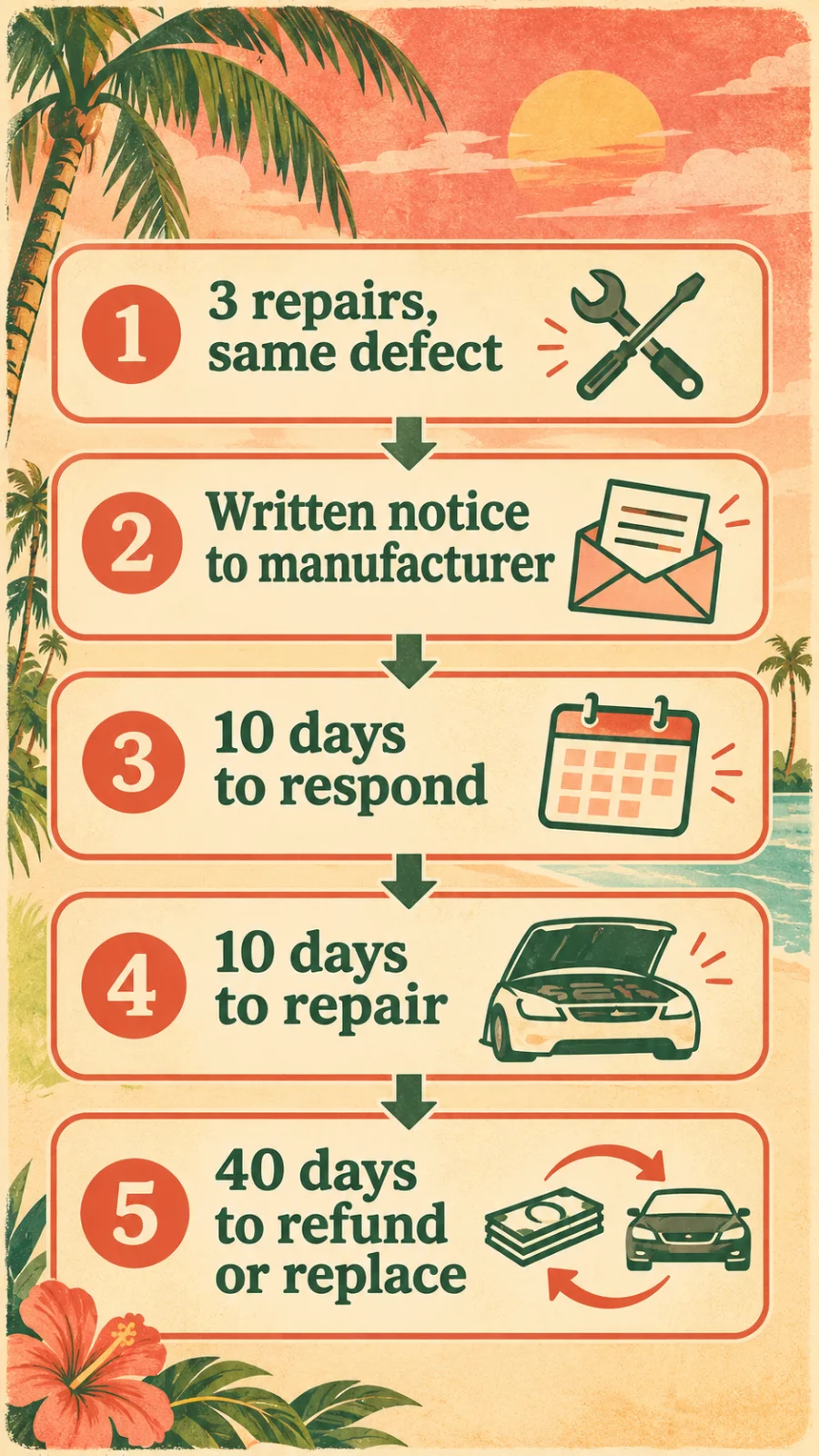
You must send the manufacturer written notice by registered or express mail after three failed repairs of the same defect, or after 15 cumulative days out of service. The notice goes to the manufacturer, not the dealer, and the address is in your warranty booklet or owner’s manual. The Attorney General’s office provides a Motor Vehicle Defect Notification form for this purpose.
The notice gives the manufacturer a final attempt, and the statute puts a clock on each side of it:
- The manufacturer has 10 days after receiving your notice to respond and tell you where to bring the vehicle, a reasonably accessible repair facility.
- After you deliver the vehicle, it has 10 days to conform it to the warranty (45 days for a recreational vehicle).
- If it does not respond or repair within those periods, the final-attempt requirement drops away and you move on to a remedy.
What to keep from every shop visit
Section 681.103 requires the service agent to hand you an itemized repair order whenever the vehicle comes back from warranty work. It must show the test drive, the diagnosis, the work, parts and labor, your reported problem, the odometer reading and the completion date. Those papers are your proof of both the repair count and the days out of service.
- Every repair order, including ones that say “could not duplicate”
- Drop-off and pick-up dates, which you need for the 15-day and 30-day counts
- Odometer readings on each repair order
- The registered-mail receipt for your notice and any reply
- The signed rights statement the dealer gave you at purchase, if you kept it
What Do You Get Back: Refund or Replacement?
The manufacturer must, within 40 days, repurchase the vehicle for the full purchase price less a reasonable offset for your use, or replace it with a vehicle acceptable to you. Under § 681.104(2), the choice is yours: you have an unconditional right to take the refund instead of a replacement. Either way, the refund or replacement must include reasonably incurred collateral and incidental charges.
How the use offset is calculated
The offset is the miles attributable to you, up to the earlier of a settlement or the arbitration hearing, multiplied by the base sale price and divided by 120,000 (60,000 for an RV). Taxes, government fees and dealer fees are left out of the base price.
Say a car’s base price is $40,000 and 12,000 miles are attributable to you. The offset is 12,000 × $40,000 ÷ 120,000, which is $4,000, and that amount comes off the refund.
What else is included
- Collateral charges are costs caused by acquiring the vehicle: installed items, earned finance charges, sales tax and title charges (§ 681.102(3)).
- Incidental charges are reasonable costs directly caused by the defect (§ 681.102(7)).
- Trade-ins are counted at the allowance in your contract if you and the manufacturer accept it. If not, the allowance is 100 percent of the NADA retail price at the time of the trade-in (§ 681.102(18)).
- Leases: the lessee receives the lessee cost and the lessor receives the lease price minus that cost. No early-termination penalty may be charged.
After you receive the refund or replacement, you, any lienholder and any lessor must give the manufacturer clear title and possession. A lienholder is paid first as its interest appears.
How Does Lemon Law Arbitration Work in Florida?
If the manufacturer does not fix the problem or pay, you can take the dispute to the Florida New Motor Vehicle Arbitration Board, run by the Attorney General’s Lemon Law Arbitration Division. A three-member panel hears the case, and a majority decides. If the manufacturer runs its own state-certified dispute program and told you how to use it at purchase, you must start there (§ 681.108(1)).
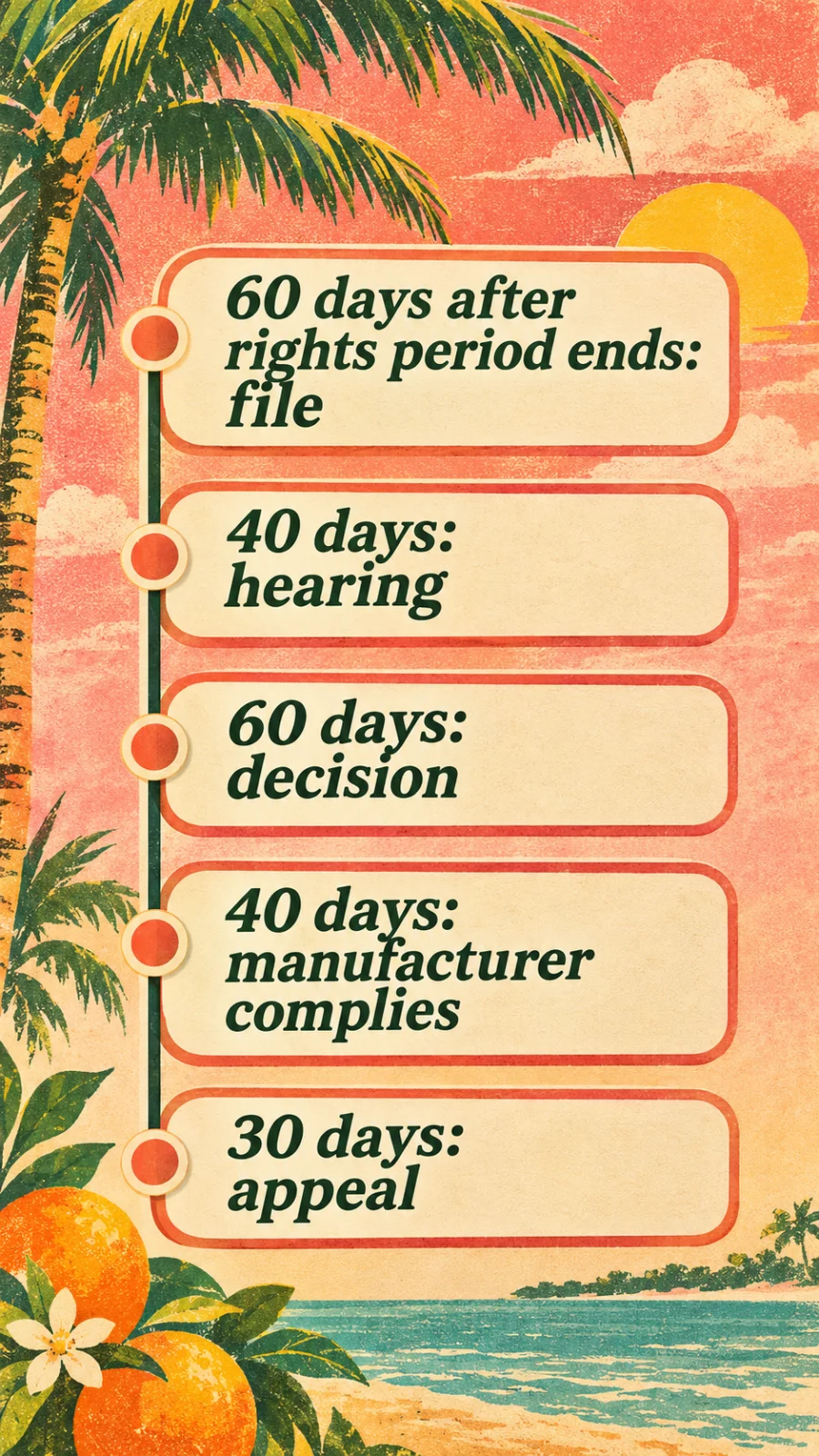
Here is the timeline, all counted under § 681.109 and § 681.1095:
| Step | Deadline |
|---|---|
| File with a certified manufacturer program | Within 60 days after the rights period ends |
| Certified program decides | 40 days, or you may go to the board |
| Request board arbitration | 60 days after the rights period ends, or 30 days after the certified program’s final action, whichever is later |
| Board hearing | Within 40 days after approval of the request |
| Board decision | Within 60 days after approval of the request |
| Manufacturer complies | 40 days after receiving a favorable decision |
| Petition circuit court to review | 30 days after receiving the decision |
The Attorney General’s office screens each request first and forwards the disputes it finds potentially entitled to relief. Use the Lemon Law page for the Request for Arbitration form. The toll-free hotline is 1-800-321-5366 inside Florida and 850-414-3500 from outside.
If the manufacturer ignores the award
A manufacturer that misses the 40-day compliance period faces $25 per day in continuing damages if a court upholds the award, along with the award’s value, costs and your attorney’s fees for confirming it. Either side can ask the circuit court to review the decision, and that review is a trial de novo, a fresh trial rather than an appeal on the record. A court that finds a bad-faith or harassing appeal must double the award and may triple it.
Can You Sue Under the Florida Lemon Law?
Yes. Section 681.112 lets a consumer sue to recover damages caused by a violation of Chapter 681, and a consumer who prevails recovers pecuniary loss, litigation costs, reasonable attorney’s fees and appropriate equitable relief. The suit must be filed within one year after the 24-month rights period ends. If you used a certified program or the state board, the year runs from that body’s final action.
A violation of the chapter is also an unfair or deceptive trade practice under Part II of Chapter 501 (§ 681.111). The risk runs the other way too: under § 681.106, a consumer whose claim a court finds was filed in bad faith, only to harass, or without a justiciable issue owes the manufacturer’s costs and attorney’s fees.
Does arbitration have to come first?
Sources disagree on how firmly. The text of § 681.112 does not make arbitration a precondition to suing, but § 681.108(1) requires you to use a state-certified manufacturer program first if one exists and you were told about it. The Florida Bar’s consumer guide to the Lemon Law also tells readers to seek arbitration before filing a civil action. A lawyer can tell you which route fits your manufacturer, and the one-year suit deadline and the 60-day arbitration deadline both start from the same date.
What Happens to a Bought-Back Vehicle?
A returned lemon cannot be resold without disclosure. Under § 681.114, a manufacturer that takes back a vehicle must report its VIN to the state within 10 days. Nobody may knowingly sell, lease or transfer title to it unless the nonconformity is “clearly and conspicuously disclosed” to the next buyer. The manufacturer must warrant correction of that defect for 1 year or 12,000 miles, whichever comes first.
Recreational Vehicles and Farm Equipment
RVs are covered with longer clocks: 45 days for the manufacturer’s final repair, 60 days out of service for the presumption, and a 60,000 divisor in the offset formula. Manufacturers’ RV disputes can also go through a separate mediation and arbitration program under § 681.1096.
Farm equipment is not under Chapter 681. SB 386, signed March 27, 2026 as ch. 2026-5 and effective July 1, 2026, amends s. 604.40 to let a buyer report a defect within the warranty period or one year after delivery. It presumes a reasonable number of attempts after three repairs of the same defect, but only if the manufacturer received direct written notice and a chance to cure. The act states it does not limit remedies available under Chapter 681.
Frequently Asked Questions
Does Florida’s lemon law cover used cars?
No. The statute defines a covered motor vehicle as new, and it extends to demonstrators. A used car with remaining factory warranty may still have claims under the warranty itself or other laws, but not under Chapter 681.
Does the lemon law apply to a leased car?
Yes. A leased vehicle is covered if a manufacturer’s warranty was a condition of sale or you are responsible for repairs. A lessee who wins receives the lessee cost and pays no early-termination penalty.
How long do I have to file a lemon law claim in Florida?
You must report the problem within 24 months of delivery. A request for arbitration is due 60 days after those 24 months end, and a lawsuit must be filed within one year after the 24 months end.
Can I choose a refund instead of a replacement?
Yes. Section 681.104(2) gives you an unconditional right to choose the refund. The manufacturer must pay it within 40 days, less the use offset.
Does the law cover motorcycles or heavy trucks?
No. Motorcycles, mopeds, electric bicycles, off-road vehicles and trucks over 10,000 pounds gross vehicle weight are excluded from the definition of motor vehicle.
Do I need a lawyer to file for arbitration?
The statute does not require one for board arbitration, and you file a state form with the Attorney General’s office. If you go to court and prevail, § 681.112 requires the manufacturer to pay your reasonable attorney’s fees.
References
- Florida Senate, Fla. Stat. § 681.104, nonconformity of motor vehicles
- Florida Senate, Fla. Stat. § 681.102, definitions
- Florida Senate, Fla. Stat. § 681.109, arbitration board dispute eligibility
- Florida Senate, Fla. Stat. § 681.1095, arbitration board creation and function
- Florida Senate, Fla. Stat. § 681.112, consumer remedies
- Florida Senate, Fla. Stat. § 681.114, resale of returned vehicles
- U.S. Court of Appeals for the Eleventh Circuit, Joyce v. Forest River, Inc., No. 24-12819, Florida Lemon Law presumptions
- Florida Attorney General, How the Florida Lemon Law Works
- Florida Senate, SB 386 (2026) enrolled, farm equipment, s. 604.40