
Georgia Divorce Laws: Residency, Grounds, and Timeline

To get divorced in Georgia, you or your spouse must have lived in the state for six months before filing, and you file a verified complaint in the superior court. A no-fault divorce cannot be granted until at least 30 days after your spouse is served. The no-fault ground is that the marriage is “irretrievably broken,” one of 13 grounds in O.C.G.A. § 19-5-3.
Georgia divides property equitably, which means fairly rather than automatically 50/50. Alimony, custody and child support are each decided under separate statutes, and fault matters in some of them but not others.
Who Can File for Divorce in Georgia?
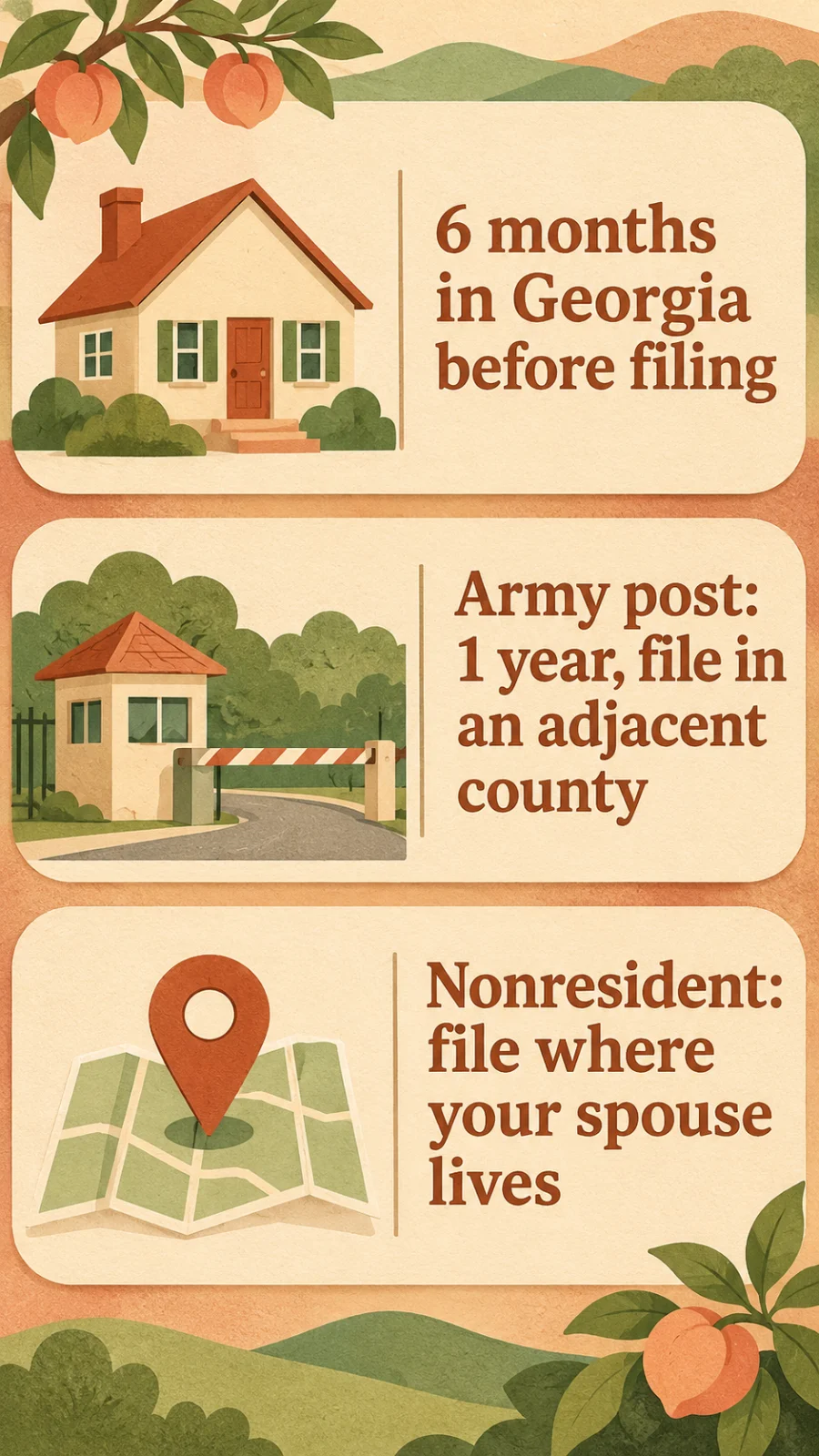
Someone must be a bona fide Georgia resident for six months before the petition is filed. That rule comes from O.C.G.A. § 19-5-2, and Georgia courts treat “resident” as meaning domicile, the place you actually live and intend to stay.
The six-month rule is not a separation period
Six months is a residency test, not a requirement that you live apart before filing. Your petition does have to state the date of separation under § 19-5-5, but nothing in the statute sets a minimum separation time.
Military and nonresident exceptions
A person who has lived for one year on a U.S. army post or military reservation in Georgia may file in a county adjacent to that post. A nonresident can file in the county where the respondent lives, if the respondent has been a Georgia resident, and a resident of that county, for six months.
The residency requirement does not apply to a spouse who files a counterclaim in a case the other spouse already started.
Where to file
Divorces are tried in the superior court. File in the county where your spouse lives, unless your spouse has left the state and you are the Georgia resident.
What Are the Grounds for Divorce in Georgia?
Georgia lists 13 grounds, and your petition must name the one you rely on. Twelve involve a defect or misconduct; the thirteenth is the no-fault ground that the marriage is irretrievably broken.
Most people use the thirteenth. It requires no proof of wrongdoing and no agreement from your spouse, though the court cannot grant the divorce until 30 days after service on the respondent.
The fault grounds
- Marriage within the prohibited degrees of blood or marriage
- Mental incapacity at the time of the marriage
- Impotency at the time of the marriage
- Force, threats, duress or fraud in obtaining the marriage
- Pregnancy of the wife by another man at the time of marriage, unknown to the husband
- Adultery after the marriage
- Willful and continued desertion for one year
- Conviction of a crime of moral turpitude with a sentence of two years or more
- Habitual intoxication
- Cruel treatment, defined as the “willful infliction of pain, bodily or mental” that reasonably justifies fear for life, limb or health
- Incurable mental illness, which has the strictest proof: adjudication or physician certification, at least two years of confinement or continuous treatment, and sworn statements, among other requirements
- Habitual drug addiction to a controlled substance
Fault grounds are harder to prove and rarely change how property is split. Their real weight is in alimony, covered below. Section 19-5-4 also bars a divorce in cases of collusion, consent, guilt of like conduct, or condonation, which is another reason most filers avoid fault grounds.
How Long Does a Georgia Divorce Take?
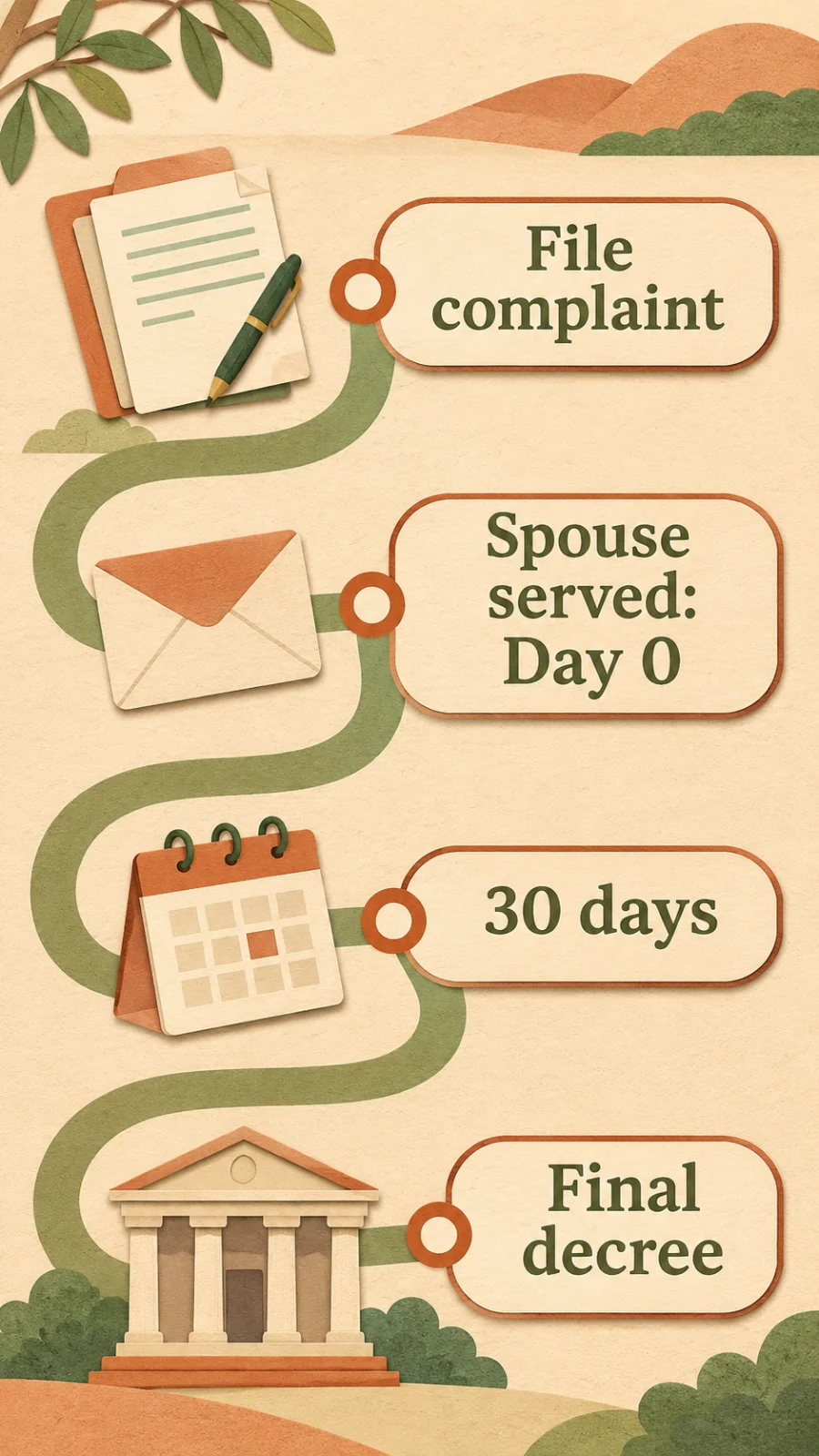
The fastest possible divorce is a little over 30 days after your spouse is served. A contested case with children, property or alimony disputes can run many months, because the 30 days is only a minimum.
The clock starts at service, not filing. Say your spouse signs an acknowledgment of service on March 2. The 30th day is April 1, so no judge can grant a no-fault divorce before then, and most courts schedule the final hearing later than that.
| Stage | What happens | Timing |
|---|---|---|
| Filing | Verified complaint, case filing form, and Domestic Relations Financial Affidavit go to the Clerk of Superior Court | Day 0 |
| Service | Sheriff serves the summons, or your spouse signs an Acknowledgment of Service | Starts the 30-day count |
| Waiting period | No no-fault judgment may be granted | At least 30 days from service |
| Children | Parenting plan, child support worksheet, and a divorcing parents seminar certificate | Before final judgment |
| Final decree | Judge signs the Final Judgment and Decree of Divorce | After day 30, once all issues are resolved |
Forms, fees and service
The Judicial Council of Georgia publishes a basic self-help divorce checklist. It lists the complaint and verification, the case filing form, the disposition form, the financial affidavit, child support worksheets and parenting plans if you have children, and a settlement agreement if you agree on everything. It also lists an Affidavit of Poverty if you want a fee waiver.
Each county clerk sets the filing fee, and it varies by county, so confirm the amount with your clerk before you go. If your spouse will not sign an acknowledgment of service, you can still file and use sheriff service.
The financial affidavit and its deadlines
Uniform Superior Court Rule 24.2 requires a sworn Domestic Relations Financial Affidavit in cases involving child support, alimony, property division or attorney’s fees. The deadline for exchanging it depends on the rule version and your circuit’s standing order. Some circuits require it with the complaint; others tie it to a deadline of 5, 10 or 15 days before a hearing or mediation. Read your county’s standing order for domestic cases when you file.
Those standing orders also bind both spouses once the case is filed. Some bar changes to insurance beneficiary designations while the case is pending.
How Does Georgia Divide Property?
Georgia uses equitable division: the court divides property acquired during the marriage in the way it finds fair, with no automatic 50/50 split. The rule comes from case law rather than a formula, starting with Stokes v. Stokes, 246 Ga. 765 (1980), where the Georgia Supreme Court held that a court may divide property owned by either spouse on an equitable basis.
Many online guides cite O.C.G.A. § 19-5-13 as the source of equitable division. That section does not say that. It requires the court to carry out a jury’s verdict on property by entering a judgment or decree, and the equitable-division doctrine itself comes from Stokes and the cases that followed it.
What courts weigh
Courts look at factors such as the length of the marriage, any prior marriages, and each spouse’s contributions to the family unit, including homemaking and child care. Retirement accounts, real estate, business interests and debts can all be divided.
A jury can decide property if a party demands one. Custody is different: under § 19-9-3(a)(2), a judge decides it.
Protecting property after you file
Under § 19-5-7, a transfer of property after a divorce petition is filed generally cannot defeat the division the jury later orders. Bona fide transfers to pay existing debts are not restricted.
For real estate, filing alone does not change title. The restriction applies only if a lis pendens notice, a public notice that a lawsuit affects the property, is recorded with the superior court clerk in the county where the land sits.

When Does Georgia Award Alimony?
Alimony is allowed but never required, and it can be temporary or permanent. Under O.C.G.A. § 19-6-1, the court weighs each spouse’s needs against the other’s ability to pay, and it must consider each party’s conduct toward the other.
The adultery and desertion bar
A spouse cannot receive alimony if the other spouse proves, by a preponderance of the evidence, that the separation resulted from the first spouse’s adultery or desertion. The court must hear evidence of what caused the separation in any alimony case, even when the divorce rests on the no-fault ground.
The bar reaches alimony only. In Peters v. Peters, 283 S.E.2d 454 (Ga. 1981), the Georgia Supreme Court held that an adulterous spouse who cannot obtain alimony can still obtain an equitable division of property.
Factors for permanent alimony
Section 19-6-5(a) directs the court to consider:
- The standard of living during the marriage and the length of the marriage
- Each spouse’s age and physical and emotional health
- Each spouse’s financial resources, separate property, earning ability and fixed debts
- Time needed for education or training to find suitable work
- Contributions to the marriage, such as homemaking and supporting the other spouse’s career
- Any other factors the court finds fair
When alimony can end or change
Future permanent alimony payments that are not yet due end when the recipient remarries, unless the arrangement provides otherwise (§ 19-6-5(b)). Under § 19-6-19, either former spouse can petition to revise permanent alimony after a change in income or financial status, but not again within two years of the last ruling. Voluntary cohabitation with a third party in a meretricious relationship is also grounds for modification.
While an alimony claim is pending, neither spouse may make substantial changes to their assets outside ordinary business or bona fide transfers for value.
How Does Georgia Decide Child Custody?
Georgia gives neither parent a head start. Under O.C.G.A. § 19-9-3, there is no presumption in favor of any particular form of custody or either parent, and a judge decides based on the child’s best interest.
The statute lists 17 factors the judge may weigh, including emotional bonds with each parent and siblings, each parent’s capacity to provide care, continuity and stability, each parent’s health, involvement in the child’s education, work schedules, and willingness to support the child’s relationship with the other parent. Family violence, abuse, criminal history and substance abuse are also on the list.
What the child’s age changes
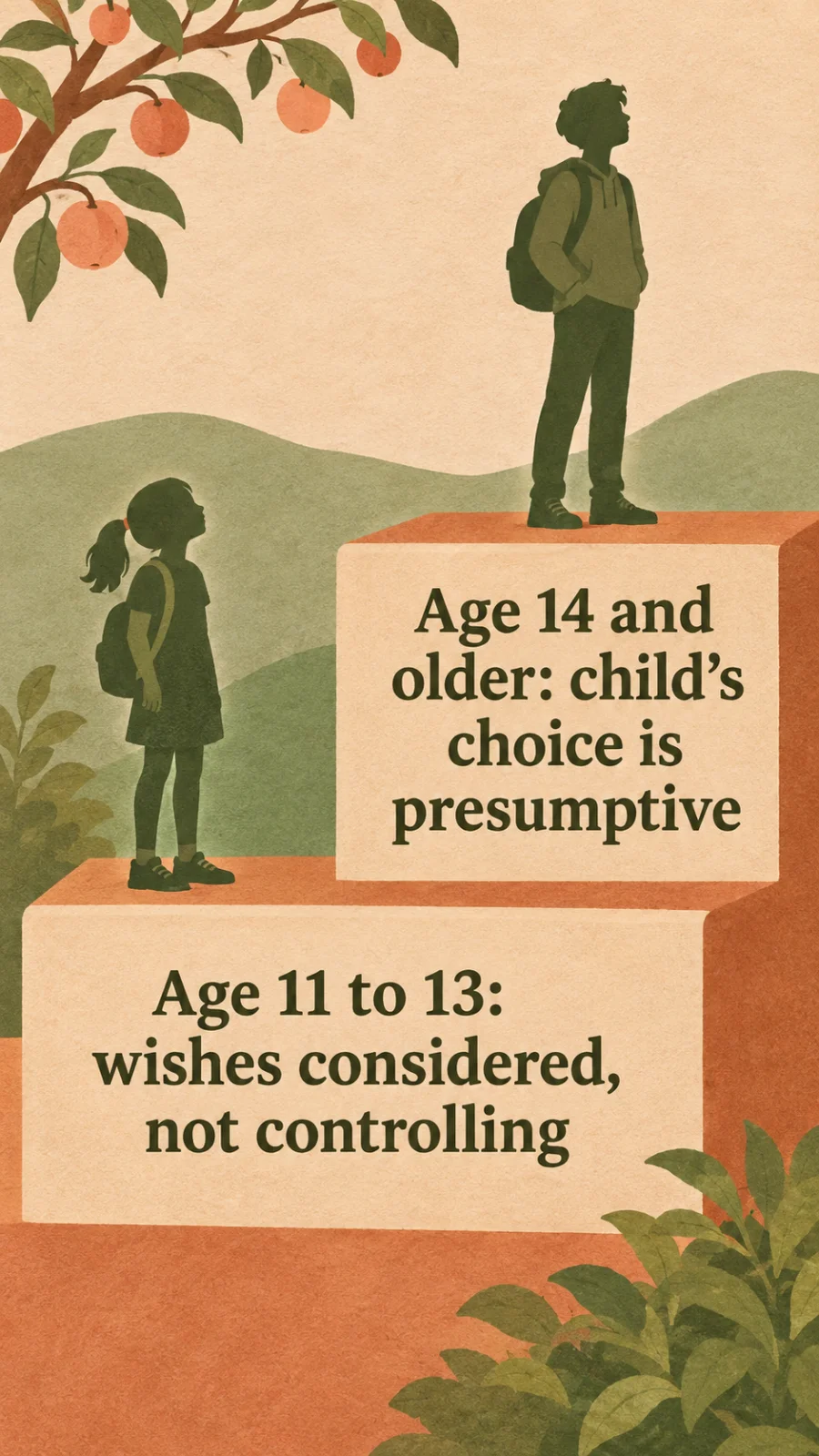
A child who is 14 or older may choose which parent to live with, and that choice is presumptive unless the chosen parent is not in the child’s best interest. A 14-year-old’s selection can count as a material change in circumstances, but only once in a two-year period.
For ages 11 to 13, the judge considers the child’s wishes and educational needs but keeps full discretion, and the wishes are not controlling.
Joint custody and family violence
If a court awards joint legal custody, the order must say how final decisions on education, health, activities and religion will be made. When the judge finds family violence, the safety of the child and the victim parent comes first, and the judge can order supervised parenting time.
Every case with minor children also needs a parenting plan under Uniform Superior Court Rule 24.10, and many circuits require a divorcing parents seminar.
How Is Child Support Calculated After the 2026 Changes?
Georgia calculates child support under O.C.G.A. § 19-6-15 using an income-shares model, and Senate Bill 454, signed in May 2024, rewrote major pieces of the guidelines in two phases. The first phase took effect July 1, 2024, and the second took effect January 1, 2026.
According to the Georgia Child Support Commission, the July 2024 phase brought a new Basic Child Support Obligation table, the first update since 2006. That table runs to $40,000 in combined gross monthly income, and cases above that may qualify for a high-income deviation. It also added a credit for VA disability benefits paid for a child.
The January 2026 phase replaced the discretionary parenting time deviation with a formula-based parenting time adjustment tied to the court-ordered schedule. It also replaced the low-income deviation with a standardized low-income adjustment. The Commission says courts keep discretion to deviate from the presumptive amount when appropriate and in the child’s best interests.
The practical effect is that the overnights written into your parenting plan now feed directly into the support calculation. Use the Commission’s official online calculator, which produces the worksheet the court requires, rather than a pre-2026 spreadsheet.
What Should You Do Before Filing?
Start by confirming residency, because a petition filed before the six-month mark fails on the jurisdictional requirement. Then work through this list:
- Pull your county Superior Court website and download its divorce packet and standing order, or use the Judicial Council’s basic forms if your county has none.
- Gather pay stubs, tax returns, bank and retirement statements, and debt records for the Domestic Relations Financial Affidavit.
- If you have children, draft a parenting schedule and run it through the Commission’s calculator.
- Decide whether to ask your spouse to sign an acknowledgment of service, which avoids waiting on the sheriff.
- If you own real estate and are worried about a sale, ask a lawyer whether a lis pendens notice fits your case.
- If you cannot afford the filing fee, file an Affidavit of Poverty with your forms.
The Judicial Council’s own instructions recommend hiring an attorney if you can, and a lawyer is worth the cost where the case involves substantial property, alimony or a custody dispute.
Frequently Asked Questions
Can I get divorced in Georgia if my spouse does not agree?
Yes. The no-fault ground does not require your spouse’s consent. If your spouse will not sign an acknowledgment of service, you can still file and have the sheriff serve the papers.
Do I have to be separated before filing?
No. Georgia sets no minimum separation period. The six-month requirement is about how long you have lived in the state, though your petition must state the date of separation.
Does adultery affect a Georgia divorce?
It can bar the adulterous spouse from alimony if the other spouse proves the separation resulted from it. It does not by itself prevent that spouse from receiving an equitable share of property.
How much does it cost to file for divorce in Georgia?
The Clerk of Superior Court in your county sets the filing fee, so the amount varies by county. If you cannot afford it, the Judicial Council’s checklist lists an Affidavit of Poverty to request a fee waiver.
Can I get my former name back?
Georgia’s divorce chapter includes a section on restoring a prior name, O.C.G.A. § 19-5-16. Ask for it in the complaint or the final decree so the order can serve as proof.
References
- Official Code of Georgia Annotated § 19-5-2, residence requirements and venue (Justia, Georgia Code)
- Official Code of Georgia Annotated § 19-5-3, grounds for total divorce (Justia, Georgia Code)
- Official Code of Georgia Annotated § 19-5-5, petition contents and verification (Justia, Georgia Code)
- Official Code of Georgia Annotated § 19-5-7, transfers of property and lis pendens (Justia, Georgia Code)
- Official Code of Georgia Annotated § 19-6-1, alimony (FindLaw, Georgia Code)
- Official Code of Georgia Annotated § 19-6-5, permanent alimony factors (FindLaw, Georgia Code)
- Official Code of Georgia Annotated § 19-6-19, modification of permanent alimony (FindLaw, Georgia Code)
- Official Code of Georgia Annotated § 19-9-3, child custody (FindLaw, Georgia Code)
- Supreme Court of Georgia, Stokes v. Stokes, 246 Ga. 765 (1980), equitable division of property
- Georgia Child Support Commission, 2024 updates to the child support guidelines under Senate Bill 454
- Judicial Council of Georgia, Basic Self-Help Divorce instructions and form checklist
- Office of the Governor of Georgia, Senate Bill 454 as signed (2024)