
Georgia Lemon Law: When Your New Car Qualifies

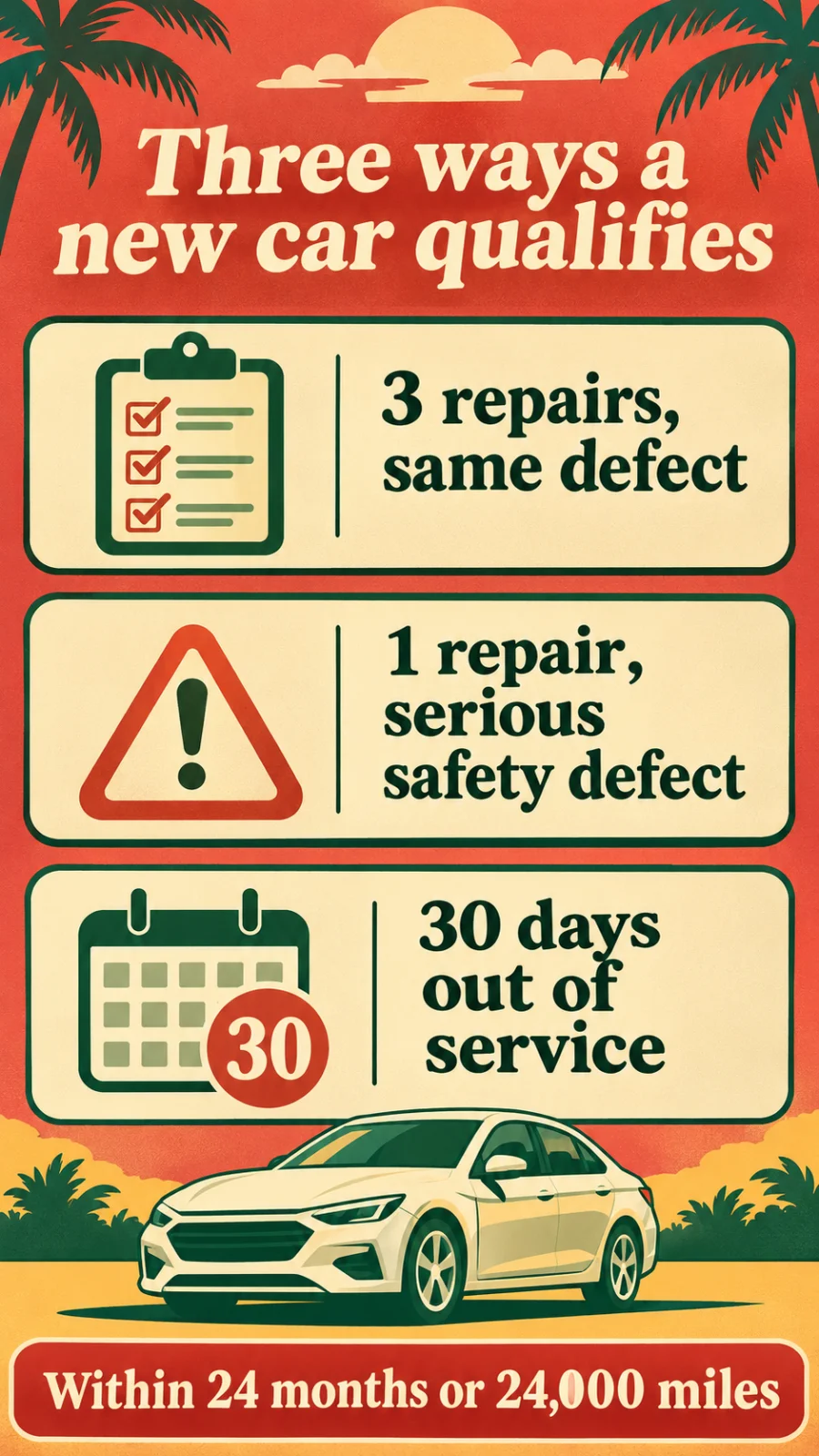
A new car qualifies as a lemon in Georgia when the same defect survives three repair attempts, a serious safety defect survives one attempt, or the car spends a cumulative 30 days in the shop, all within 24 months or 24,000 miles of delivery, whichever comes first. If the manufacturer then fails to fix it after a final repair attempt, it must repurchase or replace the vehicle. The rule is the Georgia Lemon Law, O.C.G.A. §§ 10-1-780 through 10-1-798.
The Georgia Attorney General’s Consumer Protection Division runs the program. You do not need a lawyer, and the arbitration that backs the law costs you nothing.
Which Vehicles and Buyers Does the Georgia Lemon Law Cover?
The law covers new vehicles bought, leased or registered in Georgia by the original consumer. Used cars are not covered, even if they still have factory warranty left.
Under § 10-1-782, a “new motor vehicle” is a self-propelled vehicle made to carry people or property on public highways, first titled to you or your lessor without prior use other than by a dealer. Demonstrator models can qualify if they were titled to you as new.
Who counts as a consumer
You qualify if you bought or leased the vehicle for personal, family or household use. A business can also qualify, but only if it buys or leases ten or fewer new vehicles a year, and limousine rental services are excluded no matter how few vehicles they buy.
What the law leaves out
- Trucks with a gross vehicle weight rating over 12,000 pounds
- Motorcycles, mopeds, all-terrain vehicles and boats
- Trailers, campers and other vehicles that are not self-propelled
- The living quarters, office or commercial space of a motor home (the chassis and coach are covered)
Defects caused by abuse, neglect or unauthorized modification are not “nonconformities” under the statute, so a lifted suspension or an aftermarket tune can sink an otherwise valid claim.
What Counts as a Defect Under Georgia Law?
A defect counts if it is covered by the manufacturer’s warranty or substantially impairs the vehicle’s use, value or safety. Section 10-1-782 calls this a “nonconformity,” and it can be a mechanical failure, an electrical fault or a condition such as a transmission that will not shift reliably.
The statute separately defines a “serious safety defect”: a life-threatening malfunction, one that impedes control or operation of the vehicle for ordinary or intended use, or one that creates a risk of fire or explosion. Brakes that fade, steering that binds and a fuel leak all fit. A radio that drops its connection does not.
The Lemon Law Rights Period: 24 Months or 24,000 Miles
The rights period ends two years after original delivery or after the first 24,000 miles, whichever comes first. Repair attempts only count if they happen inside that window.
Two extensions exist. If the car is already in for a repair the day the period expires, the period stretches until that repair attempt is finished. The period is also extended one day for each day repair services are unavailable because of a strike, war, terrorist act, blackout, fire, flood, other disaster or declared state of emergency.
When Is a Repair Record Enough to Presume a Lemon?
Under § 10-1-784(a)(1), the manufacturer is presumed to have had a reasonable number of attempts when any one of three things happens during the rights period.
| Trigger | What must happen | Where it comes from |
|---|---|---|
| Serious safety defect | Repaired once and not corrected | § 10-1-784(a)(1)(A) |
| Same defect, ordinary severity | Repaired three times and not corrected | § 10-1-784(a)(1)(B) |
| Time in the shop | Out of service a cumulative 30 calendar days | § 10-1-784(a)(1)(C) |
The 30 days do not have to be consecutive, and they are calendar days, not business days. Only visits to the manufacturer or its authorized dealer count, so a repair at an independent shop does not move the tally and may put your warranty at risk.
The statute also requires the shop to hand you a fully itemized, legible repair order every time the car comes back from repair (§ 10-1-783(d)). It must list the problem you reported, dates, odometer readings, test results, diagnoses, and all parts and labor. If a visit ends without a repair order, ask for one before you leave, because those papers are the proof for every step that follows.

How to Get a Georgia Lemon Law Refund or Replacement, Step by Step
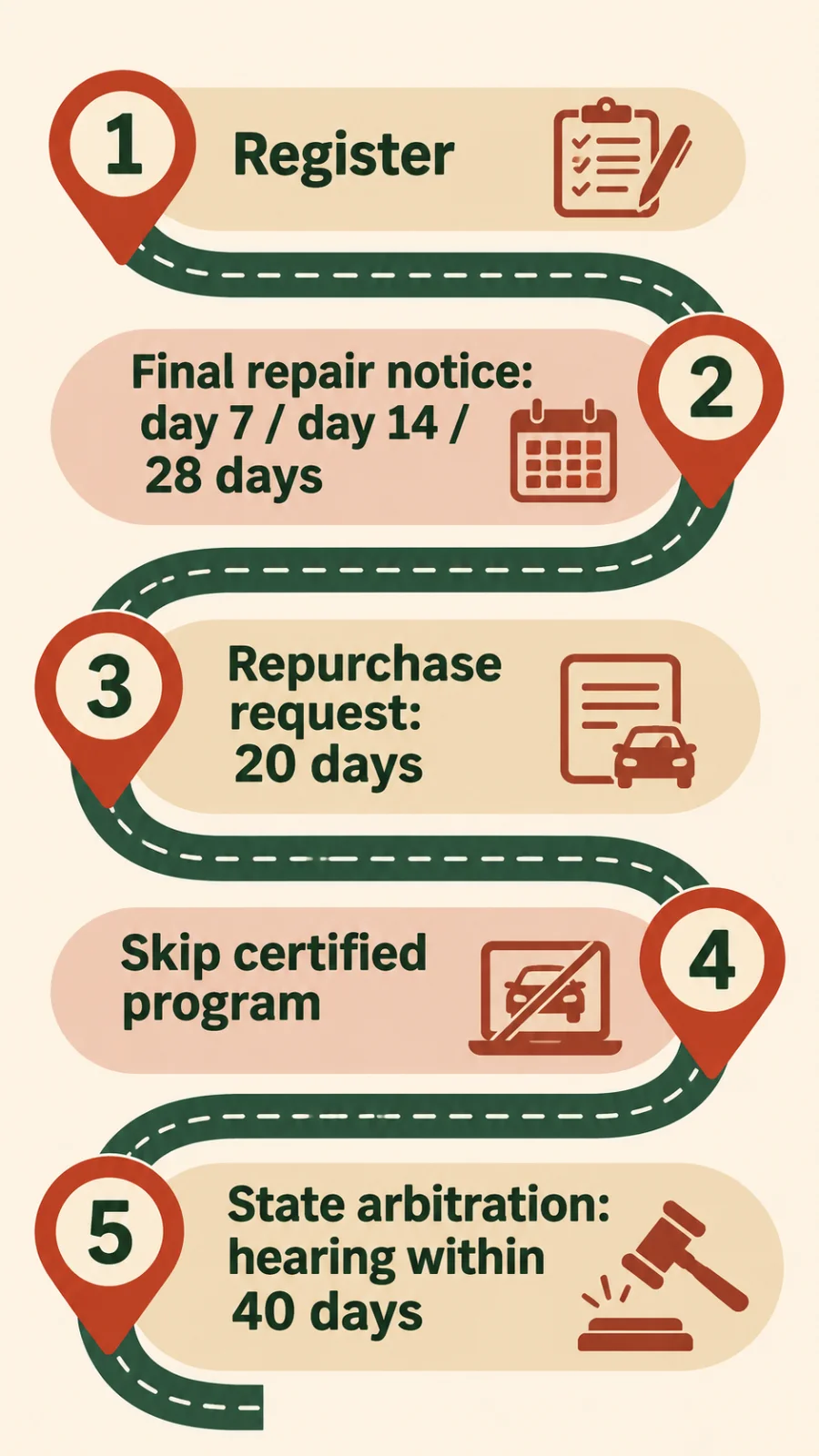
The process runs through five steps, and the order matters because a later remedy is unavailable if you skip an earlier one. Section 10-1-788 says you cannot use the Act’s remedies in a civil lawsuit until you have exhausted every remedy the article provides.
Step 1: Register with the Consumer Protection Division
Register the problem through the Division’s Lemon Law complaint form or by calling 404-458-3827. Have your VIN ready. The Division sends an information packet, and registering early speeds up arbitration later.
Step 2: Send written notice for a final repair attempt
Once the repair triggers above are met, send written notice to the manufacturer by overnight delivery or certified mail, return receipt requested, to the address in your owner’s manual or warranty booklet. The Division offers Form A for this, though a letter with the same information works.
The manufacturer then has 28 days from receipt to make one final attempt:
- By the close of business on day 7, it must name a reasonably accessible repair facility.
- You must deliver the vehicle by the close of business on day 14.
- If the manufacturer misses the day-7 designation or the 28-day deadline, the final-attempt requirement drops away.
- If you deliver the car after day 14, the manufacturer gets 14 days from delivery.
The Division’s guidance says the facility should be within 60 miles of your home or the vehicle, and that you should call the office if repairs are not finished 14 days after drop-off. Send a copy of your notice to the Attorney General’s office by fax at 404-651-9018.
Step 3: Demand repurchase or replacement in writing
If the final attempt fails, or the car has racked up 30 days out of service, send a written election to the manufacturer (Form B or a letter) choosing a repurchase or a replacement. Use the same overnight or certified delivery. The manufacturer has 20 days from receipt to act under § 10-1-784(b)(1).
Manufacturers sometimes counter with a smaller package, such as a cash payment while you keep the car. The Division advises calling its office before you sign anything.
Step 4: Skip the manufacturer’s own program, if none is certified
The statute requires you to use a manufacturer’s informal dispute program first, but only if the Attorney General has certified it (§ 10-1-785). The Division’s process page says no manufacturer has a certified program in Georgia, so you go straight to state arbitration. Programs such as BBB AUTO LINE are not certified and are optional, and nothing in the statute lets anyone tell you to use an uncertified one.
Step 5: Apply for state-operated arbitration
Call 404-458-3827 and request an original application, because photocopies are returned. The deadline under § 10-1-786(a) is the later of one year after the rights period expires or 60 days after a certified program’s proceeding ends.
The Attorney General decides whether your dispute is eligible. If it is, the manufacturer must arbitrate. The hearing is set within 40 days of eligibility, within 120 miles of your Georgia home, usually before one arbitrator (three for motor homes). A missed 40-day target does not void the process.
How Much Do You Get Back? A Worked Repurchase Calculation
A repurchase returns the purchase price, collateral charges and incidental costs, minus a “reasonable offset” for the miles you drove before the first repair visit. The offset formula in § 10-1-782(23) is purchase price × miles at your first delivery for repair of the defect ÷ 120,000 (÷ 90,000 for a motor home).
Collateral charges include factory or dealer options, sales tax, title charges and earned finance charges. Incidental costs are reasonable expenses tied to the repair, such as payments to the dealer for attempted fixes, towing and alternative transportation.
Say you paid $40,000 for a new SUV and first brought it in for the defect at 6,000 miles. Your sales tax, title fees and options add up to $3,200 in collateral charges, and you spent $450 on towing and a rental. The offset is $40,000 × 6,000 ÷ 120,000 = $2,000, and the manufacturer owes $40,000 + $3,200 + $450 − $2,000 = $41,650. If you still have a loan, the payment goes to you and the lienholder of record.
Because the offset uses mileage at the first repair visit, not at the end of the dispute, bringing a defect in early works in your favor. Miles you pile up while the dispute drags on are not charged against you.
Leased vehicles
On a repurchase, the manufacturer pays you all lease payments (including your up-front lessee cost and incidental costs) minus the offset, and pays the lessor 110% of the adjusted capitalized cost. On a replacement, the lease terms continue with the new vehicle. You must notify your leasing company in writing within 10 days of learning your dispute is eligible for arbitration, and the arbitration panel provides the form.
What Happens After the Arbitrator Decides?
The arbitrator’s written decision is final unless someone appeals to superior court within 30 days of its entry. An appeal is heard de novo, meaning the judge decides the case fresh, though the arbitration decision is admissible. If the manufacturer appeals and loses, your recovery can include continuing collateral and incidental costs, expert fees, attorney’s fees and court costs (§ 10-1-787(c)).
A manufacturer that does not appeal has 40 days to comply. If it does not, the Attorney General can impose a civil penalty of up to $1,000 per day under § 10-1-787(d). Report non-compliance to the Division at 404-651-9396. Separately, § 10-1-791(b) lets the Attorney General issue cease-and-desist orders and civil penalties up to $2,000 per violation.
Final decisions can also be filed with the superior court clerk and enforced as a judgment (§ 10-1-786(g)).
What the Georgia Lemon Law Does Not Provide
The Act has no treble-damages provision, despite what some online complaint templates claim by citing a § 10-1-784(d) that does not exist in the statute. Its remedy is repurchase or replacement, with attorney’s and expert-witness fees available to a prevailing consumer from the arbitrator under § 10-1-786(e).
Dealers sit outside the process. Under § 10-1-792, a dealer cannot be liable for refunds, replacements, collateral charges or incidental costs, cannot be named in arbitration, and is entitled to attorney’s fees if it is named anyway. Your claim is against the manufacturer.
The Act is cumulative under § 10-1-793, so it does not erase other remedies you may have, such as breach of warranty claims. Anyone weighing a lawsuit alongside the arbitration route should speak with a Georgia consumer attorney, because other claims can carry their own deadlines and trade-offs.
Can a Lemon Be Resold in Georgia?
Yes, but only with written disclosure. A manufacturer that takes back a vehicle cannot knowingly resell, lease or transfer title to it unless it discloses the reacquisition and the nature of the defect in writing and warrants the fix for one year or 12,000 miles, whichever comes first (§ 10-1-790). A knowing violation is an unfair or deceptive practice that a buyer can pursue in a private action under § 10-1-399.
The same rule applies to vehicles bought back under other states’ lemon laws. If you are shopping for a used vehicle, ask for the disclosure in writing.
Who Pays for the Program?
A $3.00 Warranty Rights fee collected on every new vehicle sale or lease funds the program. Dealers remit it quarterly to the Department of Law and keep $1.00 of each fee for administration (Ga. Comp. R. & Regs. 60-2-1-.04; § 10-1-791(a)). That is why the arbitration is free to you.
Frequently Asked Questions
Does Georgia’s lemon law cover used cars?
No. The Georgia Lemon Law applies only to new motor vehicles that are bought, leased or registered in Georgia. Used cars, including certified pre-owned vehicles, fall outside it.
How many repair attempts does Georgia require before a car is a lemon?
Three attempts for the same defect, or one attempt for a serious safety defect, or 30 cumulative days out of service. All of it must happen within 24 months or 24,000 miles of delivery, whichever comes first.
Do I need a lawyer to file a Georgia lemon law claim?
No. The Attorney General’s Consumer Protection Division designed the process so consumers can complete it themselves, and the state arbitration is free. You can hire an attorney, and an arbitrator may award attorney’s fees to a prevailing consumer.
How long do I have to apply for lemon law arbitration in Georgia?
You must apply within one year after the 24-month or 24,000-mile rights period ends, or within 60 days after a certified manufacturer program finishes, whichever is later.
Can I use the lemon law if I leased my car?
Yes, if the lease is at least one year long and you are responsible for repairs. You must notify the leasing company in writing within 10 days of getting notice that your dispute is eligible for arbitration.
What if the manufacturer ignores the arbitration award?
If it does not appeal within 30 days, it has 40 days to comply, and the Attorney General can fine it up to $1,000 per day. You can also file the decision with the superior court clerk and enforce it as a judgment.
References
- Georgia Department of Law, Consumer Protection Division, Georgia Lemon Law, O.C.G.A. §§ 10-1-780 to 10-1-798
- Official Code of Georgia Annotated, O.C.G.A. § 10-1-782, definitions (Georgia Lemon Law)
- Georgia Attorney General Consumer Protection Division, Georgia Lemon Law Process, step-by-step instructions and deadlines
- Georgia Attorney General Consumer Protection Division, The Georgia Lemon Law, eligibility and covered vehicles
- Georgia Department of Law, Rules and Regulations Chapter 60-2-1, Georgia Lemon Law
- Georgia Attorney General Consumer Protection Division, Lemon Law Complaint Form