
How Divorce Works in Illinois: Steps, Costs and Rules

Illinois grants a divorce, which the statute calls a dissolution of marriage, on a single ground: irreconcilable differences that have caused the marriage to break down beyond repair under 750 ILCS 5/401. One spouse must have lived in Illinois for at least 90 days, and no waiting period is built into the process.
Property is divided in “just proportions” rather than 50/50, spousal support follows a formula for most couples, and child support uses an income shares model. The sections below cover each piece, with the numbers, forms and deadlines you will run into.
Who Can File for Divorce in Illinois?
You can file if either you or your spouse lived in Illinois, or was stationed here as a member of the armed forces, for at least 90 days before the case was filed or before the court makes its finding. Only one spouse has to meet the test. The other spouse can live in another state.
The case is generally filed in the Illinois county where at least one spouse lives. Every circuit court clerk has its own fee schedule and local rules, but the forms are the same statewide.
Spouses on active military duty or living abroad
The statewide divorce forms cannot be used if the responding spouse is on active duty in a U.S. military branch or lives outside the United States, unless that spouse signs the divorce Appearance form. In those cases you will usually need a lawyer or a locally drafted petition.
Grounds for Divorce: Irreconcilable Differences
Illinois has no fault grounds such as adultery or desertion. Under § 401(a), the court must find that irreconcilable differences caused an irretrievable breakdown, and that efforts at reconciliation have failed or further efforts would be impractical and not in the family’s best interests.
Section 401(a-5) removes the argument when you have been apart long enough. If the spouses have lived separate and apart continuously for at least six months immediately before the judgment is entered, the breakdown is conclusively presumed. The other spouse cannot rebut it.
Can you be “separate and apart” in the same house?
Illinois appellate courts have said yes, under the older two-year version of the statute. In re Marriage of Kenik, 181 Ill. App. 3d 266 (1989), upheld a finding that spouses lived separate and apart while sharing a house, and In re Marriage of Dowd, 214 Ill. App. 3d 156 (1991), followed it.
Those cases interpreted earlier statutory language, and a judge decides each case on its facts. Separate bedrooms, separate meals and no marital relationship are the kinds of facts that mattered.
The Divorce Process From Filing to Judgment
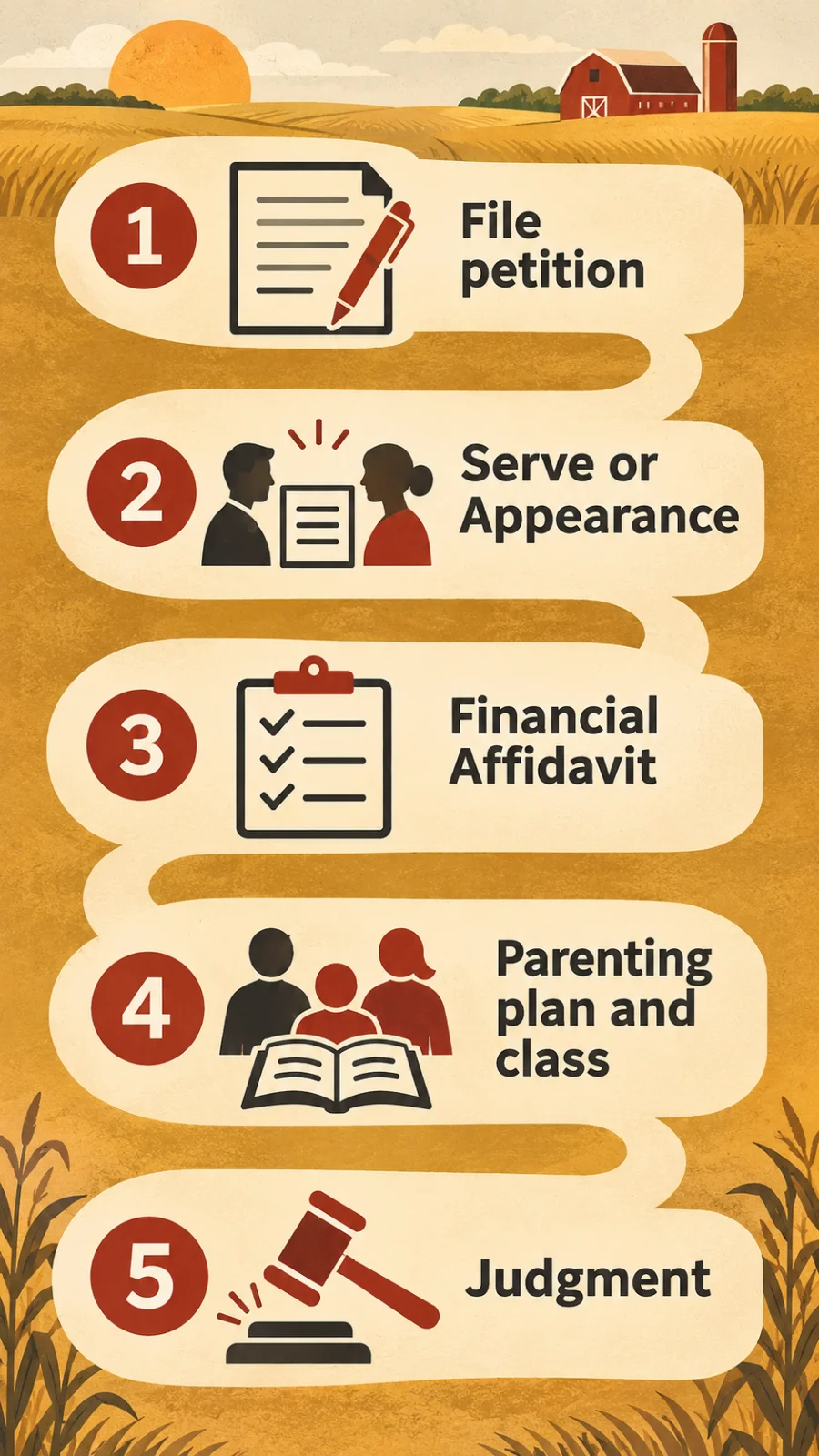
A divorce moves through a handful of fixed stages, whether you file alone, with a lawyer or jointly. The order below is how a typical contested or uncontested case runs in a circuit court.
- File a Petition for Dissolution of Marriage and pay the filing fee (or file a fee waiver application).
- Serve your spouse with the summons and petition, or get your spouse to sign an Appearance.
- Exchange financial information, including a Financial Affidavit.
- If you have minor children, file a parenting plan and complete the required parenting class.
- Negotiate an agreement or go to hearing, then the judge enters the Judgment of Dissolution.
Forms and filing fees
Illinois courts must accept the statewide forms approved by the Supreme Court Commission on Access to Justice, and the Cook County clerk notes that these suites are required for use under 750 ILCS 5/501(a)(1). The Illinois Courts divorce forms page has separate packets for divorce with children and divorce with no children under 18, along with the Summons, Appearance, Answer and Financial Affidavit.
Fees vary by county. In Cook County, the Domestic Relations Division fee schedule (CCDR 0703) lists $388 to file a Petition for Dissolution of Marriage and a $250 appearance fee. If you cannot afford the fees, you can ask the court to waive them under 735 ILCS 5/5-105 using the statewide Application for Waiver of Court Fees. A full waiver is available if you receive a means-based public benefit or your available income is at or below 125% of the federal poverty level, and partial waivers exist above that.
Serving your spouse, or skipping service
Your spouse can be served by the sheriff, or can skip formal service by signing and filing an Appearance and an Answer or Response. A served spouse generally has 30 days to respond under Supreme Court Rule 101(d). If your spouse never responds, you can ask for a default using the statewide Motion for Default and Order for Default forms.
No waiting period, but all issues must be handled
Illinois has no mandatory waiting period between filing and judgment. What controls timing is § 401(b): the court cannot enter a judgment until it has considered, approved or reserved parental responsibilities, child support, maintenance and property division.
The court must reserve an issue when the parties agree or when a party asks and the court finds appropriate circumstances. That is how a judge can end the marriage first and resolve a disputed issue later. If a party dies after judgment but before reserved issues are decided, the case does not abate.
Joint Simplified Dissolution: The Short Route
A joint simplified dissolution under 750 ILCS 5/452 is a shortened procedure for short, small, childless marriages. You and your spouse file together and certify that every condition in the statute is met.
| Condition | Joint simplified (§ 452) | Regular divorce |
|---|---|---|
| Children | None born or adopted during the marriage, and no pregnancy | Any |
| Length of marriage | 8 years or less | Any |
| Marital property | Under $50,000 after encumbrances | No cap |
| Real estate and retirement | None, except IRAs under $10,000 combined | Any |
| Income | Combined under $60,000, neither over $30,000 | No cap |
| Maintenance | Both waive it | Available |
You also need a written agreement dividing every asset worth more than $100 and allocating debts, plus a written agreement on companion animals. Cook County publishes the packet as form CCDR 0019, and the clerk assigns a judge and a hearing date.
How Illinois Divides Property and Debt
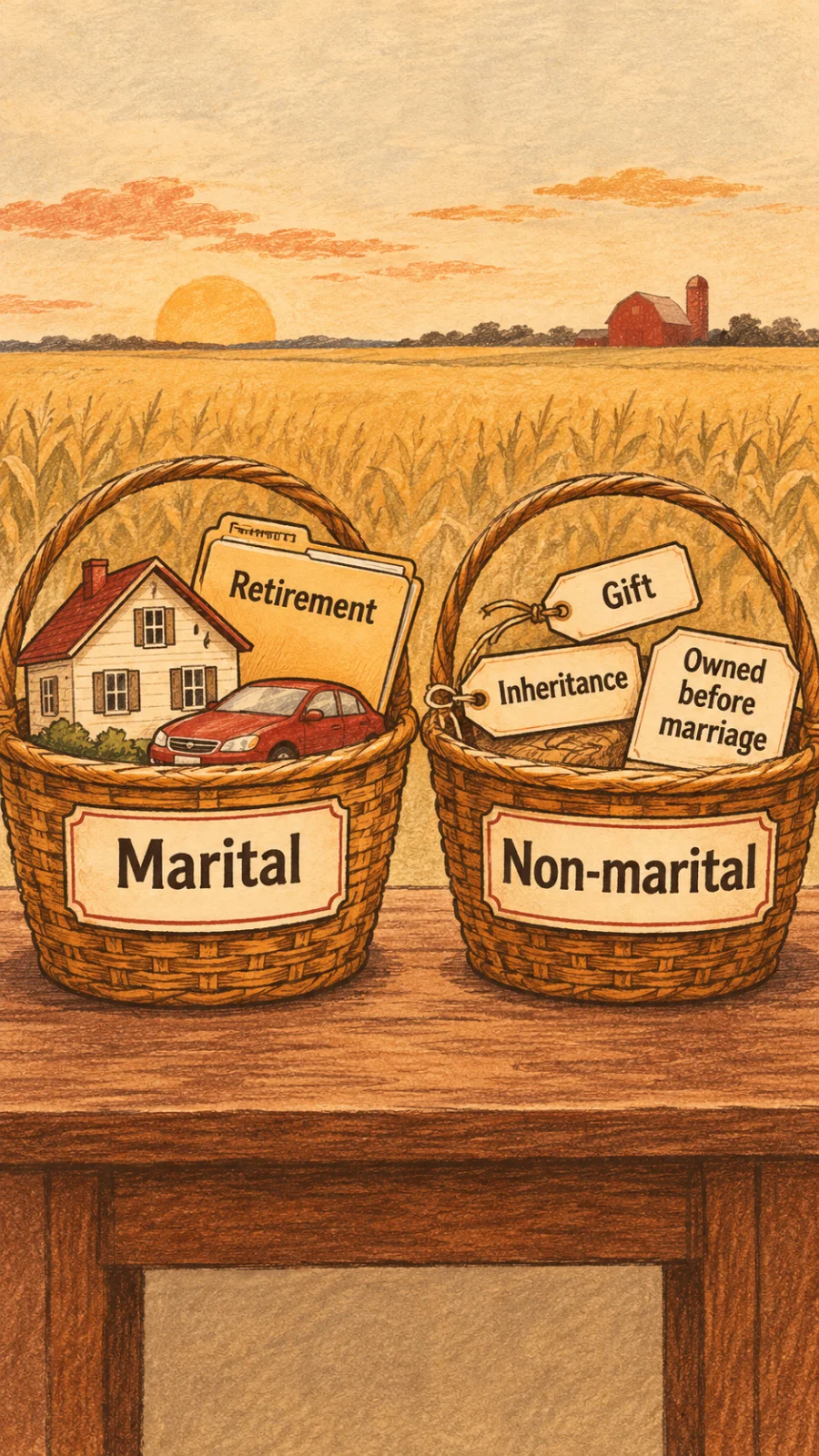
Illinois is an equitable distribution state. Under 750 ILCS 5/503, the judge assigns each spouse’s non-marital property to that spouse and divides marital property in “just proportions,” without regard to marital misconduct. Debts incurred during the marriage are treated as marital property too.
Anything acquired after the wedding and before the judgment is presumed marital. That includes property acquired after you separate or after the petition is filed.
What counts as non-marital property
Non-marital property includes gifts and inheritances, property owned before the marriage, property acquired in exchange for those items, and property excluded by a valid prenuptial or postnuptial agreement. Income from non-marital property stays non-marital unless it came from a spouse’s personal effort.
Mixing the two can undo the protection. If marital and non-marital funds combine into new property and lose their separate identities, the result is marital. A contribution you can trace by clear and convincing evidence may still earn reimbursement.
The 12 division factors
Section 503(d) lists the factors a judge weighs. They include each spouse’s contributions (including homemaking), dissipation, the length of the marriage, each spouse’s economic circumstances, any prenuptial agreement, the custodial arrangements for children, and the tax consequences of the division. One factor asks whether the property award replaces or adds to maintenance.
Dissipation has strict notice rules
Dissipation means one spouse spent marital property for a purpose unrelated to the marriage while the marriage was breaking down. A spouse who wants to claim it must file and serve a notice no later than the later of 60 days before trial or 30 days after discovery closes. The notice must name the property, the period of dissipation, and when the breakdown began.
Two time limits apply. Dissipation is not found more than 3 years before the claiming spouse knew or should have known of it, and in no event more than 5 years before the petition was filed.
Retirement accounts, stock options and pets
Pension and retirement accounts earned during the marriage are presumed marital, and a division is carried out through a Qualified Illinois Domestic Relations Order. Stock options and restricted stock granted during the marriage are presumed marital whether or not they have vested. A companion animal that is a marital asset can be allocated by the judge, who considers the animal’s well-being.
Spousal Maintenance: Amount and Duration
Illinois calls alimony “maintenance.” Under 750 ILCS 5/504(b-1), the guidelines apply when the spouses’ combined gross annual income is under $500,000 and the payor owes no child support or maintenance from a prior relationship. The judge can still find the guidelines inappropriate and set a different amount.
The formula is 33⅓% of the payor’s net annual income minus 25% of the payee’s net annual income. The result, added to the payee’s net income, cannot lift the payee above 40% of the spouses’ combined net income.
A worked example of the 40% cap
Say the payor nets $90,000 a year and the payee nets $30,000. One-third of $90,000 is $30,000, and 25% of $30,000 is $7,500, so the formula gives $22,500 a year.
Combined net income is $120,000, and 40% of that is $48,000. Adding $22,500 to the payee’s $30,000 gives $52,500, which is over the cap. The award is limited to $18,000 a year, or $1,500 a month.
How long maintenance lasts
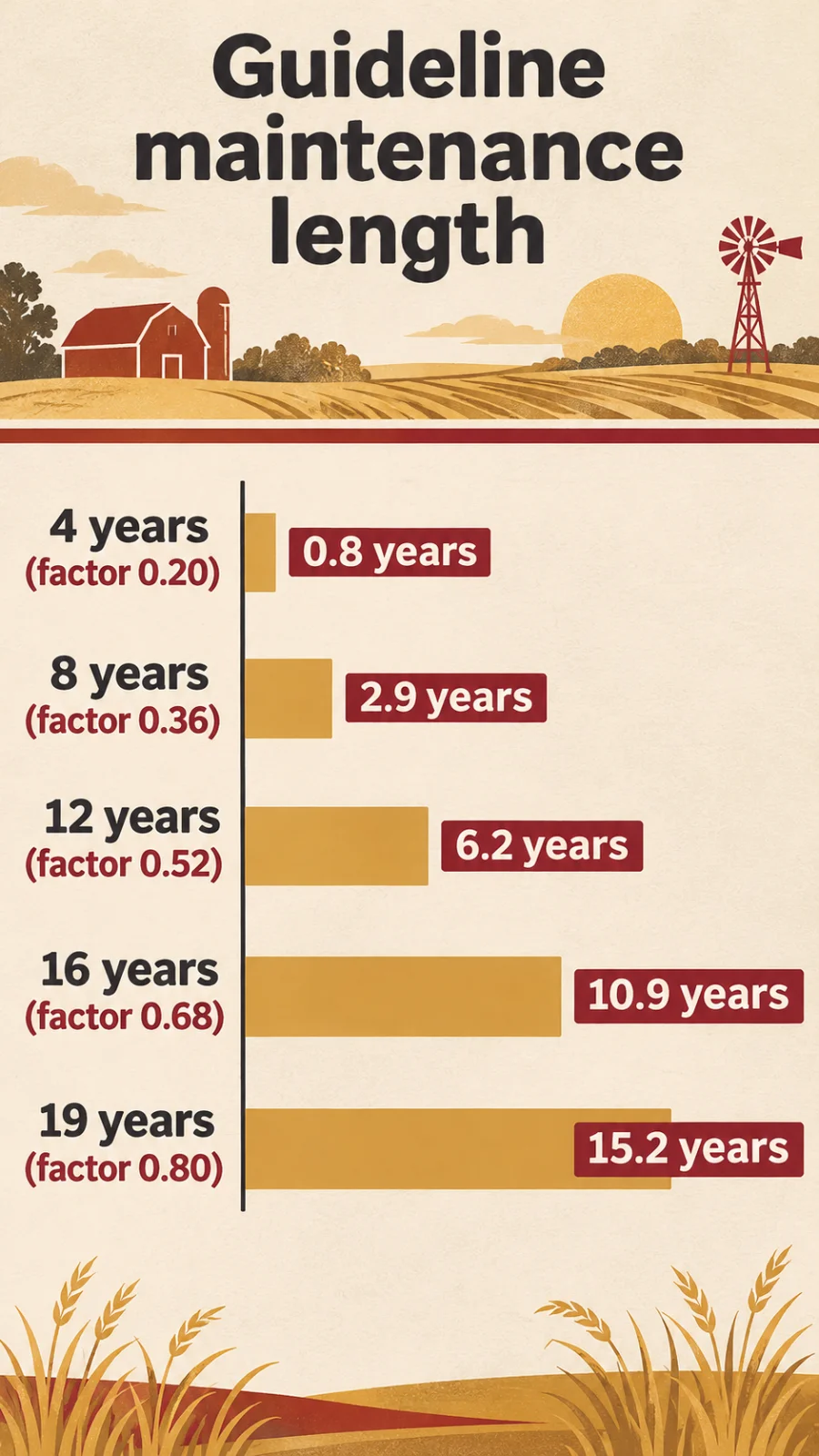
Duration is the length of the marriage when the case was filed multiplied by a factor that rises 0.04 for each year of marriage. The table shows sample cases.
| Marriage at filing | Factor | Guideline duration |
|---|---|---|
| 4 years | 0.20 | About 0.8 years |
| 8 years | 0.36 | About 2.9 years |
| 12 years | 0.52 | About 6.2 years |
| 16 years | 0.68 | About 10.9 years |
| 19 years | 0.80 | About 15.2 years |
| 20+ years | Judge’s discretion: equal to the marriage length, or indefinite | |
The judge may credit temporary maintenance already paid against the duration. If guideline maintenance plus child support would exceed 50% of the payor’s net income, the judge may depart from the guidelines for either one.
Types of awards and when they end
Section 504(b-4.5) has three types: fixed-term, which ends on a set date; indefinite, which continues until modified or terminated; and reviewable, which has a set term and can be reviewed, extended or ended. Under § 510(c), future maintenance ends on the death of either party, the recipient’s remarriage, or the recipient living with another person on a resident, continuing conjugal basis, unless the parties agreed otherwise in writing. The recipient must give the payor 30 days’ notice before remarrying.
Parenting Time and Decision-Making for Children
Illinois no longer uses the words “custody” and “visitation” in the divorce statute. Courts allocate parenting time and significant decision-making responsibilities, and both are decided by the child’s best interests.
Under 750 ILCS 5/602.5, decision-making covers four areas: education, health, religion and extracurricular activities. The statute does not require that each parent receive a share, so a judge can give an area to one parent or both. Each parent has sole responsibility for routine and emergency decisions during their own parenting time.
Section 602.7 governs parenting time and lists 17 best-interests factors. They include each parent’s and the child’s wishes, the time each parent spent on caretaking in the 24 months before the petition was filed, the child’s adjustment to home and school, and a catch-all for any other factor the court finds relevant.
The parenting plan
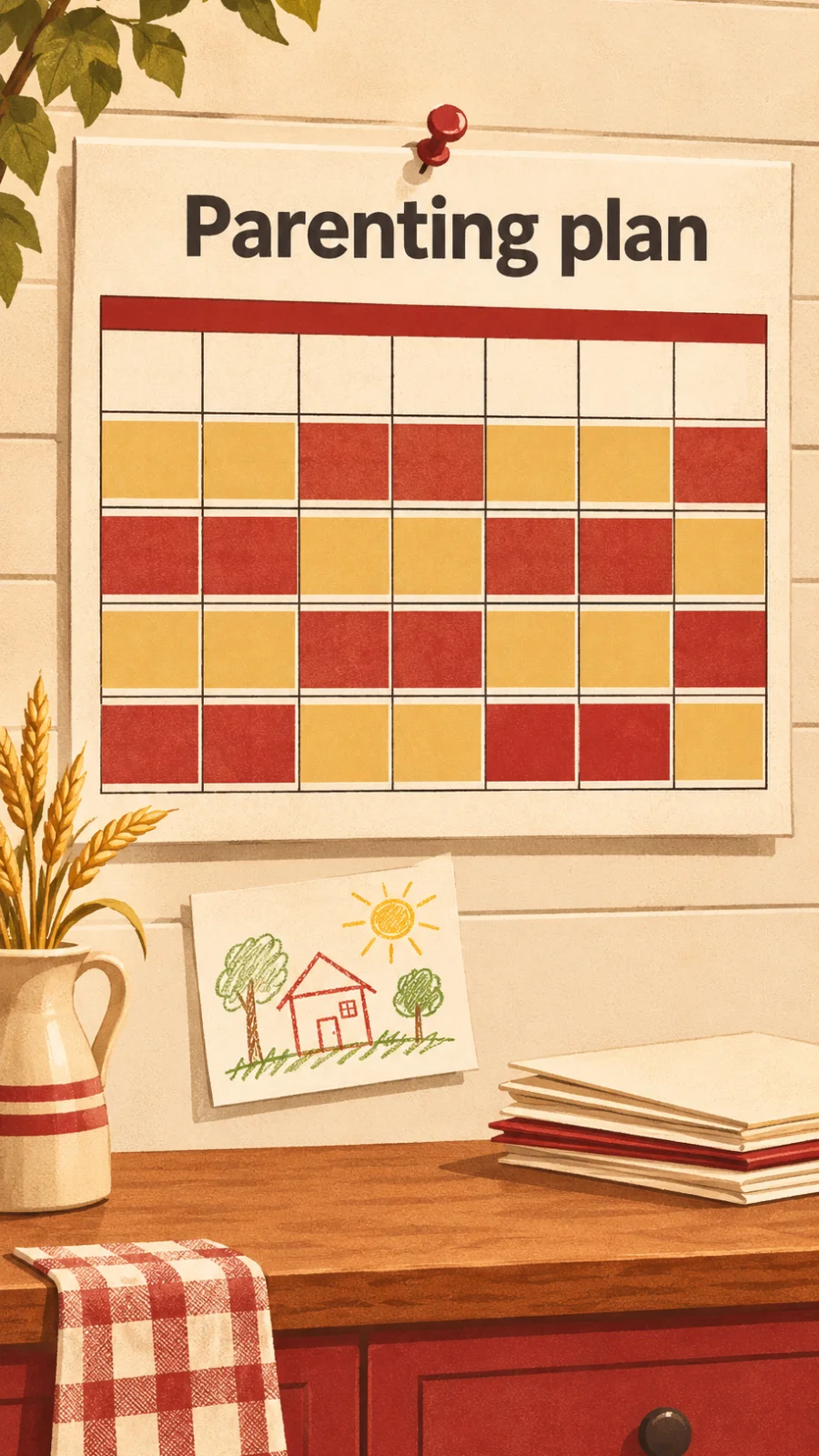
Section 602.10 requires a parenting plan. It covers decision-making, the parenting time schedule, and a 60-day notice before a change of residence, among other terms. Plans are due within 120 days, and mediation is required unless an impediment exists. The statewide Parenting Plan form is part of the approved divorce packet.
The required parenting class
Supreme Court Rule 924 requires each circuit to run or approve a parenting education program of at least four hours. Parents are expected to complete it within 60 days after the initial case management conference, unless the court excuses it, and a judge may sanction a parent who willfully skips it.
In Cook County, Family Court Services runs the “Focus on Children” program under § 404.1 and Rule 924. A parent in a Cook County case cannot assume the class can be put off until after the hearing, because Cook’s local rule ties the final parenting judgment to filed certificates of completion.
Child Support Under the Income Shares Model
Under 750 ILCS 5/505, child support is based on both parents’ combined net income. The Illinois Department of Healthcare and Family Services adopts the guidelines and the schedule of basic obligations, which reflects what parents in the same household typically spend on a child. Each parent pays their percentage share of that amount, and the guideline result is presumed correct unless the judge makes written findings to deviate.
Net income is gross income minus a standardized tax amount, using a single filer’s federal and state taxes plus Social Security and Medicare. Gross income covers all sources, but it excludes means-tested benefits such as TANF, SSI and SNAP. Maintenance that is taxable to the recipient counts as the recipient’s income.
Shared parenting time and add-ons
If each parent has the child for 146 or more overnights a year, the basic obligation is multiplied by 1.5. Each parent’s share is then multiplied by the percentage of time the child spends with the other parent, and the two amounts are offset. The parent with the higher obligation pays the difference.
Childcare costs a parent needs in order to work, train or search for a job, and extracurricular and school expenses, are added on top. They are divided in proportion to each parent’s net income.
Public Act 104-340, signed August 15, 2025, amended § 505’s definition of a child, and the section covers a child who is 19 or younger and still attending high school.
Changing Orders After the Judgment
Under 750 ILCS 5/510, child support and maintenance can be changed only on a showing of a substantial change in circumstances. A change can only reach installments that come due after the other side has been given notice of the motion, so a delay in filing costs you money.
Property division is harder to reopen. It cannot be revoked or modified unless the court finds conditions that justify reopening a judgment under Illinois law.
Child support has one more route. For a case in which a party receives child support enforcement services from the Department of Healthcare and Family Services and at least 36 months have passed, the guideline amount can justify a change if it differs from the existing order by at least 20% and at least $10 a month.
What to Do Next
Start by deciding whether you qualify for the joint simplified route or need a full petition. Then gather what the Financial Affidavit asks for.
- Proof of the date you and your spouse began living separate and apart, if you plan to rely on the six-month presumption.
- Income records for the last 12 months, plus recent tax returns.
- Statements for bank, retirement and investment accounts, and records for mortgages and other debts.
- A list of non-marital property, such as gifts, inheritances and premarital assets, with documents that trace them.
- If you have children, a draft parenting plan and the schedule for your county’s parenting class.
Download the statewide packet from the Illinois Courts website, file with the circuit clerk in the county where you or your spouse lives, and ask the clerk about the local fee and the filing method. Illinois Legal Aid Online offers free guided forms and the state’s self-help centers help with paperwork, although they cannot give legal advice.
Frequently Asked Questions
How long does a divorce take in Illinois?
Illinois has no mandatory waiting period, so timing depends on your case. A judgment cannot be entered until the court has handled or reserved parental responsibilities, support, maintenance and property.
Do I need a reason to get a divorce in Illinois?
No. The only ground is irreconcilable differences that caused an irretrievable breakdown. Living apart for six months settles that question, and a judge does not weigh fault when dividing property.
Can I file for divorce if my spouse does not agree?
Yes. Your spouse does not have to consent. If your spouse does not respond after being served, you can ask the court for a default.
Will I get half of everything?
Not automatically. Illinois divides marital property in “just proportions” using 12 statutory factors, and the judge assigns non-marital property to the spouse who owns it.
Do I have to pay spousal maintenance?
Not in every case. The guideline formula applies when the spouses’ combined gross income is under $500,000, and the judge can find maintenance inappropriate. Maintenance ends on either spouse’s death, the recipient’s remarriage, or the recipient’s cohabitation unless the parties agreed otherwise in writing.
Do I have to take a parenting class?
Yes, if the case involves minor children. Rule 924 requires an approved program of at least four hours, and a judge can sanction a parent who willfully refuses.
References
- Illinois General Assembly, 750 ILCS 5/401, Dissolution of marriage
- Illinois General Assembly, 750 ILCS 5/503, Disposition of property and debts
- Illinois General Assembly, 750 ILCS 5/504, Maintenance
- Illinois General Assembly, 750 ILCS 5/505, Child support
- Illinois General Assembly, 750 ILCS 5/510, Modification and termination of maintenance and support
- Illinois General Assembly, 750 ILCS 5/452, Joint simplified dissolution
- Illinois General Assembly, 750 ILCS 5/602.5, Allocation of decision-making
- Illinois General Assembly, 750 ILCS 5/404.1, Parenting education
- Illinois General Assembly, Public Act 103-0967, amendments to Sections 504, 505, 600, 602.10 and 607.5
- Illinois Appellate Court, In re Marriage of Kenik, 181 Ill. App. 3d 266 (1989)
- Administrative Office of the Illinois Courts, Approved Statewide Forms for Divorce, Child Support and Maintenance
- Illinois Supreme Court, Rule 924, Parenting Education Requirement
- Clerk of the Circuit Court of Cook County, CCDR 0703 Domestic Relations Division Fee Schedule
- Administrative Office of the Illinois Courts, Justice Corner on 735 ILCS 5/5-105 civil fee waivers