
Iowa Lemon Law 2027: Is Your Vehicle Eligible for a Buyback?
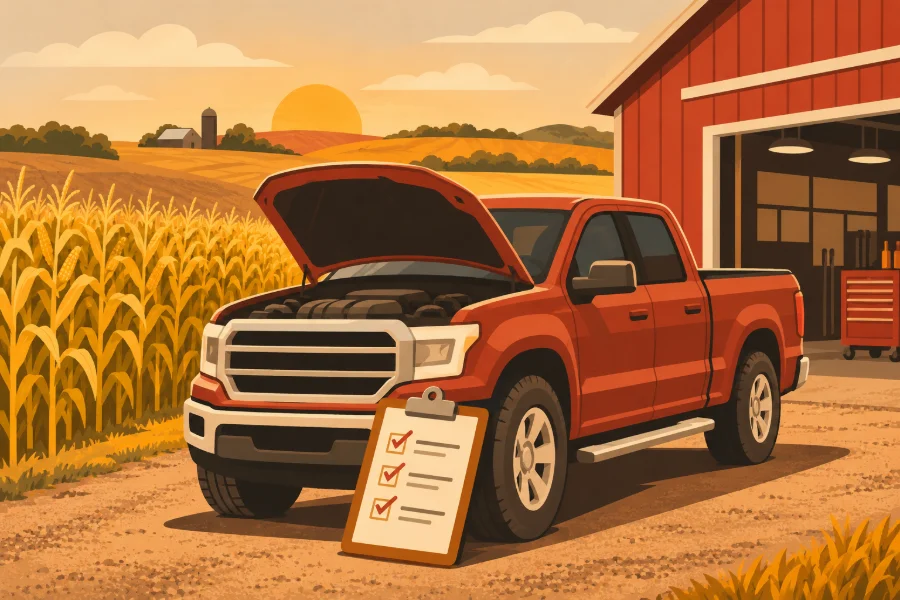
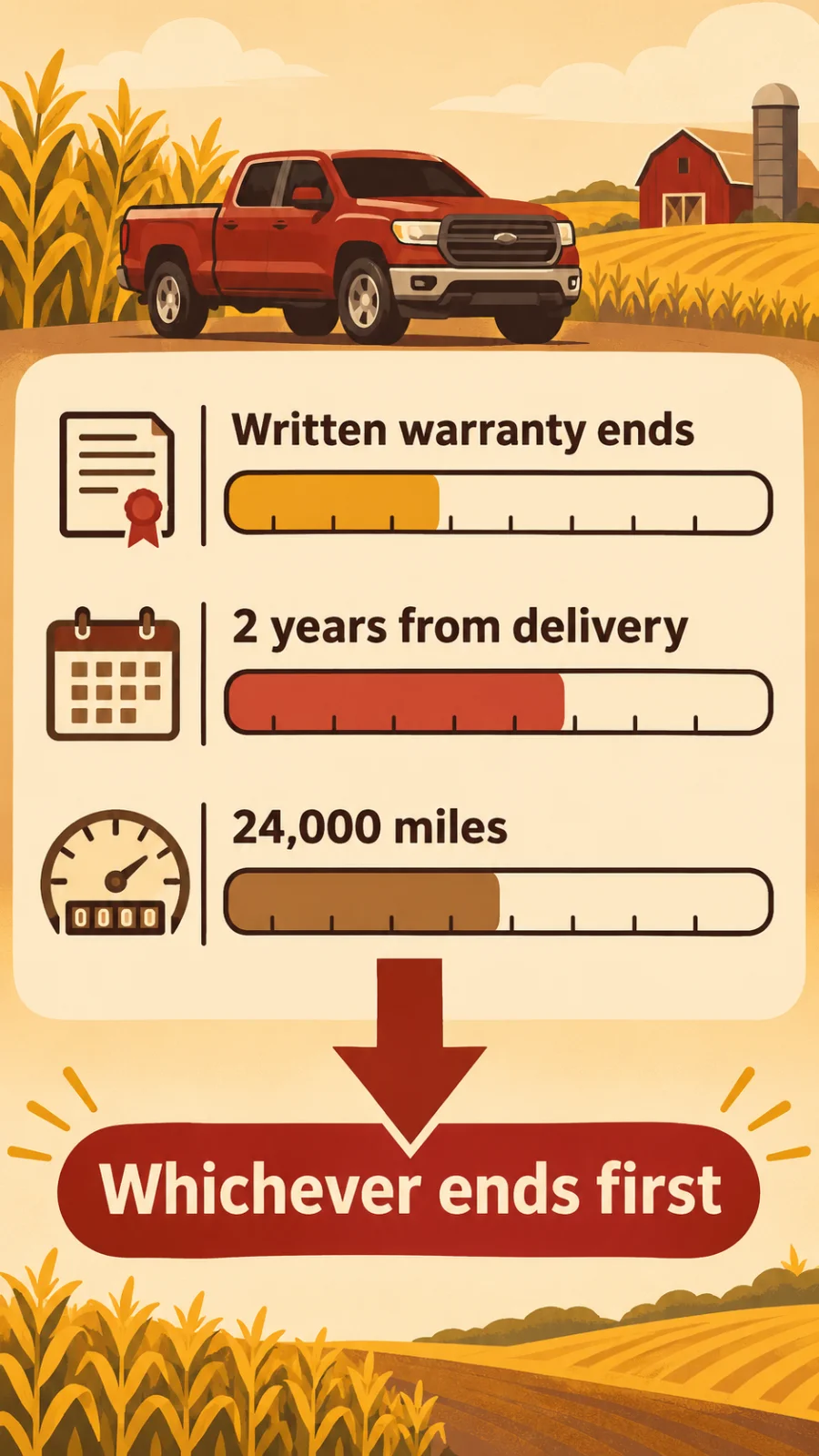
Iowa’s lemon law, Iowa Code chapter 322G, entitles you to a refund or a replacement if a new vehicle has a defect the manufacturer cannot fix after a reasonable number of tries. The defect must show up within the “lemon law rights period,” which ends at two years, 24,000 miles, or the end of the written warranty, whichever comes first.
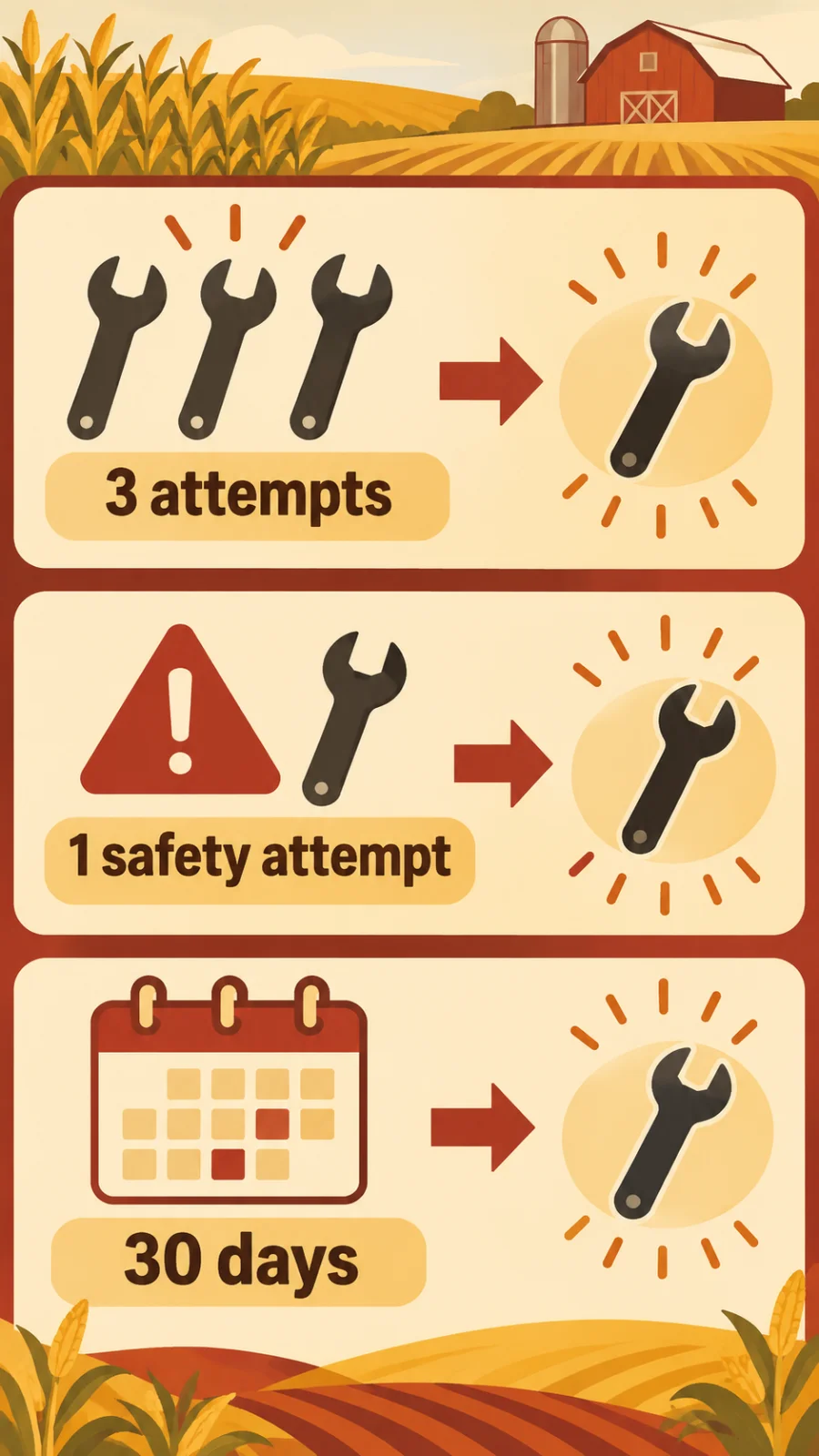
A vehicle is presumed to be a lemon after three failed repairs of the same problem, one failed repair of a defect likely to cause death or serious injury, or 30 cumulative days in the shop. Each of those triggers also requires a final repair attempt for the manufacturer, and Iowa makes you use the manufacturer’s certified dispute program before you can claim the statutory buyback.
Which Vehicles and Time Limits Does the Iowa Lemon Law Cover?
The law covers a passenger vehicle or light truck that was new or never titled when you bought or leased it, and only for defects that appear during the lemon law rights period. Under Iowa Code § 322G.2(8), that period ends at the earliest of three things: the end of the manufacturer’s written warranty, two years after original delivery, or the first 24,000 miles of operation attributable to a consumer.
Both limits matter. A truck delivered March 1, 2025, with 30,000 miles by October 2026 has already passed 24,000 miles, even though the two-year mark is months away. The Attorney General’s lemon law page lists the age and mileage limits with an “or” between them, but the statute’s wording is “whichever expires first.”
What counts as a motor vehicle?
Section 322G.2(13) defines a covered motor vehicle as a self-propelled vehicle bought or leased in Iowa and designed mainly to carry people or property on public roads. It excludes mopeds, motorcycles, autocycles, motor homes, and any vehicle with a gross vehicle weight rating over 15,000 pounds. Bills to add motorcycles and autocycles were introduced in 2019 (HF 345) and 2021 (HSB 79, SSB 1136) at the Attorney General’s request, but the exclusion remains in the code.
Who counts as a consumer?
A “consumer” is a purchaser or lessee who is not buying for resale or to lease the vehicle onward. The definition also reaches any other person the warranty allows to enforce it during the rights period. That can matter if you received the vehicle as a gift or bought it from the first owner while the warranty was still running.
Leases are covered, and so are vehicles that were never titled before you got them, such as a dealer demonstrator. A used car that was titled to someone else before you is outside the chapter, even if the factory warranty is still active.
What Kind of Defect Qualifies?
The defect must substantially impair the vehicle and be covered by the manufacturer’s express warranty. Section 322G.2(20) defines “substantially impair” two ways: rendering the vehicle unfit, unreliable, or unsafe for warranted or ordinary use, or significantly diminishing its value.
A rattling glove box probably does not meet that test. A transmission that shudders, an engine that stalls in traffic, or a brake fault does. If the same defect also cuts the vehicle’s resale value sharply, that value loss alone can satisfy the second prong.
Damage you or someone else caused does not count. Under § 322G.2(14), problems from an accident, abuse, neglect, or modification by anyone other than the manufacturer or its authorized service agent are not nonconformities. A manufacturer can raise those facts as defenses, along with a claim that you did not file in good faith (§ 322G.5).
How Many Repair Attempts Make a Vehicle a Lemon in Iowa?
Iowa presumes a reasonable number of repair attempts has been made when any one of three situations occurs during the rights period and the problem still exists. The presumption comes from § 322G.4(3)(a), and each version is built around a final repair attempt the manufacturer gets after you send written notice.
| Situation | Threshold | Then |
|---|---|---|
| Same substantially impairing defect | 3 repair attempts | Final attempt by manufacturer |
| Defect likely to cause death or serious bodily injury | 1 repair attempt | Final attempt by manufacturer |
| Vehicle out of service for repairs | 30 or more cumulative days | Presumption applies |
The days do not have to be consecutive, and routine maintenance does not count toward the 30. The statute lets the 30-day figure stretch when repair services were unavailable because of war, invasion, strike, fire, flood, or natural disaster.
Why do some sources say 20 days and others 30?
Both numbers appear in the law, for different purposes. At 20 or more cumulative days out of service, you may send the manufacturer written notice, and the manufacturer then has ten cumulative days to fix the problem (§ 322G.4(1)). The presumption that the manufacturer had a reasonable number of attempts takes 30 days. The 20-day mark also stops the clock on your mileage offset, covered below.
What Must You Do Before You Can Claim a Buyback?
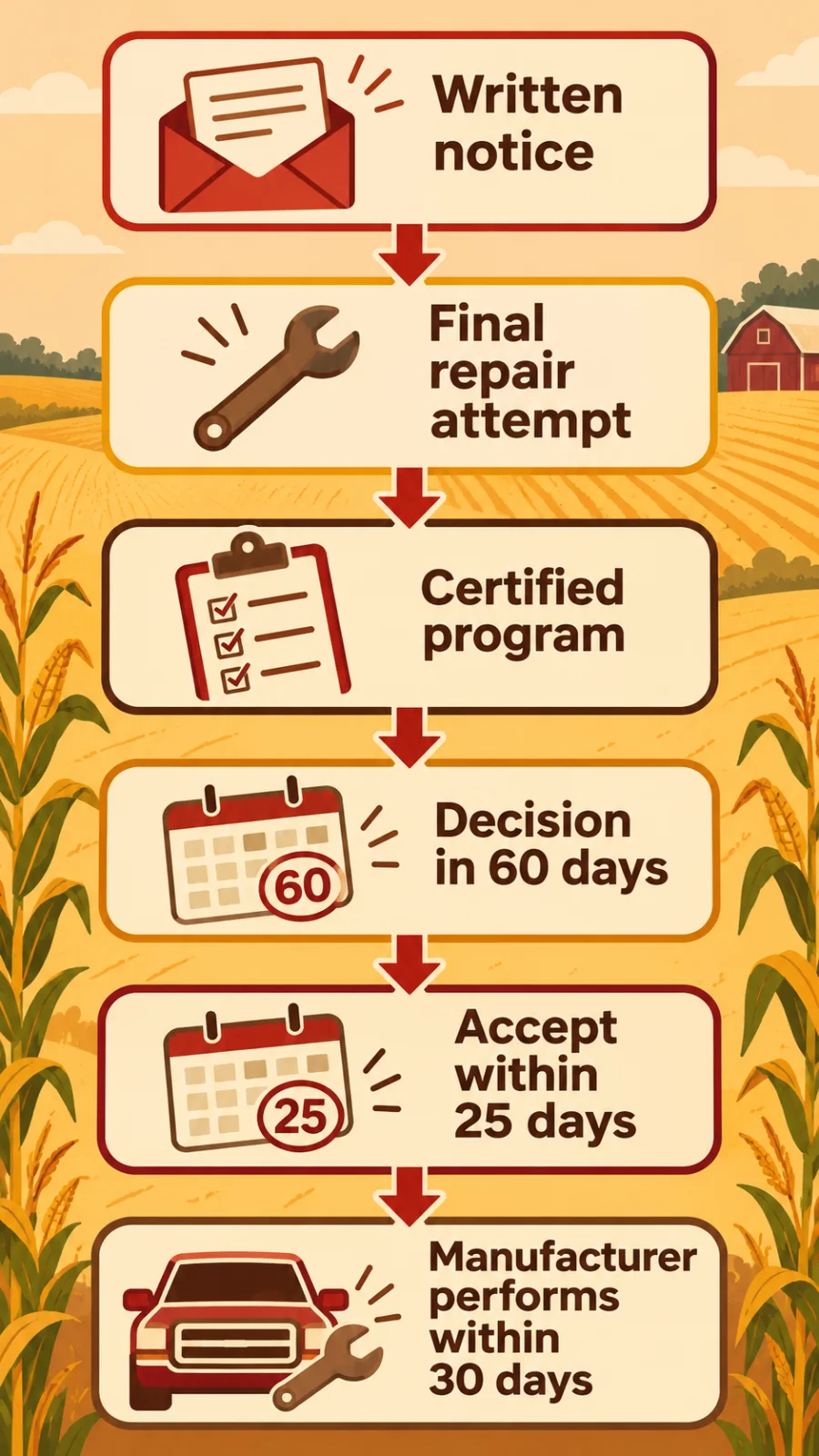
You must give the manufacturer written notice and a last chance to fix the defect before the presumption applies. Send the notice by certified or registered mail, or by overnight delivery service, after the third failed attempt (or the first, for a safety defect).
The manufacturer then has ten days to tell you it will repair the vehicle at a reasonably accessible facility, and ten more days after you deliver the vehicle to complete the work. If the manufacturer misses either deadline, the final-attempt requirement drops away.
The Attorney General’s office does not accept lemon law claims. Its lemon law page tells you to submit your claim to the manufacturer and its certified dispute resolution program through the program’s online portal, by email, or by certified mail, and it offers an optional Motor Vehicle Defect Notification form you can include.
What to gather before you file
- A repair order from every shop visit, showing the date, odometer reading and diagnosis
- Your purchase or lease agreement
- A day count of how long the vehicle sat in the shop
- Towing receipts and any employer letter documenting lost work time
- Photos, videos and technician statements about the defect
Manufacturers must give you an itemized, legible repair order each time the vehicle comes back, and on request they must hand over diagnostic computer printouts and technical service bulletins for your year and model (§ 322G.3). Ask for those in writing.
How Does the Manufacturer Dispute Program Work?
If the manufacturer runs a program certified by the Attorney General, you must use it first. Section 322G.6(11) says the refund and replacement remedies of § 322G.4(2) do not apply to a consumer who has not first resorted to a certified program, provided the manufacturer told you how to file a claim. The Attorney General’s page names two certified programs: the National Center for Dispute Settlement and BBB AUTO LINE.
The program is free to you. It must tell both sides within five days of your claim that each may make an oral presentation, and the Attorney General’s page says the hearing can be in person or remote.
| Step | Deadline | Source |
|---|---|---|
| Program issues decision | 60 days from your claim (7 more days if the manufacturer was not yet notified) | § 322G.6(4) |
| You accept a favorable decision | Up to 25 days from receipt | § 322G.6(5) |
| Manufacturer performs | Time set in the decision, no more than 30 days from your acceptance | § 322G.6(5) |
| Appeal to district court | 50 days after receipt, or 25 days after you accept, whichever is first | § 322G.8(4) |
Refund or Replacement: What You Actually Get
When the manufacturer cannot fix a substantially impairing defect after a reasonable number of attempts, it must replace the vehicle or repurchase it within 40 days of receiving your payment of a reasonable offset for use (§ 322G.4(2)). The choice is yours: the statute gives you an “unconditional right” to take a refund rather than a replacement. Until a replacement arrives, the manufacturer must provide a substitute vehicle.
A refund covers the full purchase or lease price, plus collateral charges and reasonably incurred incidental charges, minus the offset. You, your lienholder or your lessor must provide clear title and possession of the vehicle. The lienholder is paid as its interest appears, and a lease ends without an early-termination penalty.
How the use offset is calculated
The manufacturer may deduct a charge for the miles you drove. Section 322G.2(18) multiplies the miles attributable to you by the purchase price and divides by 120,000. The miles stop counting at the earliest of three events: the third repair attempt on the same defect, the first repair attempt on a life-threatening defect, or the 20th cumulative day out of service.
Take a hypothetical truck bought for $40,000, with 6,000 miles on the odometer at the third repair attempt for the same defect. The offset is 6,000 × $40,000 ÷ 120,000, which equals $2,000. If you also paid $3,000 in collateral charges and $200 for towing, the refund works out to $40,000 + $3,000 + $200 − $2,000 = $41,200, before any amount goes to a lienholder.
For a lease, the statute swaps the purchase price in the formula for the lessor’s actual lease price plus two percent of the purchase price.

Going to Court: Deadlines, Damages and Attorney Fees
You can sue in Iowa district court if the program fails to decide on time, if the manufacturer has no certified program, or if you accepted a decision and the manufacturer did not perform. The deadlines in § 322G.8 are short, and they differ by situation.
- No timely decision or no certified program: sue within one year after the lemon law rights period expires, or after it is extended under § 322G.4(3).
- Manufacturer ignores a decision you accepted: sue within six months after the date the decision gave for performance.
- Appeal of a program decision: file within 50 days of receiving it, or 25 days after you accept it, whichever comes first. Appeals are tried from scratch, called de novo, and can rest on stipulated facts.
As a hypothetical, say your truck was delivered March 1, 2025, and the rights period runs the full two years. It ends March 1, 2027, and a suit for failure to decide in time would be due by March 1, 2028. Under § 322G.4(3)(b), a defect reported but not fixed before the period ended extends it, up to two years from delivery or 24,000 miles, whichever comes first.
What a winning consumer recovers
A prevailing consumer recovers any pecuniary loss, the § 322G.4(2) refund or replacement relief, reasonable attorney fees, and costs. If a court affirms a program decision in your favor, you can also recover continuing damages of $25 per day for days beyond the 25-day period after the manufacturer receives your acceptance. A manufacturer that appeals in bad faith faces a doubled award, and the court may triple it (§ 322G.8(7)).
Dealers are generally not defendants. Section 322G.11 gives franchised dealers no liability under the chapter, apart from duties on resold returned vehicles, and bars manufacturers from charging refund costs back to dealers unless a court finds the dealer’s repairs were substantially inconsistent with the manufacturer’s published instructions. Section 322G.8(9) preserves your other legal rights, such as warranty claims under other laws.
What Happens When a Manufacturer Breaks the Rules?
The Attorney General can fine a manufacturer up to $1,000 per violation after a hearing under Iowa’s administrative procedure act (§ 322G.9; Iowa Admin. Code r. 61-30.5). A violation is also an unfair or deceptive trade practice under Iowa Code § 714.16 (§ 322G.10). Any agreement that waives your lemon law rights is void (§ 322G.13).
A separate penalty targets a manufacturer that ignores a decision you accepted. If you accepted within 25 days, the manufacturer neither complied nor appealed, and no notice of a petition reached the Attorney General within 60 days, the Attorney General may seek a fine of up to $1,000 per day until it reaches twice the vehicle’s purchase price (§ 322G.8(4)). The manufacturer escapes the fine by proving with clear and convincing evidence that the delay was beyond its control, or by showing you accepted the delay in a signed writing.
What If Your Vehicle Does Not Qualify?
A vehicle outside the rights period, a motorcycle, a motor home, or a used car falls outside chapter 322G, but other remedies may still apply. Section 322G.8(9) leaves your rights under other laws intact, and the Attorney General’s lemon law page suggests consulting a private attorney if the vehicle fails the eligibility test. The Attorney General’s office is barred from representing citizens privately.
Safety defects and recalls belong with NHTSA, which takes complaints at safercar.gov or the U.S. DOT Vehicle Safety Hotline at 1-888-327-4236. For general consumer questions, the Iowa Attorney General’s Consumer Protection Division answers at 515-281-5926, or 888-777-4590 outside the Des Moines area.
Buying a car that was bought back
If you are shopping rather than suing, Iowa requires paperwork on bought-back cars. A manufacturer that takes back a vehicle under § 322G.12 must report its VIN to the state within ten days and have the title branded as returned under a lemon law. No one may knowingly sell or lease it without clearly disclosing the nonconformity, and Iowa Admin. Code ch. 61-30 sets the disclosure wording.
Frequently Asked Questions
Does Iowa’s lemon law cover used cars?
No. Chapter 322G covers only new or previously untitled vehicles, so a car titled to a prior owner before you is outside it. A used-car defect may still be covered by a warranty or other consumer law.
Do I have to use arbitration before suing in Iowa?
If the manufacturer has a certified dispute program and told you how to file a claim, yes. Section 322G.6(11) denies the statutory refund or replacement to a consumer who skipped it.
How long do I have to file an Iowa lemon law claim?
If the program misses its 60-day decision deadline or none exists, you have one year after the rights period expires to sue. After an accepted decision the manufacturer ignores, you have six months from the date set for performance.
Can I get a refund instead of a replacement?
Yes. Iowa gives you an unconditional right to choose a refund over a replacement, reduced by the mileage offset.
Do I need a lawyer to file a lemon law claim in Iowa?
No. The Attorney General’s page says the law lets owners pursue claims independently, but a prevailing consumer can recover reasonable attorney fees, so hiring a lawyer need not cost you out of pocket.
Can I sue the dealership under the lemon law?
Generally no. Section 322G.11 places lemon law liability on the manufacturer and bars suits against franchised dealers under the chapter, apart from duties on resold returned vehicles.
References
- Iowa Legislature, Iowa Code chapter 322G, Defective Motor Vehicles (Lemon Law)
- Iowa Legislature, Iowa Code § 322G.2, definitions of rights period, nonconformity and offset
- Iowa Legislature, Iowa Code § 322G.4, repair attempts, presumption, refund and replacement
- Iowa Legislature, Iowa Code § 322G.6, certified dispute resolution programs
- Iowa Legislature, Iowa Code § 322G.8, consumer remedies and deadlines
- Iowa Attorney General, Iowa Admin. Code ch. 61-30, New Motor Vehicle Warranty Protection (Lemon Law) rules
- Iowa Attorney General, The Iowa Lemon Law consumer guidance and claim process