
Kansas Lemon Law: 4 Repairs, 30 Days, 10 Attempts Explained
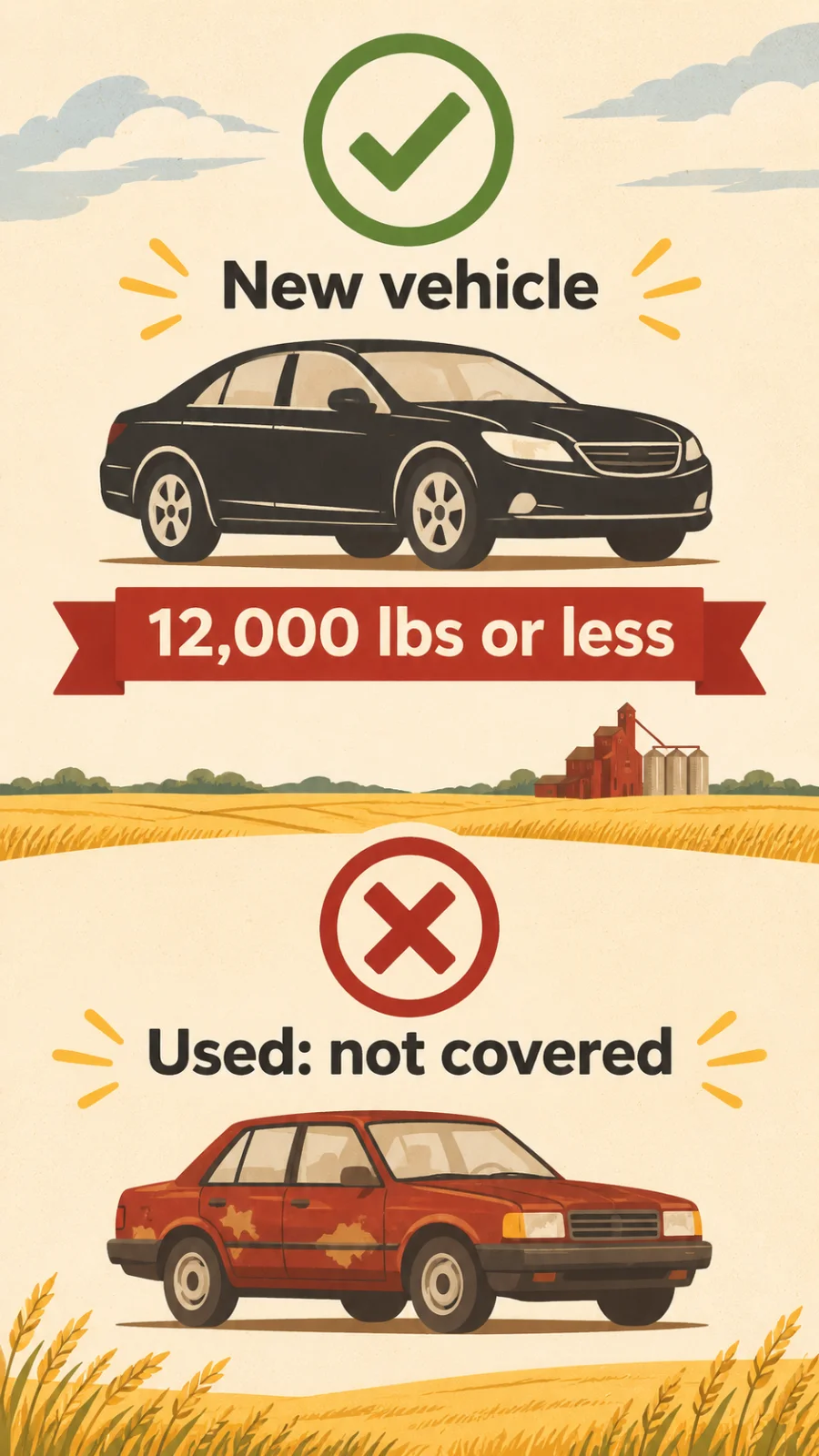
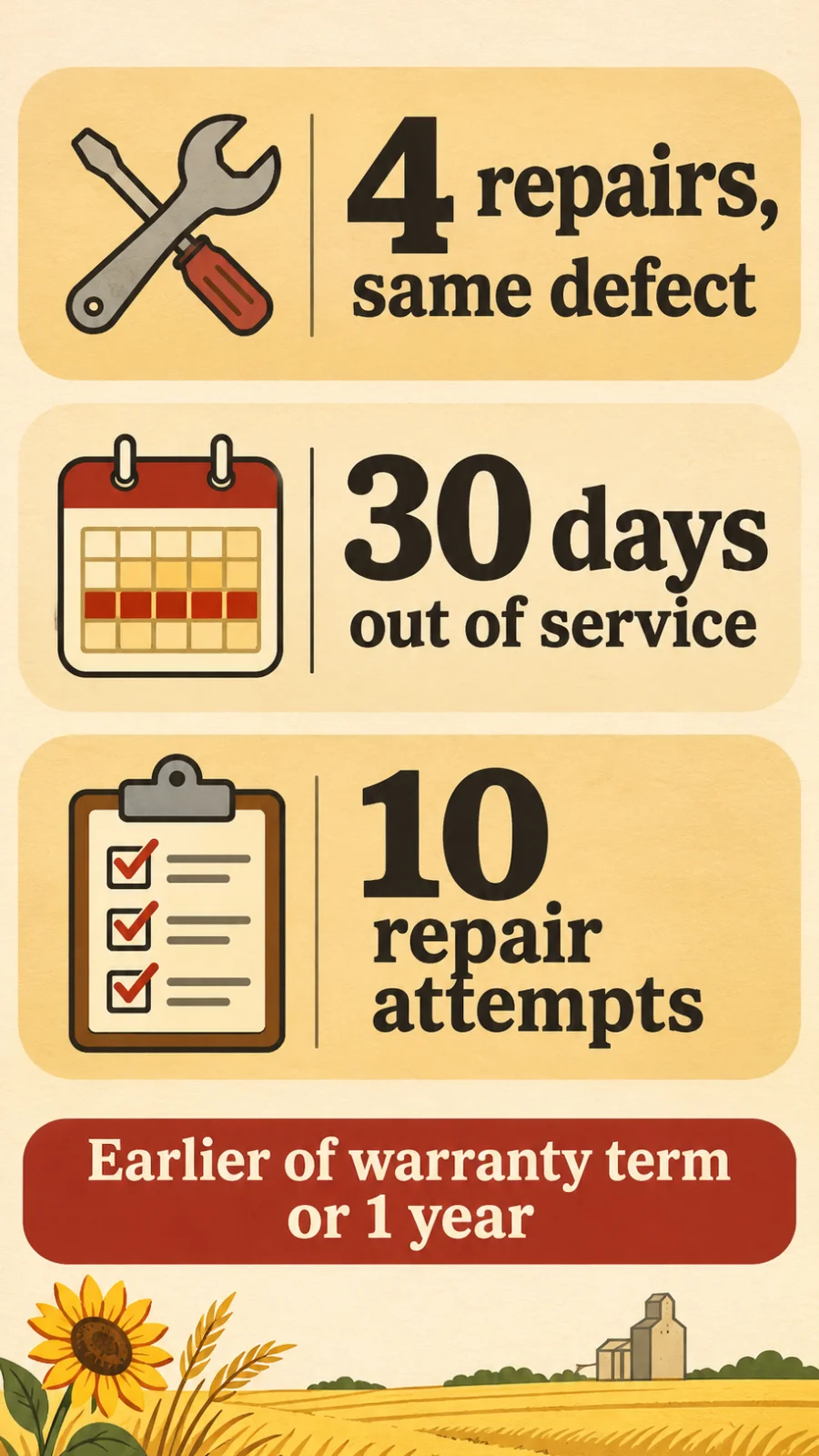
The Kansas lemon law, K.S.A. 50-645, requires a manufacturer to replace a new vehicle or refund its price when the manufacturer cannot fix a warranty defect after a reasonable number of tries. Kansas presumes that number has been reached after four repairs of the same defect, 30 days out of service, or 10 total repair attempts, all inside the first year or the warranty term, whichever ends first. Used vehicles are not covered.
The rule is short, only six subsections, and its timing is stricter than many owners expect. Read it closely before you rely on a longer warranty.
Which Vehicles and Buyers Does the Kansas Lemon Law Cover?
The law covers a new motor vehicle sold or leased in Kansas and registered at a gross weight of 12,000 pounds or less. The protected person is the “consumer,” defined as the original purchaser or lessee who did not buy for resale. A second owner is not an original purchaser, so the second owner has no claim under this statute.
New vehicles only
The Kansas Attorney General’s office states that the law does not apply to used cars. A used car with a warranty problem falls under the warranty itself, the Uniform Commercial Code and the Kansas Consumer Protection Act instead. Section 50-646 keeps all of those remedies alive alongside the lemon law.
Conversions and custom work
The definition excludes customized parts added or modified by second stage manufacturers, first stage converters or second stage converters, as those terms are defined in K.S.A. 8-2401. If a defect sits in an upfit, such as a camper or wheelchair conversion, the lemon law does not reach that part. It still reaches the chassis and powertrain from the original manufacturer.
Cars bought outside Kansas
A vehicle sold in another state but delivered to you in Kansas is treated as sold in Kansas. K.S.A. 8-2440, added in 2000, says delivery within the state to a consumer brings the vehicle under sections 50-645 and 50-646. A border-town purchase in Missouri with delivery to your Kansas driveway can therefore qualify.
Leases are written into the statute, but one old case points the other way
The current text names lessees, so a leased new vehicle is covered on its face. The wrinkle is Ford Motor Credit Co. v. Sims, 12 Kan. App. 2d 363, 743 P.2d 1012 (1987), where the Court of Appeals held the law did not apply to a “true lease” and imposed liability on the manufacturer only. The Legislature amended the statute in 1989 and 1996, after that decision, and the annotations list no later appellate ruling that settles how Sims fits the current wording. If your claim involves a lease, a lawyer should check this point.
The One-Year Window That Catches Kansas Owners Off Guard
You must report the defect to the manufacturer, its agent or its authorized dealer during the warranty term or within one year of original delivery, whichever ends first. A five-year powertrain warranty does not stretch that window past one year. Every count in the lemon law presumption also runs inside this same period.
Two details work in your favor. First, the manufacturer must still make the repairs even if the work happens after the term or the year ends, as long as you reported the problem in time. Second, the warranty term, the one-year period and the 30-day count are all extended by any time repair services are unavailable to you because of war, invasion, strike, fire, flood or other natural disaster.
The statute contains no mileage cap and no requirement that you give the manufacturer a final repair attempt before a claim. Some summaries online add both. The text of K.S.A. 50-645 does not.
When Is a Car Presumed a Lemon in Kansas?
A reasonable number of repair attempts is presumed once the manufacturer has actual notice of the problem and any one of three conditions is met. Each condition must occur within the warranty term or the first year, whichever ends first.
| Trigger | Threshold | What must also be true |
|---|---|---|
| Same defect repaired | 4 or more times | The defect substantially impairs use and value and still exists |
| Days out of service | 30 or more cumulative calendar days | The vehicle was out of service for repair |
| Total repair attempts | 10 or more | The attempts were for defects that substantially impair use and value |
The third trigger is the one owners overlook. Ten attempts can be spread across different defects, so a car that goes back for a transmission fault, a sensor fault and a brake fault can qualify without any single problem reaching four visits.
“Actual notice” means the manufacturer, not only the dealer
The presumption depends on the manufacturer having actual notice. The statute does not say a dealer’s repair order counts as notice to the manufacturer. Sending the manufacturer’s customer-care office a letter by certified mail, with your repair order numbers, removes the doubt.
The two defenses a manufacturer can raise
The manufacturer can defend a claim by showing the defect does not substantially impair the vehicle’s use and value, or that it results from your abuse, neglect or unauthorized modification. A cosmetic rattle may fail the first test. An aftermarket engine tune is the sort of change that supports the second.
What the Manufacturer Owes You: Refund or Replacement
If the manufacturer cannot conform the vehicle after a reasonable number of attempts, it must either replace it with a comparable vehicle under warranty or accept the return and refund the full purchase or lease price, including all collateral charges, less a reasonable allowance for use. The statute lists replacement and refund as the two options.
How the use allowance is calculated
The allowance comes from the most recent edition of Your Driving Costs, published by the American Automobile Association. It covers your own use and any earlier user’s use before the first report of the defect, plus use after that during periods when the vehicle is not out of service for repair. Miles you drive while the car sits in the shop do not count against you.
A worked example
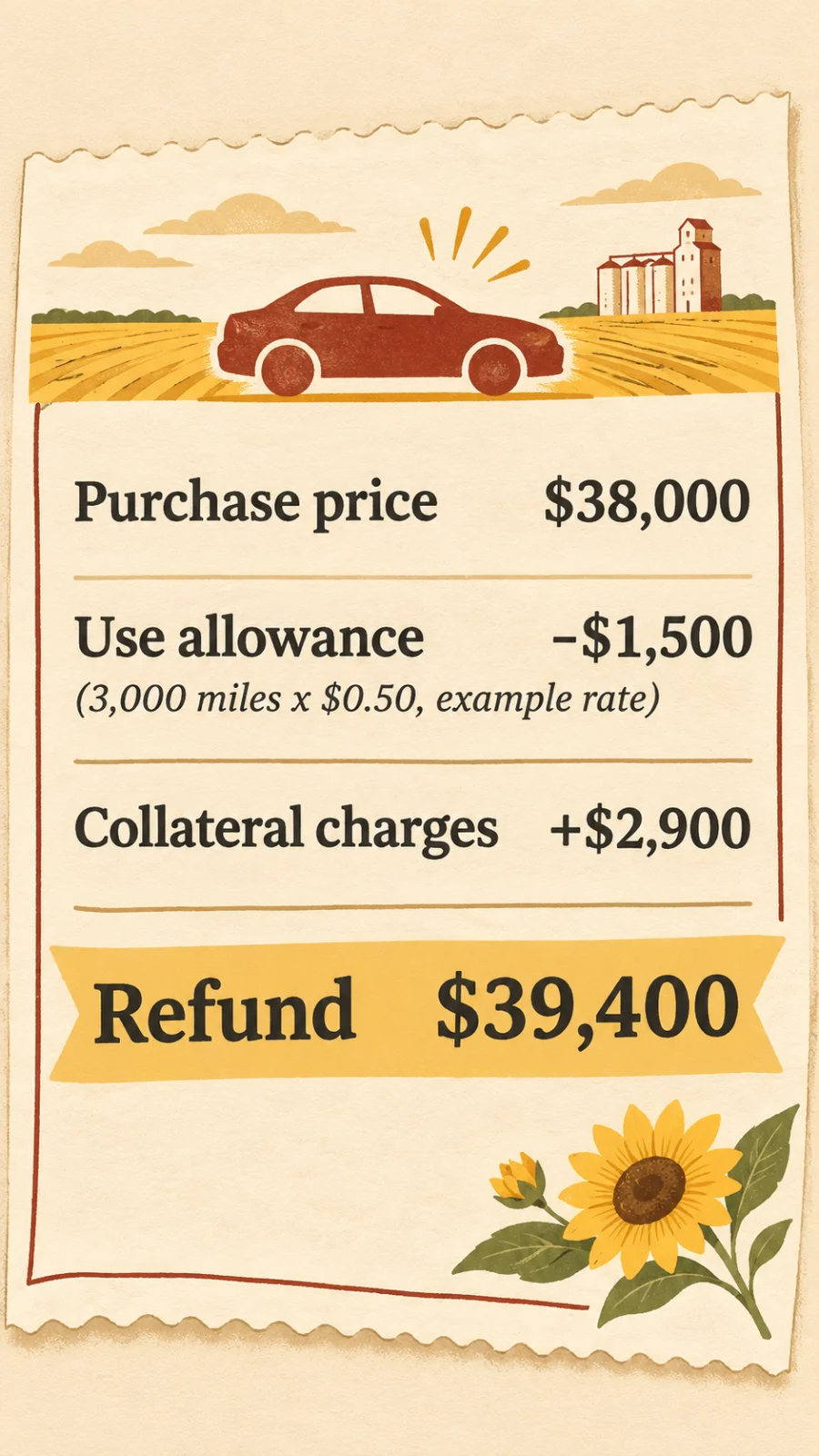
Say you bought a new SUV for $38,000, and the first report of the defect came at 3,000 miles. For this example only, assume a use rate of $0.50 per mile. The real rate comes from the AAA publication and changes with each edition.
- Purchase price: $38,000
- Use allowance: 3,000 miles × $0.50 = $1,500
- Price after allowance: $36,500
- Add $2,900 in documented collateral charges: $39,400 refund
If you still owe money on the vehicle, the statute directs the refund to you and the lienholder according to your interests. The lender is paid its balance first, and you receive what remains.
The undefined term: collateral charges
Kansas does not define “collateral charges.” Sales tax, title and registration fees are common candidates, and so are finance charges and rental costs, but the statute does not list them. Senate Bill 423 in 2022 proposed a definition and a change to the use allowance, and the bill died in committee on May 23, 2022. The undefined term remains the law, so keep receipts for every out-of-pocket expense tied to the defect.
Do You Have to Use the Manufacturer’s Arbitration Program First?
Only if the manufacturer’s program meets federal rules. Under subsection (e), if a manufacturer has an informal dispute procedure that fully complies with 16 C.F.R. part 703, the refund and replacement provisions do not apply to a consumer who has not used it first. Your warranty booklet should say whether such a program exists.
A compliant program must issue a decision no later than 40 days after it is notified of the dispute (16 C.F.R. § 703.5). Its decision does not bind you. If you are unhappy with it, you can still go to court, and the decision can be used as evidence.
Arbitration can reach beyond the manufacturer. In Hemphill v. Ford Motor Co., No. 98,966, the Court of Appeals held in 2009 that a Mustang buyer was estopped from avoiding arbitration with Ford because the claims against Ford were closely intertwined with claims against the dealer and the finance company that were subject to arbitration. Read the arbitration clause in your purchase contract before you file anything.
Who You Can Hold Responsible, and What Else You Can Recover
The lemon law’s refund duty falls on the manufacturer. Sims held that the statute imposes liability on the manufacturer only and creates no lemon law action against the dealer. The dealer still performs repairs, but a refund demand goes to the manufacturer.
Beyond the refund, the Kansas Consumer Protection Act allows an aggrieved consumer to recover the greater of actual damages or a civil penalty, with the penalty capped at $10,000 per violation under K.S.A. 50-636. A court may award reasonable attorney fees to a consumer who prevails against a supplier under K.S.A. 50-634. The attorney general also has jurisdiction to enforce the lemon law under subsection (f).
One point is unsettled. Section 50-645 itself does not mention penalties or attorney fees, so whether a lemon law claim automatically opens the door to KCPA damages is a question for a lawyer. The federal Magnuson-Moss Warranty Act gives a cleaner fee path: under 15 U.S.C. § 2310(d)(2), a consumer who finally prevails may recover costs and attorney fees based on actual time spent, unless the court finds an award inappropriate.
What to Do Now If You Think You Have a Lemon
- Build a repair log. Keep every repair order and write down the date the vehicle went in, the date it came out, the mileage and the complaint. Add up the calendar days out of service.
- Write to the manufacturer. Send a letter by certified mail to the manufacturer’s customer-care address in your owner’s manual. List each repair order and say the defect persists.
- Check the warranty booklet. If it names an informal dispute program, file with it. The 40-day decision clock starts when the program receives your dispute.
- Contact the Attorney General. The Consumer Protection Division takes complaints at 1-800-432-2310 or (785) 296-3751, and the AG’s office advises consumers to file early.
- Talk to a lawyer before the first-year window closes. Fee-shifting rules mean many consumer attorneys will review a claim without charging you up front, though that varies by firm.
Frequently Asked Questions
Does the Kansas lemon law cover used cars?
No. The Kansas Attorney General says the law applies to new motor vehicles under 12,000 pounds and does not apply to used cars. A used car with a defect may still give you claims under its warranty, the Uniform Commercial Code or the Kansas Consumer Protection Act.
How many repairs make a car a lemon in Kansas?
Four repairs of the same defect, 30 cumulative days out of service, or 10 total repair attempts create a presumption of a reasonable number of attempts. The manufacturer must have actual notice, and the count must fall within the warranty term or first year, whichever ends first.
Is there a mileage limit in the Kansas lemon law?
No. K.S.A. 50-645 sets its limits by time, using the warranty term or one year from original delivery, not by odometer reading. Mileage matters only for the use allowance deducted from a refund.
Can I sue the dealer under the lemon law?
No. The Court of Appeals held in Ford Motor Credit Co. v. Sims that the Kansas lemon law imposes liability on the manufacturer, not the authorized dealer. Other claims against a dealer may exist under different laws or your contract.
Is there a deadline to file a lemon law lawsuit in Kansas?
K.S.A. 50-645 states no filing deadline of its own, but the one-year reporting window is firm and general limitation statutes (K.S.A. 60-512, 60-513 and 60-514, noted in the annotations to K.S.A. 50-634) can apply to related claims. Acting well before the first year ends avoids the question.
Do I have to use arbitration before going to court?
Only when the manufacturer runs a dispute program that complies with 16 C.F.R. part 703. In that case the refund and replacement provisions do not apply until you have used it. The program’s decision is not binding on you.
References
- Kansas Office of Revisor of Statutes, K.S.A. 50-645, motor vehicle warranties and consumer remedies
- Kansas Office of Revisor of Statutes, K.S.A. 50-646, other remedies
- Kansas Legislature, K.S.A. 8-2440, transactions executed outside the state
- Kansas Office of Revisor of Statutes, K.S.A. 50-636, civil penalties under the Consumer Protection Act
- Kansas Court of Appeals, Hemphill v. Ford Motor Co., No. 98,966
- Kansas Legislature, 2022 Senate Bill 423, collateral charges and use allowance (died in committee)
- Kansas Attorney General, What Is the Lemon Law
- U.S. Code, 15 U.S.C. § 2310, remedies in consumer disputes (Magnuson-Moss Warranty Act)