
Kentucky Lemon Law: What to Do When Repairs Keep Failing
Kentucky’s lemon law, KRS 367.842, requires a manufacturer to replace your new vehicle or refund the purchase price when it cannot fix a defect that substantially impairs the vehicle’s use, value, or safety. The defect must show up and be reported within the first 12 months or 12,000 miles, whichever comes first.
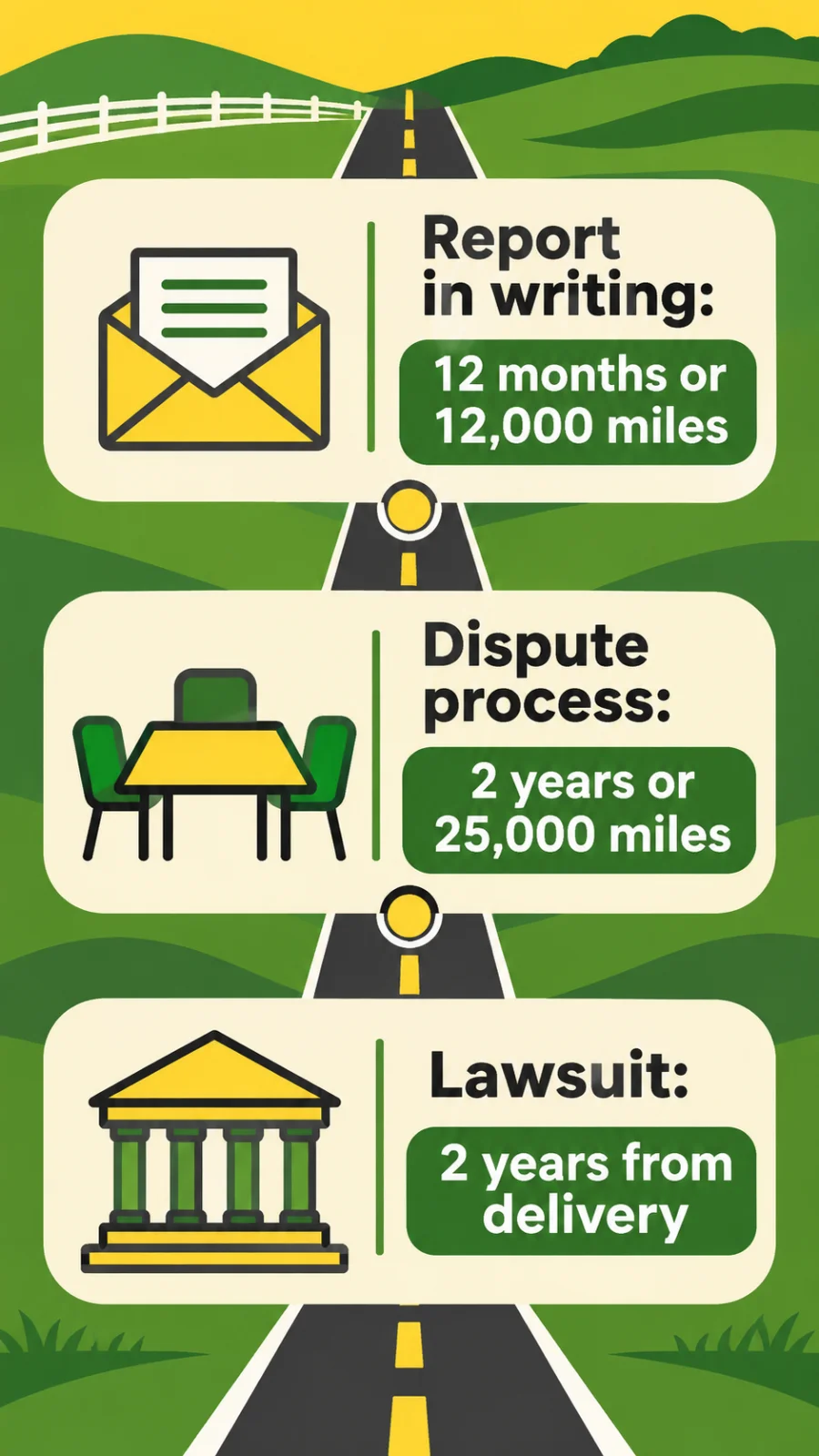
The law presumes the manufacturer has had a fair chance to fix the problem if the same defect was repaired four or more times and still exists, or if the vehicle was in the shop for a cumulative 30 calendar days. You report the defect in writing, go through the manufacturer’s dispute process, and file any lawsuit within two years of the original delivery date.
Which Vehicles and Buyers Does the Kentucky Lemon Law Cover?
The law covers new vehicles that you buy or lease in Kentucky, and it protects Kentucky residents. Under KRS 367.841, a “buyer” is a resident who buys, contracts to buy, or leases a new motor vehicle in the state. For a lease, the lessor, the lessee, or both can be the buyer. The statute applies to vehicles purchased after July 15, 1986 and leased after July 15, 1998 (KRS 367.846).
The vehicle itself has to be new, meaning fully assembled, held by a manufacturer or authorized dealer, and never titled to anyone before you. A used car does not qualify under the state statute, even a young one with factory warranty left.
What the statute leaves out
The definition of “motor vehicle” excludes motor homes, motorcycles, mopeds, farm tractors and similar farm machinery, vehicles with more than two axles, and vehicles substantially altered after their first sale to an individual. Several websites say motorcycles are covered. They are not. A bill to add new motorcycles was filed in 2006 (House Bill 205), and the exclusion is still in the definition.

The warranty has to cover the defect
A “nonconformity” is a failure to match the manufacturer’s written warranty that substantially impairs the vehicle’s use, value, or safety. A defect the warranty does not cover is outside the law. So are minor annoyances, such as a rattling trim piece or a sticky radio knob, that do not substantially impair the vehicle.
The manufacturer can also defend by showing the problem came from your abuse, neglect, or unauthorized modification of the vehicle. Aftermarket changes to the engine or electronics are the usual fight.
How Many Repair Attempts Make a Car a Lemon in Kentucky?
Four repair attempts for the same defect, or 30 cumulative calendar days out of service, within the first 12 months or 12,000 miles. Either one triggers the presumption that the manufacturer had a reasonable number of attempts.
| Trigger | What counts | Detail |
|---|---|---|
| Same defect, repeat repairs | 4 or more repairs | The defect must still exist after the fourth attempt |
| Days in the shop | 30 calendar days | Cumulative for the same defect, not consecutive |
| Time window | 12 months or 12,000 miles | Whichever comes first from delivery |
Both triggers are measured inside the same window, so a fourth repair on month 13 does not count. The 30-day trigger can be extended by a reasonable time when parts are unavailable because of war, invasion, civil unrest, fire, flood, or natural disaster. That extension was added by House Bill 347, signed in 2012 and effective July 12, 2012. It does not stretch the four-repair trigger.

Do You Have to Notify the Manufacturer in Writing?
Yes. The statute says you must report the nonconformity to the manufacturer in writing within the same 12-month, 12,000-mile period. A phone call to the dealer, or a repair order the service department wrote, does not do that job. The manufacturer’s address is in your warranty booklet or owner’s manual.
Send a letter by certified mail with a return receipt. Put the VIN, the dates and mileage of each repair, a short description of the defect, and the remedy you want (refund or replacement) in it. Keep a copy.
The statute does not describe a second “final repair attempt” notice, even though some guides present one as a Kentucky step. The letter belongs inside the window, so send it as soon as the defect shows a pattern, not after the fourth failed repair.
Why the two-year deadline matters more than it looks
Any lawsuit must be filed within two years of original delivery, and the dispute process described below has to come first. Because the 12-month window and the two-year suit deadline run from the same delivery date, time spent waiting on the manufacturer eats into the second one.
| Step | Deadline | Measured from |
|---|---|---|
| Defect appears and is reported in writing | 12 months or 12,000 miles | Delivery |
| Manufacturer must accept a dispute | 2 years or 25,000 miles | Start of ownership |
| Lawsuit filed | 2 years | Original delivery |
What Is the Dispute Resolution Step Before You Can Sue?
Refund and replacement disputes must go through an informal dispute system before you can go to court. KRS 367.842 points to the program under KRS 367.860 to 367.870 or to the federal rule at 16 C.F.R. part 703. In practice most manufacturers run the program through a third party.
The rules for that program are in KRS 367.865. The program must be free, impartial, and quick. A manufacturer cannot refuse a dispute that arose in the first two years or 25,000 miles of your ownership, whichever comes first. You are entitled to an oral hearing unless you agree in writing to a decision on documents only. At least 51 percent of panel members must have no involvement in making, distributing, or selling vehicles.
Is the decision binding?
It binds the manufacturer. It binds you only if the manufacturer made the program binding on all participating buyers and you signed a conspicuous, bold-faced disclosure before the dispute was submitted. Without that signed statement you can reject the decision and sue.
If the manufacturer does not tell you about the program or will not let you use it, call the Attorney General’s Consumer Protection Division at 502-696-5389. The Attorney General can enforce the lemon law against a manufacturer under KRS 367.845, and the Attorney General’s office takes automobile lemon law complaints.
What Do You Get Back: Refund or Replacement?
You choose between a comparable replacement vehicle and a refund of the full purchase price. The manufacturer does not get to pick. The refund is not limited to the sticker price.
| Refund component | Included? | Note |
|---|---|---|
| Amount paid for the vehicle | Yes | Includes finance charges |
| Sales tax, license and registration fees | Yes | Plus similar governmental charges |
| Collateral charges | Yes | Add-ons tied to the sale |
| Reasonable allowance for your use | Subtracted | Excludes time the vehicle was out of service |
The statute gives no per-mile formula for the use allowance. The definition in KRS 367.841 says only that it is the amount directly attributable to your use, leaving out the days the car was in the shop for the defect. That makes it the main number to negotiate. Ask for the manufacturer’s calculation in writing.
If you have a car loan, the lienholder (the lender with a claim on the vehicle) is paid first. A refund goes to you and the lienholder as your interests appear on the records, and the lien must be paid in full before a refund or exchange unless the lienholder agrees to a matching lien on the replacement.
Can You Sue, and Who Pays the Lawyer?
You can sue the manufacturer after the dispute process, within two years of delivery. KRS 367.843 lets a buyer who suffered an ascertainable loss of money or property sue under KRS 367.220, the Kentucky Consumer Protection Act’s private action section. A court may award reasonable attorney’s fees to a prevailing plaintiff. The word is “may,” so the award is discretionary.
You cannot sue the dealer under the lemon law. The statute says nothing in it creates a cause of action against a dealer, and KRS 367.844 bars manufacturers from pushing liability onto franchised dealers. Other consumer claims against a dealer can exist, but they sit outside this statute.
The federal backup
The Magnuson-Moss Warranty Act, 15 U.S.C. § 2310(d), gives you a separate claim for breach of a written warranty. It carries fee-shifting for a prevailing consumer and can reach defects that surface after Kentucky’s 12-month, 12,000-mile window if the written warranty is still running. It has its own rule that you may have to use a qualifying dispute program first.
What to Bring When You Escalate
- Every repair order, with the date in, date out, mileage, and the complaint as you described it
- The purchase or lease contract and the window sticker
- The warranty booklet
- Your certified-mail receipt and the letter you sent
- A running count of days out of service, by repair visit
- Photos or video of the defect, such as a warning light or a stall
Insist that each repair order list your actual complaint. A repair order that says “could not duplicate” is a visit that still counts toward the four-repair trigger only if it records the same defect, so make sure it does.
Frequently Asked Questions
Does Kentucky have a lemon law for used cars?
No. KRS 367.841 covers only new vehicles never titled to anyone before. A used car with a written warranty may still be covered by the federal Magnuson-Moss Warranty Act.
How many repair attempts does Kentucky require?
Four for the same defect, or 30 cumulative calendar days in the shop, within the first 12 months or 12,000 miles. Either one creates the presumption that the manufacturer had a reasonable number of attempts.
Can I leave a lemon claim to the dealer?
No. The lemon law makes the manufacturer responsible, and nothing in it creates a claim against the dealer. Your written report goes to the manufacturer.
Does the 12,000-mile limit mean the warranty ends?
No. The limit is the window for reporting and repair attempts under the lemon law. Your factory warranty usually runs longer, and ordinary warranty repairs continue under it.
What if the manufacturer’s dispute panel rules against me?
You can usually still sue, within two years of delivery, unless you signed the bold-faced statement agreeing to be bound. A panel decision binds the manufacturer in your favor even when it does not bind you.
Who do I call if the manufacturer ignores my letter?
The Attorney General’s Consumer Protection Division, 502-696-5389. It accepts automobile lemon law complaints and can enforce the statute against manufacturers.
References
- Kentucky Revised Statutes, KRS 367.842, options of buyer if manufacturer unable to repair nonconformity
- Kentucky Revised Statutes, KRS 367.841, definitions for the new motor vehicle lemon law
- Kentucky Revised Statutes, KRS 367.865, informal dispute resolution system
- Kentucky Revised Statutes, KRS 367.843, action for relief by purchaser
- Kentucky General Assembly, 2012 Regular Session House Bill 347, defective new motor vehicles
- Federal Trade Commission, 16 C.F.R. part 703, informal dispute settlement procedures
- United States Code, 15 U.S.C. § 2310, remedies in consumer disputes under the Magnuson-Moss Warranty Act
- Kentucky Legal Aid, Kentucky’s Vehicle Lemon Law consumer guide