
Maryland Divorce Laws: A Clear Guide to Filing and Custody

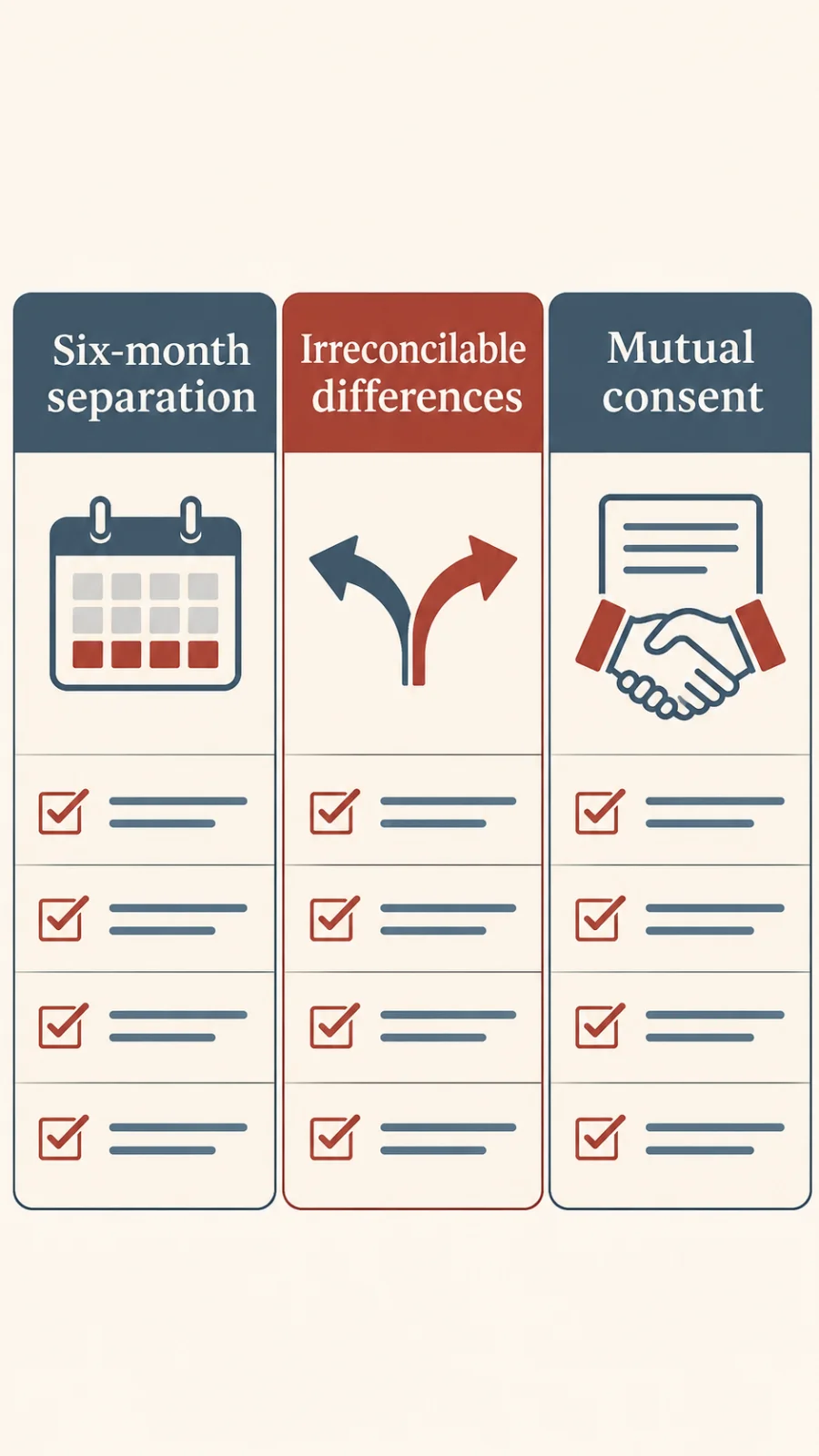
Maryland grants only one kind of divorce, an absolute divorce, and every ground for it is no-fault. Under Md. Code, Family Law § 7-103, you can divorce after living apart for six months, on irreconcilable differences, or by mutual consent with a signed settlement agreement.
You file in the circuit court, the initial filing fee is $165, and the judge also decides property, alimony, custody and child support if you and your spouse have not settled them.
What Are the Grounds for Divorce in Maryland?
Maryland has three grounds, all listed in Family Law § 7-103(a). Adultery, desertion, cruelty and the old 12-month separation were removed from the statute, and the court can no longer grant a limited divorce at all.
| Ground | What it requires | Waiting period |
|---|---|---|
| Six-month separation | Living separate and apart for 6 months without interruption before filing | 6 months |
| Irreconcilable differences | Reasons the filing spouse states for permanently ending the marriage | None stated |
| Mutual consent | Written settlement agreement signed by both spouses covering alimony, property, custody and support | None stated |
Six-month separation
You must have lived apart for six months without interruption before the divorce application is filed. Say you and your spouse begin living separate lives on March 1. Six full months run out at the start of September, so that is the earliest you could file on this ground.
You do not need two addresses. Section 7-103(b) says spouses who pursue separate lives can count as separated even while sharing a home, and a court-ordered separation also counts.
Irreconcilable differences
This ground rests on the reasons the filing spouse gives for permanently ending the marriage. The statute names no waiting period for it. It is the ground most contested cases use, because it does not depend on the spouse agreeing to anything.
Mutual consent
Mutual consent requires a written settlement agreement signed by both spouses. The agreement has to resolve alimony, property distribution (including relief under Family Law §§ 8-205 and 8-208), and custody, access and support of any minor or dependent children.
If child support is part of the deal, you attach a child support guidelines worksheet. Neither spouse can have filed a pleading to set the agreement aside before the required hearing, and the judge must find that the child-related terms serve the children’s best interests.
Under § 7-103(e), the court may merge or incorporate the agreement into the decree and can later modify or enforce it. Recrimination, meaning blaming the other spouse’s own misconduct, is no bar to divorce on any of the three grounds (§ 7-103(c)).
What changed on October 1, 2023
Senate Bill 36 (Chapter 645) and House Bill 14 (Chapter 646) were approved May 16, 2023, and took effect October 1, 2023. They repealed the limited divorce and replaced the older fault-based and 12-month grounds with the three above.
A limited divorce used to be a court order covering things like support while spouses stayed legally married. Spouses who want defined terms while living apart now use a private separation agreement. Section 7-103(f) keeps applications for limited divorce filed before October 1, 2023 workable for purposes of the six-month ground.
Residency and Where to File
Maryland’s residency rule is narrow. Under Family Law § 7-101, if the grounds for divorce occurred outside Maryland, one spouse must have lived in the state for at least six months before the application is filed. The statute adds no separate waiting period when the grounds arose inside Maryland.
You file in the circuit court for the county where you or your spouse lives. Courts & Judicial Proceedings § 6-202 lists the plaintiff’s residence as proper venue for a divorce.
How Do You File for Divorce in Maryland?
You open the case by filing a Complaint for Absolute Divorce, form CC-DR-020, and paying the fee. The Maryland Courts’ how-to-file tip sheet lays out the sequence.
- Complete the complaint and make copies for your spouse and yourself.
- File in the right county and have the clerk date-stamp your copies.
- Pay the fee, or file a Request for Waiver of Prepaid Costs (CC-DC-089) with the complaint.
- Have someone other than you serve your spouse with the complaint and summons.
- File proof of service with the court.

Forms checklist
Which forms you need depends on your case. The Maryland Courts forms tip sheet lists these:
- CC-DR-020: Complaint for Absolute Divorce (also used for a counter-complaint)
- CC-DCM-001: Civil Domestic Case Information Report, filed with the complaint or the answer
- CC-DR-050: Answer, for the spouse who is served
- CC-DR-033: Joint Statement of the Parties Concerning Marital and Non-Marital Property, needed if either spouse asks the court to divide property
- CC-DR-030: Financial Statement when child support is involved and combined monthly income is $30,000 or less
- CC-DR-031: Financial Statement when alimony, property or support is at issue and combined monthly income is above $30,000
- Report of Absolute Divorce or Annulment of Marriage: a Vital Statistics form you get from the clerk and submit at the end of the hearing
Free help is available from the Maryland Courts Self-Help Center at 410-260-1392, and most circuit courts have a walk-in family law self-help center.
If you are the spouse who was served
Your answer is due within 30 days if you live in Maryland, 60 days if you live in another state, and 90 days if you were served outside the United States. You file form CC-DR-050, admit or deny each statement in the complaint, and say what you want from the court.
Miss the deadline and your spouse can ask for an Order of Default. After a default, the case can go forward without you, and a defaulted party may be heard only on custody and visitation. The court will not enter a default against a spouse on active military duty.
What Does a Divorce Cost and How Long Does It Take?
The circuit court filing fee for a new family case is $165 under the Maryland Judiciary’s circuit court fee schedule. A petition to modify an existing order costs $31 in Baltimore County. You also pay for service of process, and a fee waiver is available if you cannot afford the fee.
Timing depends on whether the case is contested. In Baltimore County, an uncontested hearing before a magistrate is set about 30 to 45 days after the answer is filed, or about 45 to 60 days after a default. Maryland’s case-processing standard for family cases is 12 months for 98 percent of cases.
How Does Maryland Divide Property?
Maryland divides marital property by equitable distribution, which means fair rather than automatically equal. Family Law § 8-205 has the judge first decide which property is marital and what it is worth, then choose a remedy, then set its terms.
What counts as marital property
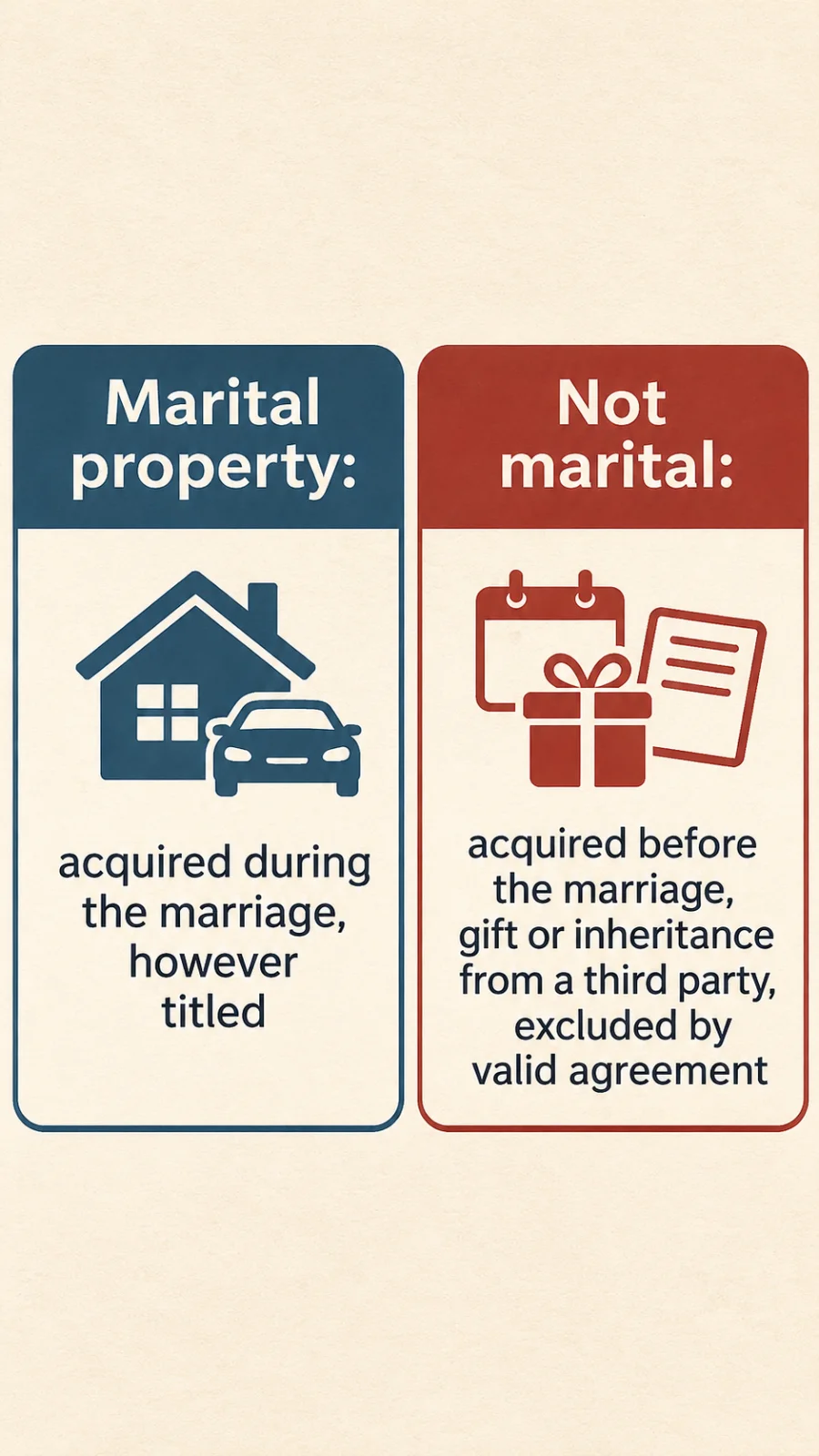
Under Family Law § 8-201(e), marital property is anything either spouse acquired during the marriage, however titled. Putting a house or account in one name does not make it separate.
Property is not marital if it was acquired before the marriage, received as a gift or inheritance from a third party, excluded by a valid agreement, or is directly traceable to one of those sources. Real estate held as tenants by the entirety is the exception: it is marital even if it would otherwise be excluded, unless a valid agreement says otherwise.
What the judge weighs
Section 8-205 lists factors including each spouse’s monetary and non-monetary contributions, the value of each person’s property, their economic situations, what led to the estrangement, the length of the marriage, ages, health, and how and when the property was acquired. Any alimony award and the use of the family home are also factored in.
The judge can order a monetary award, transfer ownership of a pension or other retirement-type plan, transfer family-use personal property, or order a jointly owned principal residence transferred or bought out on set terms. A monetary award can be reduced to a judgment only for the part that is due and owing.
Alimony in Maryland
The judge sets both the amount and the period of alimony under Family Law § 11-106, and it can run from the date the request was filed. No alimony accrues after the award period ends.
Section 11-106(b) lists 12 factors, including the recipient’s ability to become self-supporting, the time needed for training, the marital standard of living, the length of the marriage, contributions to the family, the circumstances of the separation, ages, health, the payer’s ability to pay, any agreement between the spouses, and each side’s finances and retirement rights.
Indefinite alimony is allowed in two situations under § 11-106(c). One is that age, illness, infirmity or disability keeps the recipient from becoming substantially self-supporting. The other is that, even after reasonable progress toward self-support, the spouses’ living standards would be “unconscionably disparate.”
Alimony ends at either spouse’s death or the recipient’s remarriage, unless the parties agree otherwise (§ 11-108). Fault is no longer a ground for divorce, but under § 11-103 a ground for divorce against the spouse seeking alimony was never an automatic bar, and the circumstances that led to the separation remain one of the 12 factors.
Child Custody in a Maryland Divorce
Maryland courts decide custody by the child’s best interests. Legal custody is the right to make major decisions about the child, and physical custody is where the child lives and how parenting time is shared. Joint arrangements are allowed, and the best-interest standard stays the deciding test.
The 16 best-interest factors in Family Law § 9-201
Senate Bill 548 (Chapter 484), approved May 13, 2025, took effect October 1, 2025 and put the custody factors into statute as Family Law § 9-201. It lists 16 factors, including the child’s stability and welfare, contact with each parent, the child’s relationships with parents and others, the child’s age, and the child’s preference if age-appropriate. The last factor lets the judge consider anything else that is appropriate.
Before that law, courts relied on case law, mainly Montgomery County Department of Social Services v. Sanders, 38 Md. App. 406, and Taylor v. Taylor, 306 Md. 290 (1986), which set a list of factors for custody and joint custody. Many older guides still describe only those cases.
Section 9-201(b) requires the judge to state findings of fact on the record or in a written opinion, addressing each factor. The same law lets a court modify a custody or visitation order on a material change in circumstances related to the child’s needs or the parents’ ability to meet them, if modification serves the child’s best interests.

Abuse and parenting plans
Under Family Law § 9-101.1, the judge must weigh evidence that a party mistreated the other parent, a spouse, or a child in the household, including children outside the case. If abuse is found, custody or visitation must be arranged to best protect both the child and the abuse victim.
Maryland Rule 9-204.1 governs parenting plans, which set out decision-making authority and parenting time. A plan you both sign can go straight into a mutual consent agreement.
How Is Child Support Set?
Child support follows the guidelines in Family Law § 12-204. The basic obligation comes from a schedule based on combined adjusted actual income, divided between the parents in proportion to their incomes.
The schedule runs up to $30,000 of combined adjusted actual income, and above that the court may use its discretion. Work-related child care, health insurance and extraordinary medical expenses are added and shared proportionally. A parent who is voluntarily impoverished can be assigned potential income, with exceptions for disability, caring for a child under 2, and incarceration.
Frequently Asked Questions
Is Maryland a no-fault divorce state?
Yes. Since October 1, 2023, the only grounds under Family Law § 7-103 are six-month separation, irreconcilable differences and mutual consent.
Can I get a legal separation in Maryland?
Not from a court. The limited divorce was repealed effective October 1, 2023, so spouses who want written terms while living apart use a private separation agreement.
How long do I have to live in Maryland before filing?
Six months, but only when the grounds for the divorce occurred outside Maryland. Section 7-101 states no separate rule for grounds that arose in the state.
How much does it cost to file for divorce in Maryland?
The circuit court filing fee is $165, plus the cost of serving your spouse. You can ask the court to waive the fee with form CC-DC-089.
What if my spouse does not respond to the divorce papers?
Your spouse has 30 days to answer if living in Maryland, 60 days if living in another state and 90 days if served outside the United States. After that you can ask for an Order of Default.
Does a child’s preference decide custody?
No. The child’s preference is one of the 16 factors in Family Law § 9-201, considered only if the child is old enough, and the judge decides by the child’s overall best interests.
References
- Maryland General Assembly, Family Law § 7-103, grounds for absolute divorce
- Maryland General Assembly, 2023 Laws of Maryland Chapter 646 (House Bill 14), Family Law, Grounds for Divorce
- Maryland General Assembly, Family Law § 7-101, residency requirement
- Maryland General Assembly, Family Law § 8-205, marital property awards
- Maryland General Assembly, Family Law § 11-106, alimony
- Maryland General Assembly, Family Law § 9-201, custody best-interest factors
- Maryland General Assembly, 2025 Senate Bill 548, Chapter 484, Child Custody Determinations
- Maryland General Assembly, Family Law § 12-204, child support guidelines
- Maryland Courts, Divorce tip sheet, how to file for divorce
- Maryland Courts, Divorce tip sheet TIP50, forms you need to file
- Maryland Judiciary, Circuit Court schedule of charges, costs and fees