
Maryland Lemon Law: Refund or Replacement Rules Explained
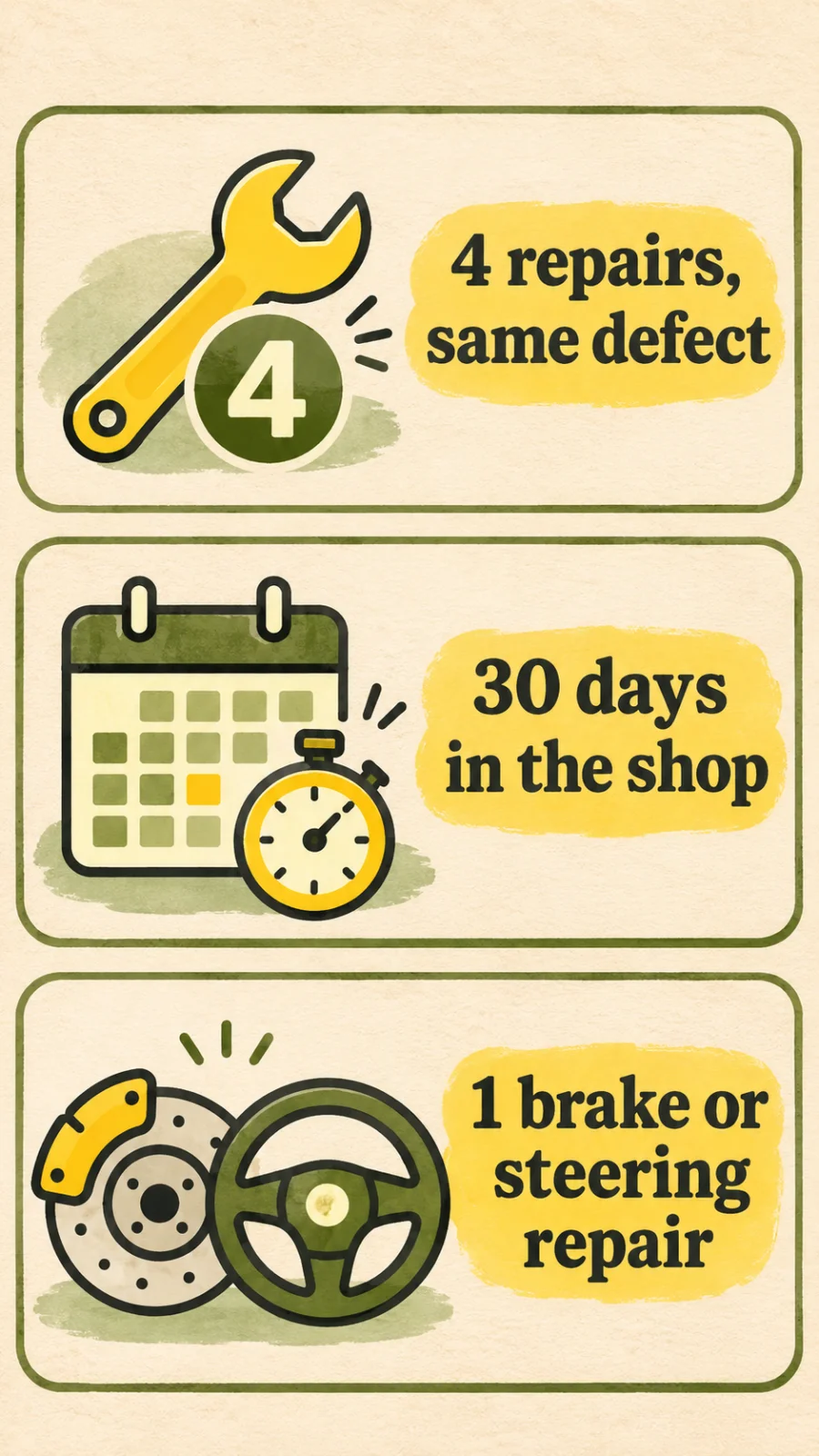
Maryland’s lemon law, formally the Automotive Warranty Enforcement Act, entitles you to a refund or a comparable replacement when the manufacturer cannot fix a defect that substantially impairs your new vehicle’s use and market value. The defect has to arise within the warranty period, which is the earlier of 24 months or 18,000 miles after delivery, and the law presumes the manufacturer has had enough chances once the same problem has been repaired four times, the car has spent 30 days in the shop, or a brake or steering failure survives one repair (Md. Code, Com. Law § 14-1502).
You must give the manufacturer written notice by certified mail, and any lawsuit has to be filed within 3 years of the date the car was delivered to you. The rest of this article covers who qualifies, how to send the notice, what a refund actually adds up to, and where to go when the manufacturer says no.
Which Vehicles and Buyers Does the Maryland Lemon Law Cover?
The Act covers new motor vehicles registered in Maryland: Class A passenger cars, Class D motorcycles, Class E trucks rated at 3/4 ton or less, and Class M multipurpose vehicles (§ 14-1501(f)). Motor homes are excluded, and so are fleet purchases of five or more vehicles (§ 14-1502(m)).
A “consumer” is a buyer who is not purchasing for resale, a person who receives the vehicle during the warranty period, or anyone else entitled to enforce the warranty (§ 14-1501(b)). That wording means a family member who is given the car, or a second owner, can still bring a claim if the problem arises inside the window.
The 24-month, 18,000-mile warranty period
The statute defines the manufacturer’s warranty period as the earlier of the vehicle’s first 18,000 miles of operation or 24 months after original delivery to the first consumer. It does not extend any express warranty the manufacturer wrote, so a 5-year powertrain warranty does not stretch the lemon law window to 5 years.
Older court opinions describe a 15,000-mile, 15-month period, and some websites repeat those figures. The statute now says 18,000 miles and 24 months.

Used cars and second owners
The lemon law does not reach a used car once the original window has closed. The Attorney General’s Consumer Protection Division says it can still apply to a second owner if the original owner bought the vehicle less than 24 months ago and it has fewer than 18,000 miles.
Outside that window, the protection comes from implied warranties. Under Com. Law § 2-316.1, a seller cannot disclaim the implied warranty of merchantability on consumer goods, with one vehicle exception: a car that is more than 6 model years old, has over 60,000 miles, and was sold with the required notice form. Any other disclaimer must be in writing, conspicuous, and separately signed by the buyer.
Leased vehicles
Leases for personal, family or household use have their own subtitle, Com. Law § 14-2001 and following, which applies to leases longer than 4 months from a lessor that leases five or more vehicles in a 12-month period. That subtitle defines its own warranty period as the earlier of 15,000 miles or 15 months from delivery to the lessee (§ 14-2001(n)).
The Attorney General’s guidance describes the 24-month, 18,000-mile window for leased vehicles too, so the two sources do not line up. If you lease, send your notice inside the shorter window and do not rely on the longer one.
What Makes a Car a Lemon Under Maryland Law?
A lemon has two parts: a defect that substantially impairs the vehicle’s use and market value, and a manufacturer that cannot fix it after a reasonable number of attempts during the warranty period. Section 14-1502(d) removes the guesswork about “reasonable” by presuming it is met when any one of three things happens.
| Trigger | What the statute requires |
|---|---|
| Same problem, 4 or more repairs | The same defect has been repaired 4 or more times within the warranty period and still exists. |
| 30 or more days in the shop | The car is out of service for repair for a cumulative total of 30 or more days during the warranty period. |
| Brake or steering failure | The failure has been repaired at least once, the manufacturer was notified and had a chance to cure, and the car still does not meet state safety inspection requirements. |
Both the warranty period and the 30-day count are extended for any time repair services are unavailable because of war, invasion, strike, fire, flood, or another natural disaster (§ 14-1502(e)).
The dealer’s reporting duty
The dealer must notify the manufacturer within 7 days when your car comes back for a fourth repair of the same problem, or when it reaches 20 cumulative days out of service. The notice goes by certified mail with a copy to the Motor Vehicle Administration (MVA). If the dealer skips it, your rights are unaffected.
Defenses the manufacturer can raise
The manufacturer has an affirmative defense if the problem does not substantially impair use and market value, or if it results from abuse, neglect, or unauthorized modifications. A loose trim piece or a noisy speaker is the kind of complaint that tends to fail the first test, while an engine that stalls at highway speed does not.
Why you need proof the defect still exists
In Zitterbart v. American Suzuki Motor Corp., No. 897, September Term 2007 (filed October 7, 2008), the Court of Special Appeals, now the Appellate Court of Maryland, affirmed summary judgment for the manufacturer. The court held that the four-repair presumption does not remove a consumer’s burden to produce admissible evidence that a defect persists.
The owners’ expert referred to unidentified “powertrain defects,” and the court found that too vague. It also treated the existence of a mechanical defect as something that requires expert testimony, so an owner’s description of “hesitation” was not enough. Keep every repair order, and get a written diagnosis from an independent mechanic before you file.
How to Send the Notice the Maryland Lemon Law Requires
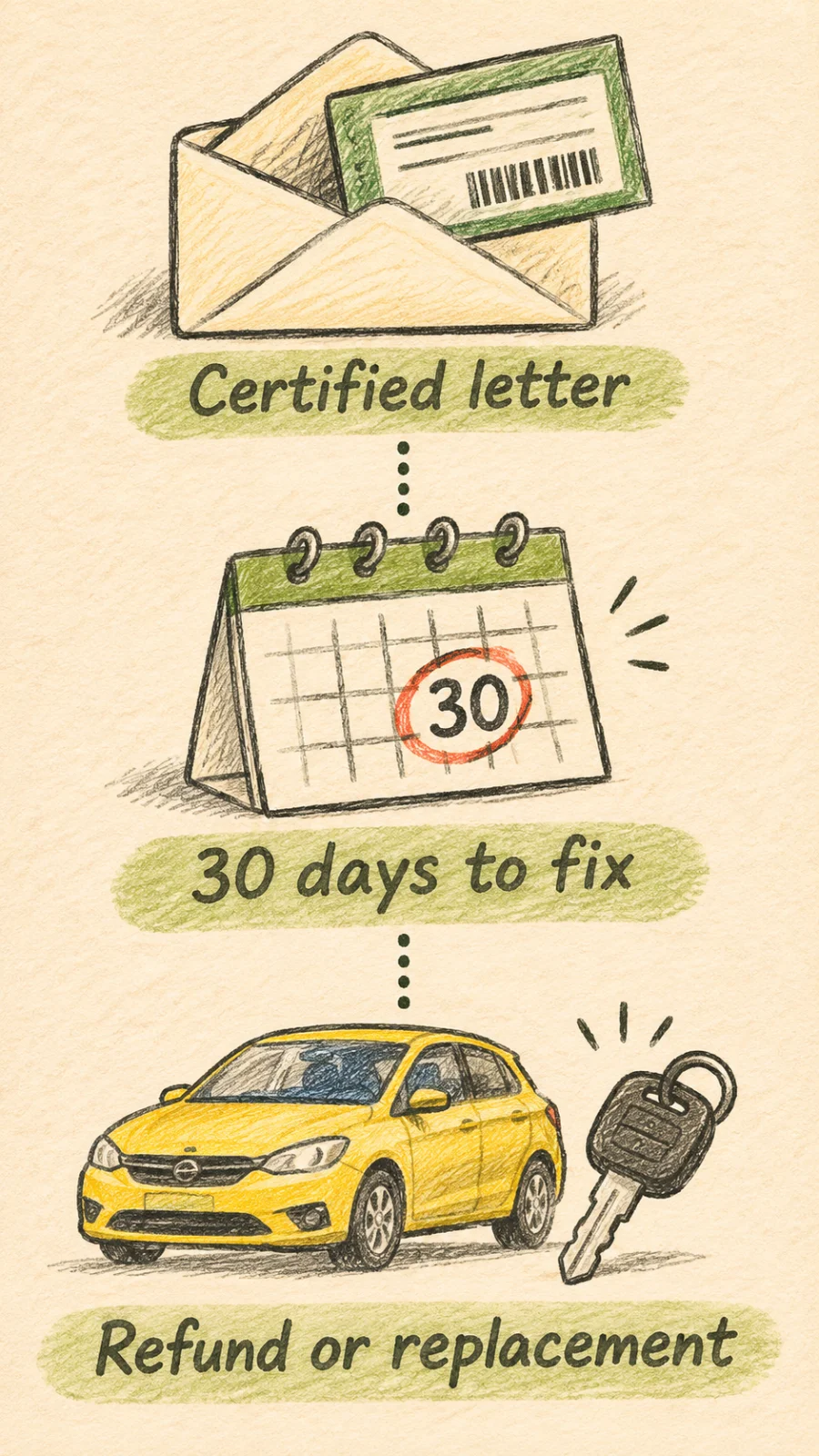
You must report the defect in writing, by certified mail with return receipt requested, during the warranty period (§ 14-1502(b)). The dealer is required to tell you about this procedure in writing at sale or delivery, and COMAR 11.12.01.17 requires new-car dealers to give buyers a notice describing their lemon law rights.
- Take the car to the dealer for warranty repairs at no charge. If that dealer will not cooperate, try another dealer that sells the same make, and keep every receipt and repair order.
- Write to the manufacturer with the year, make, model, VIN, dealership name, purchase date, a description of the problem, and each repair attempt with dates and copies of the repair orders. Send it certified mail, return receipt requested.
- Send a copy of the letter and a completed complaint form to the Attorney General’s Consumer Protection Division.
- Wait for the manufacturer to act. Once it receives your letter, it has 30 days to correct the problem at no charge, even if the repair happens after the warranty has expired.
- If the problem remains, send a second certified letter describing what is still wrong and asking for a replacement or a repurchase. The Attorney General’s sample letter asks for an answer within 14 days.
You do not have to wait for four repairs or 30 days out of service before writing. The Attorney General’s office advises sending the notice as soon as you suspect a lemon, which starts the manufacturer’s 30-day clock sooner.
Refund or Replacement: What You Actually Get
If the manufacturer cannot fix a covered defect, you choose between a comparable replacement vehicle that you find acceptable and a refund of the full purchase price plus license, registration, and similar governmental fees. The manufacturer may subtract a use allowance of no more than 15 percent of the purchase price, plus a reasonable allowance for damage beyond normal wear, but not damage caused by the defect itself (§ 14-1502(c)).
The refund is paid to you and to any lienholder, according to the ownership records at the MVA. If you still owe money on a loan, the lender is paid first.
A refund calculation
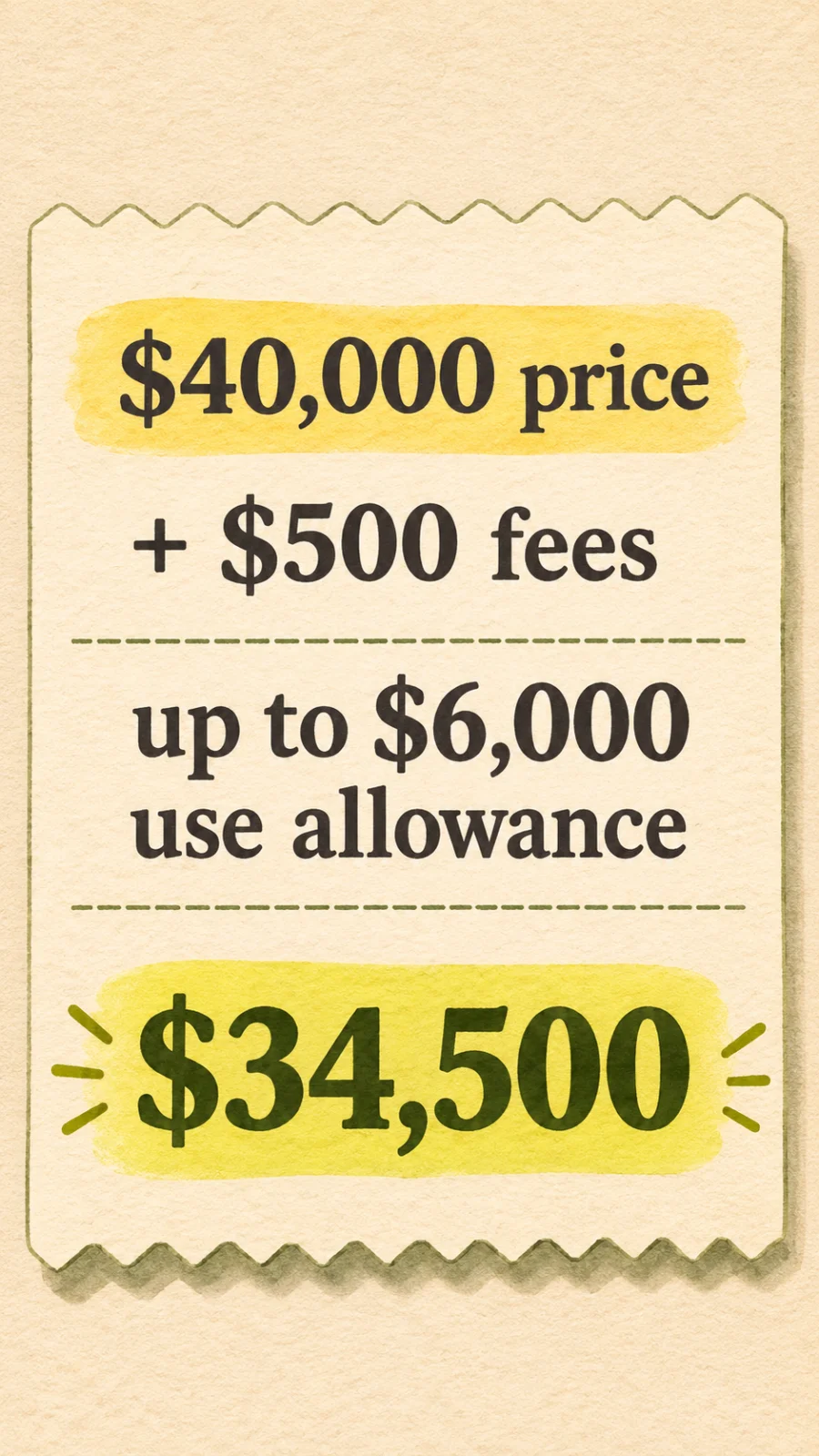
Say you bought a new car for $40,000 and paid $500 in license and registration fees. The refund starts at $40,500. The use allowance cannot exceed 15 percent of $40,000, which is $6,000, so the refund is no lower than $34,500 before any deduction for damage beyond normal wear. The statute sets only the ceiling, so the manufacturer may take less than $6,000, and you can negotiate the figure.
Getting the excise tax back
The manufacturer does not refund the excise tax you paid when you titled the car. Under § 14-1503, you recover it from the MVA instead, and the seller must tell you in writing that you can. The MVA’s page on returned vehicles says the dealer usually submits the refund request for you, and that you can send documents to the MVA Refund Unit if no replacement vehicle is involved.
With a replacement vehicle, the MVA credits the excise tax you paid on the returned car against the tax on the new one. If the replacement’s tax is higher, the dealer collects the difference, and if it is lower, you recover the difference from the MVA.
What happens to a bought-back car
When a manufacturer takes a vehicle back, it must notify the MVA in writing within 15 days. If it later transfers the car to a Maryland dealer, the manufacturer must provide a written disclosure on a separate sheet in 10-point all-capital type covering the return, the defect, and the vehicle’s condition. Anyone buying a used car can ask to see that sheet.
Arbitration, the Attorney General, and Going to Court
Arbitration is optional. If the manufacturer runs an informal dispute procedure that complies with 16 C.F.R. Part 703, you may use it first, but using it does not cost you any legal remedy (§ 14-1502(i)). The Attorney General notes that the arbitrator’s decision binds only the manufacturer, so you can still sue if you disagree with the result.
If the manufacturer refuses a refund or replacement, or you need help negotiating the refund figure, file a complaint with the Consumer Protection Division at 200 St. Paul Place, Baltimore, MD 21202. The office takes calls at 410-576-6300 or toll-free at 1-888-743-0023, and it contacts the manufacturer to assist with negotiations.
Deadlines and fee-shifting in court
A lawsuit must be commenced within 3 years of the date the vehicle was originally delivered to you (§ 14-1502(k)). The clock runs from delivery, not from the day the defect appeared or the last repair visit, so a car that fails in month 23 leaves you little more than a year.
A court may award reasonable attorney’s fees to a consumer who prevails, and may order fees against whoever brings a bad-faith or frivolous action. Under § 14-1504, a violation of the subtitle is an unfair or deceptive trade practice, and a court may award up to $10,000 in damages if a manufacturer acted in bad faith.
Any agreement that waives or limits your lemon law rights is void, and the rights pass to later owners for the length of the applicable warranties. The Act also leaves other remedies intact, including implied warranty claims (§ 14-1502(h)).
Maryland Lemon Law Deadlines at a Glance
| Who | Deadline | Section |
|---|---|---|
| You, to report the defect | Within 24 months or 18,000 miles of delivery | § 14-1501(e) |
| Manufacturer, to fix after your notice | 30 days from receipt | § 14-1502(b) |
| Dealer, to notify manufacturer | 7 days after the fourth repair visit or 20 days out of service | § 14-1502(f) |
| Manufacturer, to notify MVA of a return | 15 days | § 14-1502(f) |
| You, to file suit | 3 years from original delivery | § 14-1502(k) |
Frequently Asked Questions
Does Maryland’s lemon law cover used cars?
Only if the problem arises inside the original 24-month, 18,000-mile window and the car was bought new by its first owner, in which case a later owner can enforce the warranty. A used car outside that window is protected by implied warranties instead.
How many repair attempts make a car a lemon in Maryland?
Four repairs of the same defect within the warranty period create the presumption. Cumulative time in the shop of 30 or more days also counts, and a brake or steering failure that one repair does not fix can qualify after a single attempt.
Do I have to go through arbitration before suing?
No. An informal dispute program that meets 16 C.F.R. Part 703 is optional, and using it does not take away your right to sue. The arbitrator’s decision binds only the manufacturer.
Can I get my excise tax back if the car is returned?
Yes, but from the MVA, not the manufacturer. The dealer usually files the request, and the seller must tell you in writing that you can recover the tax (§ 14-1503).
How long do I have to file a lemon law lawsuit in Maryland?
You have 3 years from the date the vehicle was originally delivered to you. The deadline does not restart when you make a repair visit or send a notice letter.
Does the lemon law cover a leased car?
The Attorney General says leased vehicles are covered, but the lease subtitle defines the warranty period as 15,000 miles or 15 months. Send your notice inside the shorter period to protect your claim.
References
- Maryland General Assembly, Md. Code, Commercial Law § 14-1502, automobile warranty enforcement
- Maryland General Assembly, Md. Code, Commercial Law § 14-1501, definitions
- Maryland General Assembly, Md. Code, Commercial Law § 14-1503, excise tax recovery on returned vehicles
- Maryland General Assembly, Md. Code, Commercial Law § 14-1504, unfair trade practice and bad-faith damages
- Maryland General Assembly, Md. Code, Commercial Law § 14-2001, motor vehicle lease definitions
- Maryland General Assembly, Md. Code, Commercial Law § 2-316.1, implied warranties on consumer goods
- Code of Maryland Regulations 11.12.01.17, dealer warranty and lemon law notice requirements
- Maryland Court of Special Appeals, Zitterbart v. American Suzuki Motor Corp., No. 897, September Term 2007
- Maryland Office of the Attorney General, Consumer Protection Division, Your Rights Under Maryland’s Lemon Law
- Maryland Motor Vehicle Administration, Return Vehicle to Dealer or Manufacturer (Buy Back or Lemon Law)