
New York Divorce Laws: The Basics Every Spouse Should Know

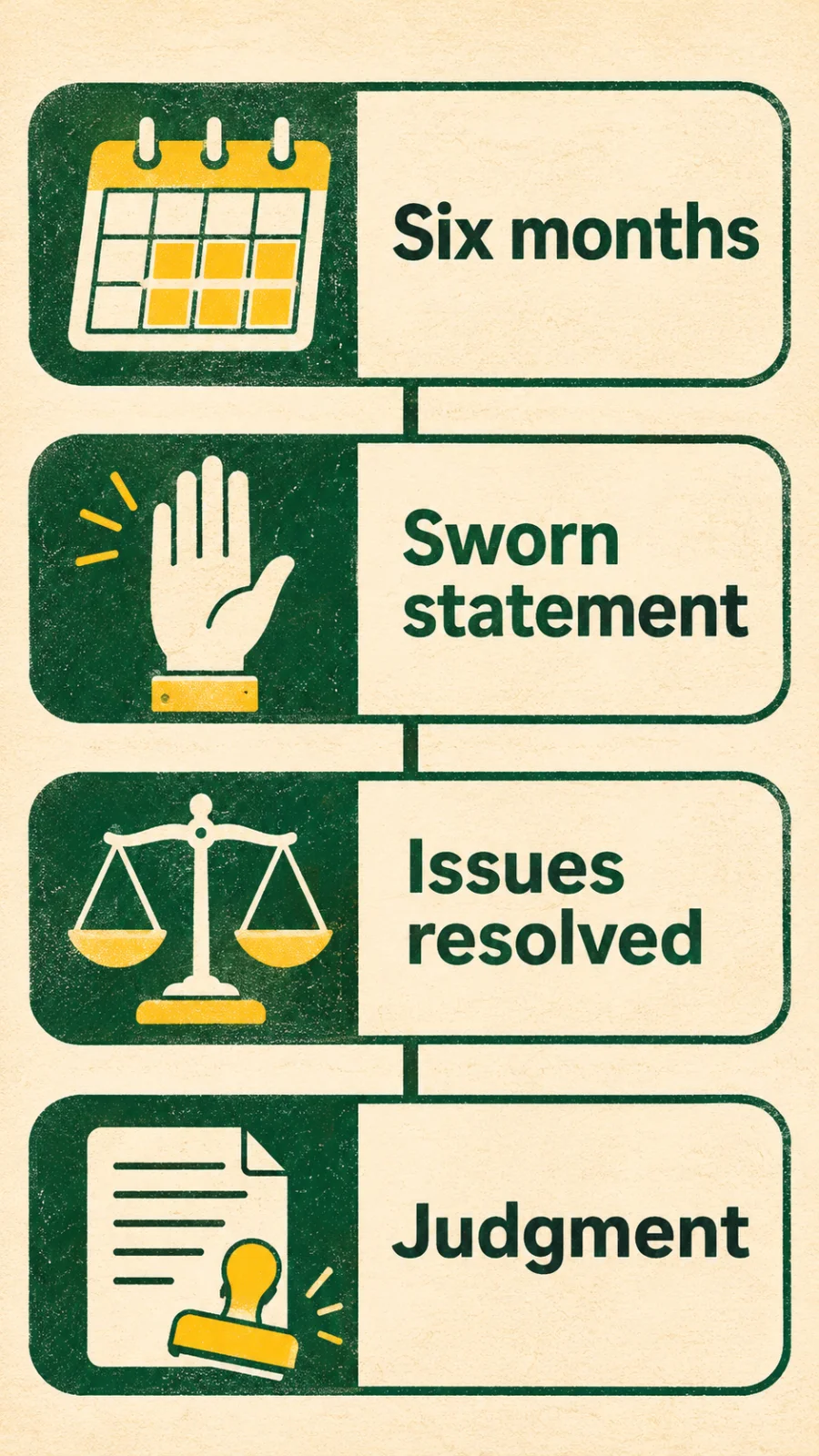
New York grants a divorce when one spouse swears under oath that the marriage has been irretrievably broken for at least six months, under Domestic Relations Law (DRL) § 170(7). No one has to prove the other spouse did anything wrong. The judge will not sign the judgment until property, support, and any custody questions are settled by agreement or decided by the court.
You also need to meet a residency rule (usually one year), and the court applies fixed formulas for maintenance and child support. After March 1, 2026, those formulas run on a $241,000 income cap for maintenance and a $193,000 cap for child support.
Who Can File for Divorce in New York?
You can file in New York only if you meet one of five residency situations in DRL § 230. Most people qualify under the one-year rule, and only one of the five situations has no minimum time at all.
| DRL § 230 | Situation | Residency needed |
|---|---|---|
| (1) | You married in New York | Either spouse lives here and has for one continuous year before filing |
| (2) | You lived in New York as spouses | Either spouse lives here and has for one continuous year before filing |
| (3) | The grounds arose in New York | Either spouse has lived here for one continuous year before filing |
| (4) | The grounds arose in New York | Both spouses live here when the case starts, with no minimum time |
| (5) | None of the above | Either spouse has lived here for two continuous years before filing |
Say you married in Vermont, moved to Albany together in 2023, and separated in 2026. Subdivision (2) lets either of you file once one of you has lived in New York for a continuous year, because you lived here as spouses.
What Are the Grounds for Divorce in New York?
DRL § 170 lists seven grounds. One is no-fault and the other six depend on proof, a prior separation, or an agreement.
The no-fault ground: irretrievable breakdown
Subdivision 7 requires two things: the marriage has been broken for six months or more, and one spouse says so under oath. The breakdown is not something the other spouse can disprove by saying the marriage is fine. The statute asks for a sworn statement, not objective evidence of what went wrong.
The six months is measured as a state of the marriage, not as time spent in separate homes. Spouses can still share a house while the clock runs.
The six other grounds
- Cruel and inhuman treatment (§ 170(1)): conduct that endangers the plaintiff’s physical or mental well-being.
- Abandonment (§ 170(2)): one year or more.
- Imprisonment (§ 170(3)): three or more consecutive years after the marriage.
- Adultery (§ 170(4)): voluntary sexual contact with someone other than the spouse after the marriage.
- Living apart under a separation judgment (§ 170(5)): six months or more after the judgment, with substantial compliance by the plaintiff.
- Living apart under a written separation agreement (§ 170(6)): six months or more, with the signed and acknowledged agreement, or a memorandum of it, filed with the county clerk.
Subdivisions 5 and 6 used to require one year apart. Chapter 673 of the Laws of 2025, signed December 19, 2025, cut that to six months and applies to cases started 60 days or more after signing. The same law added a no-fault ground to the separation statute, DRL § 200(6), but a separation does not end the marriage.
Can a spouse demand a trial on the breakdown?
Early after the 2010 enactment, a few trial courts said yes, because DRL § 173 gives a right to a jury trial on grounds. The Appellate Divisions rejected that reading. In Palermo v. Palermo, 35 Misc 3d 1211(A) (Sup Ct, Monroe County 2011), the court held that a sworn statement is enough, and the Fourth Department affirmed at 100 AD3d 1453.
The sworn statement does not end the case, though. In Trbovich v. Trbovich (4th Dept 2014), the plaintiff still could not get summary judgment because the property and support issues were unresolved.
Automatic Orders: What You Cannot Do Once the Case Starts
Automatic orders under DRL § 236(B)(2)(b) take effect against the plaintiff when the case is filed and against the defendant when served with the summons. They stay in place until judgment, dismissal, or a signed and acknowledged agreement changes them.
- No selling, transferring, hiding, or giving away property without written consent or a court order, except for ordinary business, customary household expenses, and reasonable attorney’s fees.
- No withdrawals or transfers from retirement accounts such as IRAs, 401(k)s, and pensions. A spouse already receiving pension payments may keep receiving them.
- No unreasonable debt, including heavy use of a home equity line or credit cards.
- No removing the other spouse or the children from medical, hospital, or dental insurance.
- No changing life insurance beneficiaries, and the existing life, auto, and homeowner or renter policies must stay in force.
- Written notice to the other spouse within 10 days of any tax lien, foreclosure, bankruptcy, or lawsuit that could affect marital property.
How New York Divides Property
New York divides marital property equitably, which means fairly, not necessarily 50/50. Marital property is anything either spouse acquired during the marriage and before a separation agreement or the start of the case, no matter whose name is on the title.
Marital versus separate property
Separate property stays with the spouse who owns it. Under § 236(B)(1)(d), that includes property owned before the marriage, inheritances and gifts from someone other than your spouse, and personal injury compensation. It also includes anything bought with separate property, but any increase in value counts as marital to the extent the other spouse’s contributions or efforts caused it.
A written agreement can also designate property as separate. Pre-marital and post-marital agreements are governed by § 236(B)(3).
The factors a judge weighs
Section 236(B)(5)(d) lists 16 factors. The ones that most often drive outcomes are the length of the marriage, each spouse’s age and health, each spouse’s contributions as wage earner, parent, and homemaker, and the custodial parent’s need to stay in the home. Others include the tax consequences, wasteful spending, and transfers made in contemplation of the divorce.
Two factors are easy to miss. Domestic violence is a listed factor, and so is the best interest of a companion animal. A professional license or degree does not count as distributable property, though the spouse who supported its holder can raise that contribution as a factor.
The judge must state the factors and reasons behind the distribution, and the parties cannot waive that requirement.

Spousal Maintenance: The Formulas and Duration
Maintenance is the New York term for spousal support. The spouse with the higher income pays the spouse with the lower income, and the court must award the guideline amount on the payor’s income up to $241,000, unless the parties agree otherwise or the court finds the amount unjust or inappropriate. Income above the cap is left to the judge’s discretion, and a deviation needs findings.
How the amount is calculated
Under § 236(B)(6)(c), if there is no child support, or the payor is the custodial parent, the court runs two calculations and takes the lower:
- 30% of the payor’s income minus 20% of the payee’s income.
- 40% of the combined income minus the payee’s income.
If the payor is the non-custodial parent and child support will be paid, the first calculation changes to 20% of the payor’s income minus 25% of the payee’s income. Maintenance is calculated first, and then child support is figured on incomes adjusted for it. If either result is zero or less, the guideline is zero.
Temporary maintenance during the case uses the same structure under § 236(B)(5-a) and ends no later than the judgment.
A worked example (hypothetical)
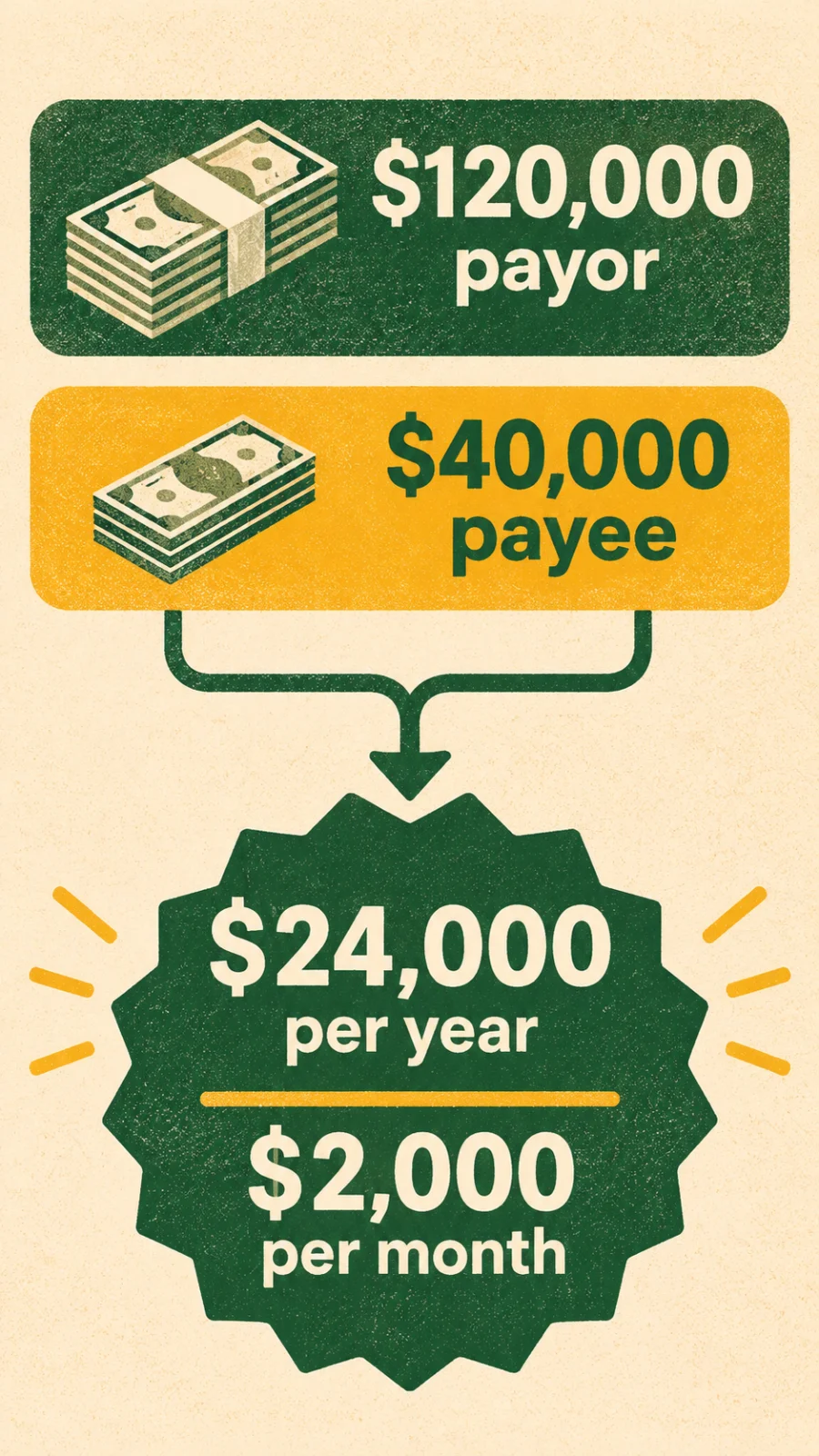
Suppose one spouse earns $120,000, the other earns $40,000, and there are no children. The first calculation gives $36,000 minus $8,000, or $28,000. The second gives $64,000 (40% of $160,000) minus $40,000, or $24,000. The lower figure controls: $24,000 a year, or $2,000 a month.
How long maintenance lasts
The advisory schedule in § 236(B)(6)(f)(1) sets duration as a percentage of the marriage’s length, measured from the wedding to the start of the case. It is advisory, and the court can use other factors or award non-durational maintenance.
| Length of marriage | Advisory duration | Example |
|---|---|---|
| Up to 15 years | 15% to 30% | 10 years: 1.5 to 3 years |
| Over 15 up to 20 years | 30% to 40% | 18 years: 5.4 to 7.2 years |
| Over 20 years | 35% to 50% | 25 years: 8.75 to 12.5 years |
Maintenance ends on either spouse’s death or the payee’s remarriage. A real drop in the payor’s income after retirement can support a modification.
Child Support and Custody
Child support follows the percentages in DRL § 240(1-b), applied to the parents’ combined income up to $193,000: 17% for one child, 25% for two, 29% for three, 31% for four, and at least 35% for five or more. Each parent pays their pro-rata share, and support runs until the child is 21.
Take two children and combined income of $150,000. The basic obligation is $37,500 (25%). A parent earning $90,000 has a 60% share, so pays $22,500 a year, or $1,875 a month, before add-ons.
Add-ons are separate: child care while the custodial parent works or trains, health insurance and uncovered medical costs, and, at the court’s discretion, education costs. Income above the cap is set using the statute’s ten deviation factors, not automatically at the percentage. The self-support reserve, set at $21,546 for 2026, protects a low-income payor.
Custody is decided on the child’s best interests, and no parent has a automatic right to it. If domestic violence is alleged in a sworn pleading and proven, the court must weigh it and say on the record how it affected the decision.
Health Insurance, Legal Fees, and Your Name
Three side issues come up in nearly every case.
- Health insurance. DRL § 255 requires the court to make sure both spouses know they may lose coverage under the other’s plan. A settlement must address coverage, and neither side can waive that. COBRA continuation may be available.
- Attorney’s fees. Under DRL § 237, there is a rebuttable presumption that fees go to the “less monied spouse,” and the court can award interim fees while the case is pending.
- Your name. Under DRL § 240-a, every judgment must let each spouse resume a premarriage or other former surname.
How to File and What It Costs
A divorce starts when either spouse buys an index number at the County Clerk’s office and files a Summons with Notice or a Summons and Verified Complaint in the county’s Supreme Court. The New York courts’ uncontested divorce overview lists the index number at $210, and a note of issue costs $125. A $95 Request for Judicial Intervention applies when a judge must be assigned.
- Prepare the forms from the court system’s uncontested packet if you and your spouse agree on everything. The packet includes the Notice of Automatic Orders, the Notice of Guideline Maintenance, and the Notice Concerning Continuation of Health Care Coverage.
- Buy the index number and file the papers.
- Serve your spouse within 120 days of filing.
- If you cannot afford the fees, ask the clerk for a fee waiver.
- Submit the judgment papers, or go to trial or settlement on any disputed issue.
Forms revised March 1, 2026 reflect the new caps, so use the court system’s latest versions rather than older copies.
Frequently Asked Questions
Is there a waiting period for a divorce in New York?
There is no waiting period after filing. The marriage must have been broken irretrievably for at least six months before the sworn statement is made, but the case itself can move as fast as the issues are resolved.
Do I have to prove my spouse did something wrong?
No. Under DRL § 170(7), your sworn statement that the marriage has irretrievably broken down for six months is the ground.
Is property split 50/50 in New York?
Not by rule. The court divides marital property equitably after weighing the 16 factors in DRL § 236(B)(5)(d), which often lands near an even split in long marriages but can differ.
How much is the income cap for maintenance and child support?
The maintenance cap on the payor’s income is $241,000, and the child support cap on combined parental income is $193,000. Both changed on March 1, 2026.
Can I get divorced if my spouse refuses to cooperate?
Yes. A spouse cannot block a no-fault divorce by refusing to sign. If the issues are not settled, the court decides them before it grants the judgment.
How much does a New York divorce cost in court fees?
An uncontested case starts with a $210 index number and a $125 note of issue. A contested case adds a $95 Request for Judicial Intervention, plus any motion fees.
References
- New York State Senate, N.Y. Dom. Rel. Law § 170, grounds for divorce
- New York State Senate, N.Y. Dom. Rel. Law § 230, residence requirements
- New York State Senate, N.Y. Dom. Rel. Law § 236(B), property, automatic orders and maintenance
- New York State Senate, N.Y. Dom. Rel. Law § 240, custody and child support
- New York State Senate, N.Y. Dom. Rel. Law § 237, counsel fees
- New York State Senate, N.Y. Dom. Rel. Law § 255, health insurance notice
- New York State Senate, N.Y. Dom. Rel. Law § 240-a, resuming a former name
- New York State Senate, Bill S1261A (Chapter 673 of 2025), no-fault separation and six-month living-apart period
- New York State Unified Court System, What’s New in Matrimonial Legislation, Court Rules, and Forms
- New York Supreme Court, Monroe County, Palermo v. Palermo, 2011 NY Slip Op 52506(U)
- New York State Unified Court System, Uncontested Divorce Overview and filing fees