
New York Lemon Law: New vs. Used Car Protections Explained
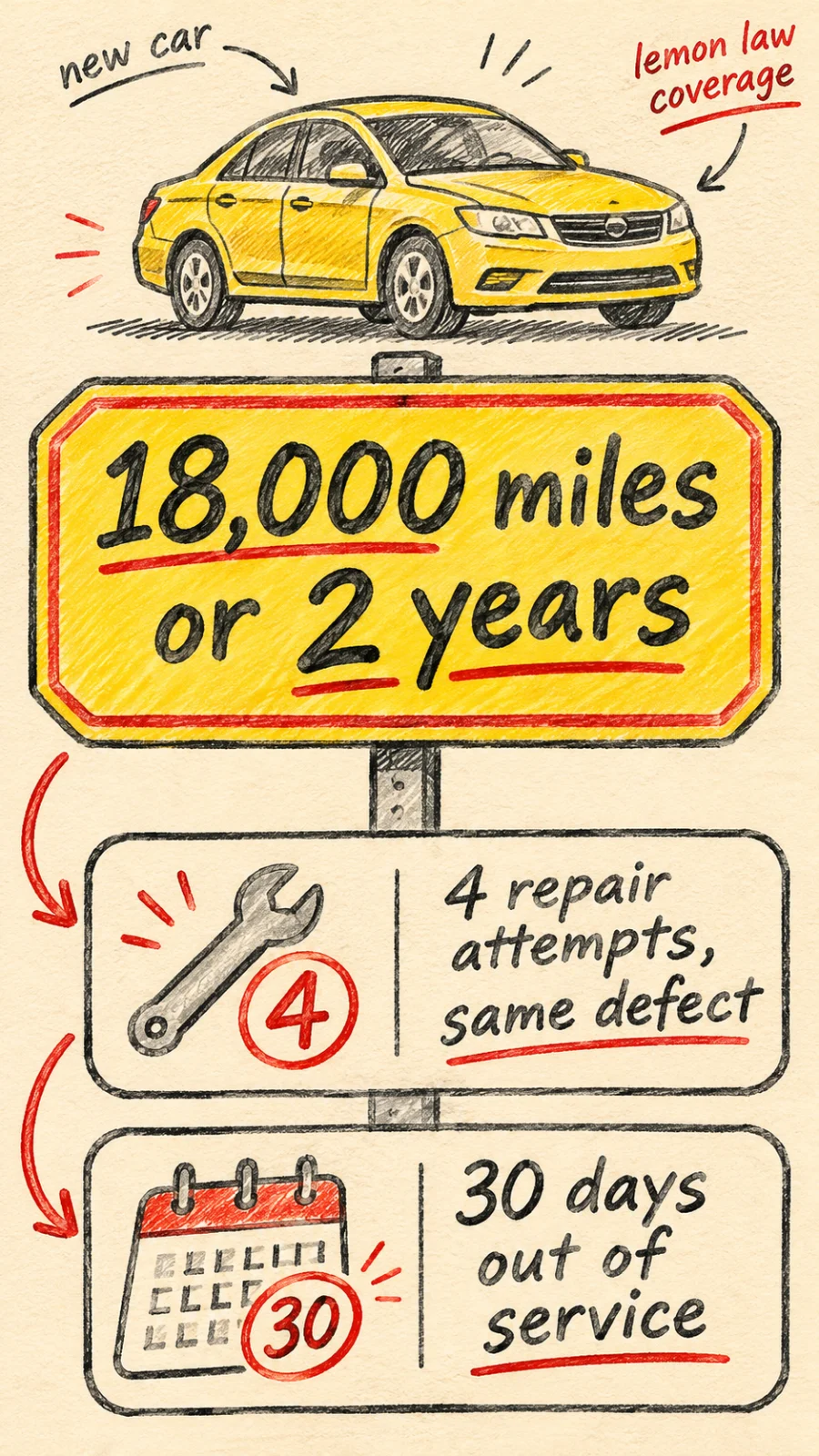
New York has two lemon laws. The New Car Lemon Law, General Business Law § 198-a, requires the manufacturer to refund or replace a car it cannot fix after four repair attempts for the same defect, or after 30 days out of service, within the first 18,000 miles or two years. The Used Car Lemon Law, § 198-b, puts the dealer on the hook after three failed repairs or 15 days out of service, for cars with under 100,000 miles that cost at least $1,500.
Which law applies depends on the car’s mileage and age on the day you bought or leased it, not on whether the title says “new” or “used.” That detail decides who you file against, what defects count, and how much the arbitration costs.
New Car or Used Car Law: Which One Covers Your Vehicle?
The two statutes meet at 18,000 miles or two years from the original delivery, whichever comes first. A car bought under that line is handled under § 198-a, even if a dealer sold it as used, a demo or a certified pre-owned car. A car bought past that line falls under § 198-b.
That overlap matters. A 14-month-old car with 11,000 miles on it still has the manufacturer’s warranty and falls under the new car law, so the manufacturer, not the dealer, owes you the refund. The table sets the two laws side by side.
| Feature | New car law (§ 198-a) | Used car law (§ 198-b) |
|---|---|---|
| Who owes the remedy | Manufacturer | Selling dealer |
| Vehicle at purchase | Under 18,000 miles or 2 years from original delivery | Over 18,000 miles or 2 years, under 100,000 miles |
| Minimum price | None stated | $1,500 |
| Repair presumption | 4 attempts, same defect | 3 attempts, same defect |
| Days out of service | 30 | 15 (remedy at 45 regardless) |
| Defects covered | Any warranty defect that substantially impairs value | Listed parts only |
| AG arbitration fee | $250 | $120 |
| Lawsuit deadline | 4 years from original delivery | 4 years from original delivery |
How the New Car Lemon Law Works (GBL § 198-a)
Which new and nearly new cars qualify
A car qualifies if it carried the manufacturer’s written warranty at original delivery, was bought, leased or transferred in New York (or is registered here), and the problem was reported within the first 18,000 miles or two years. The vehicle must be used mainly for personal, family or household purposes. The Attorney General’s new car guide adds that business use is allowed as long as personal use is more than half.
Off-road vehicles such as snowmobiles and ATVs are excluded. So is any clause in your sales contract that tries to waive these rights, because § 198-a(i) makes those waivers void.
When a car counts as a lemon
The law presumes the manufacturer has had a reasonable number of attempts once either of two things happens within the coverage period: the same defect has been repaired four or more times and still exists, or the car has been out of service for repairs a total of 30 or more calendar days. The defect must also substantially impair the car’s value to you.
The manufacturer can defend by arguing the defect is not substantial, or that it came from abuse, neglect or unauthorized modification. Courts treat “substantial impairment” as a real hurdle, as the BMW case below shows.
Notice rules that start the clock
If you report a defect to the dealer, the dealer must send written notice to the manufacturer by certified mail within seven days. You do not have to contact the manufacturer yourself for that clock to start.
If a dealer refuses to make the repair at all, you can send certified notice to the manufacturer directly. The manufacturer then has 20 days to begin repairs. If it does not, you may choose a comparable replacement or a refund.
The statute also says a manufacturer that runs its own dispute program may require you to use it first, but § 198-a(k) lets you go to the Attorney General’s arbitration program instead, and every manufacturer must take part.
How the Used Car Lemon Law Works (GBL § 198-b)
Which used cars are covered
The law applies only to purchases or leases from a dealer, meaning a business that sold or leased three or more used vehicles in the prior 12 months. Private sales are not covered. The price must be at least $1,500, and the car must have fewer than 100,000 miles when you get it. Motor homes, off-road vehicles and historic vehicles registered under Vehicle and Traffic Law § 401 are excluded.
The warranty the dealer must give you
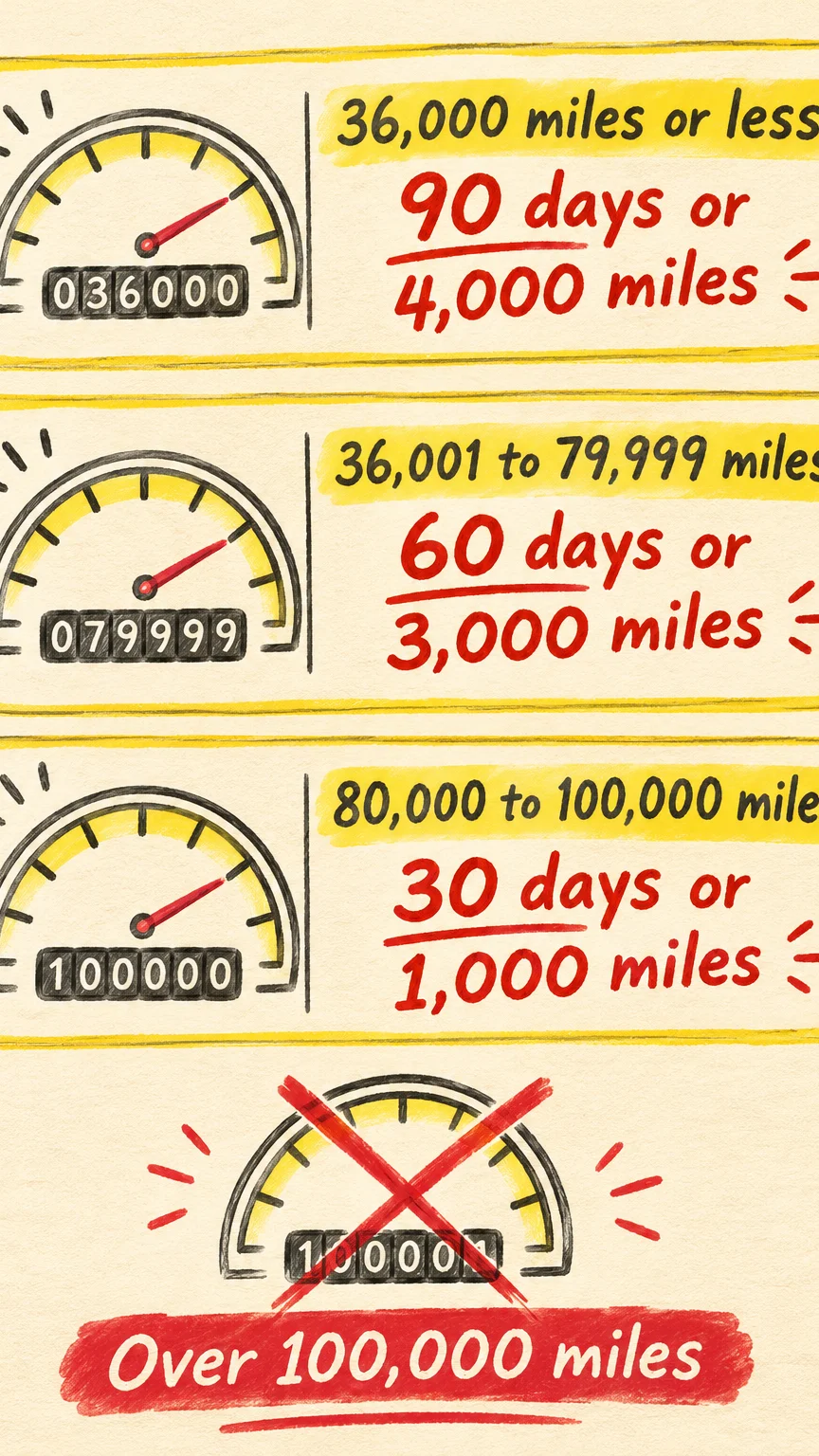
Under § 198-b(b), the dealer must provide a written warranty whose minimum length depends on the odometer reading at sale. If the dealer fails to give one, the law treats the dealer as having given it anyway.
| Mileage at purchase | Minimum warranty |
|---|---|
| 36,000 miles or less | 90 days or 4,000 miles, whichever comes first |
| 36,001 to 79,999 miles | 60 days or 3,000 miles |
| 80,000 to 100,000 miles | 30 days or 1,000 miles |
| Over 100,000 miles | Not covered |
Parts the used car law covers
Only listed components are protected: the engine and its lubricated parts, transmission, drive axle and shafts, brakes, radiator, steering, and the alternator, generator, starter and ignition system. Batteries are excluded. Body panels, tires, air conditioning and infotainment screens are not on the list, which is the most common reason a used car claim fails.
A dealer’s warranty may also exclude failures caused by missed maintenance, collision, abuse, theft, vandalism, fire, towing, racing or commercial passenger use.
When the dealer owes a refund
The dealer must take the car back if a covered defect that substantially impairs its value is not fixed after three repair attempts, or after 15 cumulative days out of service within the warranty period. Days spent waiting on parts do not count toward the 15 if the dealer was diligent, but at 45 cumulative days the remedy applies regardless.
The dealer must refund the full price (or all lease payments made) plus sales or compensating use tax, less a reasonable allowance for damage beyond normal wear. A dealer may offer a comparably priced replacement, but you can insist on the refund.
What You Get Back: Refund Math for New and Leased Cars
Under § 198-a, you choose between a comparable replacement car and a refund of the purchase price, trade-in allowance, and fees and charges. The manufacturer subtracts a mileage deduction and a reasonable allowance for damage that is not normal wear.
The mileage deduction formula is the miles over 12,000, multiplied by the purchase price, divided by 100,000. Say 15,000 miles are counted against a car that cost $40,000: 3,000 miles over the threshold × $40,000 ÷ 100,000 = $1,200 deducted.
The Attorney General’s guide says the refund covers the price (cash plus trade-in), options, and title and registration fees. It does not cover loss of use, insurance premiums or finance charges. If you financed the car, the refund is split between you and the lender.
For a lease, the lessee receives the capitalized cost (deposits and payments made, less service fees) and the lessor receives the remainder of the lease price. The lease ends with no early-termination penalty. The law covers only leases that make the lessee responsible for repairs.
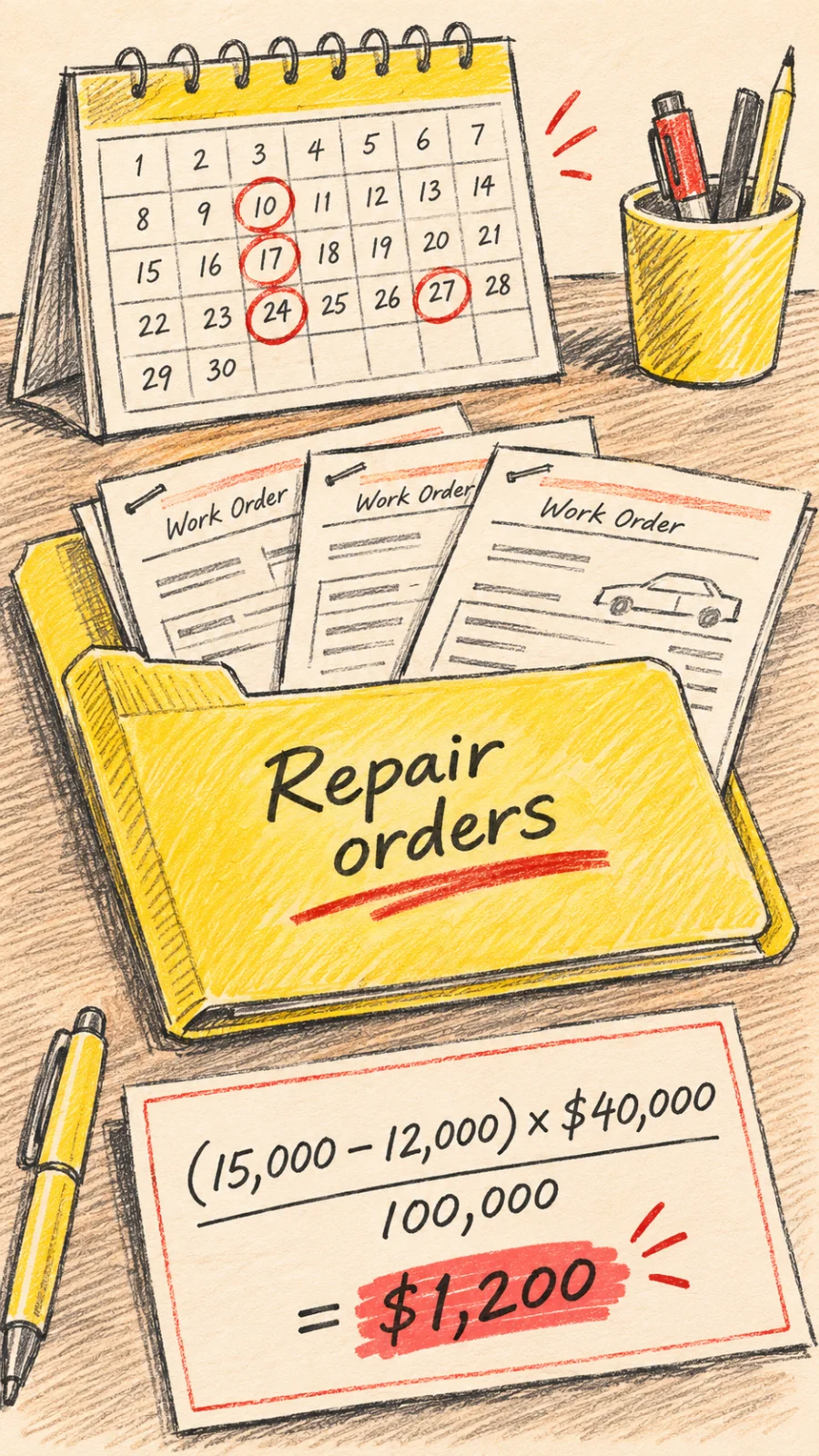
Documentation decides these claims. Dealers must give you a written work order for every repair, including warranty work. Keep each one, along with complaint emails and dates the car was in the shop. If a dealer will not hand over repair orders, the Attorney General’s fact sheet points to the DMV at 518-474-8943.
How to File for Lemon Law Arbitration in New York
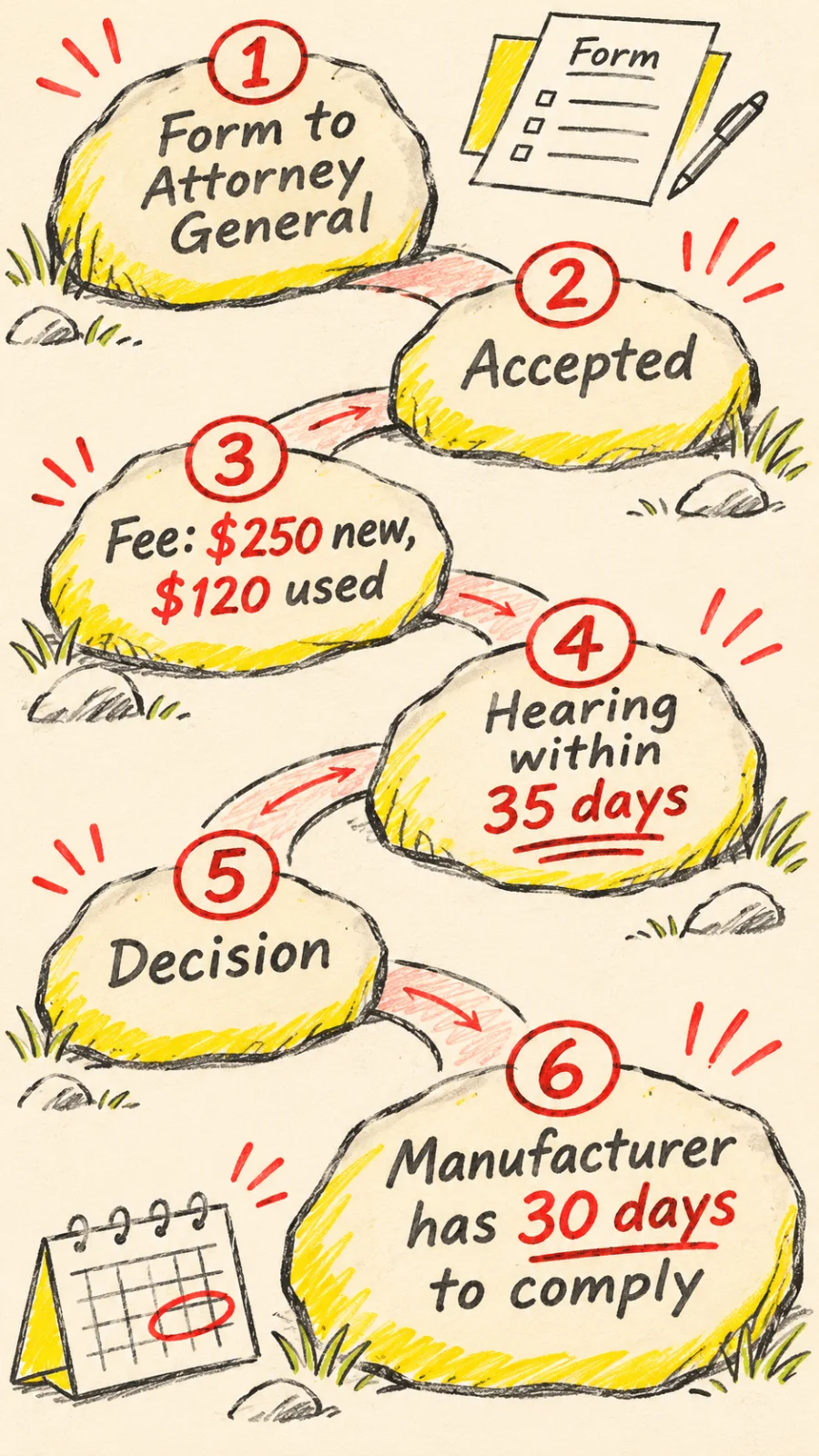
You start with a request form sent to the Attorney General’s Lemon Law Unit, which screens eligibility before a volunteer arbitrator ever sees the case. Forms for new cars, used cars, leased-car wear and tear, farm equipment and wheelchairs are on the Attorney General’s lemon law page. The arbitration itself is run by the New York State Dispute Resolution Association through community dispute resolution centers in all 62 counties.
- Send the form. Email it to [email protected] or mail it to the Lemon Law Unit, 28 Liberty Street, New York, NY 10005. Do not send the fee or documents yet.
- Wait for acceptance. The Attorney General’s office accepts or rejects the request.
- Pay the fee within 60 days. The administrator contacts you to collect $250 for a new car or motor home, or $120 for a used car. If you miss the 60-day window, the case closes and you must refile. The day the fee arrives is the official filing date.
- Prepare for a hearing within 35 days. You get at least eight days’ notice. The other side responds within 15 days, and your reply is due by day 25.
- Attend the hearing. It usually lasts one to two hours, and formal rules of evidence do not apply. Documents must reach the arbitrator at least three business days before.
- Receive the decision. The Attorney General’s guides put the decision within 40 days of the filing date and the mailed copy within 45 days. The new car guide points out that the statute and regulation describe this timing differently.
A consumer who wins gets the filing fee back with the award. NYSDRA lists a $250 fee for motorcycles in one place while telling riders to use the new or used car form, so confirm the amount when the administrator contacts you.
Deadlines after the decision
- Request a modification within 20 days of receiving the decision.
- A court challenge to vacate or modify the decision must be filed within 90 days.
- To confirm an award in court, apply within one year of receiving it.
- A lawsuit instead of arbitration must begin within four years of original delivery.
- Apply for the sales tax refund within three years of getting the manufacturer’s refund.
What Courts Have Said About Lemon Law Claims
In Matter of DaimlerChrysler Corp. v. Spitzer, 7 N.Y.3d 653, decided December 14, 2006, the Court of Appeals held that a consumer who relies on the four-repair presumption does not have to show the defect still exists at the time of arbitration. The presumption arises once the defect remains after the fourth attempt, even if the manufacturer fixes it later. The Court also noted that the law does not require you to keep driving a defective car until the case is heard.
The limits show up in Matter of BMW of N. Am., LLC v. Leonidou, decided May 14, 2020. An arbitrator awarded a lessee $62,716.31 over recurring noises in his SUV, and the First Department vacated the award. The lessee admitted the noises did not affect safety or operation, and BMW’s witnesses testified they were inherent to the design. The court found no covered defect and no evidence of substantial impairment.
Together the two rulings give a practical rule. Four failed repairs of a real defect is enough to trigger the presumption, but a cosmetic or design-related complaint can lose even after a large award.
Penalties When a Manufacturer or Dealer Ignores the Award
After you accept an arbitration decision, the manufacturer (§ 198-a(h)) or dealer (§ 198-b(f)) has 30 days to comply. Late compliance costs $25 per business day, capped at $500 total. The Attorney General’s web page words this as “$25-500 for each day,” but the statute sets the $500 cap on the whole penalty.
Dealers face an added consequence. The DMV may deny, suspend or refuse to renew a dealer’s registration if its principals deliberately fail to pay an unstayed award for 60 days after it is mailed. Courts may also award reasonable attorney’s fees to a consumer who prevails, including fees for collecting an award.
Proposed Changes: Bills A8594-A and S8430
Two companion bills would expand the law, but neither has been signed. Assembly bill A8594-A was introduced May 22, 2025 by Assembly Member P. Carroll, ordered to third reading on January 7, 2026, and amended May 6, 2026. Senate bill S8430 was referred to the Consumer Protection Committee on January 7, 2026. Each would take effect one year after becoming law, so the existing 18,000-mile and two-year limits control until a bill is signed.
- Longer coverage window: from 18,000 miles or two years to 36,000 miles or three years, for new cars and the dividing line with used cars.
- Higher penalties: A8594-A raises late fees to $250 per business day with a $5,000 cap. S8430 sets up to $250 per day with a $2,000 cap.
- Longer used car warranties: 12 months or 12,000 miles for cars up to 80,000 miles, with 6 months or 6,000 miles for 80,000 to 100,000 miles, and shorter coverage up to 200,000 miles.
- Software and electronics: computers, modules, navigation and driver-assistance systems would be covered parts.
- Different mileage offsets: A8594-A raises the offset threshold from 12,000 to 24,000 miles. S8430 raises it to 20,000 and changes the divisor from 100,000 to 200,000.
Other Lemon Laws the Attorney General Enforces
The Attorney General’s program also handles new motorcycles, motor homes, wheelchairs and self-propelled farm equipment, plus disputes over excess wear-and-tear charges at the end of a car lease. NYSDRA lists filing fees of $100 for wheelchairs, $120 for farm equipment and $75 for lease wear and tear.
Motor homes get modified rules: living facilities such as plumbing, the roof and the furnace are excluded, and a special certified-mail notice applies after two repair attempts or 21 days out of service. The Attorney General has also proposed rules (13 NYCRR Part 304) for disputes over ambulances and fire vehicles sold to municipalities under General Municipal Law § 109-d.
Frequently Asked Questions
Does the New York lemon law cover used cars bought from a private seller?
No. The used car law applies only to purchases or leases from a dealer. A private sale is not covered unless the car is still within its first 18,000 miles or two years under the manufacturer’s warranty.
How many repair attempts make a car a lemon in New York?
Four attempts for the same defect for a new car, or three for a used car from a dealer. Alternatively, 30 days out of service (new) or 15 days (used) also trigger the presumption.
How much does it cost to file a lemon law claim?
The filing fee is $250 for a new car or motor home and $120 for a used car, paid to NYSDRA after the Attorney General accepts your case. You get the fee back if the arbitrator rules in your favor.
Can I use the lemon law if I lease my car?
Yes, as long as your lease makes you responsible for repairs. The lessee receives the capitalized cost, the lessor receives the rest of the lease price, and the lease ends without an early-termination penalty.
How long do I have to file?
You have four years from the original delivery of the car to bring a lawsuit or request arbitration. The defect must have been reported within the first 18,000 miles or two years for a new car, or within the dealer’s warranty period for a used car.
Do I need a lawyer for lemon law arbitration?
No. The hearing is informal and typically lasts one to two hours. If you go to court and win, the judge may order the manufacturer or dealer to pay your reasonable attorney’s fees.
References
- New York State Senate, N.Y. Gen. Bus. Law § 198-a, Warranties (new car lemon law)
- New York State Senate, N.Y. Gen. Bus. Law § 198-b, Used car lemon law
- New York State Attorney General, Lemon Law Program and arbitration forms
- New York State Attorney General, New Car Lemon Law: A Guide for Consumers
- New York State Attorney General, Used Car Lemon Law: A Guide for Consumers
- New York State Attorney General, New Car Lemon Law Fact Sheet and arbitration request
- New York State Dispute Resolution Association, Lemon Law Arbitration Program and filing fees
- Appellate Division, First Department, Matter of BMW of N. Am., LLC v. Leonidou, 2020 NY Slip Op 02858
- New York Court of Appeals, Matter of DaimlerChrysler Corp. v. Spitzer and Matter of General Motors Corp. (Warner), 2006 NY Slip Op 09322
- New York State Senate, Bill S8430, lemon law mileage and fines