
North Carolina Divorce Laws 2027: Separation Rule Explained
North Carolina grants a divorce only after you and your spouse have lived separate and apart for one year, and at least one of you must have lived in the state for six months before filing. You do not have to prove fault. The court filing fee is $225, and the rule that catches most people is that property and support claims are lost if you do not file them before the divorce judgment is entered.
The legal name for a full divorce here is an “absolute divorce.” It is governed by N.C. Gen. Stat. § 50-6, and the practical mechanics are spread across several other chapters covered below.
What Do You Need to Qualify for a Divorce in North Carolina?
You need three things: one year of continuous separation, six months of North Carolina residency by either spouse, and a verified complaint filed in district court. Section 50-6 sets the separation period, and § 50-8 sets the residency and pleading rules.
The North Carolina Judicial Branch tells filers they can file only after being separated at least a year and a day, so treat the first day after the one-year anniversary as the earliest safe filing date.
What Counts as “Separate and Apart”?
It means living in different homes, with at least one spouse intending the separation to be permanent. Sleeping in separate bedrooms under one roof does not start the clock. The statute does not define the phrase, so the court system’s own guidance is the best statement of the working rule.
The intent requirement matters for a less obvious reason. If one spouse leaves for a job or a military deployment and both plan to reunite, the separation has not started. It starts on the date at least one of you decides the marriage is over and acts on it.
Does a Brief Reconciliation Restart the Clock?
Isolated acts of sexual intercourse do not restart the one-year period, according to § 50-6. Whether you actually resumed the marriage is decided under § 52-10.2, which looks at the totality of the circumstances and asks whether you voluntarily started living as spouses again.
A weekend together will not reset the date. Moving back in, sharing a household and presenting yourselves as a couple can.
A Sample Timeline
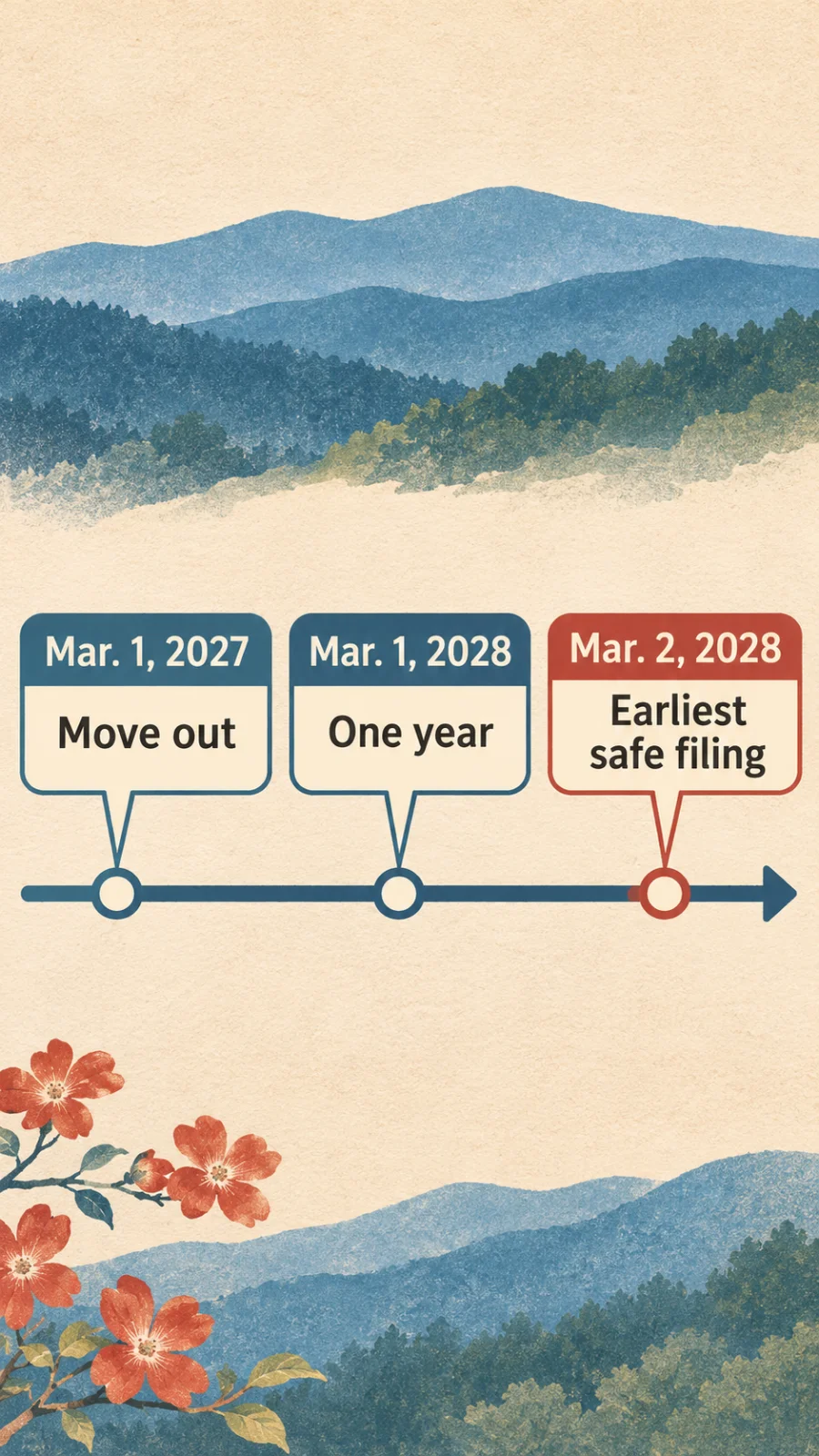
Say you move out on March 1, 2027, intending to end the marriage. One year later is March 1, 2028, and a year and a day is March 2, 2028. Filing earlier than that exposes the case to dismissal, and you would need to refile and pay the fee again.
Is There Any Way to Divorce Without the One-Year Wait?
For an ordinary divorce, no. North Carolina has one other absolute-divorce ground, in § 50-5.1, and it is longer, not shorter: three consecutive years of separation because one spouse has incurable insanity. Only the spouse who is not ill may file, and the court must order the plaintiff to provide lifetime care if the other spouse lacks enough income and property.
A separate remedy, divorce from bed and board under § 50-7, is a court-ordered separation, not an end to the marriage. It requires fault by the other spouse, such as abandonment, cruelty, drug or alcohol abuse that makes life unbearable, or adultery. After one is granted, the Judicial Branch notes you still have to wait a year and file for an absolute divorce.
Filing Requirements, Fees and Forms
The filing fee is $225. That figure is built from the district court civil costs, which add up to $150 under N.C. Gen. Stat. § 7A-305, plus a separate $75 absolute divorce cost in subsection (a2) that funds the Domestic Violence Center Fund. Several clerks do not accept personal checks, so ask your clerk what payment types are taken.
If you cannot afford it, the court system offers a petition to proceed as an indigent, and the fee can be waived.
What the Complaint Must Say
Under § 50-8, the complaint has to be verified, which means sworn before a notary. It must state that you or your spouse have lived in North Carolina for at least six months, give the names and ages of any minor children (or say there are none), and allege the facts of the separation.
If you live outside North Carolina and your spouse lives here, the statute requires you to file in your spouse’s county and to personally serve them. The reverse is simpler: the Judicial Branch says you can obtain a simple divorce no matter where your spouse lives, as long as you live here and have for the six months before filing, though your spouse must still be served.
Forms and Online Filing
The court system’s free Guide & File tool prepares an absolute divorce packet through an online interview, which you print and file with the clerk. The statewide self-help packet also lists the pieces a simple case needs:
- A verified complaint for absolute divorce and a civil summons.
- A notice of hearing and request for setting, in counties that use the hearing route.
- A Certificate of Absolute Divorce (DHHS 2089, also numbered AOC-CV-711), which you get from the clerk or Vital Records. Per the Judicial Branch packet, a judge will not sign without it.
- A proposed judgment: AOC-CV-710 for the clerk route, or AOC-CV-750 for a judge.
How the Court Actually Grants the Divorce
Most uncontested divorces end with a paper judgment, not a trial. A judge or jury must normally find the facts before a divorce is granted under § 50-10, but two shortcuts apply when nothing is truly disputed.
First, subsection (d) lets a judge enter summary judgment on the verified complaint and affidavits if there is no genuine factual dispute. Second, subsection (e) lets the clerk of superior court enter the judgment, but only if all of these are true:
- Your only claims are absolute divorce, or divorce plus resuming a former name.
- Your spouse defaulted, answered admitting the allegations, or signed a waiver of the right to answer.
- Your spouse is not a minor or legally incompetent.
Section 50-6 also bars your spouse from blocking a one-year divorce with fault-based defenses such as recrimination, which means “you did something wrong too.” Fault is irrelevant to whether the divorce is granted.
The Deadline That Costs People Their Property and Alimony Claims
Once the divorce judgment is entered, a spouse’s claim to equitable distribution is gone unless it was already filed. Section 50-11(e) says an absolute divorce ends the right to equitable distribution under § 50-20 unless the claim is asserted before the judgment. The statewide self-help packet puts the same warning in the complaint itself, which you must acknowledge.
Alimony works differently. A claim for alimony or postseparation support that is pending when the judgment is entered survives, and orders entered earlier are not impaired, under § 50-11(c). The safe course is to file before the divorce either way.
| Claim | Must be filed | Source |
|---|---|---|
| Equitable distribution | Before the divorce judgment | § 50-11(e) |
| Alimony or postseparation support | Pending when judgment is entered | § 50-11(c) |
| Child custody and child support | Not lost by divorce; can be filed separately | §§ 50-13.2, 50-13.4 |
| Resuming a former name | In the complaint, or later by application with a $10 fee | § 50-12 |

How North Carolina Divides Property
North Carolina divides marital property by equitable distribution, and § 50-20 starts from a presumption that an equal split is fair. A judge departs from 50/50 only if an equal division is not equitable after weighing twelve listed factors.
Marital property is what either spouse acquired during the marriage and before separation and still owns. Property acquired before separation is presumed marital, and real estate held as tenants by the entirety is presumed marital too. Either presumption can be rebutted by the greater weight of the evidence.
Separate Property and Divisible Property
Separate property includes what you owned before the marriage and gifts or inheritances to you alone during it. Gifts between spouses generally count as separate only if the giver stated that intent in writing. Valuation is set at the date of separation, so the separation date you plead matters beyond the one-year count.
Changes after separation, such as a bonus earned from pre-separation work or passive growth in a retirement account, are “divisible property” and are divided along with the marital estate. Factors a judge weighs include each spouse’s income, the length of the marriage, homemaker contributions, tax consequences and any waste of property after separation.
Deadlines After You File an Equitable Distribution Claim
The timetable in § 50-21 is short:
- The spouse who filed the claim must serve an inventory affidavit within 90 days of service.
- The other spouse must serve a responding affidavit within 30 days after that.
- The filing spouse must apply for a scheduling and discovery conference within 120 days of filing the claim.
A court can extend those dates for good cause, and it must sanction a spouse whose willful or unreasonable delay prejudices the other.
Alimony and Postseparation Support
Alimony in North Carolina is decided case by case, with no formula. Under § 50-16.3A, the court awards it if one spouse is dependent, the other is supporting, and an award is equitable. The judge then sets the amount, how long it lasts and how it is paid, and the term can be fixed or indefinite.
Why Adultery Matters Here but Not for the Divorce
Fault does not affect whether you get divorced, but “illicit sexual behavior” during the marriage and on or before the separation date controls alimony. If the dependent spouse engaged in it, alimony is barred. If the supporting spouse did, the court must award alimony to the dependent spouse. If both did, the judge has discretion. Either spouse can ask for a jury on whether misconduct occurred, and condoned conduct is not counted.
The court also weighs sixteen factors, including relative earnings, age and health, length of the marriage, the marital standard of living, and the effect of caring for a minor child.
Temporary Support While the Case Is Pending
Postseparation support under § 50-16.2A is the short-term version. A dependent spouse is entitled to it when their resources do not meet their reasonable needs and the other spouse can pay.
When Alimony Ends
Under § 50-16.9, support ends if the recipient remarries or cohabits, or if either spouse dies. The statute defines cohabitation as two adults dwelling together continuously and habitually in a private relationship, shown by the voluntary mutual assumption of marital rights, duties and obligations. Sexual relations are part of that but are not required. Orders can be modified on a showing of changed circumstances.
Custody and Child Support
Custody follows the child’s best interests, with no presumption favoring either parent. Section 50-13.2 requires the court to consider domestic violence between the parties and the safety of the child and each party, and to put written findings in the order. Joint custody must be considered if either parent asks.
Most counties send contested custody and visitation issues to mediation first under § 50-13.1. Judges can waive it for good cause, including domestic violence, substance abuse or abuse allegations. Money issues such as alimony and child support cannot be sent to this mediation.
The 2027 Child Support Guidelines
Revised guidelines apply to child support actions heard on or after January 1, 2027. The Conference of Chief District Court Judges sets them under § 50-13.4(c1) and must review them at least every four years. According to a UNC School of Government presentation on the revisions, the maximum income covered by the schedule rises to $50,000 a month ($600,000 a year), and the minimum support order is $100 a month.
If your hearing is set close to the cutoff, ask your attorney or the clerk which version will apply. Support generally runs until the child turns 18, or until graduation or age 20 if the child is still in high school at 18.

Resuming Your Former Name and Separation Agreements
You can ask for your former name in the divorce complaint, and the court can include it in the judgment. Otherwise you apply to the clerk under § 50-12 with a $10 fee. A divorced woman may use her maiden name or the surname of a deceased former husband. She may use a living former husband’s surname only if she has children with that surname. A divorced man may return to his premarriage surname.
A written separation agreement can settle property, support and custody before you file. Section 52-10.1 requires it to be in writing and acknowledged by both spouses before a certifying officer who is not a party to it. An agreement that meets those rules is binding if it does not conflict with public policy.
Frequently Asked Questions
How long does a divorce take in North Carolina?
You must be separated one year before filing, and the Judicial Branch advises a year and a day. After filing, an uncontested case often finishes within a few months once your spouse is served and signs a waiver or fails to answer.
Do I need a lawyer to get divorced?
No. A simple divorce with no property, support or custody claims can be filed on your own using the court’s free Guide & File tool or the self-help packet. If you have a home, retirement accounts, children or alimony issues, a consultation is worth the cost because those claims can be lost.
Can I get divorced if my spouse refuses to sign?
Yes. Your spouse’s agreement is not required. If they do not answer after proper service, the clerk can enter judgment under § 50-10(e), and if they contest, a judge can decide on summary judgment.
Is North Carolina a fault or no-fault divorce state?
The divorce itself is no-fault, since the only requirement is the separation period. Fault still matters for alimony, where illicit sexual behavior before separation can bar or require an award.
Can I file in North Carolina if my spouse lives in another state?
Yes, if you have lived in North Carolina for the six months before filing. Your spouse must still be served wherever they live.
What happens to the marriage if we reconcile and then separate again?
A true resumption of marital relations ends the separation period, and a new one-year period starts only when you separate again. Isolated acts of sexual intercourse do not restart it.
References
- North Carolina General Assembly, N.C. Gen. Stat. § 50-6, Divorce after one year’s separation
- North Carolina General Assembly, N.C. Gen. Stat. § 50-11, Effect of absolute divorce on rights
- North Carolina General Assembly, N.C. Gen. Stat. § 50-20, Equitable distribution
- North Carolina General Assembly, N.C. Gen. Stat. § 50-16.3A, Alimony
- North Carolina General Assembly, N.C. Gen. Stat. § 7A-305, Costs in civil actions
- North Carolina Judicial Branch, Separation and Divorce help topic
- North Carolina Judicial Branch, Absolute Divorce self-help packet
- North Carolina Judicial Branch, Form AOC-CV-710, Judgment for Absolute Divorce Before the Clerk
- UNC School of Government, Child Support Guidelines presentation on the 2027 revisions