
North Carolina Lemon Law: The 4-Repair, 20-Day Rule
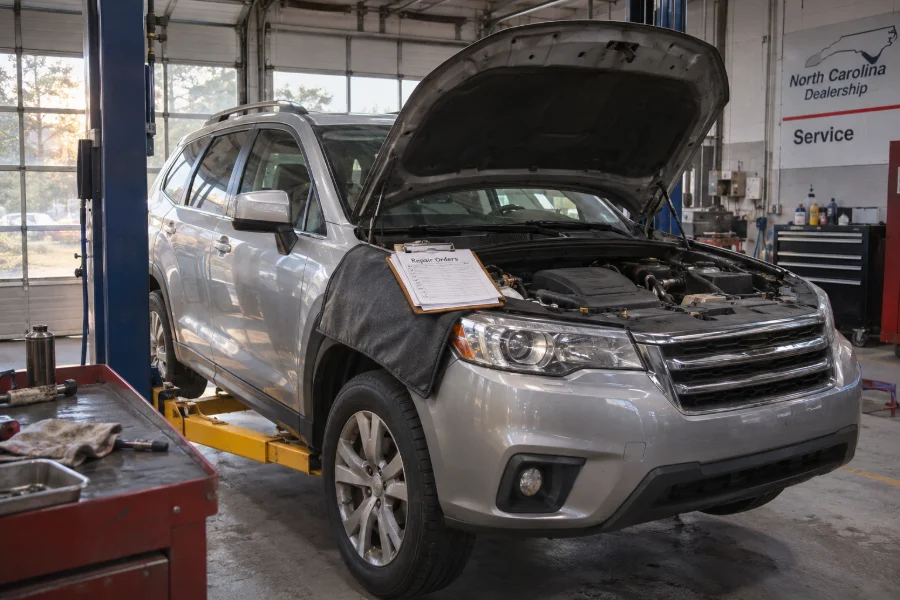
North Carolina’s lemon law makes the manufacturer replace or refund a new vehicle it cannot fix. The law presumes the manufacturer has had enough chances when the same defect has been repaired four or more times, or the vehicle has been out of service for 20 or more business days in a 12-month warranty period. The defect has to show up within 24 months or 24,000 miles of delivery, and you must first notify the manufacturer in writing and give it up to 15 calendar days to fix the problem.
The law is the New Motor Vehicles Warranties Act, N.C. Gen. Stat. §§ 20-351 through 20-351.10. The General Assembly passed it in 1987 (S.L. 1987-385) and it has been amended only a few times since, most recently in 2005.
Which Vehicles and Buyers Does the Law Cover?
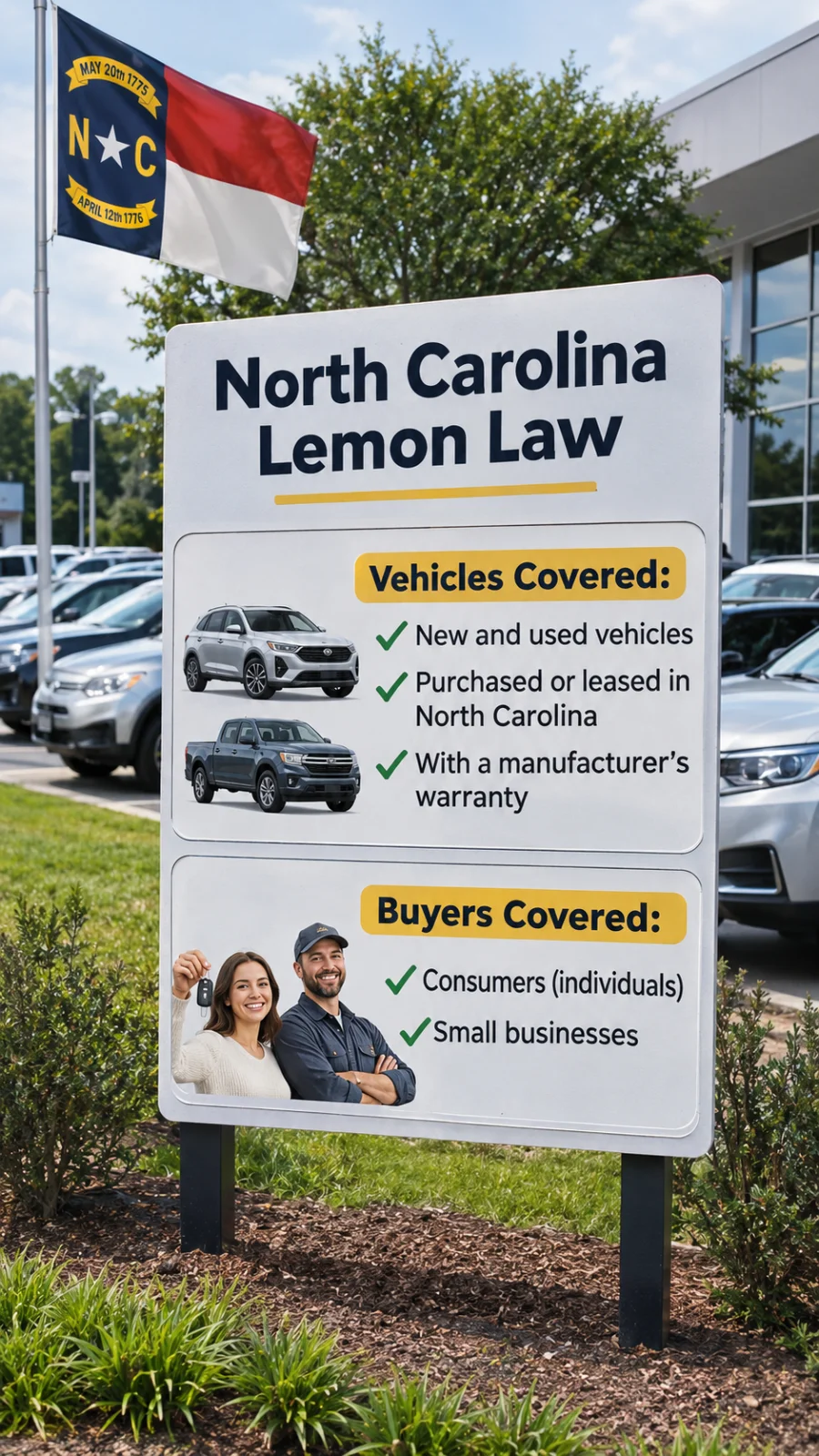
The Act covers new motor vehicles bought or leased in North Carolina, by the original buyer or lessee or anyone entitled to enforce the warranty. Under § 20-351.1, a vehicle counts as new if no certificate of origin has ever been supplied to a consumer, or if the manufacturer, its agent, or a dealer states in writing that it is sold as new.
Two groups are carved out. House trailers are excluded, and so is any vehicle weighing more than 10,000 pounds. The North Carolina Department of Justice says the law reaches new passenger cars, pickup trucks, motorcycles and most vans.
Leased vehicles are covered too
Lessees are “consumers” under the Act, and § 20-351.3(b) gives them their own refund formula. The manufacturer repays the lessee’s payments and upfront costs, and the lessor receives the lease price plus 5% of that price, minus 85% of what the consumer paid the lessor.
Used cars are not covered
The Act applies only to new vehicles, so a used car bought “as is” has no lemon law protection. The options for used vehicles are covered further down.
What Counts as a Lemon in North Carolina?
A lemon is a new vehicle with a defect or series of defects that substantially impairs its value to you, that appeared within 24 months or 24,000 miles of delivery, and that the manufacturer could not fix after a reasonable number of attempts (§ 20-351.3(a)). The defect does not have to stop the car from running. The Attorney General’s office lists faulty air conditioning and peeling paint as examples that can qualify.
The statute never defines “substantially impair.” The pattern jury instructions published by the UNC School of Government note that North Carolina follows a subjective test borrowed from the Uniform Commercial Code, which asks about value to you as the consumer, not to an average driver.
The two ways to prove “a reasonable number of attempts”
Section 20-351.5 presumes the manufacturer has had a reasonable number of attempts if either of these is true:
- The same problem was presented for repair four or more times and still exists.
- The vehicle was out of service for 20 or more cumulative business days in any 12-month period of the warranty.
The presumption applies only if you have first notified the manufacturer directly, in writing, and the manufacturer has had up to 15 calendar days to correct the problem. You can also prove a reasonable number of attempts without the presumption. Three failed repairs on a safety defect, for example, can still support a claim if you can show the manufacturer had its chance.
The Written Notice Rule and Its Exception
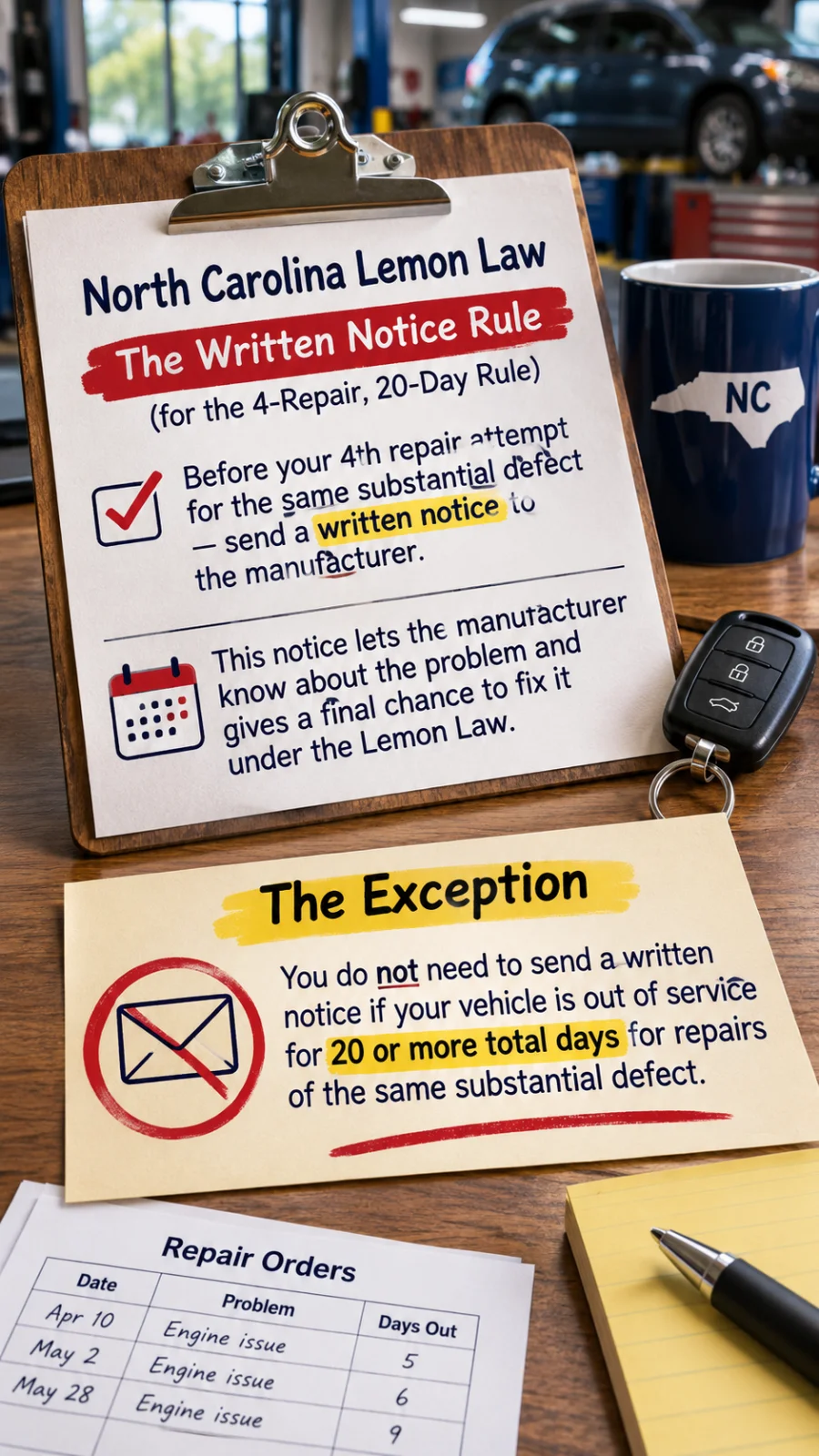
You must send the manufacturer written notice, and it gets up to 15 calendar days after receiving it to fix the problem. The notice goes to the manufacturer, not the dealer, at the address in your warranty booklet or owner’s manual.
There is a catch that favors you. Under § 20-351.5, the manufacturer must clearly disclose in the warranty or owner’s manual that written notice is required and give an address for it. If it fails to make that disclosure, you do not have to send written notice at all. A court has treated this requirement seriously: in Hardison v. Kia Motors America, Inc., 226 N.C. App. 22 (2013), the Court of Appeals found Kia’s manual satisfied the disclosure rule because it had a North Carolina section telling owners to write to Kia and listing an address.
Hardison also settled when the 15 days start. Kia argued the clock began once it got physical access to the car. The court disagreed and held the period runs from receipt of the written notice. Kia did not inspect or repair the vehicle until about a month after the letter arrived, so it had violated § 20-351.3, and the order requiring a repurchase was affirmed.
What You Get: Refund, Replacement, and the Mileage Offset
If your vehicle is a lemon, you can choose a comparable new vehicle or a refund. The statute does not define “comparable,” though the Attorney General’s guidance indicates it would most likely be the same make and model. A purchaser’s refund under § 20-351.3 includes:
- The full contract price, including options, dealer prep, transportation, and the non-refundable portion of any extended warranty or service contract
- Collateral charges such as sales tax and registration fees
- Finance charges you paid after first reporting the defect
- Incidental and monetary consequential damages
How the use allowance is calculated
The manufacturer may subtract an allowance for your use of the vehicle. The formula in § 20-351.3(c) multiplies the miles you drove by the purchase price (or the lessor’s actual lease price for a lease), then divides by 120,000.
The miles that count are only those driven up to the third repair attempt for the same defect, or up to the 20th cumulative business day the vehicle was out of service, whichever comes first. Miles you add after that point do not reduce your refund. Here is a hypothetical: say you paid $40,000 and the car had 8,000 miles on it at the third repair visit. The allowance is 8,000 × $40,000 ÷ 120,000, or about $2,667, even if you have since driven it 14,000 miles.
| Item | Example amount | Source |
|---|---|---|
| Purchase price | $40,000 | § 20-351.3(a) |
| Miles at third repair visit | 8,000 | § 20-351.3(c) |
| Use allowance (8,000 × 40,000 ÷ 120,000) | about $2,667 | § 20-351.3(c) |
Resale of returned lemons
When a manufacturer, its agent, or a dealer resells a vehicle that was returned under the Act (or another state’s lemon law), it must tell the next buyer before the sale that the car was returned and what defect caused it. A buyer who later resells it with notice must pass the same disclosure along.
Dispute Programs, Notice to Sue, and Going to Court
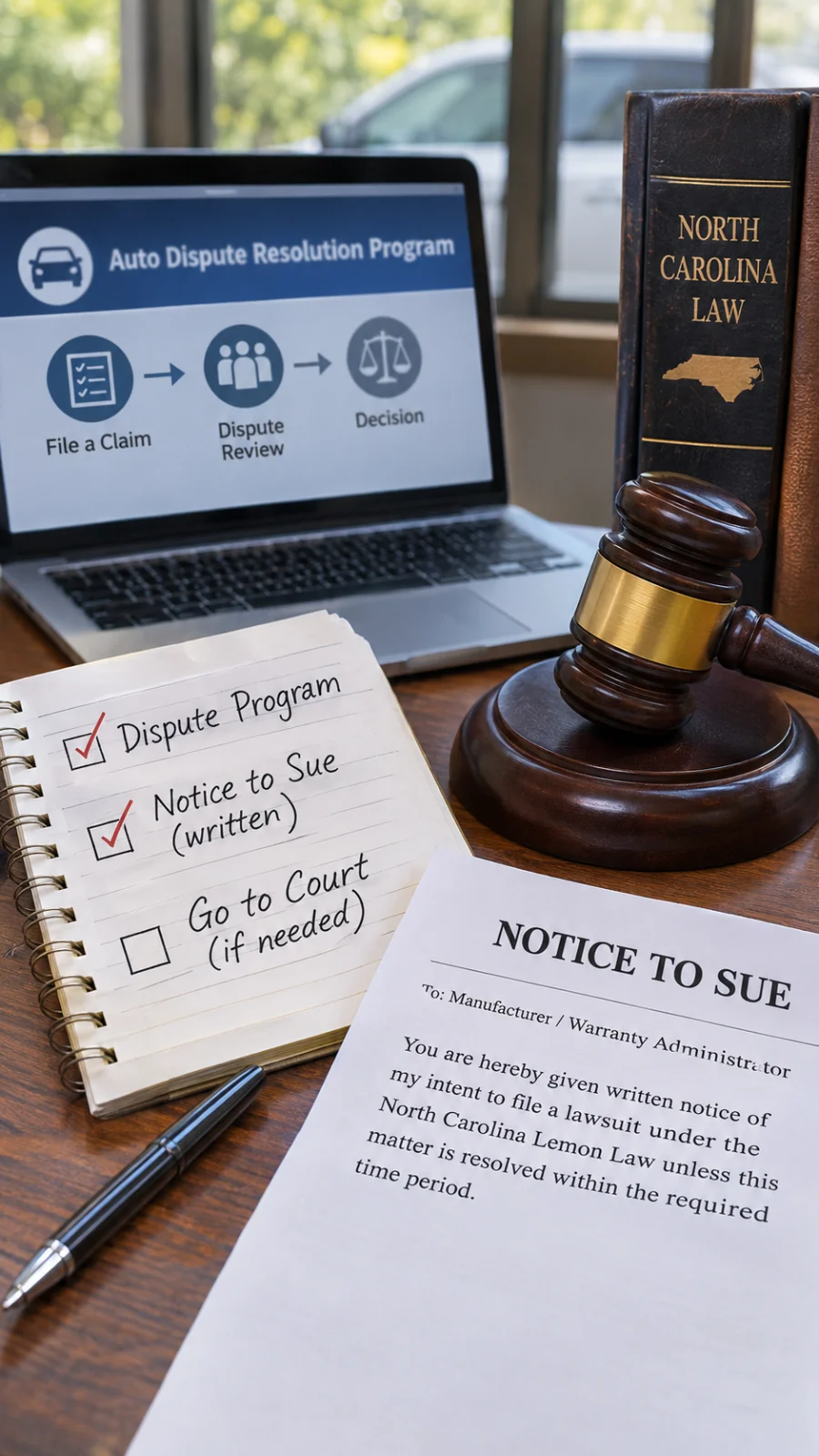
Before you file suit, § 20-351.7 requires written notice of your intent to sue at least 10 days before you file. A manufacturer can also require you to use its informal dispute program first, but only if the program substantially follows the federal Magnuson-Moss Warranty Act and the requirement is clearly stated in the warranty.
Many manufacturers use BBB AUTO LINE. The BBB’s North Carolina page says the service is free and needs no lawyer, and that a claim generally must be filed within four years of discovering the defect, though some manufacturers shorten this to one year, so check your warranty.
Who you sue
You sue the manufacturer, not the dealer. Section 20-351.9 says the Act creates no cause of action against an authorized dealer, and it also protects dealers from owing the manufacturer for a refund unless the dealer’s repairs were substantially inconsistent with the manufacturer’s instructions.
Damages and attorney’s fees
A court can award an injunction or money damages set by the verdict. Under § 20-351.8, damages are trebled if the manufacturer unreasonably refused to comply with its repair or refund duties. The court may also award attorney’s fees to the prevailing party if the manufacturer unreasonably failed or refused to fully resolve the matter, or if the plaintiff knew or should have known the suit was frivolous and malicious.
Hardison shows how hard trebling and fees can be to get. Kia missed the 15-day cure period, but because the record otherwise showed it responded promptly and honestly, the court reversed the attorney’s fee award and affirmed the denial of treble damages. Being late is not enough; the refusal must be unreasonable.
How Long Do You Have to File?
The Act itself contains no limitation period, and sources disagree on what applies. A 1988 North Carolina Law Review article noted the lemon law has none. Some law firm sites say three years under the general statute, while a breach of warranty claim under the Uniform Commercial Code carries a four-year limit under G.S. 25-2-725, running from the breach.
The practical answer is not to wait. Keep every repair order, send the written notice as soon as the repairs fail, and check your warranty for a shorter dispute program deadline.
Steps to Take If You Think Your Car Is a Lemon
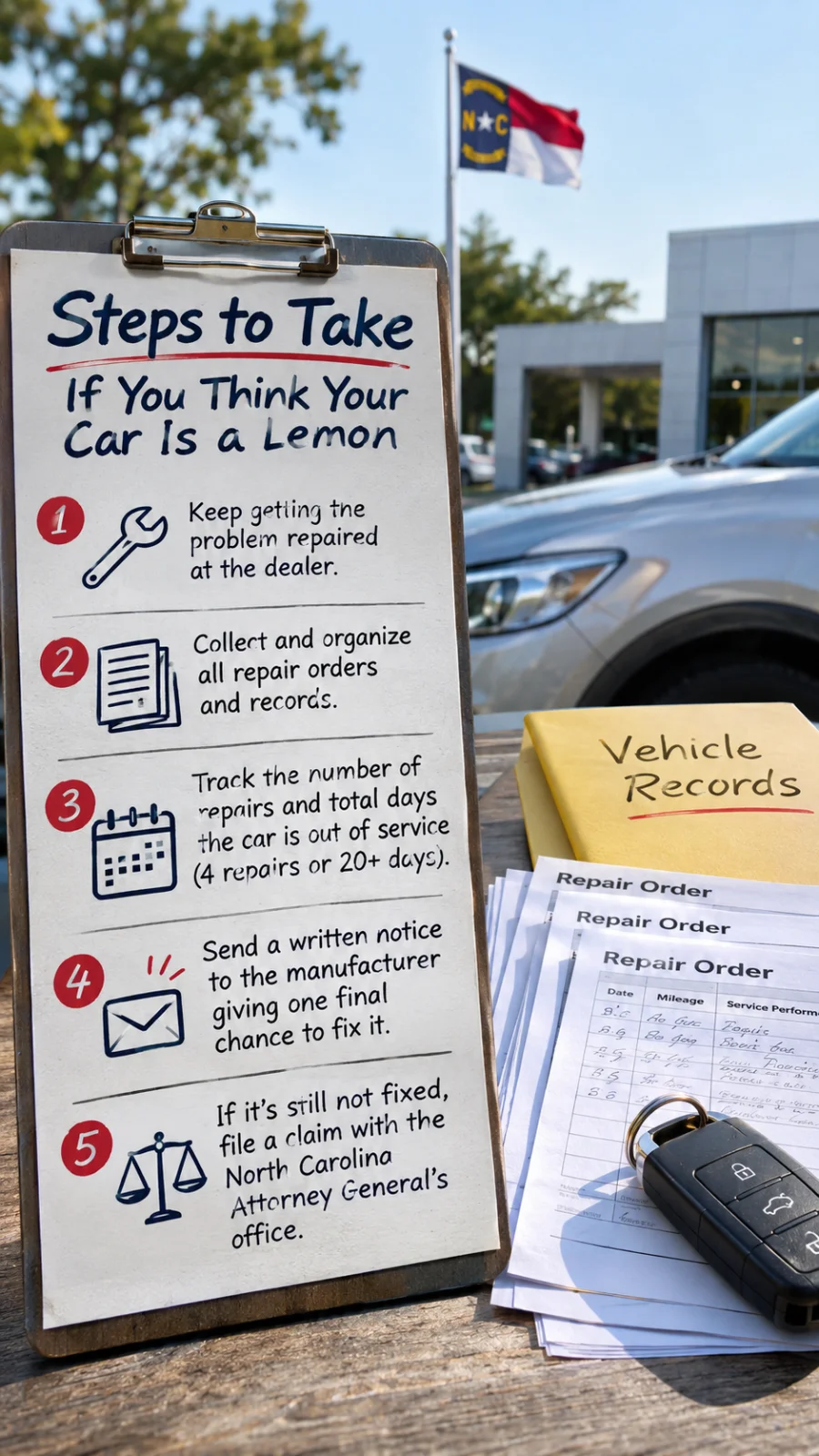
- Keep every repair order. Each one should list the date the car went in, the date it came out, the mileage, and the complaint. These prove both the four-repair count and the 20-business-day count.
- Report the defect during the warranty period. The nonconformity must occur within 24 months or 24,000 miles of delivery.
- Send written notice to the manufacturer. Use certified mail with a return receipt, to the address in your owner’s manual or warranty booklet. Describe the defect, the repair history, and your VIN.
- Let the manufacturer make its final attempt. It gets up to 15 calendar days from receipt of the notice.
- Use the manufacturer’s dispute program if the warranty requires it.
- Send a 10-day notice of intent to sue, then file in court if the manufacturer will not repurchase or replace the vehicle.
You can also file a complaint with the Consumer Protection Division at 1-877-5-NO-SCAM (1-877-566-7226) or through the online motor vehicle complaint form on ncdoj.gov. The office does not represent individuals in private cases, so for a lawyer the Department of Justice points people to the North Carolina State Bar’s lawyer referral service. Under § 20-351.6, the Attorney General can sue a manufacturer in the State’s name when the public interest requires it.
What About Used Cars?
North Carolina has no lemon law for used cars, but other laws can apply. If a used vehicle is still under a manufacturer’s written warranty, the federal Magnuson-Moss Warranty Act, 15 U.S.C. § 2310, lets you sue for breach of that warranty and can shift attorney’s fees to the seller if you win.
A dealer who sells without disclaiming the implied warranty of merchantability under the Uniform Commercial Code may also be liable, and a deceptive sale may fall under the Unfair and Deceptive Trade Practices Act, whose G.S. 75-16 provides for trebled damages. A car sold “as is” with the required FTC Buyers Guide window sticker usually disclaims the implied warranties, which is why the sticker matters before you buy.
Other Defenses the Manufacturer Can Raise
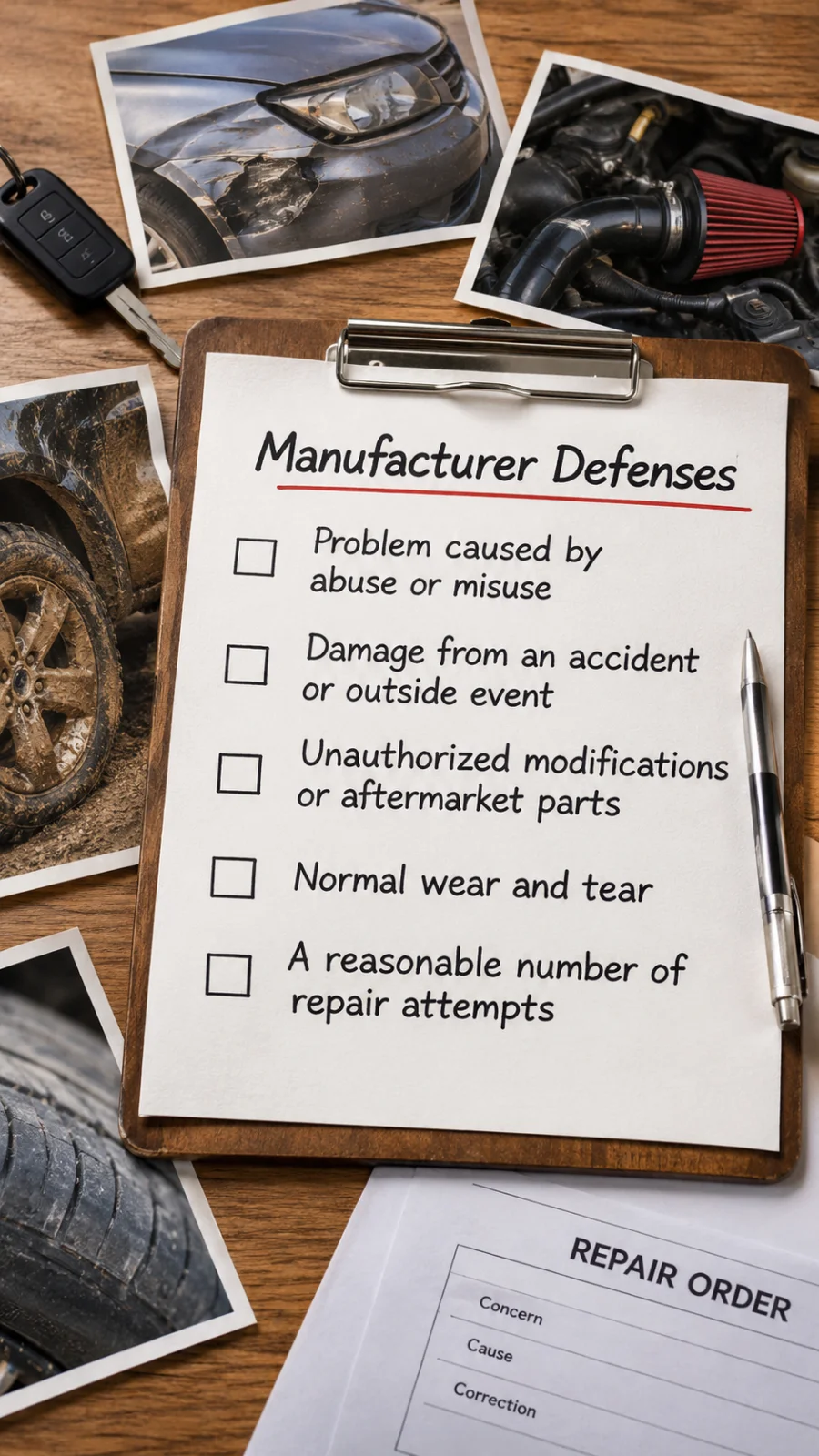
Section 20-351.4 gives the manufacturer an affirmative defense if the problem was caused by your abuse or neglect, by odometer tampering you did, or by unauthorized modifications. Skipping scheduled maintenance, installing aftermarket parts, or damage from an accident are the usual ways these arguments come up. Keeping service records protects you here.
The warranty period, the one-year period, and the 20-day period are all extended if repair services are not available to you because of war, strike, or natural disaster.
Frequently Asked Questions
How many repairs does it take to qualify as a lemon in North Carolina?
Four or more repair attempts for the same problem create a presumption that the manufacturer has had a reasonable number of attempts. A vehicle out of service for 20 or more cumulative business days in a 12-month warranty period creates the same presumption.
Does North Carolina’s lemon law cover used cars?
No. The Act covers only new vehicles. Used car buyers may have claims under the Magnuson-Moss Warranty Act, the Uniform Commercial Code, or the Unfair and Deceptive Trade Practices Act.
Do I have to send the manufacturer a letter before filing a lemon law claim?
Yes, unless the manufacturer failed to disclose the written notice requirement in its warranty or owner’s manual. You also need to send a separate notice of intent to sue at least 10 days before filing suit.
Can I sue the dealership under the lemon law?
No. Section 20-351.9 does not create a cause of action against an authorized dealer. Your claim is against the manufacturer.
What if my car is a lemon but I have already driven it many miles?
You can still get a refund, but the manufacturer may deduct a use allowance. Only the miles driven up to the third repair attempt, or the 20th business day out of service, count toward that deduction.
Can I get more than my purchase price back?
Possibly. Damages are trebled if the manufacturer unreasonably refused to comply, and attorney’s fees can be awarded if it unreasonably failed to resolve the matter. Courts do not award either automatically.
References
- North Carolina General Assembly, N.C. Gen. Stat. Chapter 20, Article 15A, New Motor Vehicles Warranties Act (§§ 20-351 to 20-351.10)
- North Carolina Department of Justice, Lemon Law guidance for new vehicles
- North Carolina Court of Appeals, Hardison v. Kia Motors America, Inc., 226 N.C. App. 22 (2013), No. COA12-981
- North Carolina General Assembly, N.C. Gen. Stat. § 25-2-725, limitation of actions for breach of a sales contract
- North Carolina General Assembly, N.C. Gen. Stat. § 75-16, treble damages under the Unfair and Deceptive Trade Practices Act
- U.S. House Office of the Law Revision Counsel, 15 U.S.C. § 2310, Magnuson-Moss Warranty Act remedies
- BBB National Programs, BBB AUTO LINE North Carolina Lemon Law program