
North Dakota Abortion Laws: Ban, Exceptions, Penalties
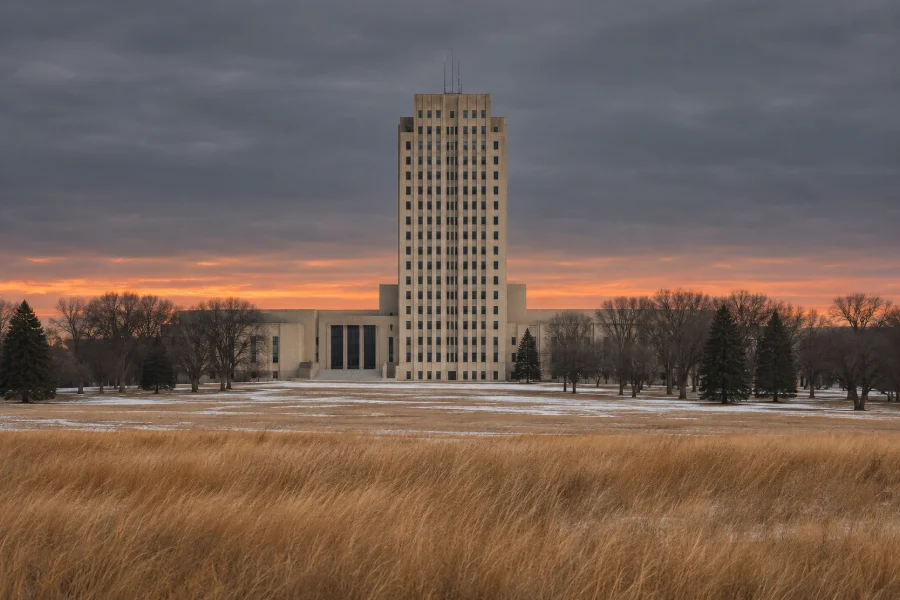
North Dakota bans abortion for nearly everyone. Under N.D.C.C. ch. 12.1-19.1, performing an abortion is a class C felony, with exceptions only to prevent the patient’s death or a serious health risk, and for pregnancies from certain sexual offenses or incest when the gestational age is six weeks or less. The ban has been enforceable since November 21, 2025, when the North Dakota Supreme Court’s 3-2 vote fell one short of the four votes needed to strike it down.
The law targets the person who performs the abortion, not the patient. The state has no abortion clinic, and the former Fargo clinic now operates across the Red River in Moorhead, Minnesota.
What the North Dakota Abortion Ban Says
The ban is short. Section 12.1-19.1-02 makes it a class C felony for anyone other than the pregnant woman to perform an abortion. The statute does not penalize the woman herself.
The legislature passed it as Senate Bill 2150, and Gov. Doug Burgum signed it on April 24, 2023. It took effect immediately and repealed the older 2007 “trigger” ban, which had been written to apply if Roe v. Wade was overturned (N.D.C.C. § 12.1-31-12, repealed by S.L. 2023, ch. 122, § 11).
How the law defines an abortion
An abortion is any use, sale, prescription or provision of an instrument, drug, substance or device intended to end a clinically diagnosable pregnancy, when the person knows the method will with reasonable likelihood cause the unborn child’s death (§ 12.1-19.1-01). That definition covers abortion pills as well as procedures.
Three things are written out of the definition: removing a dead unborn child after a spontaneous abortion (miscarriage), treating an ectopic pregnancy, and treating a molar pregnancy. A doctor performing those procedures is not committing a crime under this chapter.
Exceptions: When Abortion Is Allowed in North Dakota
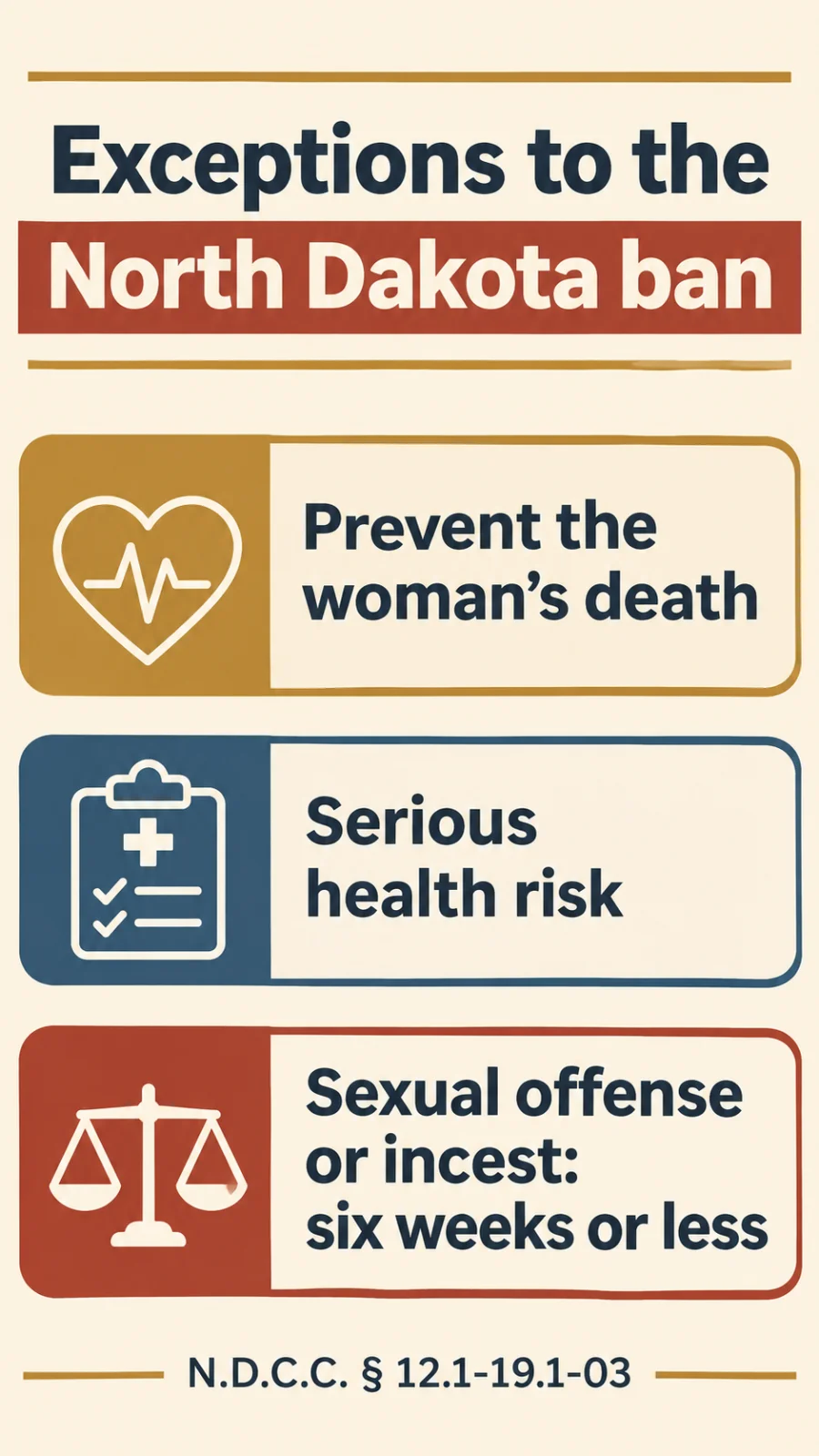
Section 12.1-19.1-03 sets out three exceptions. Each turns on “reasonable medical judgment,” which the statute defines as the judgment a reasonably prudent physician, knowledgeable about the case and the treatment options, would make.
| Situation | Covered? | Condition in the statute |
|---|---|---|
| Abortion needed to prevent the woman’s death | Yes | Reasonable medical judgment |
| Serious health risk | Yes | Needed to prevent substantial physical impairment of a major bodily function |
| Pregnancy from gross sexual imposition, sexual imposition, sexual abuse of a ward, or incest | Yes, up to six weeks | Probable gestational age of six weeks or less |
| Same pregnancies after six weeks | No | Only the life and health exception can apply |
| Psychological or emotional conditions | No | Excluded from “serious health risk” |
| Staff assisting a physician | Protected | Acted within their profession, under a physician’s direction, without knowing the abortion was unlawful |
The health exception is narrower than it sounds
A “serious health risk” is a condition that complicates the pregnancy so that an abortion is needed to prevent substantial physical impairment of a major bodily function. Mental health conditions are excluded. A doctor also cannot base the determination on a claim that the woman will harm herself.
The six-week exception does not use the word “rape”
The statute lists specific offenses from chapter 12.1-20: gross sexual imposition, sexual imposition, sexual abuse of a ward, and incest. The term “rape” does not appear. The six-week limit applies only to this category, and it is measured by probable gestational age, which is counted from the last menstrual period. Many people do not know they are pregnant that early.
How the Ban Came Back After Being Struck Down
A district judge struck the ban down, and the state Supreme Court then reinstated it without upholding it on the merits. The reason is a voting rule in the state constitution.
From the 2022 trigger ban to the November 2025 ruling
The Red River Women’s Clinic sued in July 2022. In March 2023 the Supreme Court held, in Wrigley v. Romanick, 2023 ND 50, that the state constitution protects a right to abortion to preserve a woman’s life or health, and kept the trigger ban blocked.
The legislature responded with SB 2150 a month later. In September 2024, Burleigh County District Judge Bruce Romanick vacated that law as unconstitutional. The Supreme Court refused to restore it during the appeal, in 2025 ND 26 (January 24, 2025), so abortion stayed legal in the state for more than a year.
Why a 3-2 majority did not win
On November 21, 2025, in Access Independent Health Services, Inc. v. Wrigley, 2025 ND 199, three justices concluded that the ban’s life and health exceptions were unconstitutionally vague. Two justices disagreed. In his dissent, Justice Jerod Tufte wrote that when North Dakota adopted its constitution in 1889, abortion was largely criminal. For another example of how courts and lawmakers have shaped access, see our guide to Iowa abortion laws.
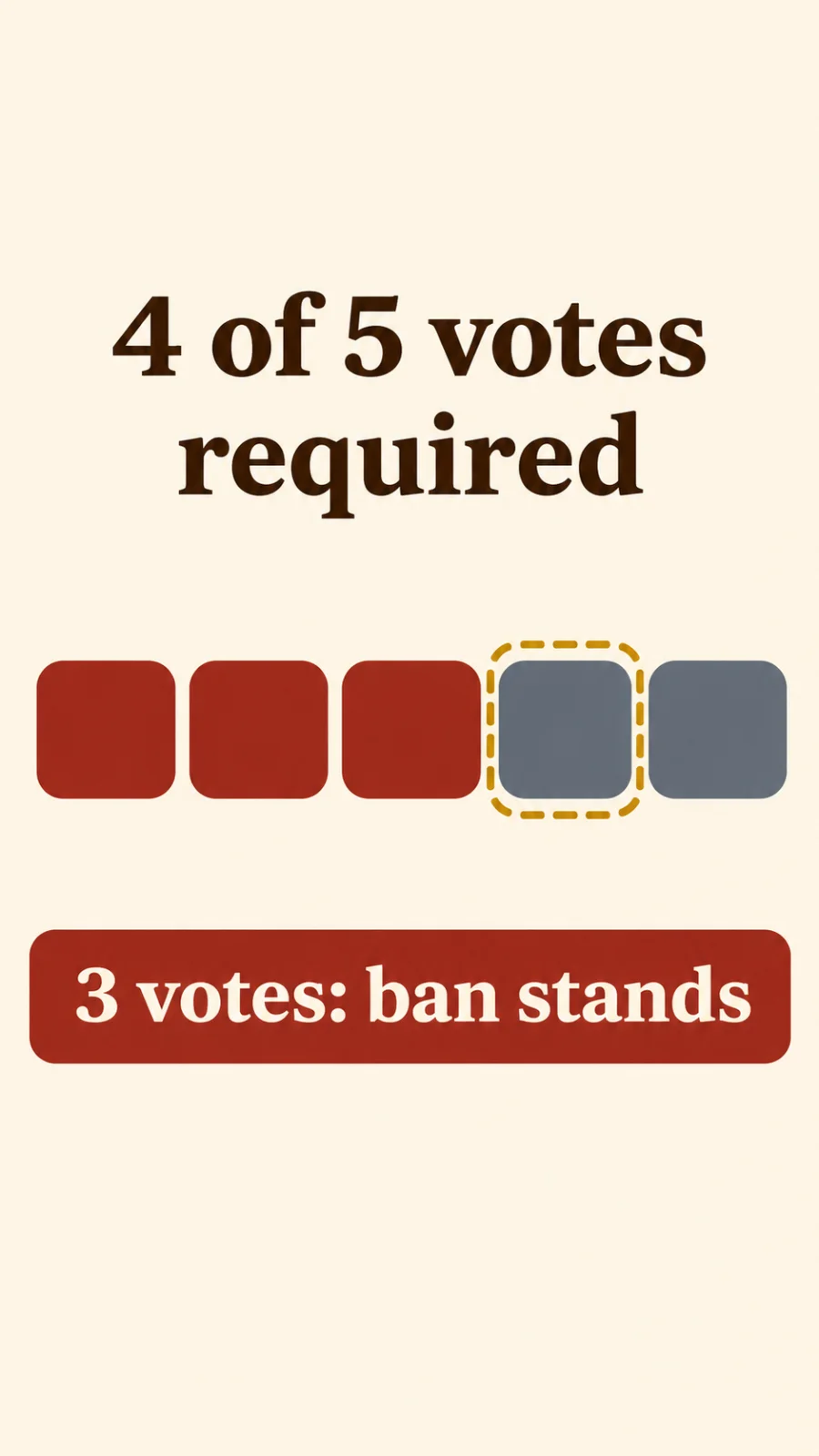
The North Dakota Constitution requires at least four of the five justices to declare a law unconstitutional. With only three, the district court’s judgment was reversed and the law stood. The court did not hold that the ban is constitutional. It held that the plaintiffs did not reach the required supermajority.
Penalties Under the Ban
A person who performs an abortion in violation of chapter 12.1-19.1 commits a class C felony. Under N.D.C.C. § 12.1-32-01, that carries up to five years in prison, a fine of up to $10,000, or both.
Other offenses in the Abortion Control Act carry different penalties:
- A physician who breaks the provider requirements of § 14-02.1-04 commits a class A misdemeanor, which carries up to 360 days in jail, a fine of up to $3,000, or both.
- A person who is not a licensed physician and performs an abortion commits a class B felony, which carries up to 10 years and a fine of up to $20,000.
- Failing to have a second physician present to care for a viable child born during an abortion is a class C felony (§ 14-02.1-05).
The Mandatory Training for Doctors (HB 1511)
Doctors must complete a state-approved course on North Dakota’s abortion laws within the two years before they perform an abortion. House Bill 1511 created the requirement. It passed the House 72-17 and the Senate 41-5, and its main provisions took effect January 1, 2026.
The bill directed the Board of Medicine to post a course covering chapters 12.1-19.1, 14-02.1 and 14-02.6. The Office of Management and Budget contracts for it, and the attorney general must approve it. A physician who skips the course violates § 14-02.1-04 and faces the class A misdemeanor penalty. The only carve-out is a “medical emergency,” and the bill applies it to the training requirement alone, not to the rest of the law.
The enrolled bill also restates the provider rules: a physician must hold admitting privileges at a hospital within 30 miles of the facility, and abortions after the first 12 weeks and before viability must take place in a licensed hospital. Those provisions matter mainly when an exception applies.
Other Abortion Rules That Still Apply
When an exception lets an abortion go forward, the Abortion Control Act, N.D.C.C. ch. 14-02.1, governs how it is done. Several of its rules are written for an abortion that is otherwise legal.
- 24-hour waiting period. The physician must give the woman specified information at least 24 hours before the procedure, and she must certify in writing that she received it (§ 14-02.1-02).
- Ultrasound offer. The facility must offer an active ultrasound at least 24 hours in advance and document her response (§ 14-02.1-04).
- Minors. An unemancipated minor needs consent from the minor and her parents or guardians, or juvenile court authorization. The court must hold a hearing within 48 hours (§ 14-02.1-03.1).
- Medication abortion. Only a physician may provide abortion-inducing drugs, following the FDA label, and they must be administered in the physician’s physical presence (§ 14-02.1-03.5). That requirement rules out providing the drugs by telehealth.
- Civil damages. An abortion without informed consent exposes the provider to $10,000 in punitive damages plus treble actual damages (§ 14-02.1-03.2).
The Attorney General’s Order on Abortion Pill Links
On January 16, 2026, Attorney General Drew Wrigley issued a cease-and-desist order against the Fargo nonprofit Prairie Abortion Fund. The order alleges the group violated the North Dakota Consumer Fraud Law by linking on its website to sellers of abortion pills that were unapproved or sold without a prescription. The attorney general’s office said the Bureau of Criminal Investigation bought pills from sites the fund listed. The attorney general’s announcement sets out the allegations.
The order draws on consumer protection law, not the abortion ban itself. Critics have described it as an attempt to restrict information, and the fund had 10 days to request an administrative hearing, according to North Dakota Monitor’s coverage.
Where North Dakotans Seek Abortion Care
There is no abortion clinic inside North Dakota. The Red River Women’s Clinic left Fargo after the 2022 federal ruling that ended Roe and reopened in Moorhead, Minnesota, a few minutes across the river, where abortion remains legal. Care there is governed by Minnesota law. Courts and voters have shaped abortion access differently in each state, as our overview of Minnesota abortion laws shows.
Because the North Dakota ban penalizes the person performing the procedure, the statute does not impose a penalty on the patient. Anyone with a pregnancy emergency inside North Dakota should go to the nearest emergency room, because the life and health exception exists for those situations.
Could North Dakota’s Abortion Law Change?
Change would come from the Legislature, the voters or the courts, and the 2025 session moved in the opposite direction from loosening. On February 12, 2025, the House rejected four bills: a fetal personhood bill (HB 1373), a bill that would have allowed abortion up to 15 weeks, and bills protecting IVF (failed 59-34) and contraception (failed 66-27). North Dakota voters rejected a personhood amendment by about 64% in 2014.
On November 3, 2026, voters rejected Measure 1, which would have required 60% approval for future constitutional amendments. Supporters, including the state’s Catholic bishops and North Dakota Right to Life, had argued it would make an abortion-rights amendment harder to pass. About 56.5% voted no. The Fairness Project said it has no plans to run an abortion rights initiative in North Dakota in 2028.
The Legislature meets every other year, so the next regular session falls in 2027.
Frequently Asked Questions
Is abortion legal in North Dakota?
Only in narrow cases. The ban allows abortion to prevent the woman’s death or a serious health risk, and for pregnancies from certain sexual offenses or incest at six weeks of gestational age or less.
Can a woman be charged for having an abortion in North Dakota?
Not under the ban. N.D.C.C. § 12.1-19.1-02 penalizes anyone other than the pregnant woman who performs the abortion.
Does North Dakota have an exception for rape?
Partly. The statute covers gross sexual imposition, sexual imposition, sexual abuse of a ward, and incest, and only when the probable gestational age is six weeks or less.
Are miscarriage treatment and ectopic pregnancy care covered by the ban?
No. The definition of abortion in § 12.1-19.1-01 excludes removing a dead unborn child after a spontaneous abortion, treating an ectopic pregnancy, and treating a molar pregnancy.
What is the penalty for performing an abortion in North Dakota?
A class C felony, which carries up to five years in prison, a fine of up to $10,000, or both under N.D.C.C. § 12.1-32-01.
Can abortion pills be prescribed by telehealth in North Dakota?
No. Section 14-02.1-03.5 requires a physician to administer abortion-inducing drugs in the physician’s physical presence.
References
- North Dakota Legislative Branch, N.D. Cent. Code ch. 12.1-19.1, Abortion
- North Dakota Legislative Branch, N.D. Cent. Code ch. 14-02.1, Abortion Control Act
- North Dakota Legislative Branch, N.D. Cent. Code ch. 12.1-32, Penalties and Sentencing (§ 12.1-32-01)
- North Dakota Legislative Branch, N.D. Cent. Code ch. 12.1-31, Miscellaneous Offenses (§ 12.1-31-12 repealed)
- North Dakota Legislative Assembly, House Bill 1511 (2025), enrolled
- North Dakota Supreme Court, Access Independent Health Services, Inc. v. Wrigley, 2025 ND 26
- North Dakota Supreme Court, opinions archive (Access Independent Health Services, Inc. v. Wrigley, 2025 ND 199)
- North Dakota Attorney General, Cease and Desist Order Against Prairie Abortion Fund announcement