
Ohio Divorce Laws: Divorce vs. Dissolution Explained

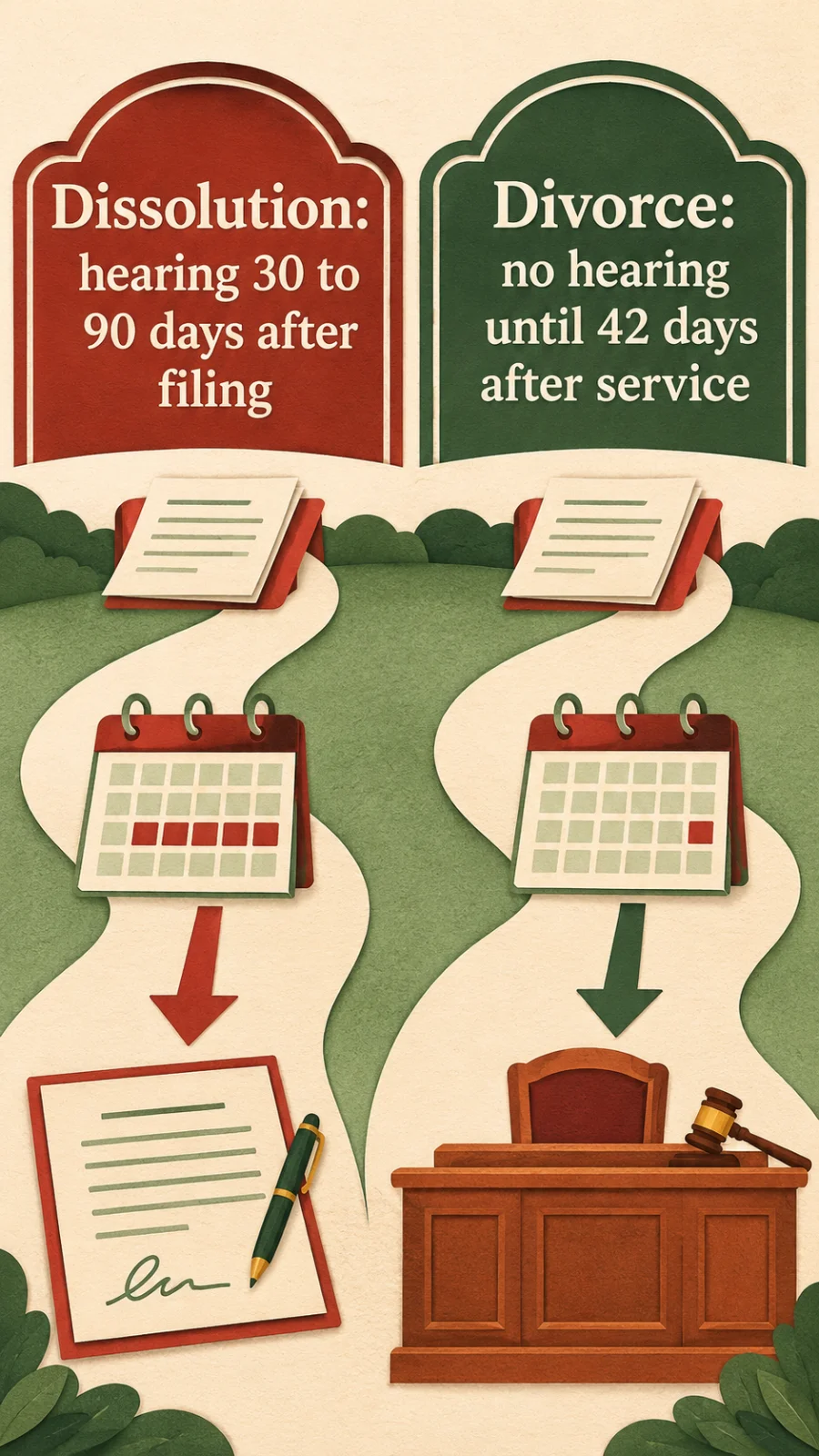
Ohio ends a marriage in one of two ways: a divorce, where one spouse files and a judge decides any disputed issues, or a dissolution, where both spouses sign a joint petition and a separation agreement. A divorce needs a legal ground and cannot be heard until 42 days after your spouse is served. A dissolution needs no ground, and the court must hold the final hearing between 30 and 90 days after filing.
The filing spouse in a divorce must have lived in Ohio for six months and in the filing county for 90 days. Property is divided equitably, spousal support has no formula, and a judge cannot grant a divorce on one spouse’s word alone.
Divorce vs. Dissolution in Ohio: How They Differ
The two routes lead to the same legal result, including the same effect on property rights, but they run on different tracks. The Supreme Court of Ohio’s domestic relations resource guide lays out the split, and the table below compares the points that matter most.
| Question | Dissolution | Divorce |
|---|---|---|
| Who files | Both spouses, on one petition | One spouse files; the other may counterclaim |
| Legal ground needed | None | Yes (R.C. 3105.01) |
| Agreement required | Signed separation agreement attached to the petition | No; the judge decides what is not agreed |
| Residency | One spouse, six months in Ohio | Filer: six months in Ohio, 90 days in the county |
| Earliest final hearing | 30 days after filing | 42 days after service |
| Latest hearing | 90 days after filing | No deadline set by statute |
| Can one spouse stop it | Yes, by declining to go forward at the hearing | No, though a ground may need proof |
Either spouse can switch tracks. Before a dissolution decree is granted, a spouse can convert the case to a divorce under R.C. 3105.08 by motion, and no filing fee is charged. A pending divorce can also be converted to a dissolution at any point before the final ruling if both spouses file a petition that meets R.C. 3105.63.
Who Can File for Divorce in Ohio? Residency Rules
You must have lived in Ohio for at least six months before filing, and R.C. 3105.03 applies that requirement to the spouse who files for divorce or annulment. Civil Rule 3(C)(9) adds a venue rule: you file in the county where you have lived for the previous 90 days. Both spouses can consent to waive the county requirement.
A dissolution is looser. Under R.C. 3105.62, only one of the two spouses needs the six months in Ohio, and venue can be waived. Legal separation has no state residency period at all, only the county venue rule.

Grounds for Divorce Under R.C. 3105.01
Ohio lists eleven grounds in R.C. 3105.01, and most filers use one of two no-fault options. The statute has been in its present form since October 6, 1994.
No-fault grounds
Either spouse can claim that the two have lived separate and apart, without cohabitation, for one uninterrupted year. The other no-fault ground is incompatibility, but it only works if neither spouse denies it. If your spouse denies incompatibility, you need another ground.
Fault grounds
- One spouse was already married when the marriage began
- Willful absence for one year
- Adultery
- Extreme cruelty
- Fraud in the marriage contract
- Gross neglect of duty
- Habitual drunkenness
- Imprisonment in a state or federal prison when the complaint is filed
- A divorce obtained outside Ohio by one spouse that leaves the other still bound
The statute says a plea of recrimination does not block a divorce, so a spouse cannot defeat your case just by pointing to your own misconduct.
Why an unanswered complaint does not end the case
Ohio has no default divorce. Civil Rule 75(F) turns off the ordinary default-judgment rule, so a spouse who never answers does not hand you a win. Civil Rule 75(M) adds that a divorce cannot be granted on a party’s testimony or admission alone without other credible evidence. That is why a corroborating witness, or the other spouse’s presence, is expected at the final hearing even when nobody is fighting.
How Long a Divorce Takes: The 42-Day Rule and the Dissolution Window
Under Civil Rule 75(K), a divorce cannot be heard until 42 days after service of process, or 28 days after the last publication of notice if the spouse was served by publication. The Supreme Court of Ohio’s guide treats the 42-day period as one that cannot be waived. If your spouse files a counterclaim, the hearing also waits 28 days after that counterclaim is served, unless a written waiver is filed.
A dissolution runs on a different clock. Under R.C. 3105.64, both spouses must appear before the court between 30 and 90 days after the petition is filed. Two exceptions apply: a converted case, and a couple that completed a collaborative family law process before filing, who can appear any time within 90 days.
A sample calendar
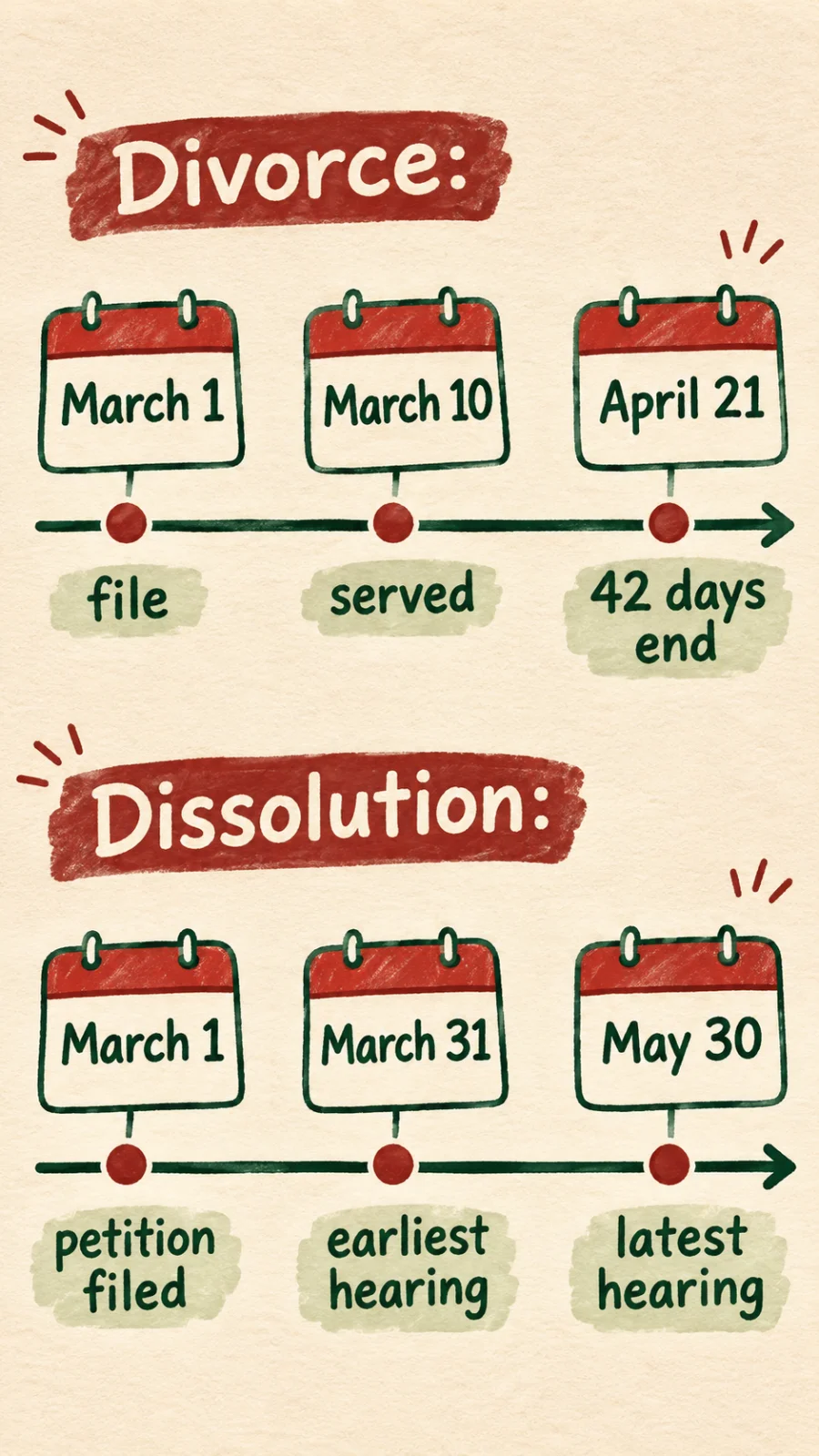
Say you file a divorce complaint on March 1 and your spouse is served on March 10. The 42 days run out on April 21, so no final hearing can happen before then. If your spouse’s counterclaim is served April 1, the hearing cannot be held before April 29 unless you waive that wait in writing.
Now say the two of you file a dissolution petition on March 1. The earliest hearing date is March 31 and the latest is May 30.
How a Dissolution Works, Step by Step
A dissolution rests entirely on the separation agreement, so the paperwork does the work that a trial would do in a divorce. R.C. 3105.63 requires both spouses to sign the petition and attach an agreement that divides all property, sets spousal support terms, and, if there are minor children, covers parental rights, residential parent, child support and parenting time.
- Both spouses sign the petition and the separation agreement. Parents also file either a shared parenting plan or a parenting plan with the petition.
- The clerk files the case, and the court sets the hearing between 30 and 90 days out.
- At the hearing, each spouse states under oath that the agreement was entered voluntarily, that they are satisfied with its terms, and that they want the dissolution.
- If both agree, the court approves the agreement and grants the decree. If either spouse is dissatisfied or no longer wants the dissolution, R.C. 3105.65(A) requires the court to dismiss the petition and refuse to validate the agreement.
A dissolution also locks in the property division more firmly than most people expect. Under R.C. 3105.65(B), the court can change the property division in the agreement only with the express written consent of both spouses. Spousal support can be modified only if the agreement authorizes it, following R.C. 3105.18.
One limit applies to retirement accounts. The agreement cannot divide a deferred compensation account in a way that conflicts with the plan’s own rules, or pay out funds before the account holder could receive them under that plan.
Property Division in an Ohio Divorce
Ohio divides marital property equitably, and R.C. 3105.171 starts from an equal split unless an equal split would be inequitable. The court first sorts everything into marital and separate property, then divides each category.
What counts as marital and what stays separate
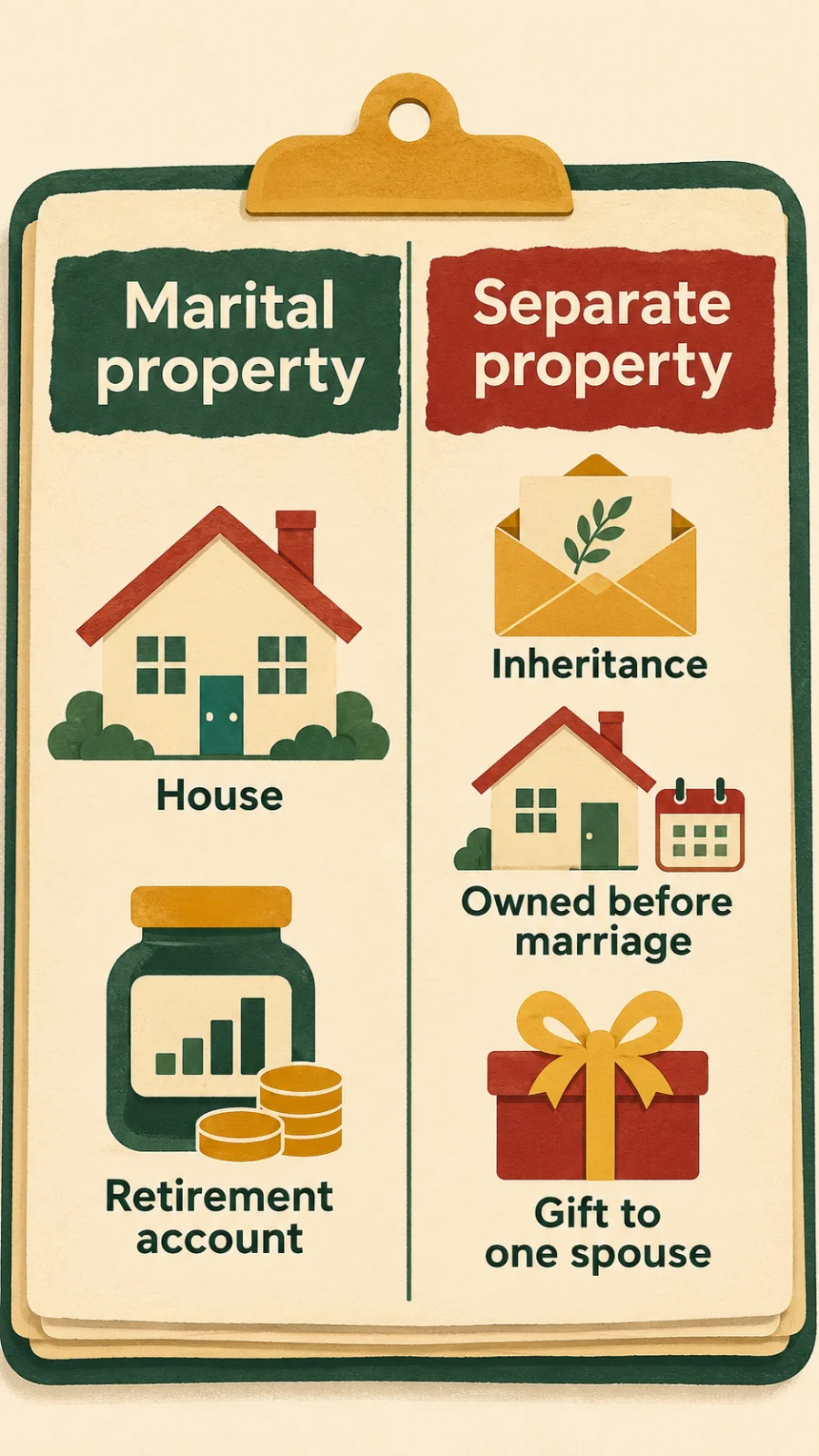
Marital property covers what either or both spouses acquired during the marriage, including retirement benefits. Separate property includes inheritances, property owned before the marriage, passive income and growth on separate property, property acquired after a legal separation decree, and property excluded by a valid prenuptial or postnuptial agreement. A gift to only one spouse is separate if that spouse proves it by clear and convincing evidence.
Title does not decide the question. A house held in one spouse’s name alone can still be marital property. Separate money mixed into a joint account also stays separate if it can still be traced.
When the marriage “ends” for property purposes
“During the marriage” generally runs from the wedding date through the date of the final hearing. If those dates would be inequitable, such as after a long separation, the court can pick other dates and must state them in its findings.
Factors, misconduct and hidden assets
The court weighs the length of the marriage, each spouse’s assets and debts, whether the family home should go to the custodial parent, how liquid each asset is, tax consequences, the cost of selling, and any other factor it finds relevant. Marital fault is not on that list.
Financial misconduct is different. If a spouse dissipates, hides or fraudulently disposes of assets, the court can award the other spouse a larger share. When a spouse substantially and willfully fails to disclose assets, the compensation can reach up to three times the value of what was hidden.
A property division, once made, generally cannot be modified unless both spouses consent in writing.
Spousal Support in Ohio
Ohio has no formula and no fixed duration for spousal support. Under R.C. 3105.18, the court divides property first, then decides whether support is appropriate and reasonable and sets its amount, terms and length.
The statute lists fourteen factors. The ones that tend to carry the most weight include the length of the marriage, each spouse’s income and earning ability, ages and health, the marital standard of living, relative education, and lost earning capacity from marital responsibilities such as raising children. Support can be paid as money in installments, a lump sum, property, or a mix.
It ends on the death of either spouse unless the order says otherwise. Modification is narrower than many people assume. For orders entered after January 1, 1991, the court can change the amount or terms only if circumstances have changed and the decree or the approved separation agreement expressly authorizes modification. If neither document reserves that power, the amount stays where it was set.
A court can also order one spouse to contribute to the other’s legal costs. R.C. 3105.73 lets it award reasonable attorney’s fees and litigation expenses if it finds that equitable, weighing marital assets, income, conduct and other relevant factors.
Custody, Parenting Time and Child Support
Ohio courts decide parental rights by the child’s best interest under R.C. 3109.04, and the statute creates no presumption favoring the mother or the father. The court may not prefer a parent because of his or her financial status.
The best interest factors include the parents’ wishes, the child’s wishes if the court interviews the child, the child’s adjustment to home, school and community, the health of everyone involved, which parent is more likely to honor parenting time, any history of abuse or domestic violence, and unpaid child support.
Shared parenting
Either parent, or both, can ask for shared parenting by filing a plan that covers living arrangements, support, medical care, school placement and holidays. For shared parenting, the court also considers whether the parents can cooperate and make joint decisions, whether each encourages the child’s relationship with the other, and how far apart they live.
Child support
Support is calculated from the basic child support schedule and worksheet in R.C. Chapter 3119, as R.C. 3119.02 requires, and it is stated as a monthly amount. Under R.C. 3119.04, combined income below $8,400 a year gets a minimum-support calculation. Income above the top of the schedule is handled case by case, and the court must set at least the amount at the schedule’s top income unless it finds that figure unjust or inappropriate and records its reasons.
Divorces and dissolutions involving children also require extra affidavits, including a parenting proceeding affidavit, a UCCJEA affidavit and a health insurance affidavit, according to the Supreme Court of Ohio’s divorce bench card.
What an Ohio Divorce Costs and Where to File
Filing fees are set county by county and differ more than most people expect. Mahoning County charges $250 for a complaint for divorce or a dissolution petition, with or without children. Muskingum County charges $175 for a dissolution petition, $200 for one with children, and $225 for a divorce complaint. Add the cost of service and any attorney fees on top of those figures.
You file with the clerk of the court of common pleas, usually its domestic relations division, in the county that meets the venue rule. The Supreme Court of Ohio publishes free Uniform Domestic Relations Forms, including Form 6 (complaint for divorce without children), Form 7 (with children), Form 17 (petition for dissolution), Form 19 (separation agreement) and Affidavit 1 (basic information, income and expenses). Many counties require their own additional forms, so check the local clerk’s page before you file.
Protections while the case is pending
Either spouse can ask for temporary support, child support and parenting orders under Civil Rule 75(N), usually on affidavits. A spouse who fears property will be hidden or sold can ask for a restraining order under Civil Rule 75(I), which can be issued without notice and lasts while the case is pending unless the court changes it.
Restoring a former name
If you ask, the court must restore any name you used before the marriage when it grants the divorce. R.C. 3105.16 puts the request in your hands, so a spouse cannot force it on you or block it.
Legal Separation and Postnuptial Agreements
Ohio also offers legal separation under R.C. 3105.17. The court can grant it on the same grounds as divorce, except for the one-year separation and prior-marriage grounds, even if the spouses still live together. A legal separation does not stop either spouse from filing for divorce later, and the court can end the decree on a motion signed by both spouses.
Senate Bill 210 (134th General Assembly) took effect March 23, 2023, and added postnuptial agreements to Ohio law through R.C. 3103.061. A valid postnuptial agreement can make property separate under R.C. 3105.171, which changes what a court divides.
Frequently Asked Questions
Is Ohio a no-fault divorce state?
Partly. Ohio allows no-fault grounds, one year of living apart or incompatibility, but it also keeps fault grounds. Incompatibility fails if either spouse denies it.
Can my spouse stop me from getting divorced in Ohio?
Not by refusing to participate, since a spouse who never answers does not win a default. A spouse can deny incompatibility, which forces you to use another ground. A dissolution is different: either spouse can end it by declining to go forward at the hearing.
How long does an Ohio divorce take?
No divorce can be heard until 42 days after service, and contested cases with property or children in dispute often take much longer. A dissolution hearing happens 30 to 90 days after filing.
Do I need a lawyer to divorce in Ohio?
No law requires one. The Supreme Court of Ohio publishes standardized forms for people filing on their own, though a contested case with property, retirement accounts or children is harder to handle without counsel.
Does Ohio recognize common-law marriage?
Not for marriages formed after October 10, 1991, apart from limited exceptions. If you never had a ceremonial marriage after that date, you may have nothing to divorce.
Can I get my maiden name back in a divorce?
Yes. If you ask, the court must restore any name you used before the marriage under R.C. 3105.16.
References
- Ohio Revised Code § 3105.01, grounds for divorce
- Ohio Revised Code § 3105.03, residency for divorce and annulment
- Ohio Revised Code § 3105.63, petition and separation agreement for dissolution
- Ohio Revised Code § 3105.64, dissolution hearing timing
- Ohio Revised Code § 3105.65, dissolution hearing, decree and modification
- Ohio Revised Code § 3105.171, equitable division of marital property
- Ohio Revised Code § 3105.18, spousal support
- Ohio Revised Code § 3109.04, allocation of parental rights and shared parenting
- Ohio Revised Code § 3119.04, child support above and below the schedule
- Supreme Court of Ohio, Ohio Rules of Civil Procedure, Civ.R. 3 and Civ.R. 75
- Supreme Court of Ohio, Domestic Relations Resource Guide, termination of marriage
- Supreme Court of Ohio, Domestic Relations Bench Card, divorce