
Ohio Lemon Law: Eligibility, Deadlines and Refunds
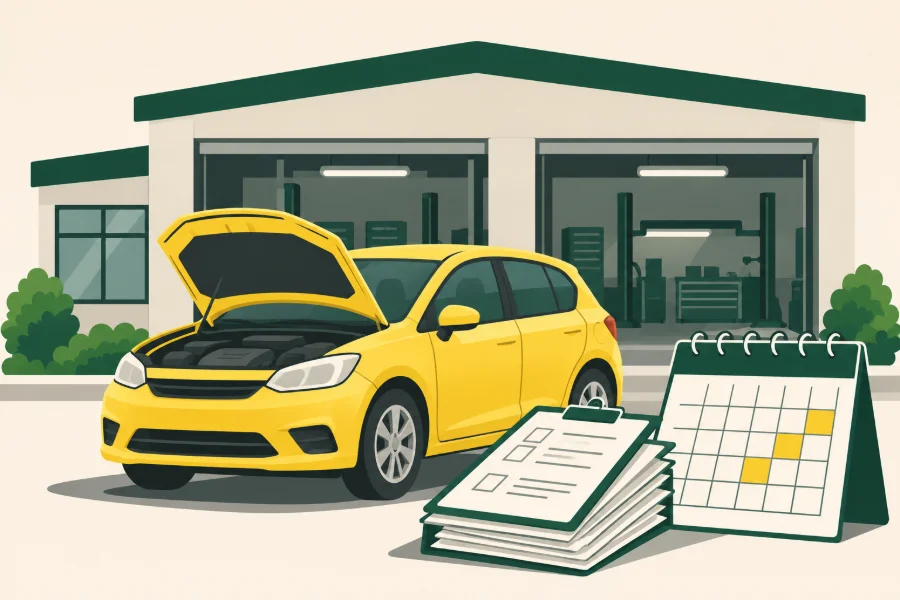
Ohio’s lemon law lets you demand a replacement vehicle or a full refund from the manufacturer when a warranty-covered defect that substantially impairs your new vehicle’s use, value or safety cannot be fixed after a reasonable number of repair attempts. You must report the defect within one year of delivery or the first 18,000 miles, whichever comes first, and the manufacturer has to keep repairing it even if the work runs past that window. If the manufacturer refuses, you can sue within five years of delivery, but only after using its Attorney General-approved arbitration program when one exists and you were told about it in writing.
The rules sit in Ohio Rev. Code § 1345.72 and the sections around it, 1345.71 through 1345.77, which the Revised Code calls the Nonconforming New Motor Vehicle Law.
Which Vehicles and Buyers Does Ohio’s Lemon Law Cover?
The law covers new passenger cars and noncommercial motor vehicles, whether you bought or leased them. The Ohio Attorney General describes the covered group as passenger cars, motorcycles and other noncommercial vehicles designed to carry no more than one ton and used exclusively for personal driving.
Buyers, lessees and later owners
R.C. 1345.71 defines “consumer” broadly. It includes a person who buys the vehicle for something other than resale, a lessee who pays a periodic rate for a term of 30 days or more while someone else holds the title, and a person who receives the vehicle during the express warranty period. Anyone else the warranty entitles to enforce it also counts.
What is left out
Mobile homes, recreational vehicles and manufactured homes are excluded. A motor home is covered only for the parts that are not permanently installed living facilities, so the engine and chassis qualify but the built-in kitchen does not.
Used cars
Ohio has no general used-car lemon law. A used vehicle gets protection only if the problem shows up inside the original first year or first 18,000 miles, and the clock runs from the first delivery, not from the day you bought it. A car with 14,000 miles on it has about 4,000 miles of protection left.

What Counts as a Defect Under the Lemon Law?
A qualifying defect, which the statute calls a nonconformity, is a condition that does not match the warranty and substantially impairs the vehicle’s use, value or safety to you. A rattle or a cosmetic flaw usually fails that test, while repeated stalling, a transmission that will not shift or brakes that behave unpredictably usually passes it.
The First District Court of Appeals handled this question in Fagen v. Jaguar Land Rover North America, L.L.C., 2023-Ohio-4324, decided December 1, 2023. A lessee of a 2020 Jaguar F-type reported recurring dashboard warning lights that technicians tied to a software problem, and the dealership visits never fixed them. The court agreed a defect existed but sent the question of substantial impairment to trial, because the record did not show the brakes had actually failed.
The same opinion helps consumers in three ways. It treats the lemon law as remedial and reads it liberally in the consumer’s favor, it does not require expert testimony to show a defect, and it accepts reduced driving and lost confidence in the vehicle as evidence of impairment, provided the belief is objectively reasonable.
How the One-Year, 18,000-Mile Window Works
You must report the problem to the manufacturer, its agent or its authorized dealer inside the window. Once you have, the manufacturer must make the necessary repairs even if they happen after the window closes.
Say your car is delivered March 1, 2026. You report a transmission fault on February 20, 2027, at 14,000 miles, and the dealer is still working on it in April 2027. The report was timely, so the repair duty continues. If you had first reported the same fault on March 15, 2027, the one-year window would have closed two weeks earlier.
Mileage can close the window sooner than the calendar does. A driver who reaches 18,000 miles in eight months has eight months, not twelve.
When Does Ohio Presume the Manufacturer Had Enough Repair Attempts?
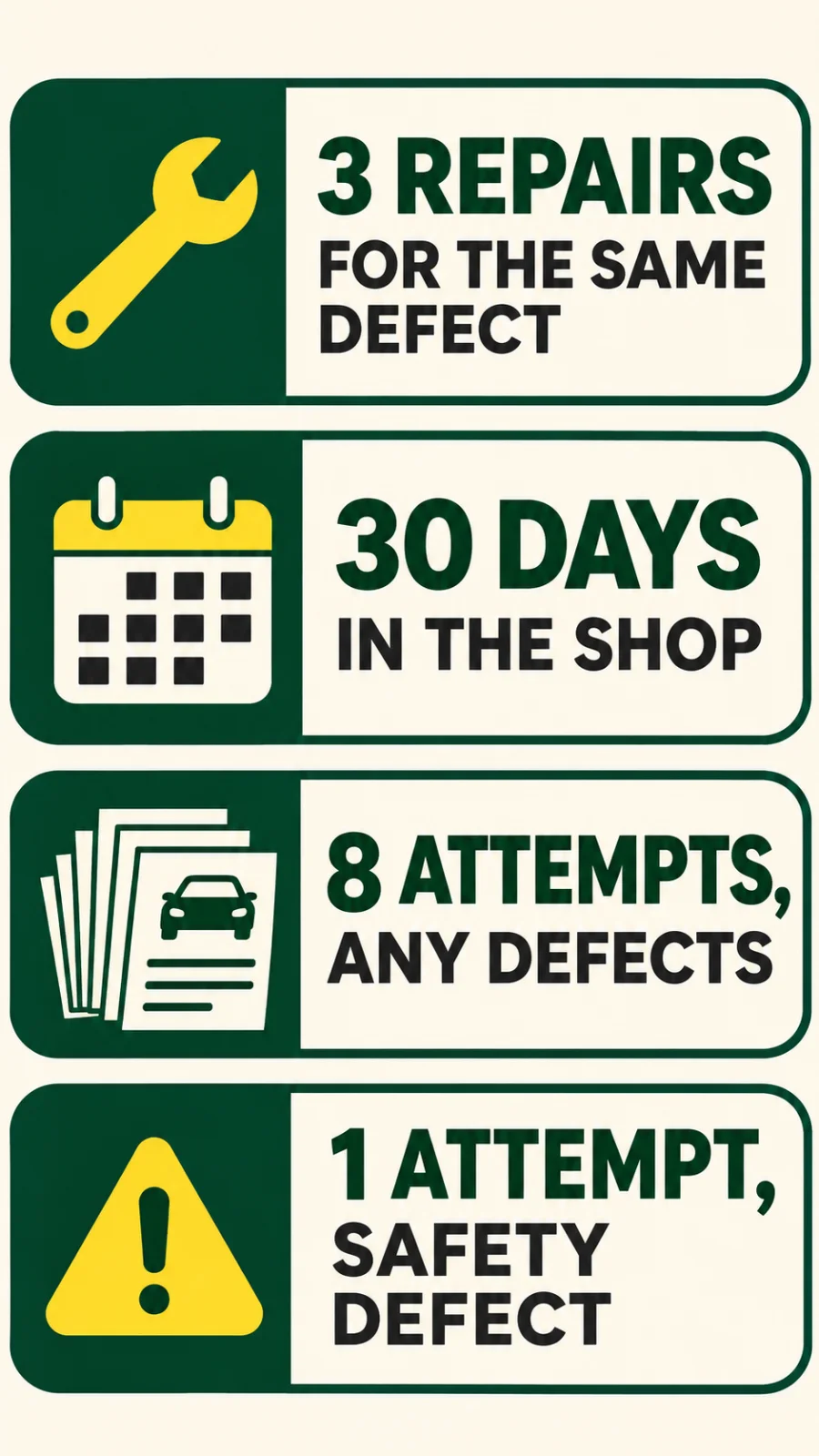
Ohio does not set one magic number. R.C. 1345.73 lists four situations, and any one of them creates a presumption that the manufacturer had a reasonable number of attempts, as long as it happens within the first year or 18,000 miles.
| Trigger | Threshold | Detail |
|---|---|---|
| Same defect | 3 or more repairs | The problem continues or comes back |
| Time in the shop | 30 or more calendar days | Counted cumulatively, not in one stretch |
| Any defects | 8 or more attempts | The defects can all be different |
| Safety defect | 1 attempt | Defect likely to cause death or serious bodily injury if driven, and it continues or recurs |
The 30-day rule is stronger than it looks
In Royster v. Toyota Motor Sales, U.S.A., Inc., 92 Ohio St.3d 327, 2001-Ohio-212, the Ohio Supreme Court decided on June 28, 2001 that a vehicle out of service for 30 or more cumulative days in the first year triggers a presumption of recovery. Royster’s leased 4-Runner sat in the shop for 55 days while the dealer hunted for a head gasket part, and the dealer then repaired it successfully. The majority still ruled for her, because the statute counts days, not outcomes. Two justices disagreed on how much the presumption proves.
Natural disasters and similar delays
R.C. 1345.73 extends the time periods when the vehicle cannot reasonably be repaired because of war, invasion, civil unrest, a strike, fire, flood or natural disaster. During that extension the manufacturer must provide you a vehicle at no cost. Fagen treated COVID-19 as a natural disaster for this purpose but applied it only from the date the service foreman’s quarantine began, and the car had already passed 31 days in the shop by then.
What You Get: Replacement or Refund, Your Choice
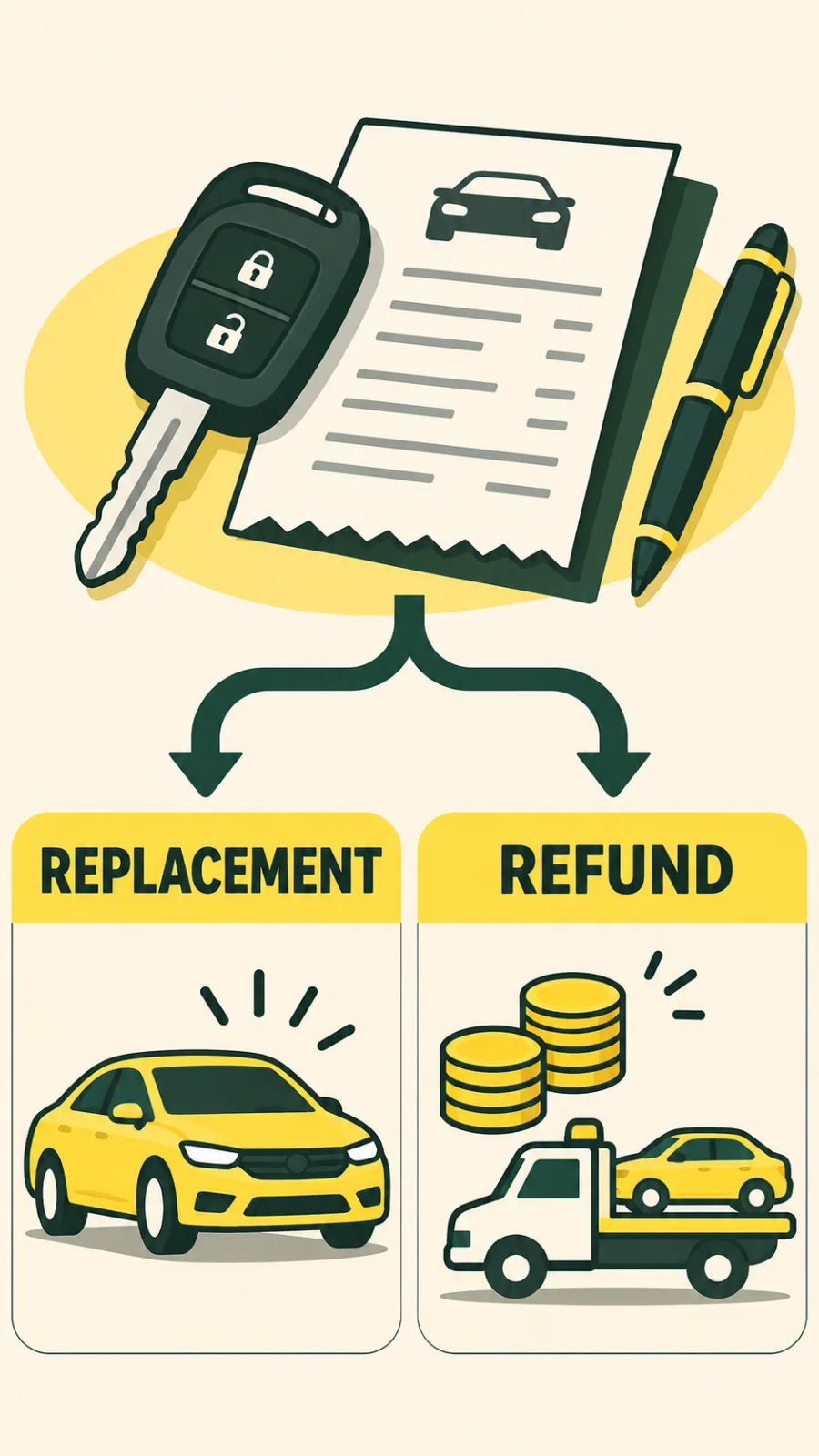
After a reasonable number of failed repairs, the manufacturer must replace the vehicle with one acceptable to you or take it back and refund the full purchase price, and the choice is yours under R.C. 1345.72. The refund also includes incidental damages such as towing, rental car costs, meals, lodging, and any lender fees for making or canceling the loan.
R.C. 1345.71 defines the “full purchase price” for a sale as the contract price plus transportation, undercoating, dealer-installed options and accessories, dealer services, preparation and delivery charges. It also adds finance, credit insurance, warranty and service contract charges you incurred, and all sales tax, license and registration fees and other government charges. For a lease, it counts items like the capitalized cost reduction, deposit, taxes, title fees and your monthly payments.
A sample refund
These figures are invented to show how the pieces add up.
| Item | Amount |
|---|---|
| Contract price, including delivery and dealer preparation | $36,500 |
| Dealer-installed accessories | $650 |
| Sales tax | $2,190 |
| Title and registration fees | $215 |
| Finance charges incurred | $2,400 |
| Towing ($185) and rental car ($310) | $495 |
| Total refund | $42,450 |
Lenders and lessors get paid first
The refund is payable jointly to you and any lienholder or lessor, and the lienholder or lessor may deduct what you still owe before you receive the rest. If you choose a replacement, the existing lienholder or lessor must be notified and must consent before the new vehicle is financed or leased.
Mileage deductions
Nothing in the statute’s definition of the full purchase price mentions a deduction for the miles you drove. The Ohio Supreme Court addressed the issue in Maitland v. Ford Motor Co., 103 Ohio St.3d 463, 2004-Ohio-5717, decided November 10, 2004. It held that settlements and informal dispute-resolution awards could be below the full price, and that a consumer who accepts such an award or settlement and receives the money cannot later sue under R.C. 1345.75. The opinion notes the Attorney General changed its policy on these setoffs in October 2000, and the board rules in Ohio Adm.Code 109:4-4-04 contain no mileage formula. The practical lesson is to treat any offer below the full price as a final deal once you cash it.
Do You Have to Use Arbitration Before Suing?
Often yes. Under R.C. 1345.77, if a qualified informal dispute resolution program exists and you received timely written notice of it, you generally cannot bring a lawsuit until you have used it. You may go straight to court if no such program exists, if you are unhappy with its decision, or if the manufacturer or dealer does not promptly carry out the decision.
How the Attorney General’s rules shape the process
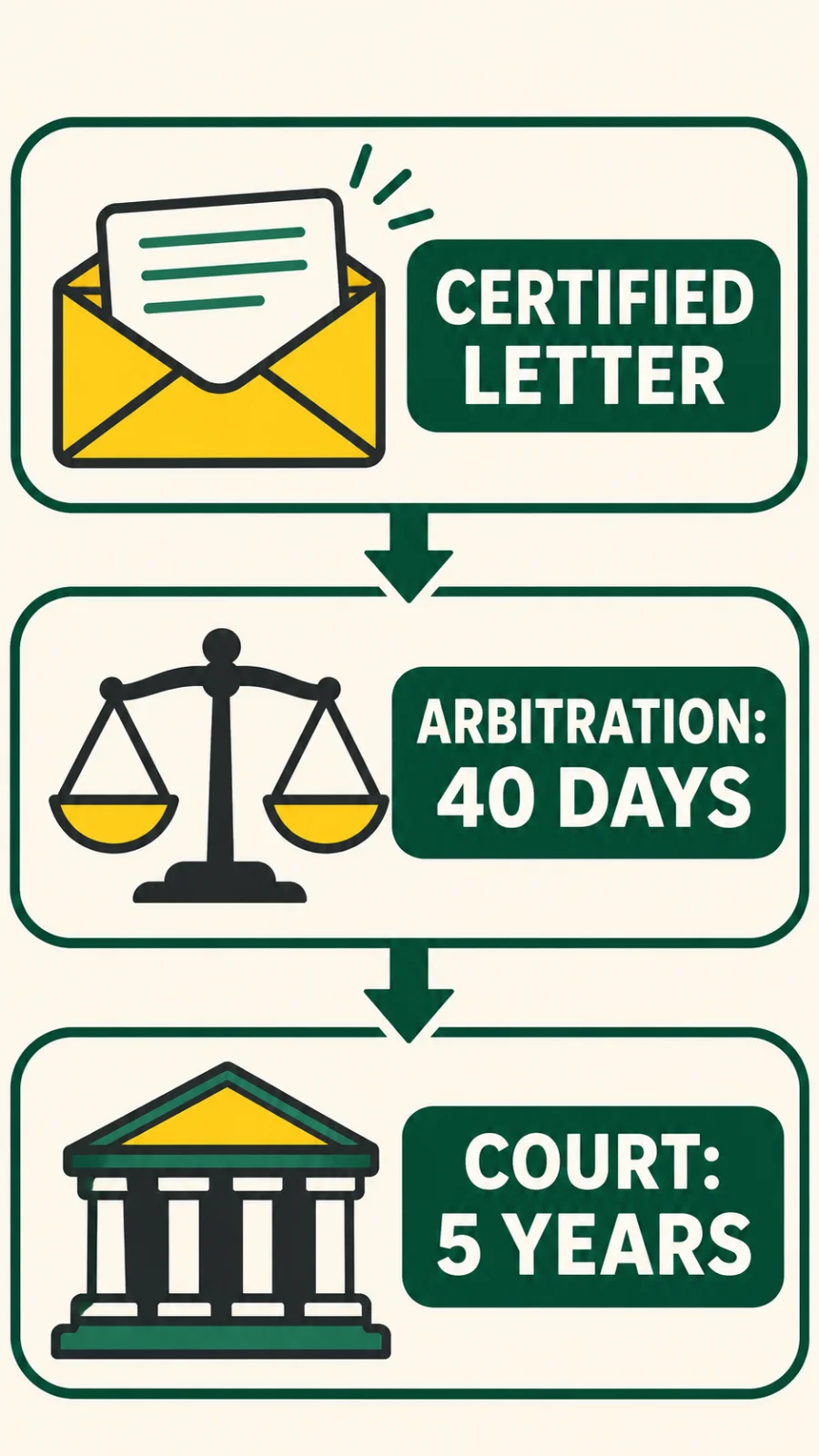
The programs follow Ohio Adm.Code 109:4-4-04. A board must decide a dispute within 40 days of notification, with limited extensions of 7 or 14 days for stated reasons, and it cannot charge you a fee. You can ask for an oral presentation by phone or in person, and a board’s decision binds the manufacturer but not you unless you choose to accept it.
When a board opens your case it must send a written notice with a bold ten-point warning, beginning “OHIO LAW REQUIRES YOU TO USE A QUALIFIED ARBITRATION PROGRAM,” that skipping the process can block a suit under R.C. 1345.75. The Attorney General’s Consumer Protection Section, at 800-282-0515, can tell you which manufacturers have approved programs.
A sequence that protects your claim
- Report each problem to the dealer in writing and keep every repair order.
- Send the manufacturer a certified letter, as the Ohio Attorney General recommends, listing the problems, the repair attempts, your VIN, and whether you want a replacement or a refund.
- Ask in writing whether an Attorney General-approved arbitration program exists.
- If one does, file with it and decide within the program’s timeline whether to accept the decision.
- If the manufacturer refuses or you reject the decision, file in court.
Limitation periods under federal and Ohio law are tolled, meaning paused, from the date you file with the program until it decides.
Suing the Manufacturer: Deadline, Fees and Defenses
R.C. 1345.75 lets you file in a court of common pleas or another competent court if the manufacturer fails to comply with R.C. 1345.72. On top of the replacement or refund, you can recover reasonable attorney’s fees and court costs. The suit runs against the manufacturer, not the dealer, because the lemon law does not create a cause of action against a new motor vehicle dealer.
The five-year deadline
Under R.C. 1345.75(C) the action must be commenced within five years of the original delivery date. Some older reprints of the statute online show a different deadline tied to the end of the warranty term, but the version published on the state’s code site and the Attorney General’s guidance both say five years from delivery.
The abuse and modification defense
The manufacturer can defend by proving the defect resulted from abuse, neglect, or unauthorized modification or alteration by anyone other than the manufacturer, its agent or its authorized dealer. R.C. 1345.75(D) makes this an affirmative defense, which means the manufacturer carries the burden of proving it. Following the maintenance schedule in your owner’s manual and keeping the records is the best answer to it.
Other claims run alongside
R.C. 1345.75 says the lemon law remedies are in addition to other remedies available under law. Many Ohio lemon suits also plead the federal Magnuson-Moss Warranty Act, breach of express warranty and the Consumer Sales Practices Act, as Fagen did.
Paperwork the Law Requires Dealers and Manufacturers to Give You
R.C. 1345.74 requires two documents, and both matter as evidence. At the time of purchase, or when you sign a lease, you must receive a separate sheet in ten-point, all-capital type stating that you may be entitled to a replacement or compensation if the vehicle is defective. Every time your vehicle comes back from service or repair, you must receive a fully itemized written statement of the parts and labor involved, even for warranty work.
- Check each repair order for your exact complaint in your own words, not just a technician’s shorthand.
- Confirm the in and out dates, since those dates count toward the 30-day trigger.
- Ask for a corrected order if the dealer wrote “could not duplicate” and you reported a problem that did occur.
- Keep a folder with the purchase contract, the rights notice, repair orders, rental receipts and tow bills.
What Happens to a Lemon After the Buyback
A returned vehicle cannot simply go back on the lot. Under R.C. 1345.76 the manufacturer must obtain the title, deliver it to the county clerk of courts within 30 days, and apply for a buyback title carrying a notation that the vehicle was returned because it may not have conformed to its warranty. Every later title must carry the notation.
The buyer of a returned vehicle must also receive a separate written warning listing each defect, signed and dated before any other document, and a warranty lasting at least the remainder of the original term or 12 months and 12,000 miles, whichever is earlier, as the statute is written. A vehicle returned for a defect likely to cause death or serious bodily injury cannot be sold, leased or operated in Ohio at all. Check a used car’s history through the Ohio Bureau of Motor Vehicles and the National Motor Vehicle Title Information System before you buy.
When the Lemon Law Sections Were Last Changed
The core sections carry a September 15, 1999 effective date from House Bill 21 of the 123rd General Assembly. The repair-attempt presumptions in R.C. 1345.73 were last amended by House Bill 153 of the 129th General Assembly, effective September 29, 2011, and the dispute-resolution section, R.C. 1345.77, dates to House Bill 232 of 1987. Knowing that history helps when an older article quotes a different threshold or deadline.
Frequently Asked Questions
Does Ohio’s lemon law cover used cars?
Only in limited cases. A used vehicle is protected if the defect appears within the original first year or first 18,000 miles, and the dealer or manufacturer must still be given a chance to repair it. Most used cars fall outside that window and are not covered.
How many repair attempts does Ohio require?
The statute does not fix one number. Ohio presumes a reasonable number of attempts after three tries on the same defect, 30 cumulative days in the shop, eight attempts on any defects, or one attempt on a defect likely to cause death or serious injury.
Can I get a refund if I lease my vehicle?
Yes. A lessee qualifies as a consumer, and the refund is payable jointly to you and the lessor, who may deduct amounts you still owe first. The refund is calculated from the lease charges defined in R.C. 1345.71.
Do I have to go to arbitration first?
If a qualified program exists and you received timely written notice of it, generally yes. You are never bound by the decision, and you can sue afterward if you reject it or the manufacturer does not carry it out.
Can I sue the dealership under the lemon law?
No. R.C. 1345.72 does not create a cause of action against new motor vehicle dealers. The claim is against the manufacturer, though dealers can still face other claims, such as under the Consumer Sales Practices Act.
How long do I have to file a lawsuit?
Five years from the date of original delivery. The clock pauses from the day you file with an informal dispute resolution program until it issues its decision.
References
- Ohio Legislative Service Commission, Ohio Rev. Code § 1345.71, definitions for the Nonconforming New Motor Vehicle Law
- Ohio Legislative Service Commission, Ohio Rev. Code § 1345.72, duty to repair, replacement and refund
- Ohio Legislative Service Commission, Ohio Rev. Code § 1345.73, presumption of reasonable repair attempts
- Ohio Legislative Service Commission, Ohio Rev. Code § 1345.74, written statements of consumer rights and work performed
- Ohio Legislative Service Commission, Ohio Rev. Code § 1345.75, civil action for loss
- Ohio Legislative Service Commission, Ohio Rev. Code § 1345.76, resale or lease of buyback vehicles
- Ohio Legislative Service Commission, Ohio Rev. Code § 1345.77, informal dispute resolution mechanism
- Ohio Attorney General, Ohio Adm.Code 109:4-4-04, minimum requirements of dispute settlement boards
- Supreme Court of Ohio, Royster v. Toyota Motor Sales, U.S.A., Inc., 2001-Ohio-212, 30-day presumption
- Supreme Court of Ohio, Maitland v. Ford Motor Co., 2004-Ohio-5717, settlements and dispute-resolution awards
- Ohio First District Court of Appeals, Fagen v. Jaguar Land Rover North America, L.L.C., 2023-Ohio-4324, substantial impairment and leases
- Ohio Attorney General, Lemon Law consumer guidance, eligibility, refund request letter and arbitration