
Texas Divorce Laws: 60-Day Wait, Property and Support

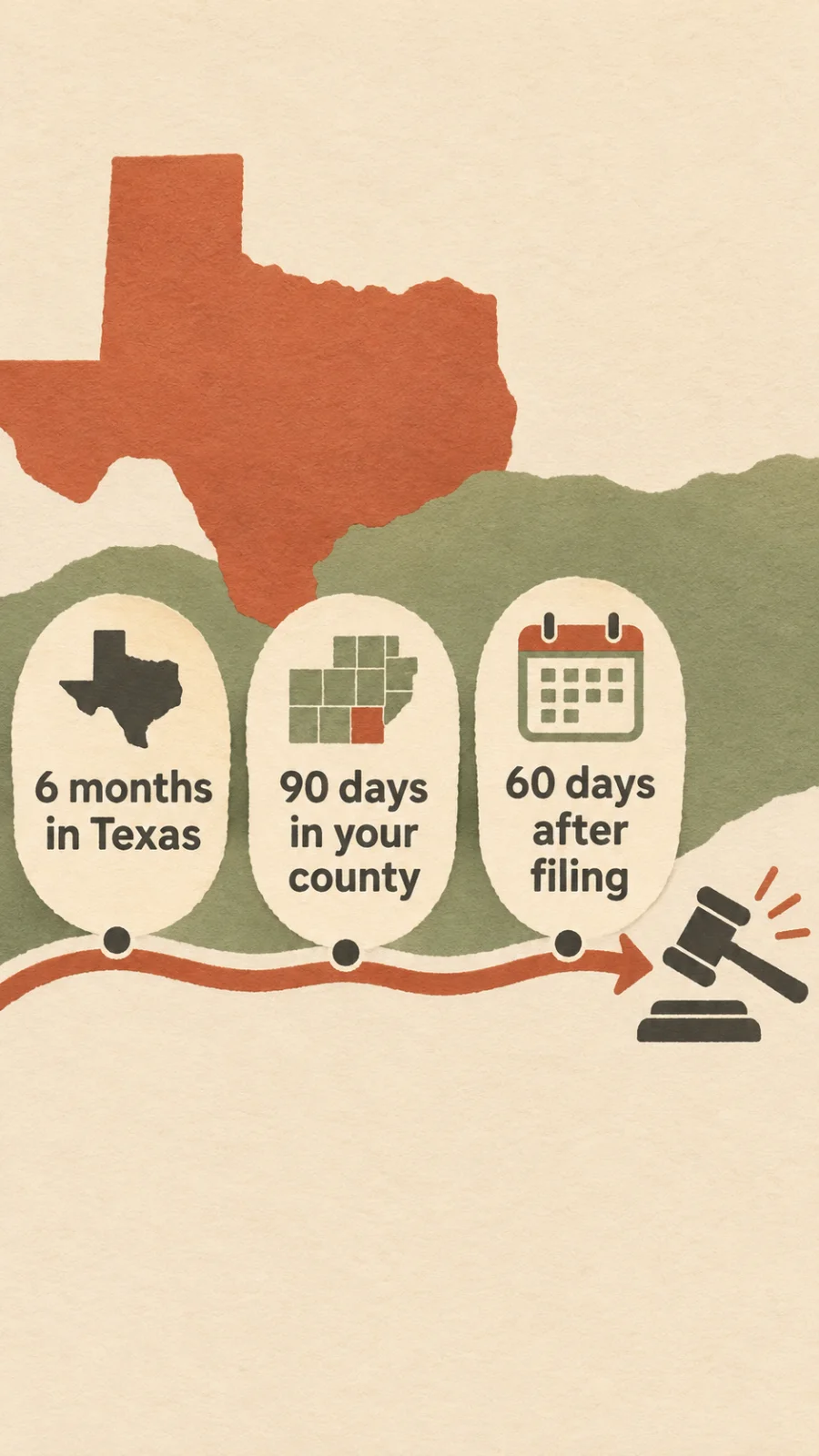
Texas lets you divorce without proving anyone did anything wrong, but you must have lived in the state for six months and in the filing county for 90 days, and a judge cannot grant the divorce before the 60th day after you file. Property is divided in the way the court considers “just and right,” which is not automatically 50/50, and spousal maintenance, custody and child support each follow their own rules.
This guide covers each of those rules with the Family Code section behind it, the dollar limits that apply, and the steps for starting a case.
Who Can File for Divorce in Texas?
Either spouse can file, as long as one of you meets the residency test in Tex. Fam. Code § 6.301. At the time of filing, the petitioner or the respondent must have been a Texas domiciliary for the preceding six months and a resident of the filing county for the preceding 90 days.
The test is satisfied by either spouse. If you moved to Texas last month but your spouse has lived in Harris County for ten years, your spouse’s residency qualifies the case.
Military families
Section 6.303 treats time spent outside Texas, or outside your home county, as residence if you are serving in the armed forces or other U.S. or Texas government service, or accompanying a spouse who is. A service member stationed in another state does not lose the clock.
What Grounds for Divorce Does Texas Recognize?
Texas recognizes seven grounds, found in §§ 6.001 through 6.007. The one that requires no accusation is insupportability, defined in § 6.001 as discord or conflict of personalities that destroys the legitimate ends of the marriage and prevents any reasonable expectation of reconciliation.
| Ground | Section | What the statute requires |
|---|---|---|
| Insupportability | § 6.001 | No fault needed; discord with no reasonable expectation of reconciliation |
| Cruelty | § 6.002 | Cruel treatment that makes living together insupportable |
| Adultery | § 6.003 | The other spouse committed adultery |
| Felony conviction | § 6.004 | Felony conviction during the marriage, at least one year imprisoned, no pardon |
| Abandonment | § 6.005 | Spouse left intending to abandon and stayed away at least one year |
| Living apart | § 6.006 | Lived apart without cohabitation for at least three years |
| Mental hospital | § 6.007 | Confined at least three years, with recovery unlikely or relapse probable |
The felony ground has a limit built in: § 6.004(b) bars it against a spouse who was convicted on the other spouse’s testimony.
Fault grounds still matter even though insupportability is available. Cruelty and adultery can influence how the court divides property and whether it orders maintenance, both covered below.
How Long Is the Waiting Period?
Section 6.702(a) says the court may not grant a divorce before the 60th day after the date the suit was filed. The clock starts at filing, not at service, so serving your spouse quickly does not shorten it.
A judge can waive the wait in two situations under § 6.702(c): the respondent was convicted of, or received deferred adjudication for, a family violence offense against the petitioner or a member of the petitioner’s household; or the petitioner has an active protective order, or an active magistrate’s emergency protection order, based on family violence during the marriage. The 2009 amendment that added these protections was H.B. 72.
The same subsection says a decree rendered in violation of the waiting period cannot be attacked collaterally. If a judge signs a decree on day 40, the decree is not void in a later lawsuit, though it could still be challenged through a direct appeal.
The 60 days is a minimum. A filing in early January with no disputes cannot produce a signed decree before early March, and a case with children, a business or a house in dispute takes longer.
How Does Texas Divide Property in a Divorce?
Texas is a community property state, and the court must divide the estate “in a manner that the court deems just and right” under Tex. Fam. Code § 7.001. That standard allows an unequal split when the facts justify one.
Community property versus separate property
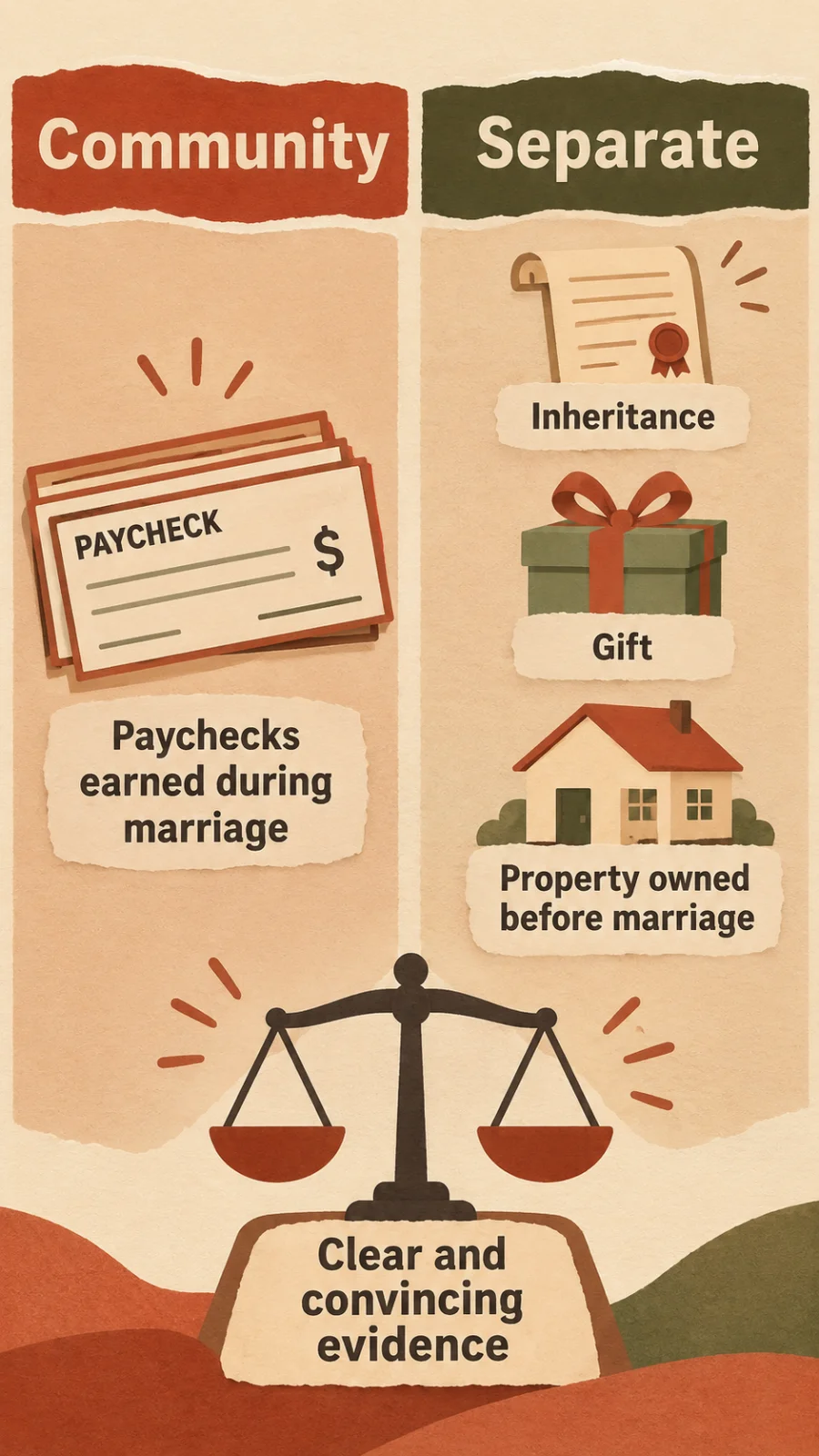
Under Tex. Fam. Code § 3.002, community property is everything either spouse acquired during marriage other than separate property. Section 3.001 defines separate property as what you owned or claimed before marriage, what you received during marriage by gift, devise or descent, and personal injury recoveries other than lost earning capacity.
The default favors community treatment. Under § 3.003, anything either spouse possesses at the end of the marriage is presumed to be community property, and you need clear and convincing evidence to prove otherwise. If you inherited money and deposited it into a joint account, tracing it back to the inheritance is your burden, and commingling makes that hard.
What a judge weighs
The Texas Supreme Court listed the factors a trial court may consider in Murff v. Murff, 615 S.W.2d 696 (Tex. 1981), including disparity in earning capacity, the size of each spouse’s separate estate, education, age and the nature of the property. The trial court has wide discretion, and an appellate court reverses a division only for abuse of that discretion.
Fault can be one of those factors when it is pleaded, but a court cannot use an unequal division simply to punish the spouse at fault. The conduct has to connect to the economics, such as money spent on an affair.
Hiding or wasting assets
Section 7.009 lets the court calculate a “reconstituted estate,” meaning what the community estate would be worth without the actual or constructive fraud. It can award the wronged spouse a larger share of what remains, a money judgment against the other spouse, or both. The provision came from H.B. 908 in 2011.
What Orders Apply While the Divorce Is Pending?
Section 6.502 lets the court issue temporary orders on a party’s motion, or on its own motion after notice and a hearing. The orders it lists include a sworn inventory and appraisal of property and debts, temporary support for either spouse, production of records, attorney’s fees, a receiver, exclusive occupancy of the home, spending limits and control of a party’s usual business.
Your petition also has to disclose protective orders. Under § 6.405, it must state whether a protective order is in effect or an application is pending for you, your spouse or a child, and the petitioner must attach a copy of each qualifying order.
Can You Get Spousal Maintenance in Texas?
Only in limited cases. Chapter 8 of the Family Code allows court-ordered maintenance, but § 8.051 requires that the spouse asking lack enough property, including separate property, to cover minimum reasonable needs, and also meet one of four conditions.
- The other spouse was convicted of, or received deferred adjudication for, a family violence offense against the spouse or the spouse’s child, committed within two years before filing or while the suit is pending.
- The spouse seeking support cannot earn enough because of an incapacitating physical or mental disability.
- The marriage lasted 10 years or longer and the spouse lacks the ability to earn enough for minimum reasonable needs.
- The spouse is the custodian of a child of any age who needs substantial care because of a disability, and that duty prevents earning enough.
The 10-year route carries a presumption against maintenance under § 8.053. You must show diligence in earning income or developing the skills to do so during the separation and while the suit is pending.
How much and how long
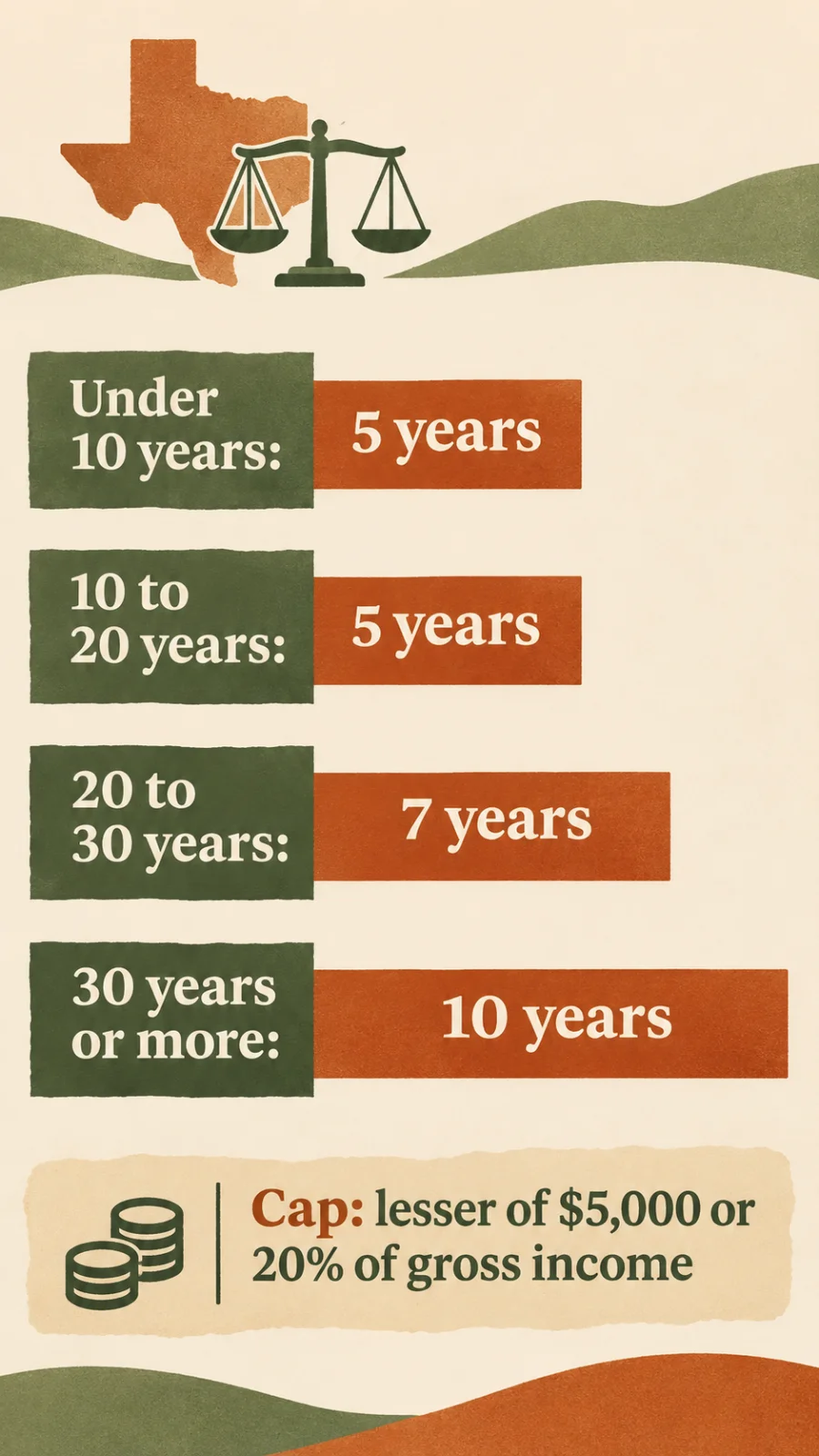
Section 8.055 caps the monthly amount at the lesser of $5,000 or 20 percent of the paying spouse’s average monthly gross income. If that spouse averages $18,000 a month, 20 percent is $3,600, so $3,600 is the ceiling. At $30,000 a month, 20 percent would be $6,000, so the $5,000 cap controls.
Gross income for this purpose includes wages, bonuses, interest, dividends, self-employment income and net rental income. It excludes SSI, Social Security and disability benefits, VA service-connected disability compensation and workers’ compensation.
Duration is limited by § 8.054 to the shortest reasonable period that lets the spouse earn enough, and never beyond these ceilings:
| Length of marriage | Maximum duration |
|---|---|
| Under 10 years (family violence ground only) | 5 years |
| 10 to 20 years | 5 years |
| 20 to 30 years | 7 years |
| 30 years or more | 10 years |
Those ceilings do not apply to disability-based maintenance. A court may order it for as long as the spouse continues to meet the eligibility criteria. H.B. 2070 (2023) clarified that continuing that maintenance follows the motion-to-modify procedure in § 8.057.
Section 8.052 lists what the court weighs, from each spouse’s earning ability and the length of the marriage to homemaker contributions, adultery, cruel treatment and any history of family violence.
How Does Texas Decide Custody?
Texas calls custody “conservatorship,” and the standard in § 153.002 is that the best interest of the child is always the primary consideration. Under § 153.131(b), there is a rebuttable presumption that appointing both parents as joint managing conservators serves the child’s best interest.
The presumption disappears when the court finds a history of family violence involving the parents. The court can also decline to appoint a parent if doing so would significantly impair the child’s physical health or emotional development.
Joint managing conservatorship does not mean equal time. It shares decision-making rights, and the schedule is set separately.
How Is Child Support Calculated in Texas?
Texas applies a percentage of the paying parent’s monthly net resources, and only that parent’s income is used. Section 154.125 sets the percentages, and net resources are figured with the Attorney General’s tax charts.
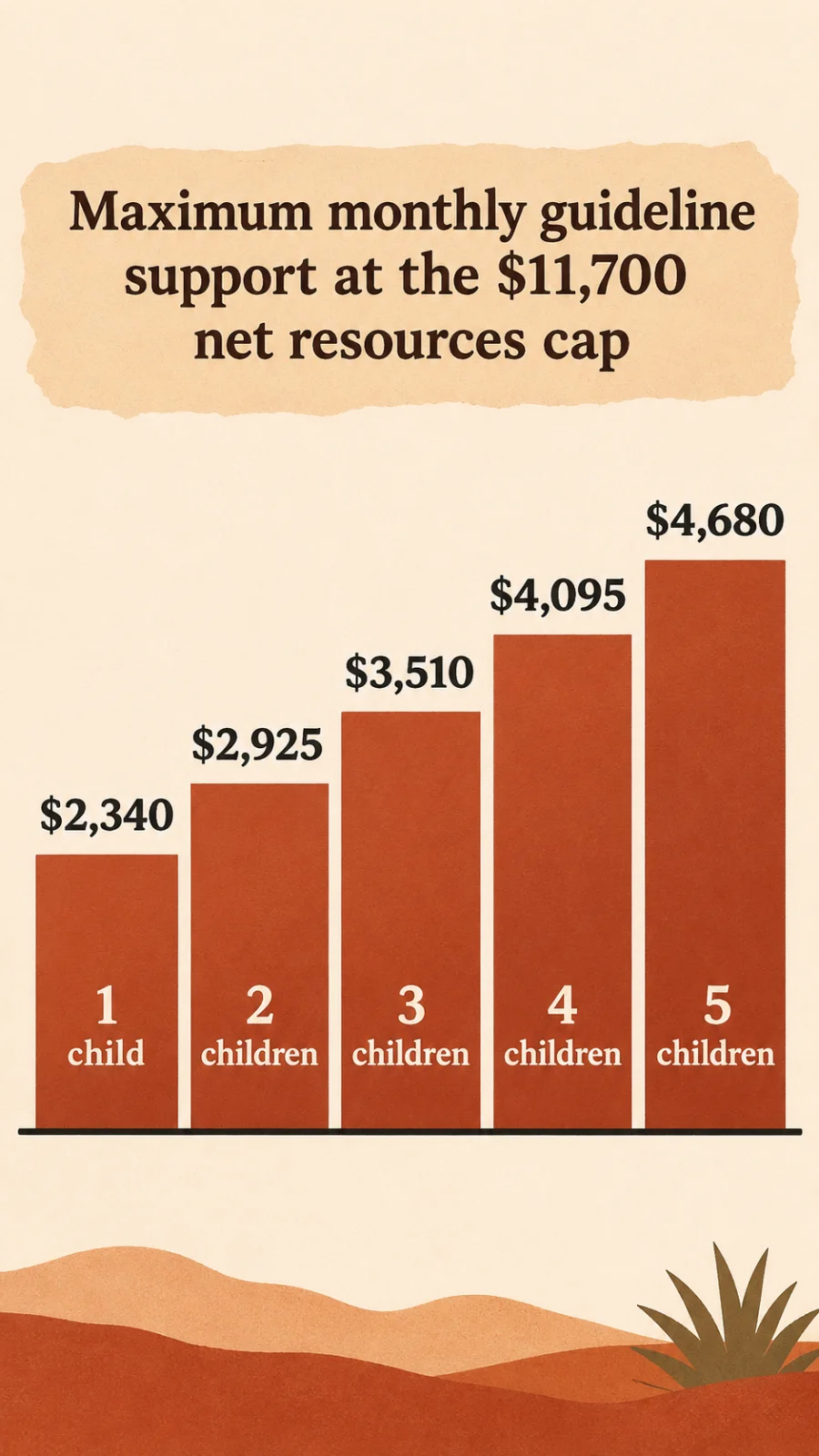
The guidelines apply to net resources up to a cap that is adjusted every six years for inflation. A Texas Register notice from the Attorney General set the cap at $11,700 a month, up from $9,200, for orders on or after September 1, 2025.
| Children | Guideline percentage | Maximum at $11,700 |
|---|---|---|
| 1 | 20% | $2,340 |
| 2 | 25% | $2,925 |
| 3 | 30% | $3,510 |
| 4 | 35% | $4,095 |
| 5 | 40% | $4,680 |
The maximums are the percentage multiplied by $11,700. For six or more children, the amount may not be less than the five-child figure.
A lower schedule applies when the paying parent’s net resources are under $1,000 a month: 15, 20, 25, 30 and 35 percent for one through five children. Above the cap, a parent can ask the court for more by proving the children’s needs, but the percentages do not apply automatically to income past $11,700.
What Does a Texas Divorce Cost and How Do You Start?
You start by filing an Original Petition for Divorce with the district clerk in the county where you meet the 90-day residency rule. Filing fees are set county by county. One rural county clerk’s sheet lists $350 when the spouse signs a waiver of service and $358 when the other side is served by citation, plus a separate service fee.
If you cannot afford the fee, file the Statement of Inability to Afford Payment of Court Costs under Texas Rule of Civil Procedure 145. The Texas Judicial Branch explains the process on its court costs page. You sign it either before a notary or under penalty of perjury, and you should attach any evidence of your finances.
The Supreme Court of Texas preliminarily approved further amendments to Rule 145 in October 2026 (Misc. Docket No. 26-9080) and asked for public comments by February 1, 2027, so the form and procedure may be revised.
Steps for an agreed divorce
- Prepare the petition. TexasLawHelp.org offers court-approved forms, and the petition includes a section for requesting a name change.
- File with the district clerk and pay the fee or file the Rule 145 statement.
- Serve your spouse, or have your spouse sign a waiver of service or file an answer.
- Wait for the 60-day period in § 6.702 to run unless an exception applies.
- Present the final decree at the hearing and ask the judge to sign it.
If you and your spouse disagree, the court can send the case to mediation if the parties agree in writing or on its own decision under § 6.602. A mediated settlement agreement is binding if it states conspicuously that it cannot be revoked and is signed by each party and by each party’s attorney who is present. A spouse who has experienced family violence can object to mediation in writing before the final order.
Frequently Asked Questions
How long does a divorce take in Texas?
At least 60 days from the filing date, unless a family violence exception under § 6.702(c) applies. Contested cases take longer.
Do I have to prove fault to get a divorce in Texas?
No. Insupportability under § 6.001 requires only that discord has destroyed the marriage with no reasonable expectation of reconciliation.
Is Texas a 50/50 state for property?
No. Section 7.001 requires a “just and right” division, so a court can divide the community estate unequally when the Murff factors support it.
Can I file for divorce if I just moved to Texas?
Only if your spouse meets the residency test. One of you must have been a Texas domiciliary for six months and a resident of the filing county for 90 days.
What is the maximum spousal maintenance in Texas?
The lesser of $5,000 a month or 20 percent of the paying spouse’s average monthly gross income under § 8.055. Duration is limited to 5, 7 or 10 years depending on the length of the marriage, except for disability-based maintenance.
How much is child support for one child?
Twenty percent of the paying parent’s monthly net resources, up to $2,340 a month at the $11,700 cap. If net resources are under $1,000 a month, the rate is 15 percent.
References
- Texas Legislature, Tex. Fam. Code ch. 6, Suit for Dissolution of Marriage (§§ 6.001 to 6.007, 6.301, 6.303, 6.405, 6.502, 6.602, 6.702)
- Texas Legislature, Tex. Fam. Code ch. 3, Marital Property Rights (§§ 3.001 to 3.003)
- Texas Legislature, Tex. Fam. Code ch. 7, Division of Property (§§ 7.001, 7.009)
- Texas Legislature, Tex. Fam. Code ch. 8, Maintenance (§§ 8.051 to 8.055)
- Texas Legislature, Tex. Fam. Code ch. 153, Conservatorship, Possession and Access (§§ 153.002, 153.131)
- Texas Legislature, Tex. Fam. Code ch. 154, Child Support (§ 154.125)
- Texas Secretary of State, Texas Register, Office of the Attorney General notice and correction on the § 154.125 net resources cap
- Supreme Court of Texas, Murff v. Murff, 615 S.W.2d 696 (1981), property division factors
- Texas Legislature, H.B. 2070 (88th Leg., R.S.), continuation of spousal maintenance
- Texas Judicial Branch, Texas Court Help, filing fees and the Statement of Inability to Afford Payment of Court Costs
- Supreme Court of Texas, Misc. Docket No. 26-9080, preliminary approval of amendments to Texas Rule of Civil Procedure 145
- TexasLawHelp.org, Divorce in Texas, forms and residency summary