
Virginia Divorce Laws: Fault, No-Fault, and 2026 Changes

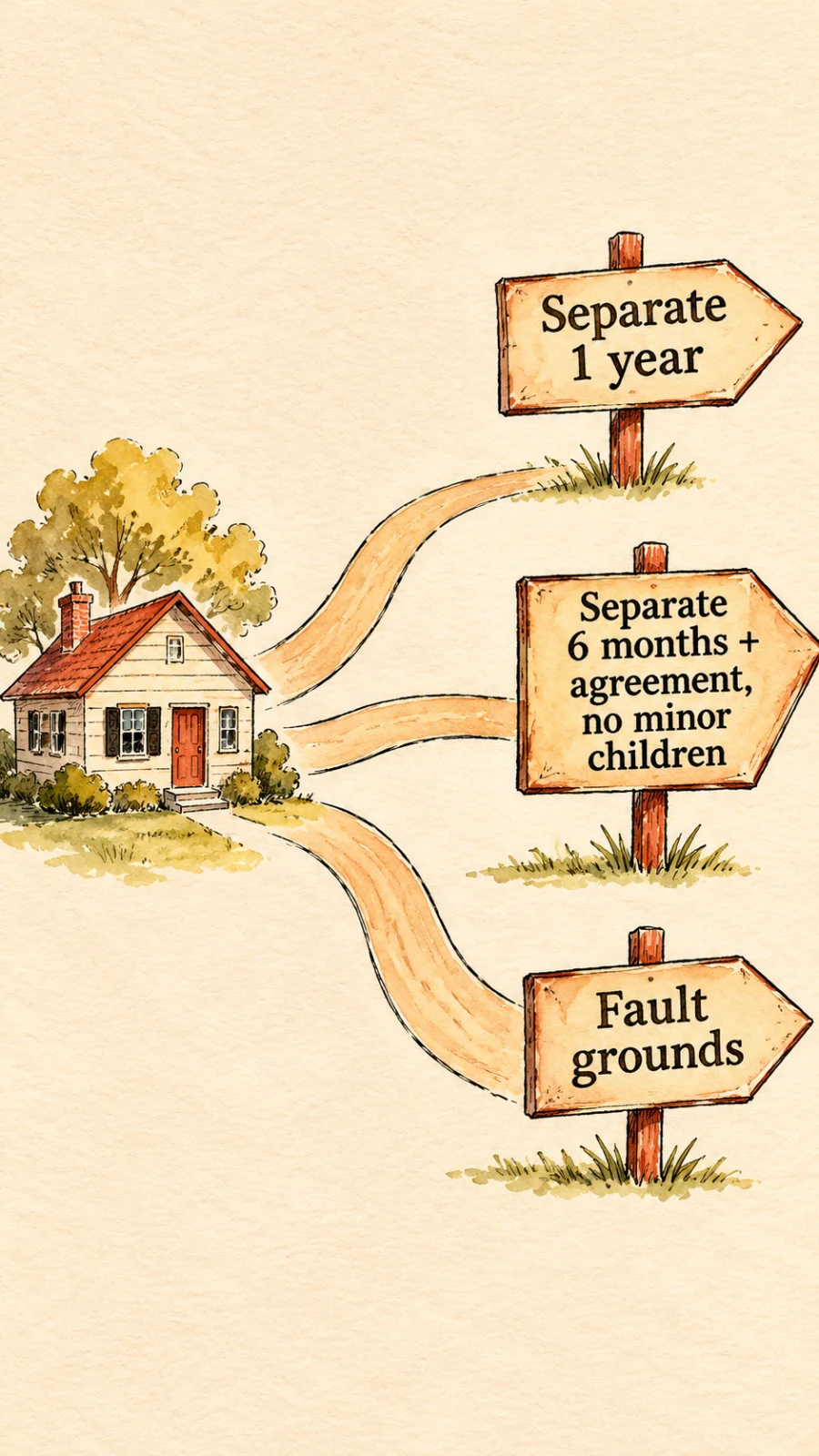
Virginia lets you divorce without proving fault once you have lived separate and apart for one year, or six months if you have a signed separation agreement and no minor children. Fault grounds (adultery, cruelty, desertion, or a felony conviction with confinement) are also available, and they matter most for spousal support. The governing statute is Va. Code § 20-91, and two parts of it changed on July 1, 2026.
Which Grounds Can You Use for Divorce in Virginia?
You can use any of five grounds, and the separation grounds are the ones most couples rely on. A final divorce is a “divorce from the bond of matrimony,” which ends the marriage and lets both spouses remarry.
| Ground | Wait | Statute |
|---|---|---|
| Separation, no agreement | 1 year | § 20-91(A)(9)(a) |
| Separation, signed agreement and no minor children | 6 months | § 20-91(A)(9)(a) |
| Adultery that occurred before the last separation | None | § 20-91(A)(1) |
| Cruelty, reasonable apprehension of bodily hurt, or willful desertion | Decree after 1 year from the act | § 20-91(A)(6) |
| Felony conviction, sentence over 1 year, and confinement | None, if you have not resumed living together after learning of it | § 20-91(A)(3) |
“Minor children” for the six-month track means children born to the two of you, born to one of you and adopted by the other, or adopted by both. Adult children do not block it.
Your spouse cannot veto a separation divorce. The statute lets either party apply, and a plea of recrimination (claiming the other spouse is also at fault) is not a bar.
What does “separate and apart” actually require?
It requires more than living apart. The Supreme Court of Virginia held in Lisann v. Lisann, Record No. 230718 (May 8, 2025) that at least one spouse’s intent to remain separated permanently must be present throughout the whole statutory period, not just on the first day.
That ruling reversed the Court of Appeals, which had held that intent at the start was enough. If one spouse spends month four telling the other the marriage can be saved, and neither party holds a settled intent to stay apart, the one-year clock is open to attack. The older case, Hooker v. Hooker, 215 Va. 415 (1975), set the day-one intent requirement that Lisann now builds on.
A divorce ends on an affidavit-only track in uncontested cases under Va. Code § 20-106, and the affiant must swear to continuous separation with intent to remain apart permanently for the statutory period. The Lisann opinion relies on that wording.
What Changed on July 1, 2026 Under HB 303?
House Bill 303, enacted as Chapter 918 of the 2026 Acts of Assembly, changed §§ 20-91 and 20-95. Governor Abigail Spanberger approved it April 13, 2026, and it took effect July 1, 2026. Some online summaries name the wrong governor or the wrong section, so the Act itself is the safer reference.
Adultery must predate the last separation
Section 20-91(A)(1) now reads “adultery that occurred prior to the date of the last separation of the parties.” A relationship that begins after you separate no longer counts as adultery for a divorce ground.
That matters for money. Adultery is a statutory bar to spousal support, and practitioners quoted by Virginia Lawyers Weekly say the amendment lets a support recipient date after separation without handing the other spouse that bar. The separation date, already important, becomes a contested fact in many cases.
You can file for a divorce from bed and board on day one
A divorce from bed and board is a court-ordered separation that does not end the marriage. Before 2026 it required cruelty, apprehension of bodily hurt, or desertion. Section 20-95 now also allows it “on the application of either party upon the parties living separate and apart with the intent of at least one of the parties to remain separate and apart permanently.”
The Act adds that no waiting period applies to filing. The practical value is access to a circuit court judge early, which opens the door to temporary orders on support and custody while the case is pending.
The catch in the new bed-and-board rule
The same sentence of § 20-95 says the divorce “may be decreed only in accordance with the provisions of § 20-91.” You can file on day one, but the decree itself still has to fit one of the § 20-91 grounds. Several summaries describe the change as a day-one divorce, and that overstates it.
A work group may reshape fault divorce
Chapter 918 directs the Virginia Family Law Coalition and the Virginia State Bar Family Law Section to convene a work group on whether to eliminate fault grounds, adopt irretrievable breakdown as the sole ground, and shorten or remove mandatory separation periods. Its report is due to the Governor and the House and Senate Courts of Justice chairs by December 1, 2026. A report changes nothing by itself. Only a new statute would.
Residency, Venue, and How to File
At least one spouse must have been a bona fide Virginia resident and domiciliary for six months before you file, under Va. Code § 20-97. A military member stationed in Virginia, or on a ship homeported here, for six months is presumed to meet the requirement.
Divorces are heard in circuit court. According to the Virginia Judicial System’s self-help page, custody, visitation, child support, and spousal support may also be handled in Juvenile and Domestic Relations District Court, and post-divorce changes to those orders generally go there.
Forms, fees, and service
Virginia has no official court-approved divorce complaint. You draft it, or use the no-fault guidance and online forms on VALegalAid.org, which the court system points to. Circuit courts that publish their fees list $86 (Prince William County) to $91 (Arlington County) to file, plus $12 for each document the sheriff serves.
You will also need the civil cover sheet (Form CC-1416) and the VS-4 statistical report, which Prince William’s clerk lists as required. If you cannot afford the fees, Form CC-1421 is the petition to proceed in a no-fault divorce without paying them.
Proof, privacy, and the decree
Under Va. Code § 20-99, a divorce cannot rest only on the parties’ own uncorroborated testimony, except for separation grounds under § 20-91(A)(9). The court must decide on its own evidence even if your spouse never answers.
Your decree must include each party’s Social Security number or a DMV control number under § 20-91(B). Pleadings cannot contain either one. Va. Code § 20-121.03 sends that data into a separate addendum.
If you took your spouse’s surname, ask for restoration of your former name in the case. Va. Code § 20-121.4 requires the court to restore it by a separate order when you request it.
A Sample Separation Timeline
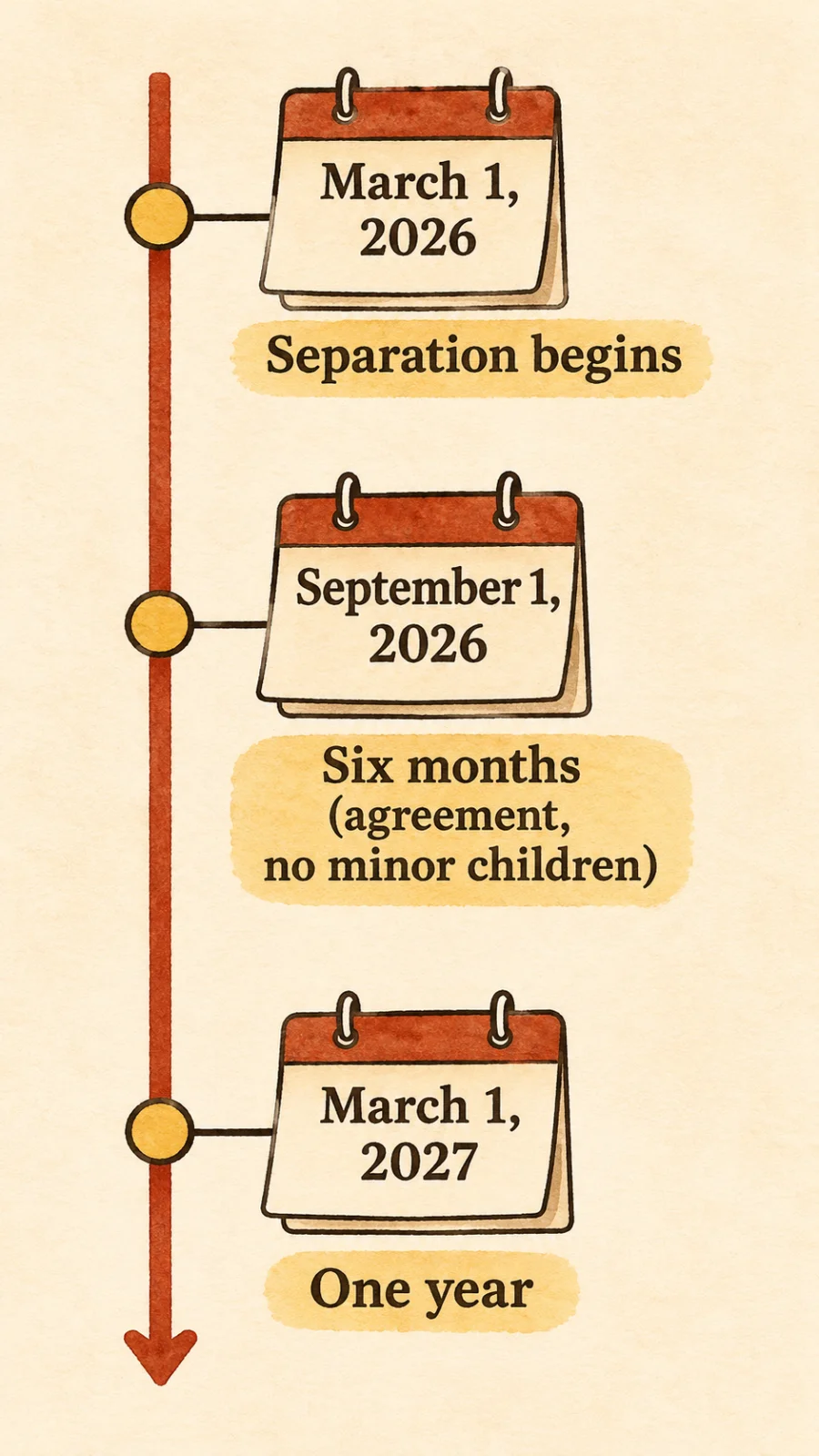
Say you and your spouse separate on March 1, 2026, and at least one of you intends the separation to be permanent. With no signed agreement, the one-year period ends March 1, 2027. With a signed separation agreement and no minor children, the six-month period ends September 1, 2026.
Both dates assume neither of you moves back in together and that the intent to stay apart lasts the full period. Write down the date and keep one dated message, email, or letter that states the intent. That record is what a court will look for if your spouse disputes the date.
How Virginia Divides Property
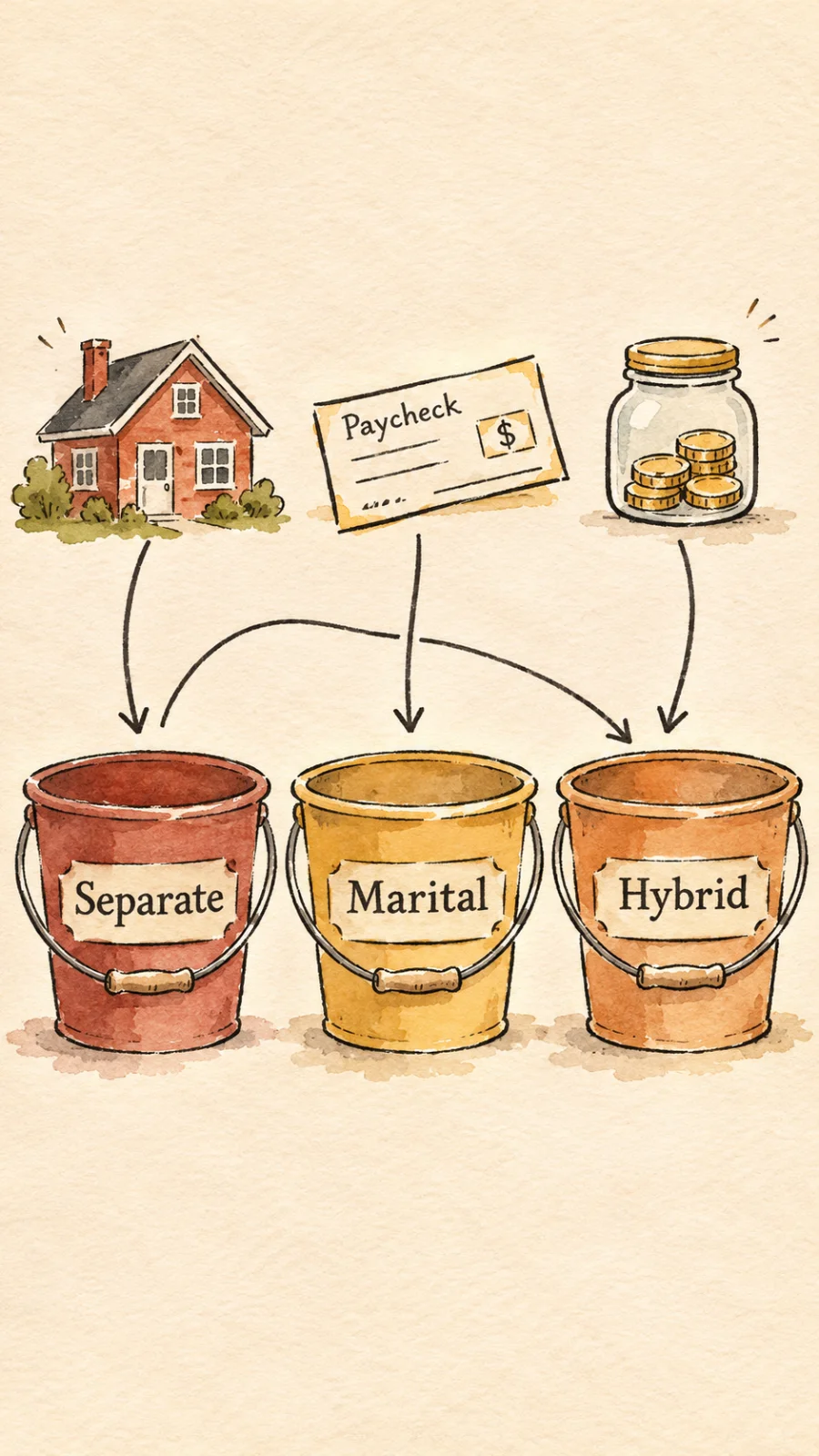
Virginia is an equitable distribution state, which means a court divides marital property fairly, and the statute does not require an equal split. Under Va. Code § 20-107.3, the court first classifies each asset and debt as separate, marital, or hybrid (part marital and part separate).
Property acquired before the marriage is separate. So is property acquired during the marriage by bequest or gift from a third party. Court of Appeals opinions applying the statute confirm that separate property can turn hybrid in two main ways: marital funds or a spouse’s personal efforts increase its value, or it is commingled with marital property and can still be traced.
A house you bought before the wedding and paid down with marital paychecks is the classic hybrid asset. The portion of the increase attributable to marital contributions or personal effort is marital, and the rest stays separate. The spouse claiming something is separate needs records to prove it.
Spousal Support: The Adultery Bar and When Support Ends
Virginia has no formula for spousal support. Va. Code § 20-107.1 sends the court through a statutory list of factors, including the length of the marriage, the standard of living during it, each spouse’s contributions, and the circumstances that led to the divorce.
If the court finds adultery, it may not award permanent support to the adulterous spouse unless it finds by clear and convincing evidence that denying support would be a manifest injustice. The Court of Appeals of Virginia has explained that this finding rests on two things together: the spouses’ respective degrees of fault and their relative economic circumstances.
A separation divorce does not erase support. Section 20-91(A)(9)(c) says it does not lessen any support obligation unless the spouse proves another ground exists.
What ends or changes support after the divorce
Under Va. Code § 20-109, support ends when either spouse dies or the recipient remarries, unless a contract says otherwise. It must also end when the recipient has habitually cohabited with another person in a relationship like marriage for one year or more, proved by clear and convincing evidence. The recipient can resist termination by proving it would be unconscionable by a preponderance of the evidence.
The payor reaching full Social Security retirement age counts as a material change in circumstances. Any order granting or denying modification needs written findings.
Custody and Child Support
Custody follows the child’s best interests, and Va. Code § 20-124.2 says there is no presumption or inference in favor of either parent. The court must also try to assure frequent and continuing contact with both parents when appropriate. The factors are in § 20-124.3 and apply to temporary orders during the case as well.
Child support follows the income-shares guidelines in Va. Code § 20-108.2. The schedule was revised by Chapter 702 of the 2025 Acts (SB 805) and now runs to $42,500 in combined monthly gross income, up from $35,000. Shared-custody calculations apply when a parent has the children more than 90 days a year.
What to Do Next
- Fix your separation date and keep a dated record that at least one of you intends to stay apart permanently.
- Confirm six months of Virginia residency under § 20-97 before you file.
- Decide whether a signed separation agreement is realistic. It is the only way to reach the six-month track.
- Gather proof of what is separate property: pre-marriage statements, inheritance paperwork, and gift records.
- Draft the complaint, then file it with Form CC-1416 and the VS-4 at the circuit court clerk’s office, or ask for fee relief on Form CC-1421.
- If the situation is unsafe or money is moving out of accounts, ask a family lawyer about a day-one bed-and-board filing and temporary orders.
Free help is available through VALegalAid.org and the Virginia State Bar’s lawyer referral resources listed on the court system’s self-help page.
Frequently Asked Questions
Is Virginia a no-fault divorce state?
Not exclusively. Virginia allows both no-fault divorce after separation and fault divorce on adultery, cruelty, desertion, or a felony conviction with confinement. A work group is studying whether to eliminate fault grounds, with its report due December 1, 2026.
Can I get divorced in less than a year?
Yes, in two ways. You can shorten the separation to six months with a signed separation agreement and no minor children, or you can use a fault ground that has no waiting period, such as adultery that occurred before your last separation. Fault grounds need corroborating evidence under § 20-99.
Can my spouse stop the divorce by refusing to sign anything?
No. Section 20-91(A)(9)(a) lets either party apply once the separation period is complete. If a served spouse does not answer, § 20-99 allows the court to enter a decree without further notice to that spouse.
Does adultery stop me from getting alimony?
It can. If adultery is established as a ground, the adulterous spouse cannot receive permanent support unless a court finds by clear and convincing evidence that denial would be a manifest injustice. Since HB 303, adultery that began after the last separation does not count as the ground.
Will the court split our property 50/50?
Not automatically. Virginia courts divide marital property equitably under § 20-107.3 after classifying everything as separate, marital, or hybrid. Separate property stays with its owner.
How much does it cost to file for divorce?
Courts that publish their fees list $86 to $91 for the complaint, plus $12 for each document the sheriff serves. Your local clerk or the Judicial System’s filing fee calculator gives the exact amount, and Form CC-1421 asks for a fee waiver in a no-fault case.
References
- Code of Virginia, Va. Code § 20-91, grounds for divorce from the bond of matrimony
- Virginia General Assembly, 2026 Acts of Assembly Chapter 918 (HB 303), amending §§ 20-91 and 20-95
- Code of Virginia, Va. Code § 20-97, residency requirement
- Code of Virginia, Va. Code § 20-99, divorce suit procedure, corroboration and service
- Code of Virginia, Va. Code § 20-109, modification and termination of spousal support
- Code of Virginia, Va. Code § 20-121.4, restoration of name
- Supreme Court of Virginia, Lisann v. Lisann, Record No. 230718, intent to separate under § 20-91(A)(9)
- Court of Appeals of Virginia, opinion on the § 20-107.1(B) adultery bar and manifest injustice exception
- Virginia Judicial System Court Self-Help, Divorce
- Virginia Judicial System, Circuit Court Civil Forms (CC-1416, CC-1421)