
Wisconsin Lemon Law: Steps to Take Before You Claim
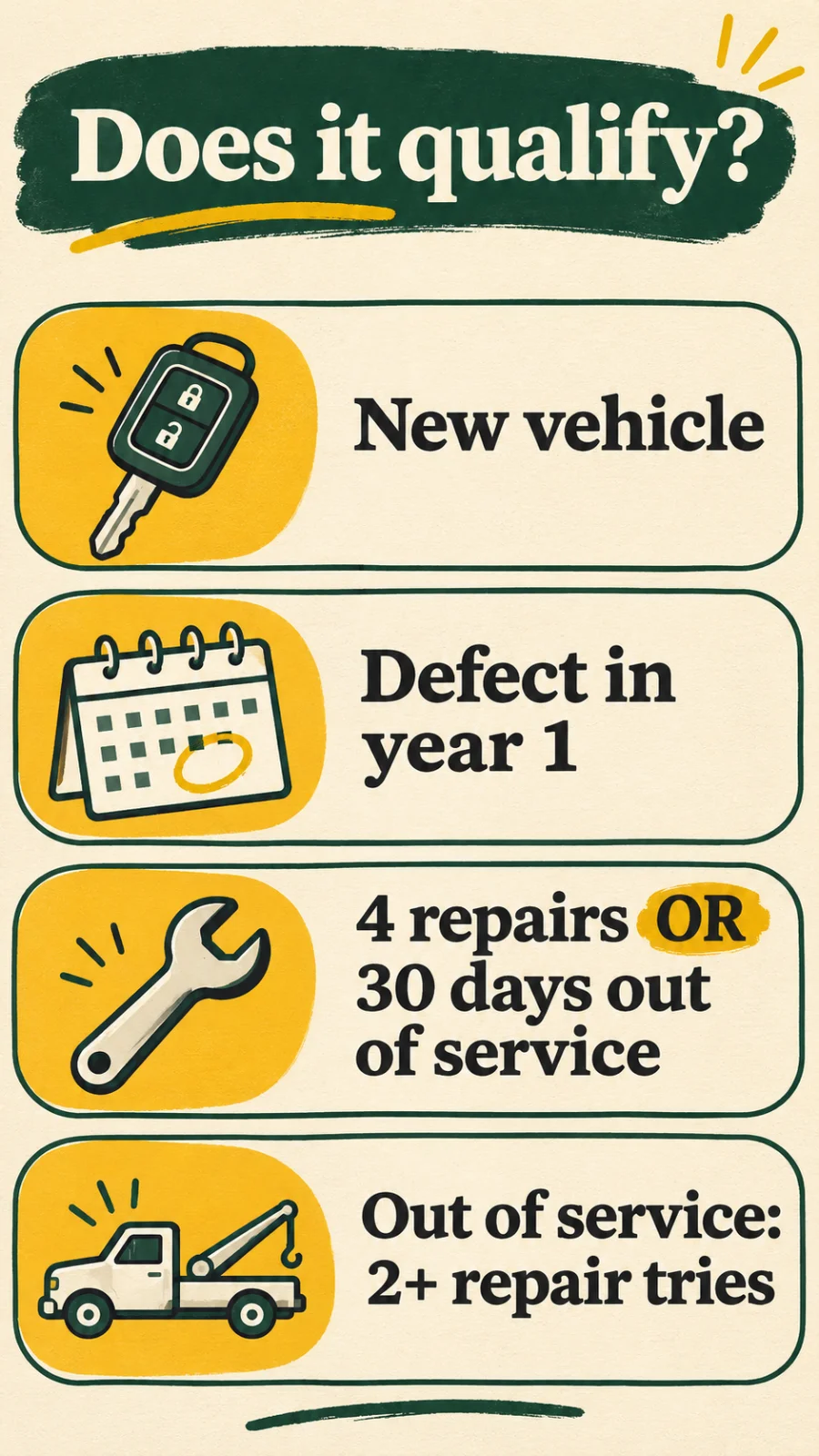
A new car, truck, motorcycle or motor home bought or leased in Wisconsin is a lemon when a serious defect appears in its first year and either the same defect survives 4 repair attempts or the vehicle is out of service for 30 days. Before you contact the manufacturer, collect every repair order, confirm each problem was reported while the warranty was active, and prepare Form MV2691 for certified mail.
Wisconsin’s law is Wis. Stat. § 218.0171. It is enforced by you and the manufacturer, not by a state office, so the paperwork you build before the claim often decides how it ends.
Does Your Vehicle Qualify as a Lemon in Wisconsin?
Your vehicle qualifies only if every item in the table below is true. The Wisconsin Department of Transportation (WisDOT) uses these same tests in its Wisconsin Lemon Law guide.
| Test | What Wisconsin requires |
|---|---|
| Vehicle | New car, truck, motorcycle, motor home or other motor-driven vehicle required to be registered in Wisconsin. Demonstrator and executive-driven vehicles count. |
| Defect | A condition covered by the manufacturer’s warranty that seriously harms use, value or safety |
| Timing | The problem is reported, and the vehicle is made available for repair, before the warranty ends or one year after first delivery, whichever comes first |
| Failure to fix | Same defect subject to repair 4 times and still present, or the vehicle out of service for an aggregate of 30 days or more |
Leased vehicles are covered. The refund works differently for a lease, but the 4-repair and 30-day tests are the same.
What “out of service” means
A vehicle is out of service when you cannot use it for its intended purpose, either because the manufacturer, lessor or an authorized dealer has it for repair, or because you have it but it carries a serious defect that has already been subject to repair at least 2 times. The second branch matters if a dealer sends you home with an unsafe vehicle between visits. Days lost to flood, natural disaster, war, invasion, fire or strike can be excluded from the 30-day count.
Dealer repairs of a defect that is later fixed do not erase your claim. A buyer who noticed problems before taking delivery is still protected, a point the Wisconsin Supreme Court settled in Dieter v. Chrysler Corp., 2000 WI 45.
Steps to Take Before You Contact the Manufacturer
The order matters less than finishing all of it. Each step below feeds the form you will send, and gaps in the repair record are the most common reason a claim stalls.
1. Confirm Wisconsin law applies
Wisconsin’s law does not cover vehicles bought out of state or bought online and delivered outside Wisconsin. It also excludes used vehicles, mopeds, semitrailers and trailers, pull-behind RVs, non-motorized recreational vehicles, ATVs, UTVs, snowmobiles and boats. If you bought elsewhere, WisDOT directs you to that state’s transportation department.
2. Report every defect to the dealer, in writing
You may report a defect to the manufacturer, the lessor or any authorized dealer, and you must make the vehicle available for repair before the warranty ends or one year after delivery, whichever is sooner. A Wisconsin-specific detail most guides miss: 2013 Wisconsin Act 101 required a WisDOT form for this repair report, but 2015 Wisconsin Act 173 removed that requirement retroactively to March 1, 2014. You do not need Form MV2691 to ask a dealer for a repair.
Mileage at your first report sets the cap on how much the manufacturer can subtract from a refund, so report early rather than waiting for the problem to get worse.
3. Get a repair order for every visit
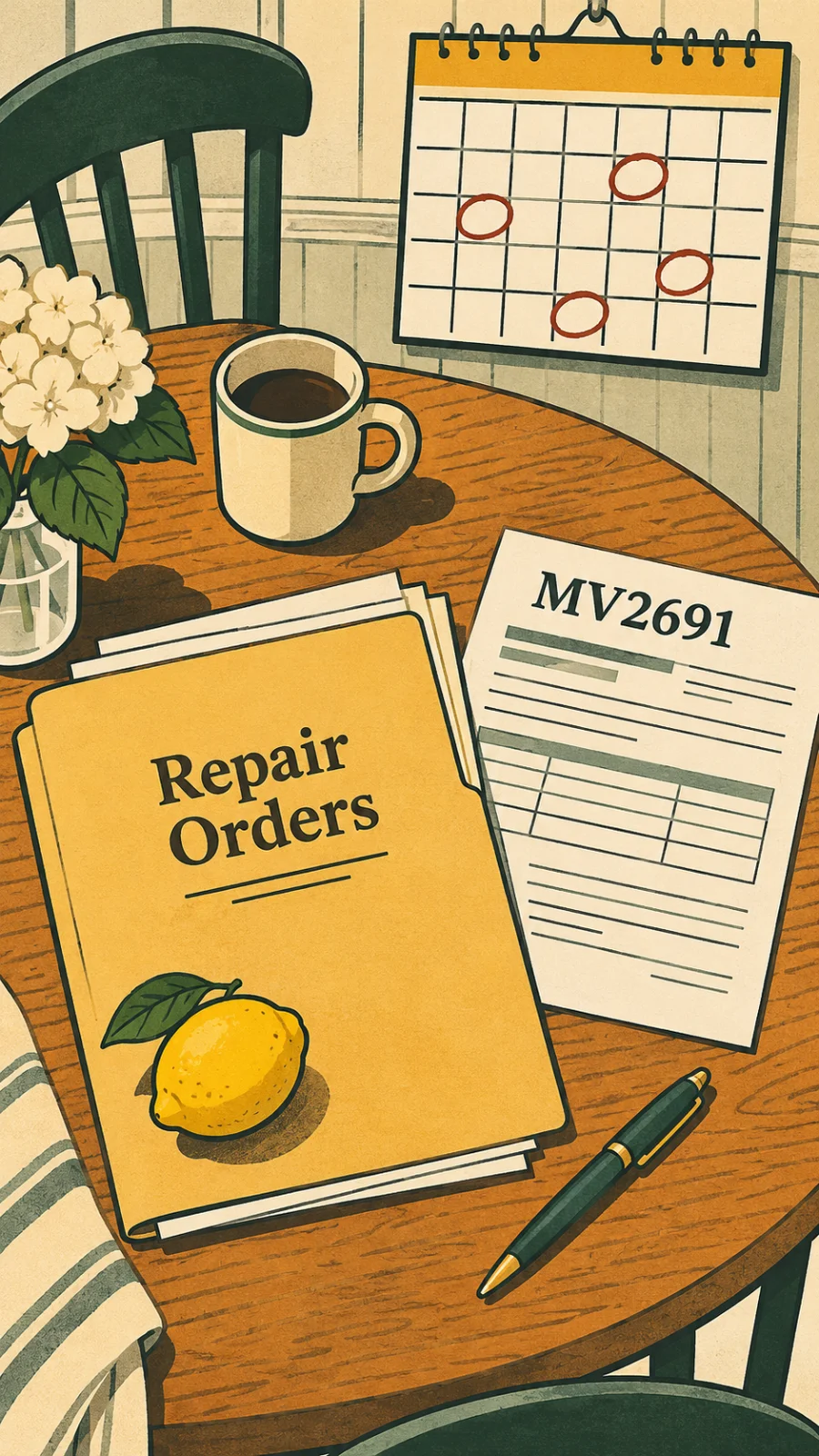
WisDOT tells owners to get a repair order for every visit, even when the shop finds nothing or does not attempt a fix. Each order should list the problems you reported and the dates the vehicle was in and out of the shop. Those dates build your 30-day count, and the matching problem descriptions build your 4-repair count.
Keep the originals outside the vehicle. Add your purchase contract, warranty booklet and any service records.
4. Count your repairs and your days
Build a simple tally from the repair orders: one column per defect, one row per visit, and a running total of days the vehicle sat at the dealer. The form asks you to pick one basis for the claim: at least 4 repair attempts for the same defect in the first year, at least 30 days out of service in the first year, or warranty expiration with a prior repair or out-of-service history.
A recall alone does not make a vehicle a lemon. If the recall defect appears in a vehicle under 1 year old and 4 repair attempts fail, or it is out of service over 30 days, it can qualify.
5. Decide between a replacement and a refund
You choose the remedy, and the form lets you check only one. A replacement is a comparable new vehicle plus a refund of your collateral costs, and the manufacturer can offer a full refund instead. A refund returns the price and related charges, less an allowance for your use (worked out below).
6. Gather your financing details
Form MV2691 asks for the selling or leasing dealer, the name of any lender with a lien, and your loan account numbers. You also sign an authorization for the manufacturer to contact those lenders, and that authorization expires 35 days after you sign. Sign the form close to the day you mail it so the authorization does not lapse while the manufacturer is still working.
7. Complete Form MV2691 and mail it by certified mail
For a vehicle purchased on or after March 1, 2014, the Motor Vehicle Lemon Law Notice and Nonconformity Report (MV2691) is the required demand. The form carries statutory wording, so leave no field blank. Itemize collateral costs such as rental cars, alternative transportation and towing.
Mail the form to the manufacturer at the address in your owner’s manual or warranty information. Include copies of all repair orders and a cover letter explaining the history. WisDOT’s process has no separate final repair attempt step, so the claim goes straight from your repair history to the manufacturer. Use certified mail and keep a complete copy of everything you send.
How Much a Wisconsin Lemon Law Refund Is Worth
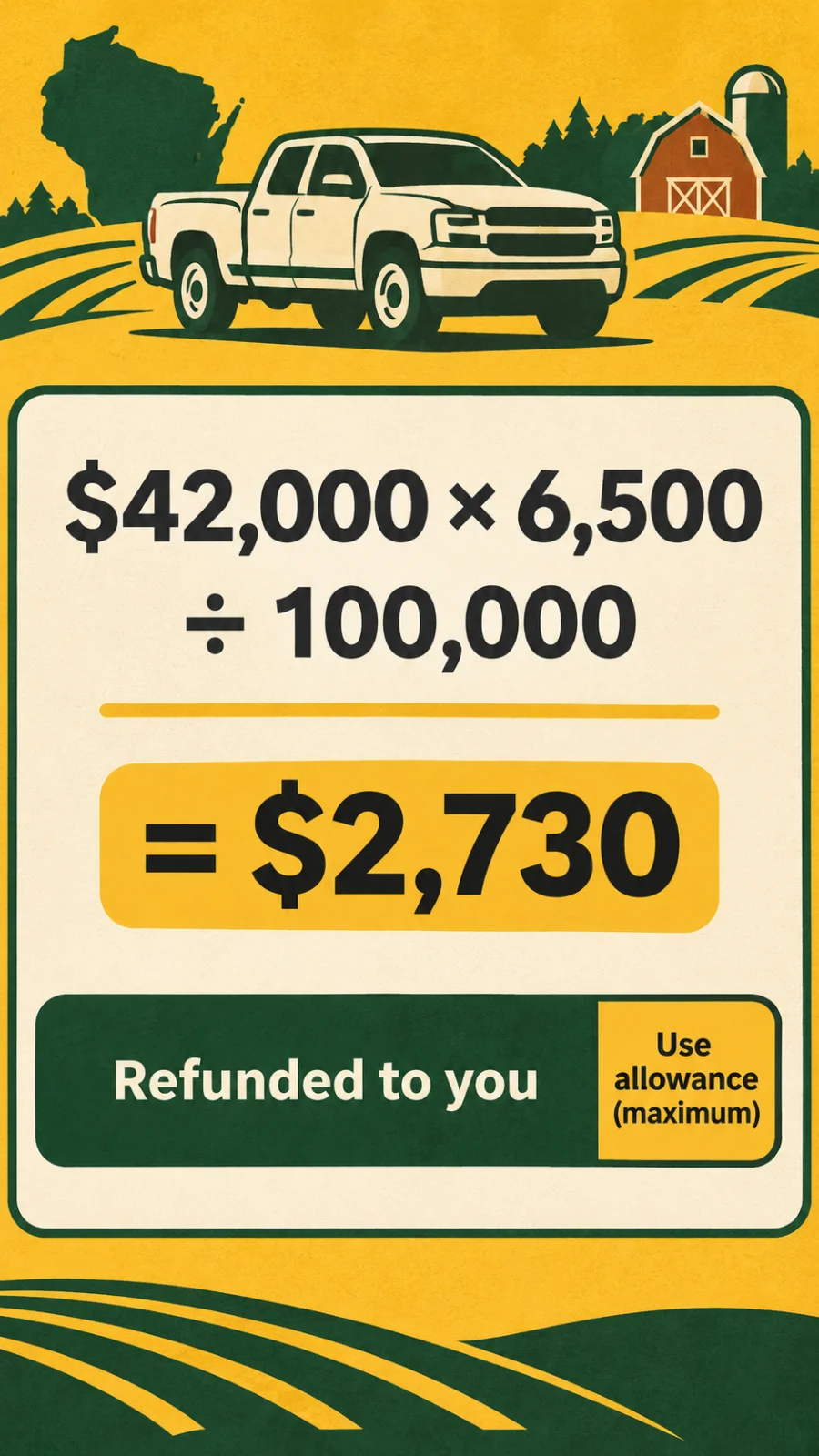
A refund covers the full purchase price, sales tax, finance charges, the amounts you paid at the point of sale, and collateral costs, minus a reasonable allowance for use. That allowance cannot exceed the purchase price multiplied by the mileage at your first reported defect, divided by 100,000. For motorcycles the divisor is 20,000.
Take a hypothetical $42,000 truck with 6,500 miles on the odometer when you first reported the problem. The most the manufacturer can deduct is $42,000 × 6,500 ÷ 100,000 = $2,730. Everything else on the list comes back to you, with payments going first to any lender that holds a perfected security interest, as its interest appears.
For a lease, the refund is built from the current value of the written lease, and the use allowance is capped at your total lease obligation multiplied by the same mileage fraction. You return the vehicle and its title, with all endorsements. Aftermarket items you added after delivery, like a bedliner, are not automatically reimbursed; the manufacturer may choose to pay for parts that add value, and you may remove parts that come off without damaging the vehicle.
What the Manufacturer Must Do After You File
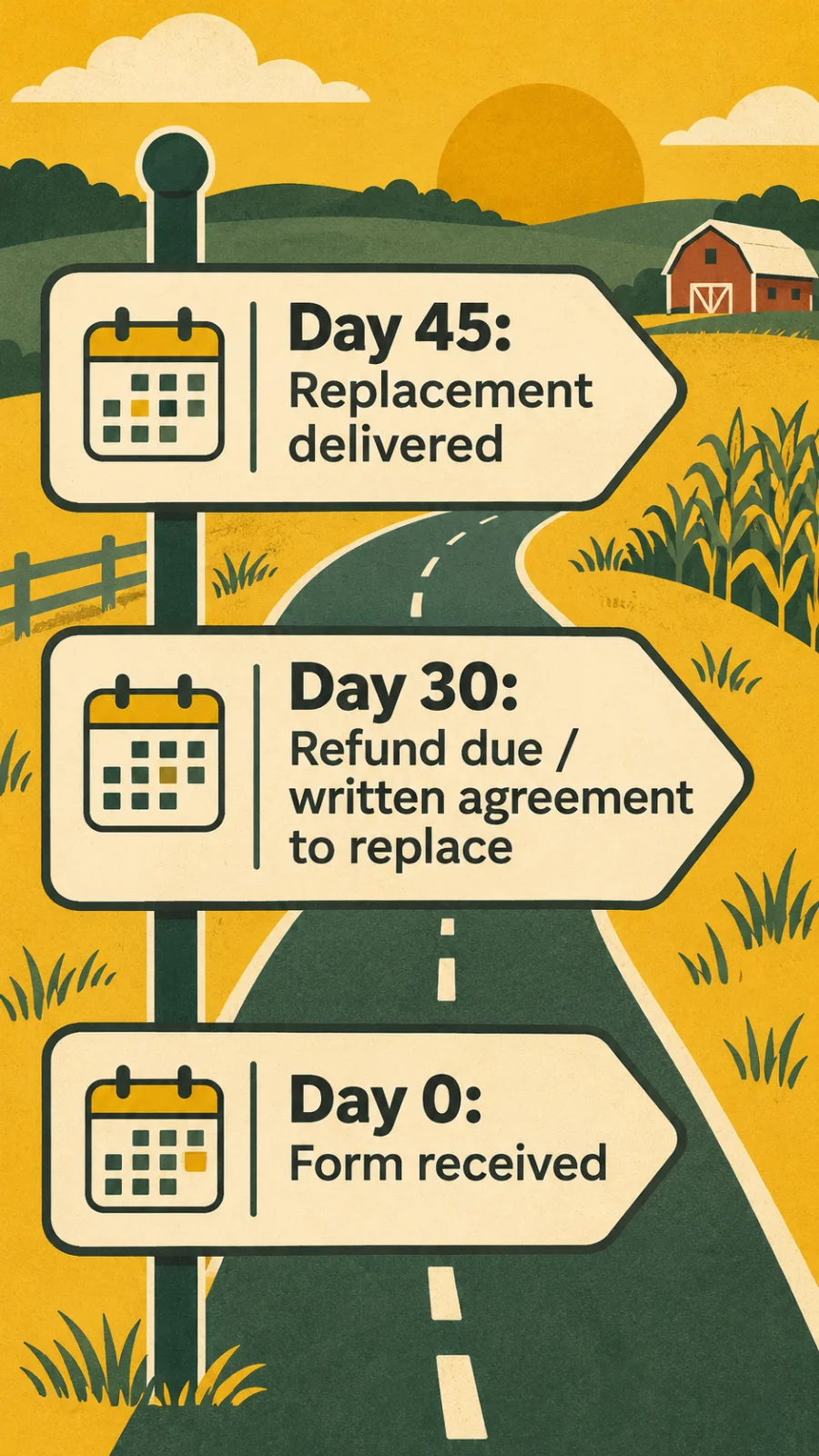
Once the manufacturer receives your form, Wisconsin’s deadlines start running. The table shows the clock for a standard vehicle.
| Event | Deadline | Heavy-duty vehicles |
|---|---|---|
| Refund provided | 30 days | 30 days |
| Written agreement to replace | 30 days after receiving MV2691 | 30 days |
| Replacement delivered | By day 45 | By day 120 |
| Request for missing form information | Within 30 days of receiving the form | Same |
If the manufacturer asks for missing information, the response deadlines do not start until you supply it. That is why a complete form and a full set of repair orders protect your timeline. A heavy-duty vehicle is one with a gross vehicle weight rating or actual gross weight over 10,000 pounds, as defined in 2013 Wisconsin Act 101.
When you elect a replacement and the manufacturer does not deliver on time, WisDOT’s guide says you are due the full refund with no use allowance deducted. A returned lemon cannot be resold in Wisconsin without full disclosure of why it came back, and the title carries a Manufacturer Buyback brand that cannot be removed.
When a Manufacturer Dispute Program Comes First
If your manufacturer runs a dispute program that WisDOT has certified, you must use it before you sue. Under § 218.0171(3), a consumer cannot bring a lawsuit when a certified informal dispute procedure is available. WisDOT certifies these programs under Wis. Admin. Code ch. Trans 143.
The programs are free and do not require a lawyer, and you are not bound by the decision. Manufacturers are not required to have one. WisDOT’s guide lists these programs for certified brands:
| Program | Certified for | Phone |
|---|---|---|
| BBB Auto Line | Audi, Ford, Lincoln, Hyundai, Kia, Mazda, Volkswagen, Nissan, Infiniti | (800) 955-5100 |
| National Center for Dispute Settlement | Acura, Honda, Lexus, Toyota | (800) 777-8119 |
| DeMars & Associates, CAP-Motors | Porsche | (800) 279-5343 |
The same programs also take cases from brands whose participation is not certified, such as General Motors, Subaru, Tesla and the Stellantis brands. For those, using the program is optional. WisDOT’s Dealer & Agent Section can tell you whether your brand’s program is certified.
Suing Under Wisconsin’s Lemon Law
You have 36 months after the vehicle is first delivered to a consumer to file suit under § 218.0171(7). A vehicle delivered March 15, 2025, for example, must be in court by March 15, 2028. Do not let a dispute program or negotiations run the clock.
A consumer who prevails recovers pecuniary loss (the money actually lost), costs, disbursements, reasonable attorney fees and any equitable relief the court finds appropriate. Fee shifting is why many lemon law lawyers take these cases without charging you up front. The double damages that older Wisconsin law awarded were removed by Act 101, which applies to vehicles whose warranty began on or after March 1, 2014.
A court can also penalize a party who fails to cooperate in a way that hinders the other side, by extending deadlines, reducing damages or fees, striking pleadings or entering default judgment. Any waiver of your lemon law rights is void, except that on heavy-duty vehicles a negotiated written settlement you sign releases the manufacturer.
Who to Contact for Help
WisDOT’s Dealer & Agent Section runs the lemon law program at (608) 266-1425, [email protected], or 4822 Madison Yards Way, PO Box 7909, Madison, WI 53707-7909. It can answer questions and help with dealer sales and warranty complaints, but it cannot resolve your claim for you.
For a suspected safety defect, call the NHTSA Vehicle Safety Hotline at (888) 327-4236. For a lawyer, the State Bar of Wisconsin Attorney Referral Service takes calls at (800) 362-9082. Problems with a used vehicle from a Wisconsin dealer go through WisDOT’s dealer complaint process, not the lemon law.
Frequently Asked Questions
Does Wisconsin’s lemon law cover used cars?
No. The law covers new vehicles only. For a used vehicle bought from a Wisconsin dealer, file a dealer complaint with WisDOT.
Do I need a lawyer to send a lemon law claim?
No. You can complete Form MV2691 and mail it yourself, and manufacturer dispute programs do not require a lawyer. A lawyer becomes useful if the claim is denied and you need to sue, since a winning consumer recovers reasonable attorney fees.
How long do I have to file a lemon law lawsuit in Wisconsin?
You have 36 months after the vehicle is first delivered to a consumer. The first year also matters because the defect must be reported and the vehicle made available for repair within the warranty period or one year after delivery, whichever is sooner.
Does a recall make my vehicle a lemon?
No. A recall alone does not qualify a vehicle. It can qualify when the recall defect appears in a vehicle under 1 year old and 4 repair attempts fail or the vehicle is out of service for more than 30 days.
Is a leased vehicle covered?
Yes. A lessee can demand a refund of amounts paid under the written lease plus sales tax and collateral costs, less a reasonable allowance for use. The lessor receives the current value of the lease.
What if I bought my vehicle in another state?
Wisconsin’s law does not apply to vehicles bought out of state or bought online and delivered outside Wisconsin. Contact the transportation department of the state where you bought it.
References
- Wisconsin Legislature, Wis. Stat. § 218.0171, repair, replacement and refund under new motor vehicle warranties
- Wisconsin Legislature, Wis. Admin. Code ch. Trans 143, certification of manufacturers’ informal dispute settlement procedures
- Wisconsin Legislature, 2013 Wisconsin Act 101 (2013 Assembly Bill 200), lemon law amendments
- Wisconsin Legislature, 2015 Wisconsin Act 173 (2015 Senate Bill 274), reporting a nonconformity
- Wisconsin Legislative Council, Act Memo on 2013 Wisconsin Act 101, Lemon Law
- Wisconsin Legislative Council, Act Memo on 2015 Wisconsin Act 173, Reporting a Motor Vehicle Nonconformity
- Wisconsin Department of Transportation, Wisconsin Lemon Law guide, Form BVS2828
- Wisconsin Department of Transportation, Form MV2691, Motor Vehicle Lemon Law Notice and Nonconformity Report
- Wisconsin Department of Transportation, Lemon Law page for consumers