
Alaska Abortion Laws: Your Rights and Legal Protections

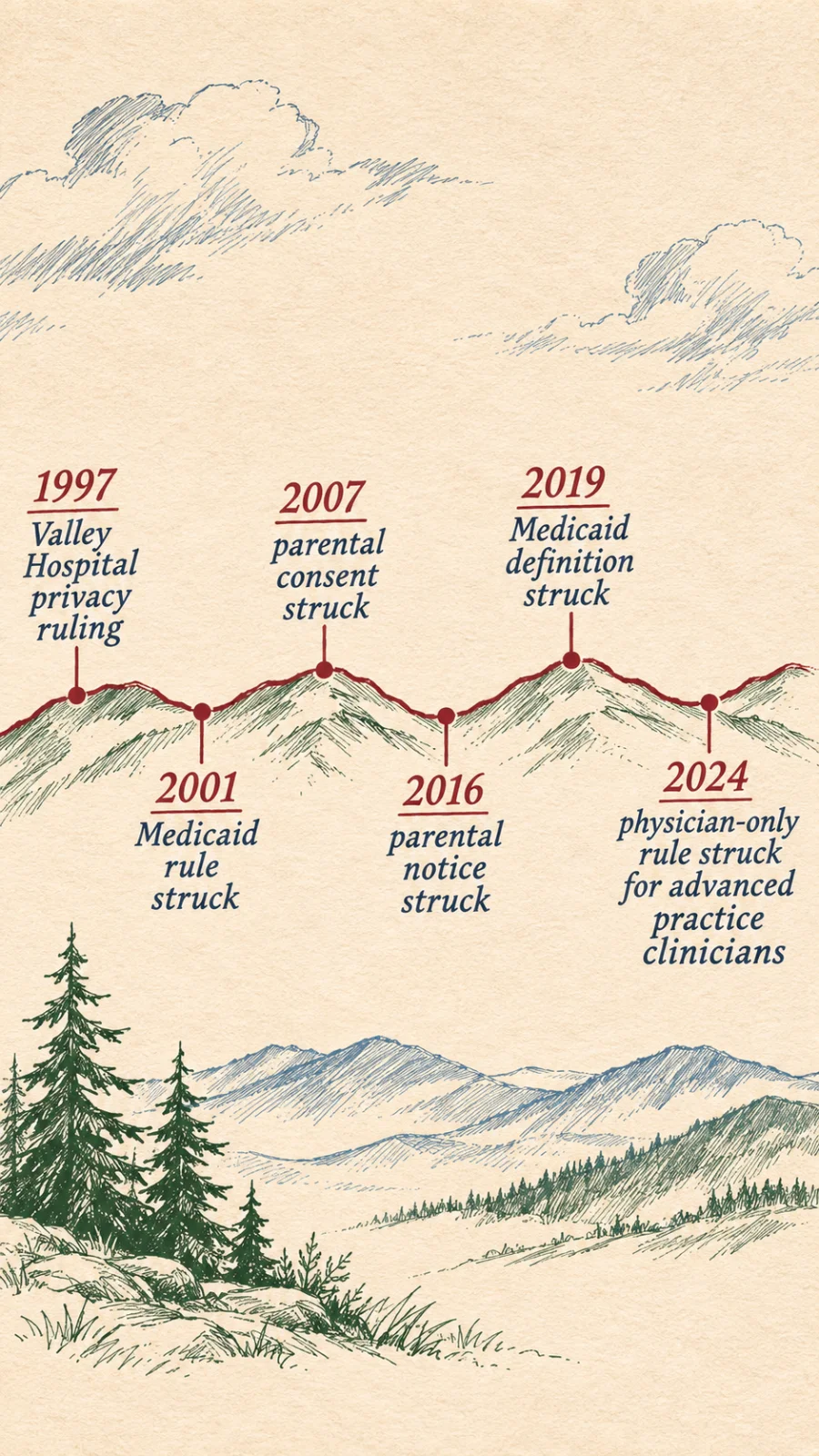
Abortion is legal in Alaska, and the state’s statute sets no gestational limit. The right rests on the privacy clause in Article I, section 22 of the Alaska Constitution, which the Alaska Supreme Court held in 1997 protects reproductive choice. The U.S. Supreme Court’s 2022 Dobbs decision did not change that, because the Alaska ruling stands on state law.
Several older provisions in AS 18.16, including the parental notice and consent rules, remain printed in the code but cannot be enforced. This guide separates what the statute says from what courts have left standing.
What Does Alaska Law Say About Abortion?
AS 18.16.010 is the core statute, and it dates to the 1970 law that legalized abortion in Alaska. It lists conditions for a lawful abortion: a licensed physician performs it, it takes place in an approved facility or federal hospital, the patient has been in Alaska for 30 days, and the informed consent steps in AS 18.16.060 are met.
Subsection (c) makes a knowing violation punishable by up to five years in prison, a fine of up to $1,000, or both. Subsection (b) protects conscience: no hospital or person has to take part in an abortion, and none is liable for refusing.
Where the printed text and the enforceable law differ
Court rulings have emptied out parts of the statute without deleting the words. The table below shows where each major provision stands.
| Provision | Where it stands | Basis |
|---|---|---|
| Physician-only rule, AS 18.16.010(a)(1) | Permanently blocked for advanced practice clinicians; state appeal argued | Superior Court, Sept. 4, 2024 |
| Minor’s parental notice or consent, (a)(3) | Cannot be enforced | Alaska Supreme Court, 2007 and 2016 |
| Medicaid “medically necessary” limits, AS 47.07.068 | Struck down | Alaska Supreme Court, Feb. 15, 2019 |
| Informed consent, AS 18.16.060 | Applies | Statute |
| Partial-birth ban, AS 18.16.050 | Applies | Statute |
| 30-day residency, (a)(4) | Still in the statute’s text | Statute |
Why Does the Alaska Constitution Protect Abortion?
Alaska voters added an explicit right to privacy to the constitution in 1972, and the state’s high court has read it to cover reproductive decisions. In Valley Hospital Ass’n v. Mat-Su Coalition for Choice, 948 P.2d 963, decided November 21, 1997, the court held that reproductive rights are fundamental and fall within that clause.
The case began when the only hospital in the Mat-Su Valley adopted a policy that barred most abortions. The court used an undue burden test and said its approach did not disturb the central holding of Roe v. Wade. Later decisions went further and applied strict scrutiny, the most demanding standard courts use, to laws that burden the right.
What Dobbs changed, and what it did not
Alaska’s protection never depended on the federal right, so overturning Roe left it intact. After the 2022 decision, Governor Mike Dunleavy said he would propose a constitutional amendment asking voters whether abortion should be a protected right, and that path would require the Legislature and then the voters.
Also in 2022, Alaskans voted on the once-a-decade question of calling a constitutional convention, which supporters and opponents both tied to abortion. Voters rejected it, 180,529 to 75,723, about 70.45% no.
Is There a Gestational Limit in Alaska?
No. The conditions in AS 18.16.010(a) contain no cutoff tied to weeks of pregnancy or viability. Bills to add a 20-week limit (HB 284) and a “heartbeat” ban (HB 357, the Alaska Heartbeat Act) have been introduced in the Legislature, but neither appears in the statute’s conditions.
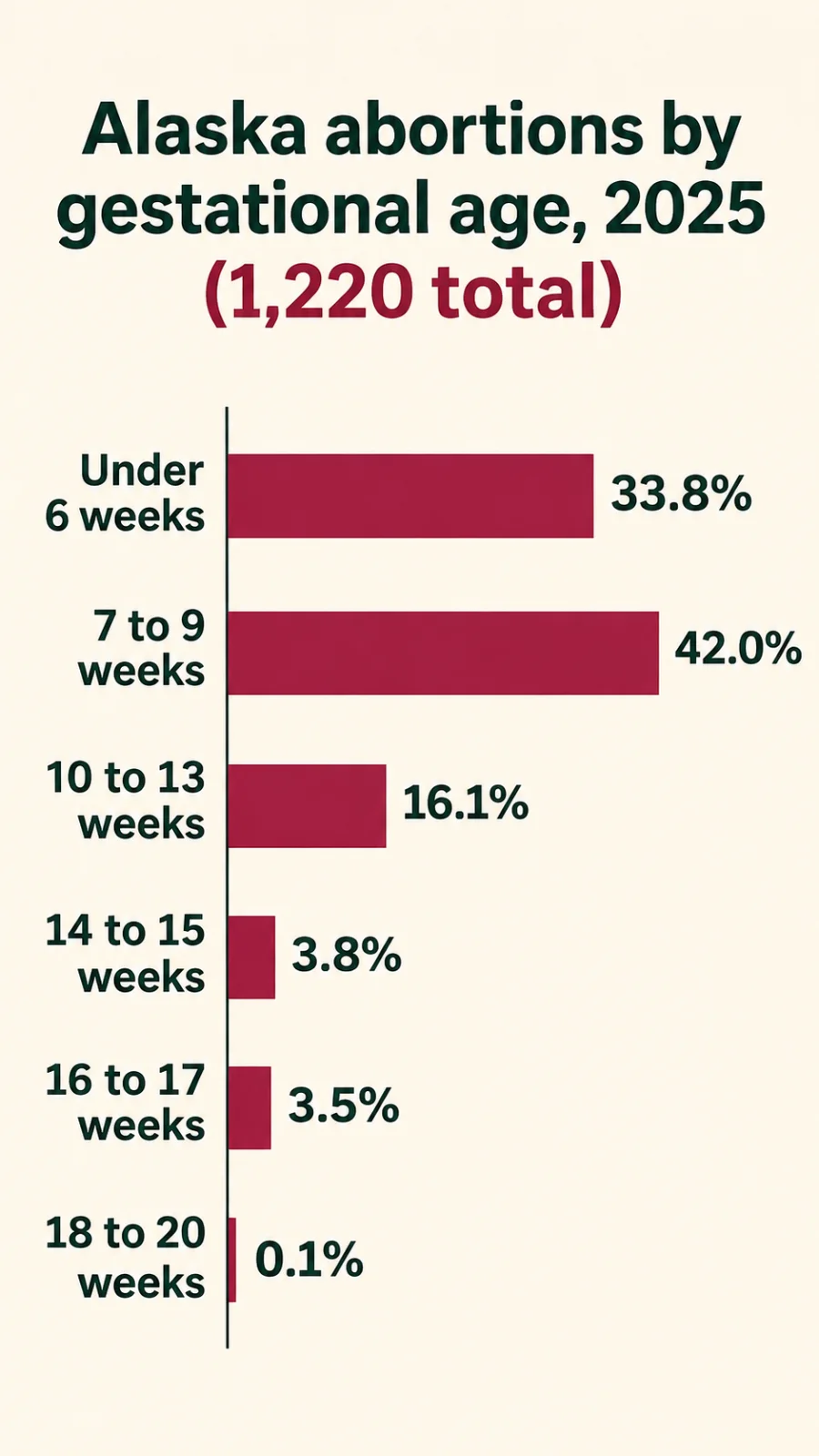
Availability inside the state is narrower than the law. The Alaska Department of Health counted 1,220 abortions in 2025, and the state’s report shows almost all happened early.
| Gestational age | Patients | Share |
|---|---|---|
| Under 6 weeks | 412 | 33.8% |
| 7 to 9 weeks | 512 | 42.0% |
| 10 to 13 weeks | 197 | 16.1% |
| 14 to 17 weeks | 89 | 7.3% |
| 18 to 20 weeks | 1 | 0.1% |
None were reported at 21 weeks or later. In 2022, Planned Parenthood’s Alaska director said no provider in the state performed abortions after the second trimester, and patients needing later care traveled to Seattle.
The partial-birth abortion ban
The one procedure-specific ban is AS 18.16.050, which applies even when AS 18.16.010 is satisfied. It prohibits an abortion in which the provider partially delivers a living fetus through the vagina, then kills the fetus and completes the delivery. The only exception is a case where the procedure is needed to save the patient’s life from a physical disorder, illness or injury and no other procedure would work. For comparison, our guide to Oregon abortion laws explains the limits and exceptions that apply there.
A violation is a class C felony, and the statute bars prosecuting the woman on whom it is performed.
Who Can Provide an Abortion in Alaska?
Licensed physicians can, and since 2021 advanced practice clinicians such as nurse practitioners and physician assistants have also been able to provide medication abortion. The statute’s physician-only rule in AS 18.16.010(a)(1) was challenged in a lawsuit filed December 12, 2019 by Planned Parenthood Great Northwest, Hawai’i, Alaska, Indiana, Kentucky.
Superior Court Judge Josie Garton issued a preliminary injunction in 2021, and after a four-day bench trial she ruled on September 4, 2024 that the rule violates the state constitution’s equal protection and privacy guarantees. Her order bars the state from preventing otherwise qualified clinicians from providing abortions, and she found no medical reason to exclude them. The lawsuit also challenged an Alaska Board of Nursing rule, based on the statute, that kept nurse practitioners from prescribing abortion medication. Courts and voters have shaped abortion access differently in each state, as our overview of Washington abortion laws shows.
The state appealed, and the Alaska Supreme Court heard oral argument on October 29, 2025. The state argued that Planned Parenthood had not shown patients were actually prevented from getting abortions, while Planned Parenthood argued the law infringes the right regardless of a minimum number of affected patients.
A later lawsuit in Superior Court challenges a state restriction on telehealth for abortion services, arguing it violates the same privacy and equal protection guarantees.
Do Minors Need Parental Permission?
No. Alaska does not enforce parental consent or parental notice for a minor’s abortion, even though AS 18.16.010(a)(3) and AS 18.16.020 still contain those requirements. The state supreme court struck down each one.
In State v. Planned Parenthood of Alaska, 171 P.3d 577 (Alaska 2007), the court held that the 1997 Parental Consent Act violated minors’ privacy rights, reasoning that the state had not shown consent was needed rather than less intrusive notice. Alaska voters then passed a 2010 initiative requiring parental notification, with 56% in favor. On July 22, 2016, in Planned Parenthood of the Great Northwest v. State, 375 P.3d 1122, the court ruled 4-1 that the notification law was unconstitutional under both equal protection and privacy.
The 2016 court reasoned that there was no basis to treat minors seeking abortion differently from minors carrying a pregnancy to term. The state’s 2025 report counted 46 patients under 18, about 3.8% of the total.
What Is Alaska’s Informed Consent Requirement?
AS 18.16.060 requires voluntary and informed consent before an abortion, but it sets no waiting period. Before the procedure the provider must give you the physician’s name and an estimate of how far along the pregnancy is. The provider must also give either the state’s online information under AS 18.05.032 or information about the risks and alternatives a reasonable patient would consider important.
The physician, a licensed provider on the physician’s staff, or the referring physician can give the information. It can come by phone, email, mail or fax before the appointment, as long as you can still ask the physician questions.
Consent counts as informed once you certify in writing that you received the information. The requirement does not apply in a medical emergency or when the pregnancy results from sexual assault, sexual abuse of a minor or incest.
Does Medicaid Cover Abortion in Alaska?
Yes. Alaska Medicaid covers abortion under court orders, and the state report shows Medicaid paid for 475 of 1,220 abortions in 2025, about 38.9%. The Alaska Supreme Court has twice refused to let the state fund pregnancy care while excluding abortion.
In 2001, in State, Dep’t of Health & Soc. Servs. v. Planned Parenthood of Alaska, 28 P.3d 904, the court struck down a 1998 regulation that limited Medicaid abortion coverage to the narrow Hyde Amendment exceptions. The second case, State v. Planned Parenthood of the Great Northwest, 436 P.3d 984, came February 15, 2019. In a 4-1 decision, the court struck down AS 47.07.068 and 7 AAC 160.900(d)(30), which redefined “medically necessary” abortion so narrowly that few procedures qualified.
Budget language that keeps coming back
For years the Legislature has put language in the state budget barring Medicaid from paying for certain abortions, and that language has been largely symbolic because of these rulings. In April 2025 the House voted down the amendment for the first time in more than 25 years, and in March 2026 two 20-20 House votes again defeated it. On March 4, 2026, the Alaska Supreme Court heard argument in a separate dispute over the constitution’s confinement clause, which limits budget bills to spending, and the case could affect budget conditions of this kind.
What Should You Do if You Need Care in Alaska?
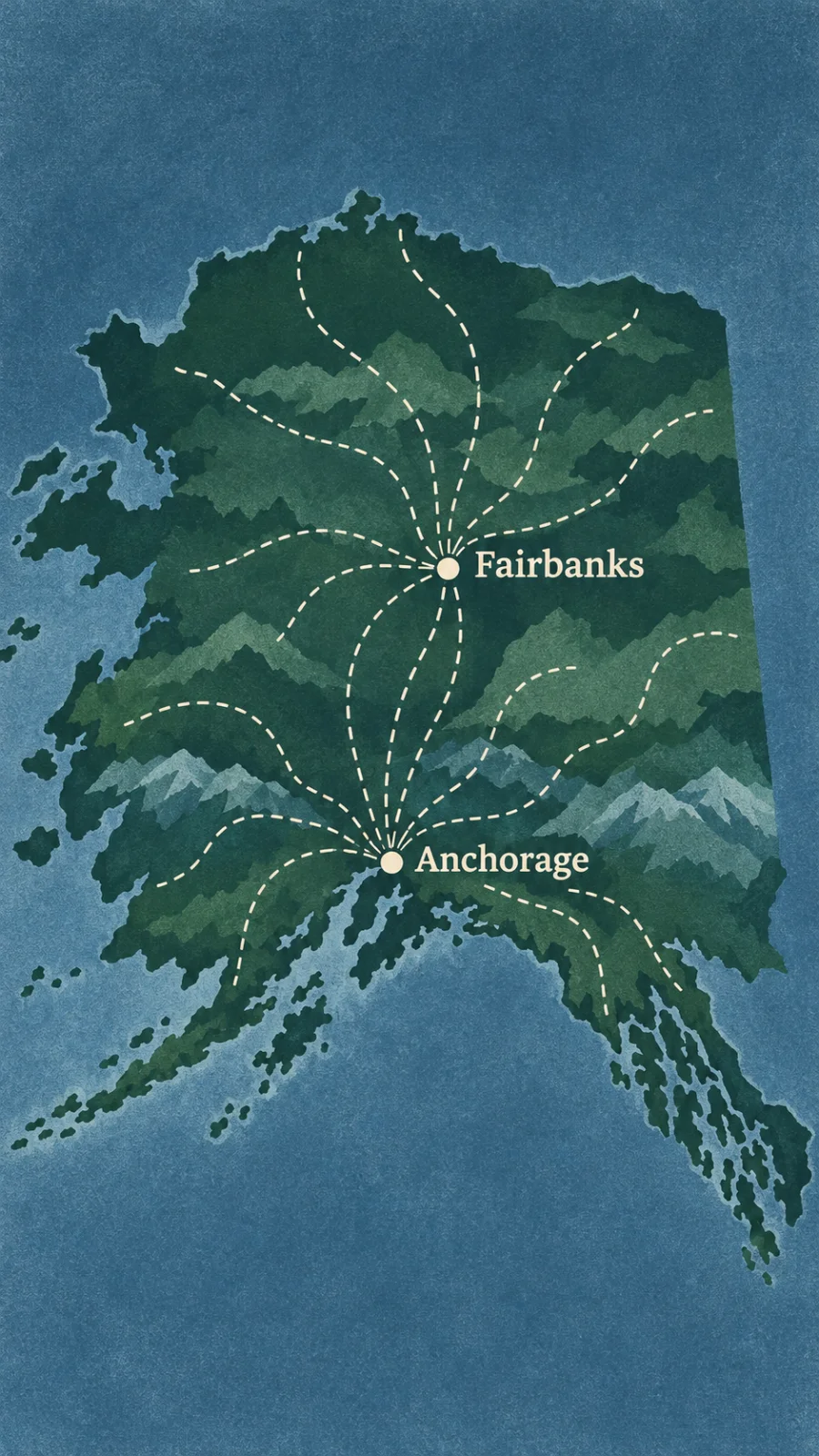
Start with a clinic that provides abortion directly, because the state’s two Planned Parenthood health centers are in Anchorage and Fairbanks. The steps below follow the legal requirements.
- Contact the clinic and ask when physicians and advanced practice clinicians are scheduled, since both can now provide medication abortion.
- Ask for the informed consent information ahead of time, because AS 18.16.060 allows it by phone, email, mail or fax.
- If you use Medicaid, say so when booking, since coverage applies without a “medically necessary” test.
- If you are under 18, you do not need a parent’s permission or notice, and the clinic should not require either.
- If you live in a rural community, ask about travel and later-pregnancy options early, because care after the second trimester is not offered in the state.
Frequently Asked Questions
Is abortion still legal in Alaska after Roe was overturned?
Yes. The Alaska Supreme Court has held since 1997 that the state constitution’s privacy clause protects reproductive choice, and that ruling does not depend on federal law.
How late in pregnancy can you get an abortion in Alaska?
The statute sets no gestational limit. The state’s 2025 report shows 1 abortion at 18 to 20 weeks and none at 21 weeks or later.
Do teenagers need a parent’s consent in Alaska?
No. The Alaska Supreme Court struck down the Parental Consent Act in 2007 and the parental notification law in 2016.
Can a nurse practitioner provide an abortion in Alaska?
Yes. A Superior Court judge permanently blocked the physician-only rule as applied to advanced practice clinicians on September 4, 2024, and the state appealed that ruling.
Does Alaska require a waiting period?
No. AS 18.16.060 requires informed consent and a written certification but specifies no waiting period.
Can a hospital or doctor refuse to take part in an abortion?
Yes. AS 18.16.010(b) says no hospital or person has to participate in an abortion, and none is liable for refusing.
References
- Alaska Legislature, Alaska Statutes Title 18, Chapter 16, Regulation of Abortions (AS 18.16.010 to 18.16.090)
- Alaska Supreme Court, Valley Hospital Ass’n v. Mat-Su Coalition for Choice, 948 P.2d 963 (1997)
- Alaska Supreme Court, State v. Planned Parenthood of the Great Northwest, 436 P.3d 984 (2019), Medicaid funding
- Alaska Department of Health, Alaska Induced Terminations 2025 Annual Report
- Ballotpedia, Alaska Ballot Measure 1, Constitutional Convention Question (2022), certified results