
Montana Abortion Laws: What the State Constitution Protects

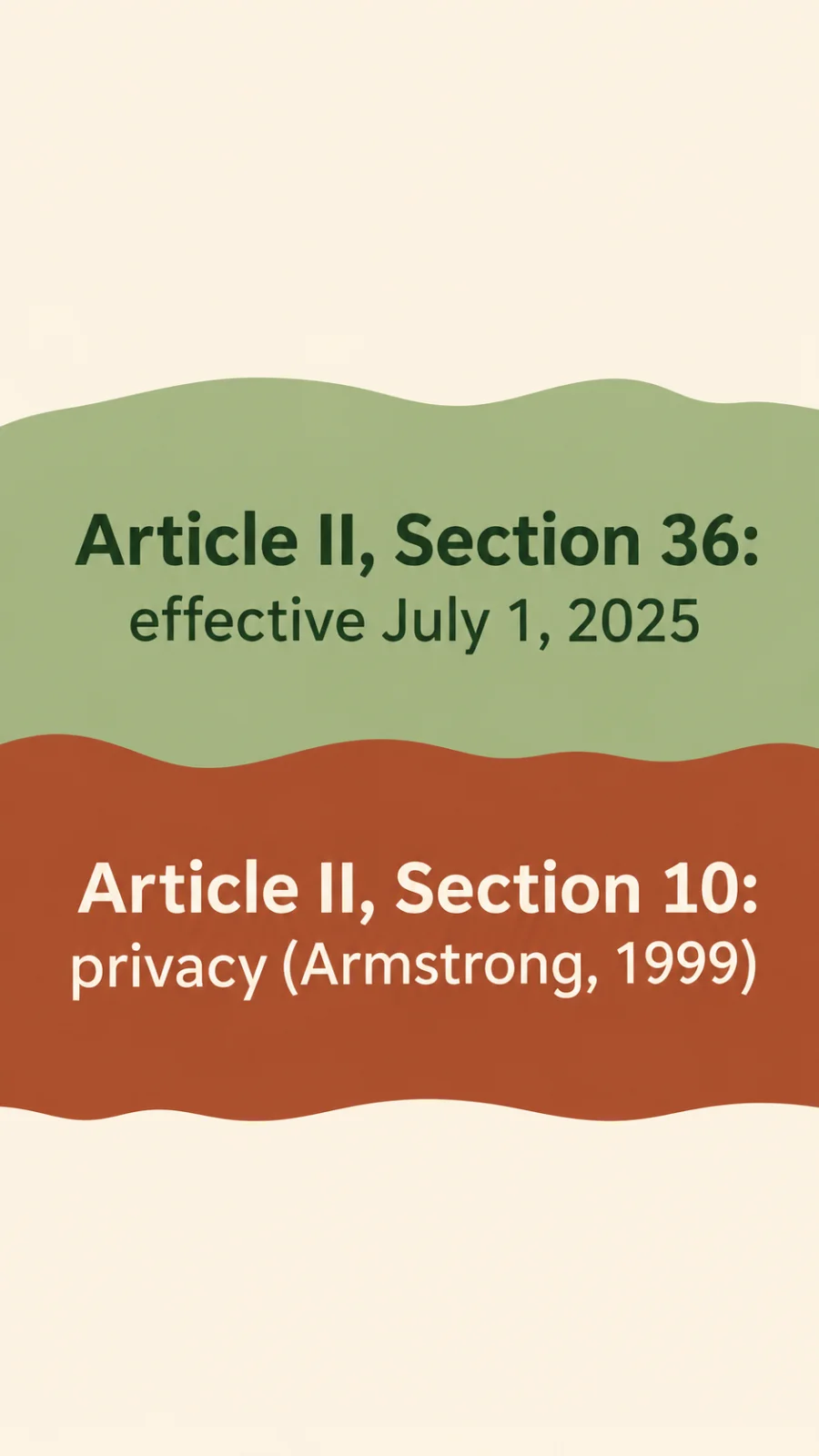
Abortion is legal in Montana up to fetal viability, and the right is written into the state constitution. The Montana Supreme Court has protected it under the privacy clause, Article II, Section 10, since Armstrong v. State, 1999 MT 261. Voters added an explicit right in Article II, Section 36 by passing Constitutional Initiative 128 (CI-128) on November 5, 2024.
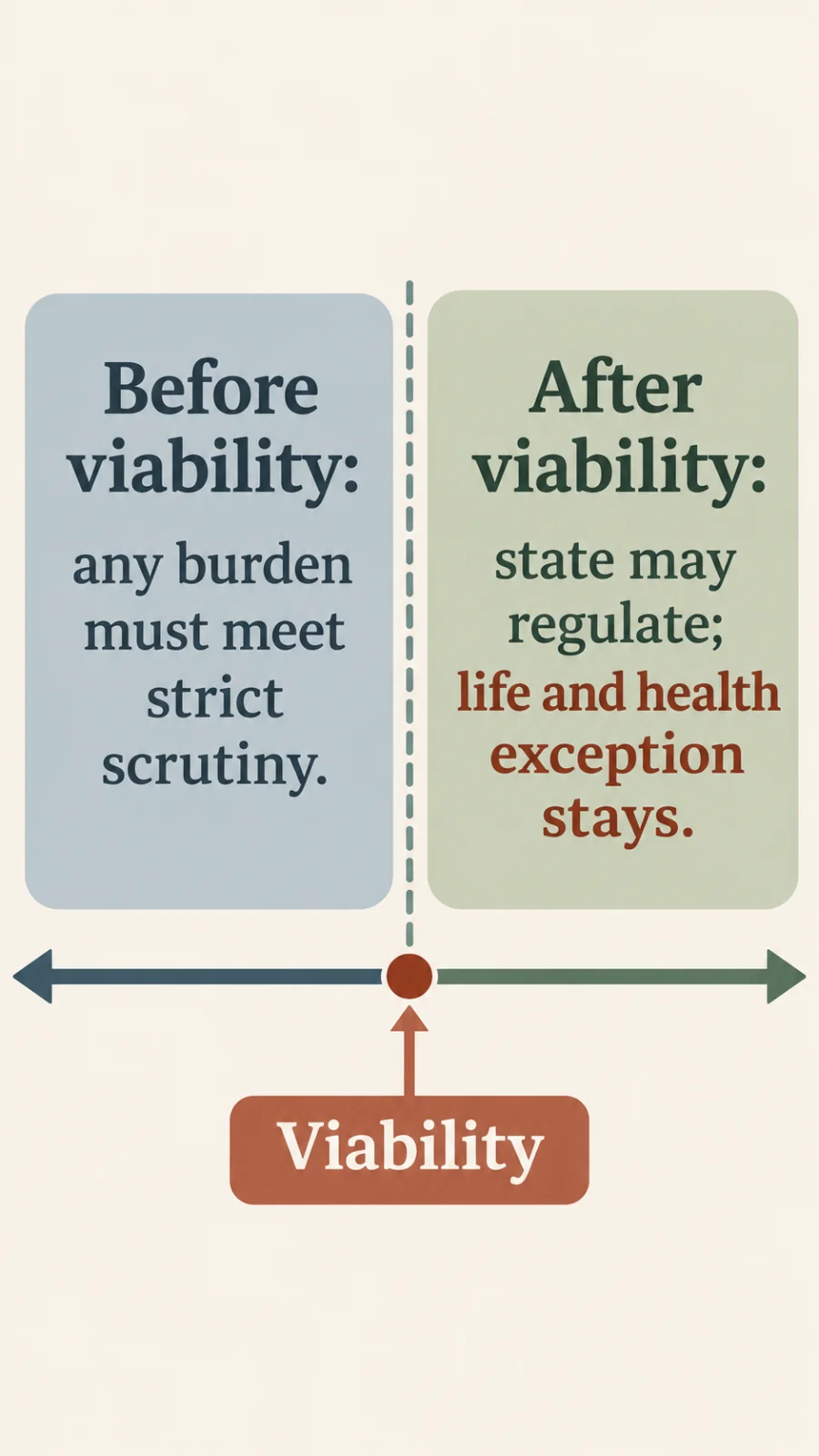
After viability, the state may regulate abortion, but it cannot block one that a treating provider, in good faith, considers medically indicated to protect the patient’s life or health.
What Does Article II, Section 36 of the Montana Constitution Say?
Section 36 guarantees a right to make and carry out decisions about your own pregnancy, including the right to abortion. The government may not deny or burden that right unless it has a compelling interest and uses the least restrictive means. You can read the text on the Montana Code Annotated page for Article II, Section 36.
CI-128 passed 345,070 to 252,300. Under § 13-27-105(2), MCA, a constitutional initiative takes effect July 1 after approval unless its text says otherwise, so Section 36 took effect July 1, 2025.
The narrow definition of “compelling”
Section 36(4)(a) defines the term tightly. A government interest is compelling only if it clearly and convincingly addresses a medically acknowledged, bona fide health risk to the patient, and does not interfere with the patient’s own decision-making.
That definition is what sinks most abortion regulations in Montana. A law justified by a general interest, such as promoting childbirth or expressing a moral view, does not qualify.
What the state can do after viability
Section 36(2) lets the government regulate abortion care after viability. Section 36(4)(b) defines viability as the point where, in the treating professional’s good faith judgment and on the facts of the case, there is a significant likelihood the fetus can survive outside the uterus without extraordinary medical measures.
Montana has no fixed week count in its constitution. Viability is a clinical judgment, not a calendar date.
Protection from penalties
Section 36(3) bars the government from penalizing, prosecuting, or taking adverse action against a person based on actual, potential, perceived, or alleged pregnancy outcomes. It extends the same protection to anyone who voluntarily helps another person exercise the right.

How Two Layers of Protection Work Together
Montana abortion rights rest on two constitutional provisions, one judge-made and one voter-approved. The privacy clause came first, and Section 36 now sits on top of it.
In Armstrong, the court held that Article II, Section 10 protects procreative autonomy, including a pre-viability abortion from the provider you choose. The case arose from a 1995 law barring physician assistants from performing abortions. For another example of how courts and lawmakers have shaped access, see our guide to Utah abortion laws.
The 2025 reaffirmation
The state asked the court to overrule Armstrong after the U.S. Supreme Court decided Dobbs v. Jackson Women’s Health Organization in 2022. The Montana court refused. In Planned Parenthood of Montana v. State, 2025 MT 120, decided June 9, 2025, it distinguished Dobbs because Montana’s right comes from its own constitution. The court’s published opinion summary says each of three 2021 laws failed because the state did not show a medically acknowledged health risk or a narrowly tailored fix.
Six of the seven justices, counting two district judges sitting in for retired justices, joined the result. Justice Jim Rice dissented.
| Ruling | Date | What it decided |
|---|---|---|
| Armstrong v. State, 1999 MT 261 | October 26, 1999 | Privacy clause protects pre-viability abortion and choice of provider |
| Weems v. State, 2023 MT 82 | May 12, 2023 | Applied Armstrong to the physician-and-physician-assistant limit in § 50-20-109 |
| Planned Parenthood v. State, 2024 MT 178 | August 14, 2024 | Struck the parental consent law |
| Planned Parenthood v. State, 2025 MT 120 | June 9, 2025 | Struck three 2021 laws and reaffirmed Armstrong |
Which Montana Statutes Conflict With Section 36?
Several older abortion statutes remain in the Montana Code even though their wording sits uneasily with the constitution. Courts apply strict scrutiny to any burden, so the text of the code is not the final word.
| Topic | What the statute says | Constitutional position |
|---|---|---|
| Who may perform | § 50-20-109(1)(a): a licensed physician or physician assistant | Weems applied Armstrong to this limit in a case brought by a nurse practitioner |
| Viable fetus | § 50-20-109(1)(b)(ii): barred unless needed to preserve the mother’s life | Section 36(2) also protects abortions a provider in good faith finds indicated to protect health |
| Informed consent | § 50-20-106: consent certified at least 24 hours before, on a state form | Any added burden must pass strict scrutiny; a separate 24-hour wait was struck in 2025 MT 120 |
The gap in the second row is the clearest one. Section 50-20-109 allows an abortion of a viable fetus only to preserve the mother’s life, while Section 36(2) reaches life or health. A provider relying on the constitution has the stronger footing.
The same subsection of § 50-20-109 also refers to an unborn child capable of feeling pain. The Supreme Court has held a 20-week ban unconstitutional because it reaches pre-viability abortions.
Which Montana Abortion Laws Have Courts Blocked?
Montana courts have struck down or enjoined every major abortion restriction passed since 2013 that reached the Supreme Court. Some rulings are final judgments. Others are preliminary injunctions that hold a law in place until trial.
| Law | What it required | Result |
|---|---|---|
| HB 136 (2021) | Ban at 20 weeks | Struck, 2025 MT 120 |
| HB 171 (2021) | Telehealth ban, multiple in-person visits, state consent form, 24-hour wait | Struck in full, 2025 MT 120 |
| HB 140 (2021) | Offer ultrasound and fetal heart tone, signed state form | Struck, 2025 MT 120 |
| HB 721 (2023) | Ban on dilation and evacuation, up to 10 years in prison | Injunction affirmed, 2024 MT 227 (October 9, 2024) |
| HB 575 (2023) | Written viability determination from an ultrasound before any abortion | Injunction affirmed, 2024 MT 227 |
| HB 937 (2023) | State licensing of abortion clinics | Injunction affirmed March 31, 2026; Justice Rice dissented |
HB 721 matters because dilation and evacuation is the only outpatient abortion procedure available in Montana after about 15 weeks, according to the court’s opinion. The court said no justification had yet been shown that either 2023 law addresses a bona fide health risk. Courts and voters have shaped abortion access differently in each state, as our overview of Wyoming abortion laws shows.
On HB 937, clinics may keep providing abortions without the state license while the case goes to trial, as the Flathead Beacon reported.
Do Minors Need Parental Consent in Montana?
No consent requirement is in force. On August 14, 2024, the Montana Supreme Court struck down the Parental Consent for Abortion Act of 2013 in Planned Parenthood of Montana v. State, 2024 MT 178. It held that the law violated a minor’s privacy right and was not narrowly tailored to any compelling state interest.
The Act would have required a physician to get notarized written consent from a parent, along with government ID and proof of parentage. A minor could skip the requirement only through a youth court bypass hearing.
The U.S. Supreme Court declined to review the case on July 3, 2025, in Montana v. Planned Parenthood of Montana, No. 24-745. Justice Alito, joined by Justice Thomas, wrote separately about the federal parental-rights question the state had raised.
The separate Parental Notice of Abortion Act, which requires notification rather than consent, was not decided in that case.
Does Medicaid Cover Abortion in Montana?
Montana courts have blocked the state’s attempts to limit Medicaid coverage of abortion. The 2023 Legislature passed HB 544 and HB 862, and the Department of Public Health and Human Services (DPHHS) adopted a rule effective May 1, 2023. All three targeted Medicaid abortion funding.
On October 9, 2024, the Supreme Court affirmed an injunction against them in 2024 MT 228. The court said the provisions went beyond funding choices because they affected the constitutional rights of Medicaid-eligible Montanans.
What Penalties Does Montana Law Set for Abortion Violations?
Performing an abortion outside the limits of § 50-20-109(1) is a felony under subsection (2). Under § 50-20-112, felonies under the chapter that are not homicide carry a fine of up to $1,000, up to 5 years in state prison, or both. Misdemeanors carry up to $500, up to 6 months in county jail, or both.
The woman is exempt. Section 50-20-112 says no penalty may be imposed on the woman who has or attempts an abortion.
Any prosecution of a provider for care that Section 36 protects would face a constitutional challenge. Section 36(3) also forbids penalties for people who voluntarily assist.
Section 50-20-111 separately gives individuals a right to refuse to take part in an abortion, with affirmative consent required.
Where Do the Disagreements Lie?
The state has argued that Armstrong was wrongly decided. In his 2025 dissent, Justice Rice wrote that it should be relegated to the dustbin of history
, though he stopped short of calling for it to be overruled. Gov. Greg Gianforte called the majority “activist justices” in a June 9, 2025 statement.
The majority’s answer is that the privacy clause is broad and independent of federal law, and that the viability line balances the interests involved.
Challenges to CI-128 itself
Opponents have tried to invalidate CI-128 on the theory that its full text was not printed on the ballot. The Montana Supreme Court unanimously declined to take the case on July 1, 2025, noting the petition came seven months after the election.
Yellowstone County District Judge Thomas Pardy then dismissed the challenge, as the Daily Montanan reported on May 8, 2026. His five-page ruling held that the constitution requires the full text to be submitted to the Secretary of State, not printed in full on the ballot. That decision can be appealed to the Montana Supreme Court.
The Legislature
Lawmakers tabled most abortion bills in the 2025 session. HB 316, a proposed “personhood” constitutional amendment, failed to reach the 100 of 150 votes needed to go to voters. Changing Section 36 would take that two-thirds vote plus voter approval.
What Should You Do If You Hit a Barrier to Care?
Start by identifying who is blocking you: a provider, an insurer, or a state agency.
- If Medicaid denies coverage, contact DPHHS, which runs Montana Medicaid, and ask for the denial in writing along with its reason.
- If a clinic says a state rule bars it from treating you, ask which statute or rule it relies on. Several of the laws in the table above are enjoined.
- If you are a provider facing an enforcement threat, a Montana health-law attorney can raise Section 36(3) and the rulings listed above.
Frequently Asked Questions
Is abortion legal in Montana?
Yes. Montana protects abortion until fetal viability under Article II, Section 10 and Section 36. After viability, the state may regulate, but cannot deny an abortion a provider in good faith considers medically indicated to protect life or health.
How many weeks can you get an abortion in Montana?
Montana has no fixed week limit in its constitution. The limit is viability, which Section 36(4)(b) leaves to the treating professional’s good faith judgment. The 20-week ban in HB 136 was struck down in 2025.
Can Montana’s Legislature ban abortion?
Not by passing a statute. Section 36 is part of the constitution, so any change needs a constitutional amendment passed by two-thirds of the Legislature and approved by voters.
Is telehealth medication abortion allowed in Montana?
Montana’s ban on telehealth medication abortion, part of HB 171, was struck down in 2025 MT 120 along with the law’s multiple-visit and 24-hour waiting requirements.
Can a woman be prosecuted for having an abortion in Montana?
No. Section 50-20-112, MCA, bars any penalty against the woman, and Section 36(3) protects people from prosecution over pregnancy outcomes.
References
- Montana Legislature, Mont. Const. art. II, § 36, Right to make decisions about pregnancy
- Montana Legislature, Mont. Code Ann. § 50-20-109, Control of practice of abortion
- Montana Legislature, Mont. Code Ann. § 50-20-112, Penalties
- Montana Legislature, Mont. Code Ann. § 50-20-106, Informed consent
- Montana Supreme Court, published opinion summary, Planned Parenthood of Montana v. State, 2025 MT 120
- Supreme Court of the United States, Montana v. Planned Parenthood of Montana, No. 24-745, order and statement of Justice Alito
- Montana Secretary of State, ballot language and complete text of Constitutional Initiative No. 128
- Daily Montanan (news report), district court ruling rejecting the challenge to CI-128