
Rhode Island Abortion Laws: Rights, Coverage, Protections

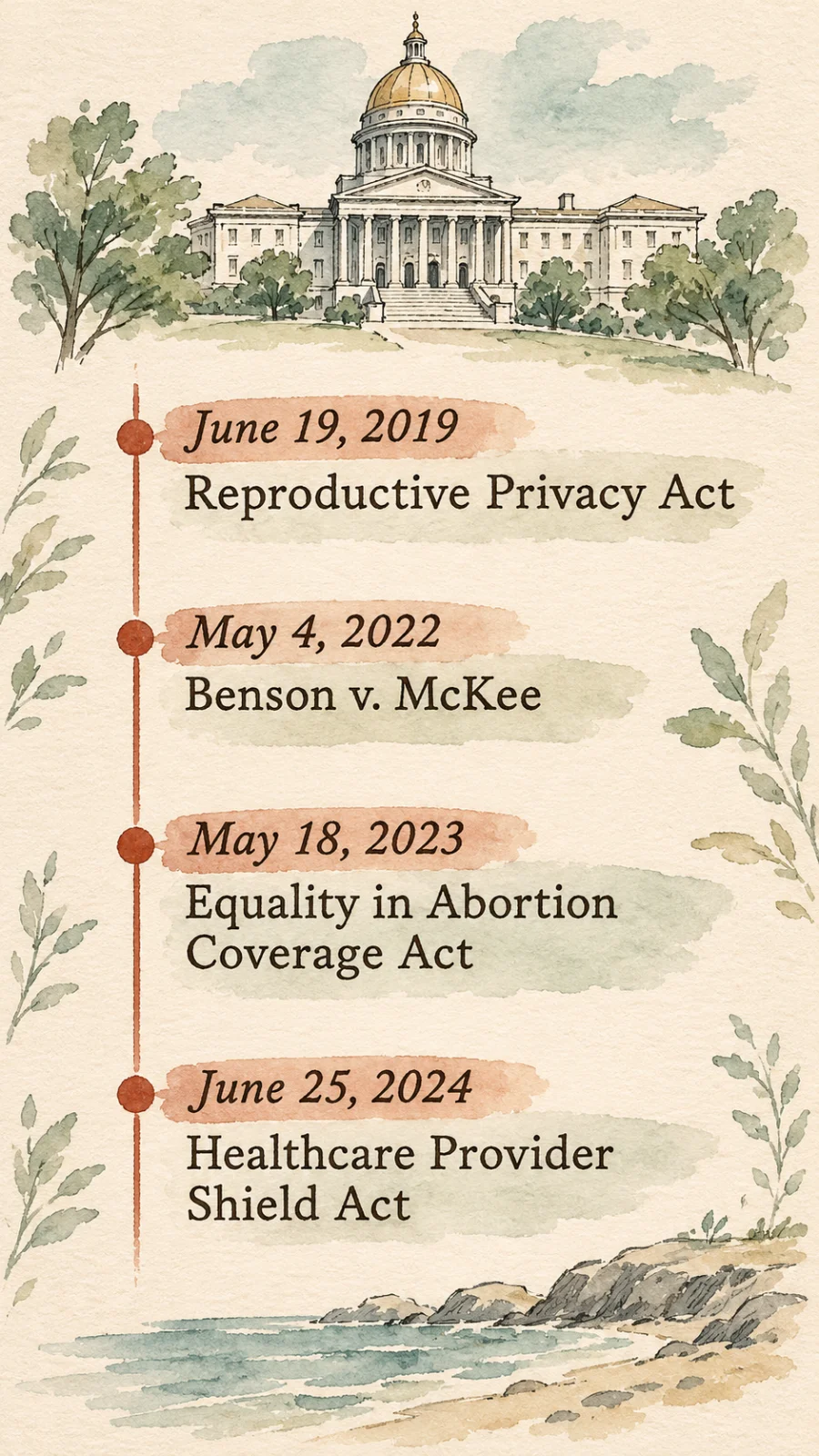
Abortion is legal in Rhode Island before fetal viability, and after viability when a physician decides it is necessary to protect the patient’s life or health. The right comes from the state’s Reproductive Privacy Act, not from the state constitution, and the law sets no week limit and no waiting period. Patients on Medicaid and state employee health plans have had coverage since May 18, 2023, and providers have had shield-law protection from out-of-state lawsuits since June 25, 2024.
When Is Abortion Legal in Rhode Island?
The Reproductive Privacy Act, R.I. Gen. Laws § 23-4.13-2, bars the state, its agencies and its towns and cities from restricting a person’s decision to prevent, begin, continue or end a pregnancy before viability. It also bars them from restricting evidence-based, medically recognized methods of abortion or contraception. Governor Gina Raimondo signed it on June 19, 2019, after the General Assembly passed it the same day.
How the law defines viability
The statute does not use a week count. Viability is the point at which the attending physician, looking at the facts of the particular pregnancy, determines there is a reasonable likelihood of sustained survival outside the womb, with or without artificial support. That makes viability a clinical judgment made case by case.
What changes after viability
After viability, ending a pregnancy is allowed only when the physician judges it necessary to preserve the patient’s life or health. The physician must record the medical basis in the patient’s chart and follow § 23-3-17, the fetal death reporting statute. For a fetal death after 20 completed weeks, that statute sends a certificate to the state registrar within seven calendar days.
A physician who knowingly violates the post-viability rule has committed “unprofessional conduct” under § 5-37-5.1. The consequence is professional discipline: the Director of Health can deny, revoke or otherwise act against a medical license after a board finding. The statute attaches no fine or jail term to it.
What the 2019 Act Repealed and What It Left in Place
The 2019 act repealed chapter 11-3 of the General Laws, the old criminal abortion statute, and wrote the protections into a new chapter 4.13 of title 23. It deliberately left several older rules standing.
Subsection (c) of § 23-4.13-2 says the act does not override these:
- § 11-9-18, care of babies born alive during an attempted abortion
- § 11-54-1, experimentation on human fetuses
- §§ 23-4.7-1 through 23-4.7-8, informed consent for abortion
- § 23-17-11, the right of staff to refuse to take part
- The federal Partial-Birth Abortion Ban Act of 2003, 18 U.S.C. § 1531
The Department of Health may still apply its generally applicable rules to licensed health care facilities that provide abortions. Those rules must follow evidence-based standards and cannot be a pretext for restricting access.
The Department of Health dropped its separate abortion rules
Abortion-specific facility rules once sat in 216-RICR-20-10-6, “Termination of Pregnancy.” The Department of Health repealed them effective July 13, 2023. It said the rules dated from 1973, were clinically outdated, and that their repeal would not affect access to reproductive care. Abortion is now regulated like most other procedures, through the provider standard of care and general facility requirements.
Is There a Waiting Period or Counseling Requirement?
Rhode Island requires written informed consent but sets no waiting period. Under § 23-4.7-2, the abortion may proceed only after the patient gives written consent. The sections on required disclosures and the consent form (§§ 23-4.7-3 and 23-4.7-5) contain no mandatory delay, no ultrasound requirement and no state-scripted counseling.
Section 23-4.7-3 requires the physician or an authorized agent to cover four things:
- That the patient is pregnant, with the estimated gestational age.
- The medical nature of the abortion, including the probable gestational age when it would be performed.
- The medical or surgical procedure to be used.
- The known material medical risks of that procedure.
A physician may withhold a risk if disclosing it would be inappropriate, but must certify the medical reason in writing in the chart. Under § 23-4.7-7, a willful failure to give the required information is prima facie evidence, meaning evidence that stands unless rebutted, of missing informed consent in a civil case.
Staff can refuse to participate
Under § 23-17-11, physicians, medical staff and facility employees can decline to take part in an abortion or sterilization. The objection must be in writing and rest on moral or religious grounds. A person who refuses cannot be sued for damages or disciplined for it.
Can a Minor Get an Abortion in Rhode Island?
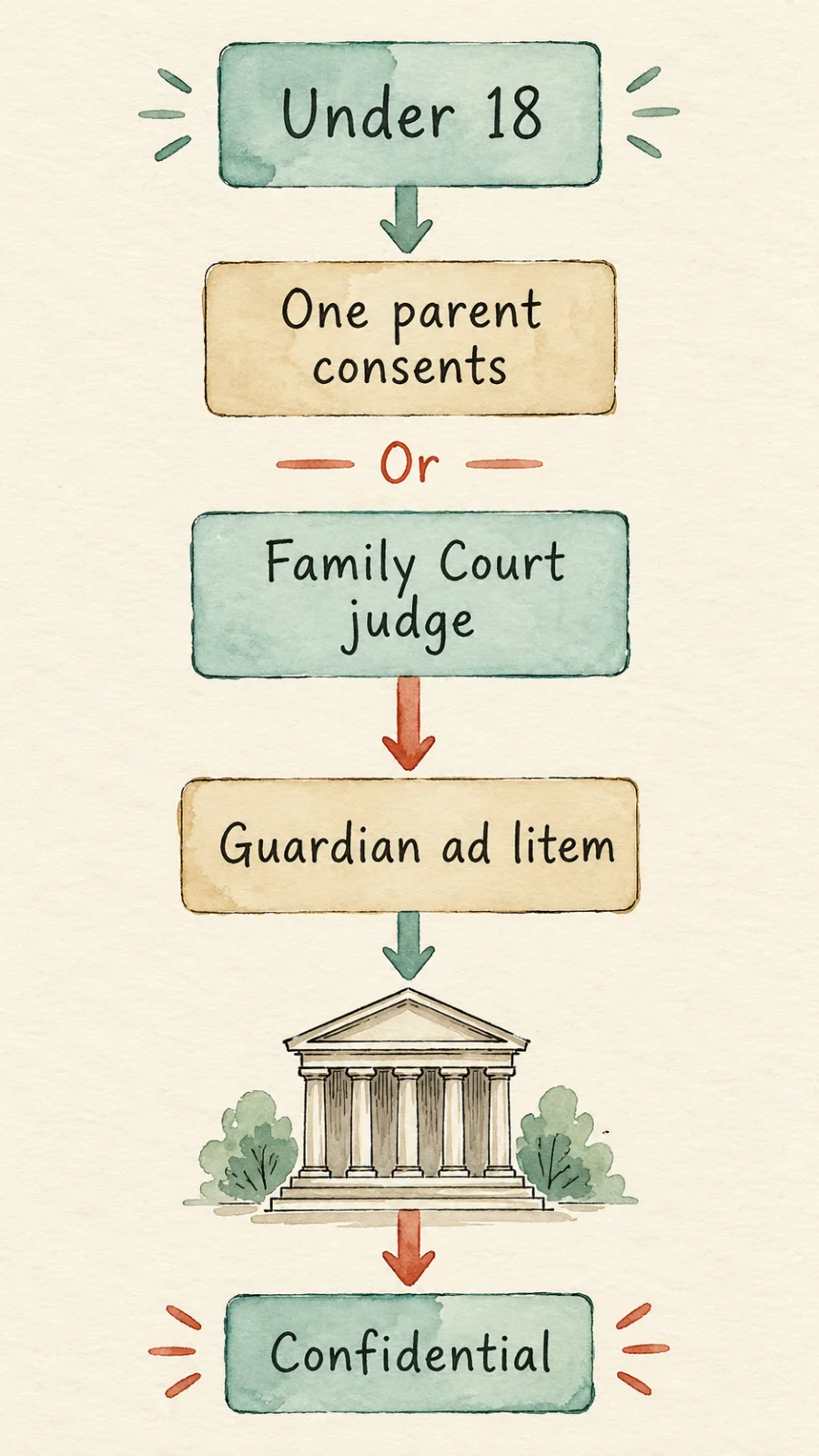
A minor under 18 who is unmarried and not court-emancipated needs her own consent and the consent of one parent, or a Family Court judge’s order. That is the rule in R.I. Gen. Laws § 23-4.7-6. Sixteen- and 17-year-olds get no exception, so the age line is 18.
A parent weighing consent may consider only the child’s best interests. If both parents have died or cannot be reached within a reasonable time and manner, a legal guardian’s consent is enough. Rules for minors are set state by state; our guide to Vermont abortion laws explains how they work there.
How the judicial bypass works
If neither parent agrees, or the minor chooses not to ask, she can petition the Family Court. The judge may authorize the abortion if the minor is mature and capable of giving informed consent. If she is not, the judge decides whether the abortion is in her best interests.
The minor can take part in the case on her own behalf and must be represented by a guardian ad litem, a lawyer-like advocate appointed by the court. The proceedings are confidential and take precedence over other pending matters. The statute sets no fixed number of days, only that the court must decide promptly and without delay, and the judge must make written findings and keep a record of the evidence.
Does Rhode Island Medicaid Cover Abortion?
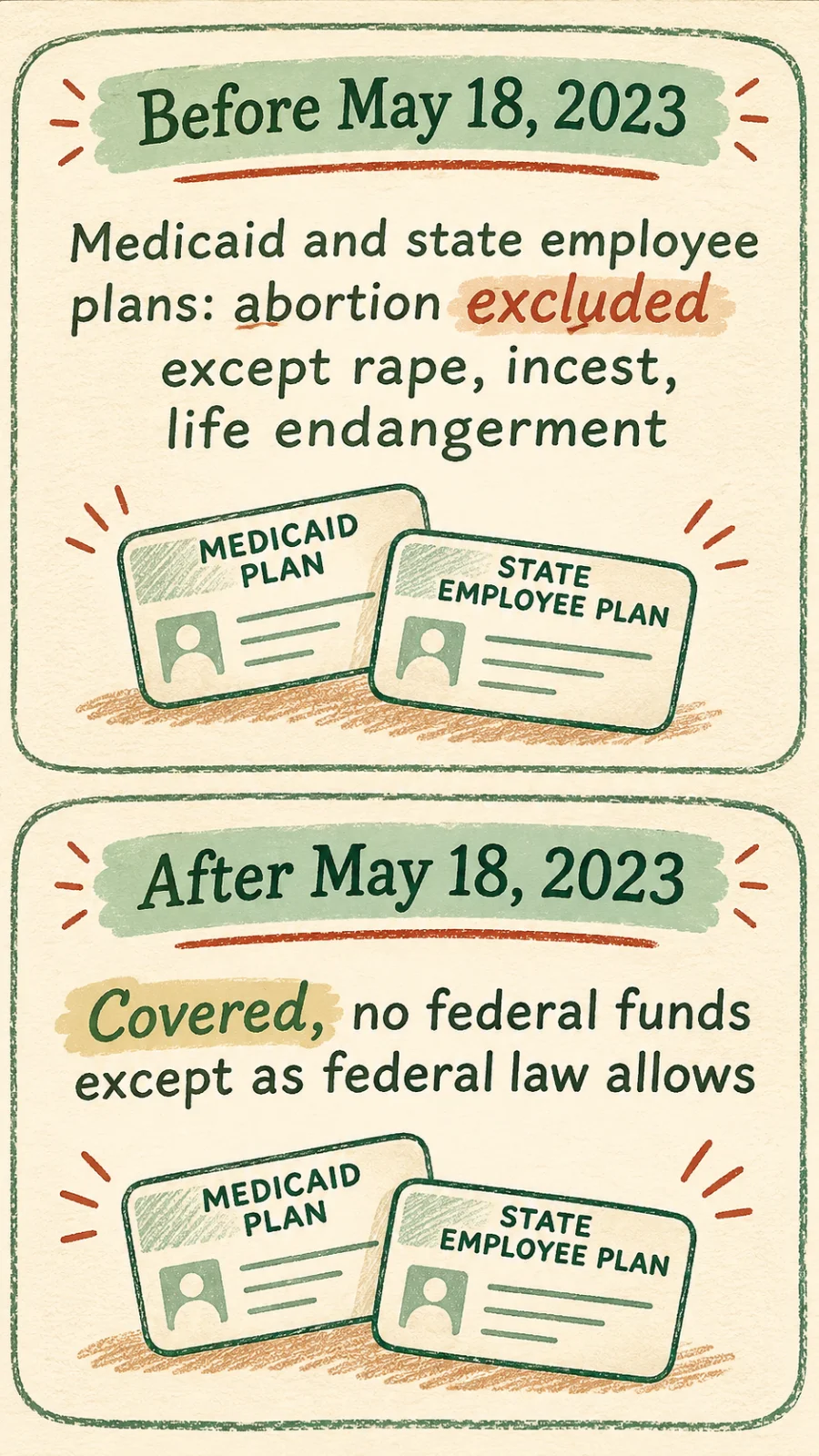
Yes. Rhode Island Medicaid and state employee health plans have covered abortion since the Equality in Abortion Coverage Act became law on May 18, 2023. Before that, state law barred both from covering abortion unless the pregnancy resulted from rape or incest or carrying it to term would endanger the patient’s life.
The Senate approved the bill 24 to 12 and Governor Dan McKee signed it the same day. Sponsors estimated that about a quarter of Rhode Islanders are on Medicaid and that another 30,000 are on state employee plans. The act repealed § 36-12-2.1, the state employee exclusion, and added subsection (h) to R.I. Gen. Laws § 42-12.3-3.
Under that subsection, people eligible for Medicaid, CHIP or RIte Start are entitled to services for any termination of pregnancy permitted under § 23-4.13-2. Federal funds cannot pay for the service except where federal law allows it, which follows the Hyde Amendment. The Executive Office of Health and Human Services opened rulemaking on December 19, 2023 to update its Medicaid regulation to match.
What Does Rhode Island’s Shield Law Protect?
The Healthcare Provider Shield Act protects Rhode Island providers of reproductive and gender-affirming care from lawsuits and prosecutions in other states. It took effect June 25, 2024 as P.L. 2024, ch. 260 and ch. 261, and sits in chapter 23-101 of the General Laws. If you are weighing care across state lines, our guide to Massachusetts abortion laws explains what is allowed there.
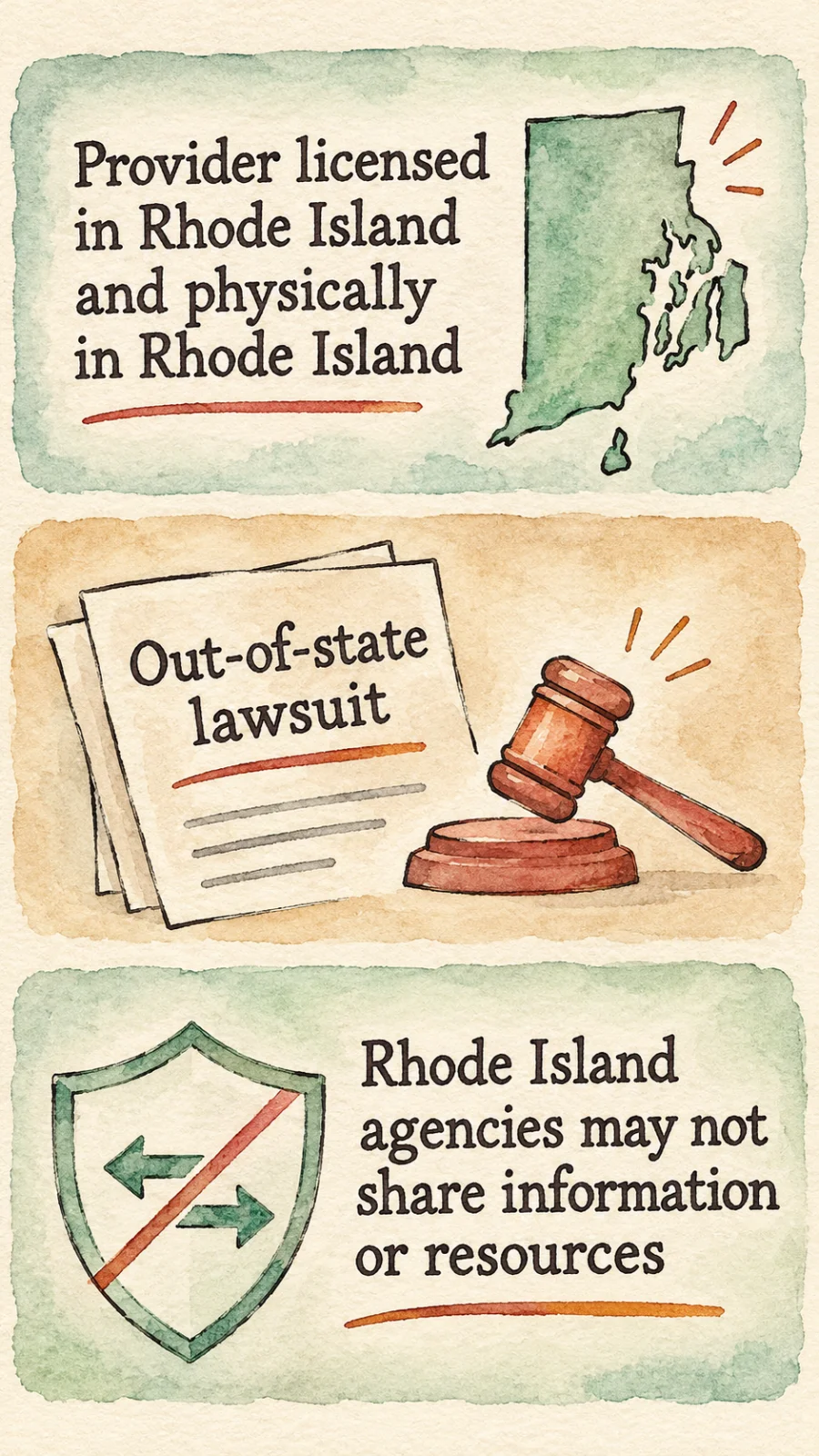
The key term, “legally protected healthcare activity,” is defined in § 23-101-2. For providers, it covers care allowed under Rhode Island law that meets the standard of care, where the provider is licensed in Rhode Island and physically in the state. The patient’s location does not matter. Reproductive services include pregnancy care, contraception, pregnancy loss management and pregnancy termination.
The law carves out conduct that would be unlawful if it happened entirely inside Rhode Island, so it does not protect care the state itself prohibits.
What state officials can and cannot do
Under § 23-101-6, Rhode Island agencies, including police, cannot share information or spend time, money or equipment to support another state’s investigation of protected care. Under § 12-9-36, the governor cannot comply with an out-of-state request to arrest and surrender someone for protected activity, unless federal law requires it. One exception applies: a person who was physically in the requesting state when the alleged offense happened and then fled from it.
The shield works by limiting what Rhode Island officials will do. It does not bind a court in another state.
Has a Court Ever Struck Down the Reproductive Privacy Act?
No court has. In Benson v. McKee, 273 A.3d 121 (R.I. 2022), decided May 4, 2022, the Rhode Island Supreme Court affirmed the dismissal of a constitutional challenge to the act. The plaintiffs lacked standing, meaning they had no personal stake in the outcome. The court also said that enacting the law was not a constitutional amendment that required a public referendum.
Justice Robinson agreed on standing but dissented from the parts of the opinion that went beyond it.
Quick Reference: Rhode Island Abortion Rules
| Question | Rhode Island rule | Source |
|---|---|---|
| Gestational limit | Before viability; after viability to protect life or health | § 23-4.13-2 |
| Waiting period | None; written informed consent only | §§ 23-4.7-2, -3, -5 |
| Minors under 18 | One parent’s consent or Family Court bypass | § 23-4.7-6 |
| Medicaid and CHIP | Covered; no federal funds except as federal law allows | § 42-12.3-3(h) |
| State employee plans | Exclusion repealed May 18, 2023 | § 36-12-2.1 |
| Out-of-state lawsuits | Agencies barred from helping; extradition limited | §§ 23-101-6, 12-9-36 |
What to Do If You Need Care or Face a Problem
If you are on Medicaid, tell the provider when you book so the visit is billed under the 2023 coverage rule. If a plan or provider refuses coverage, ask the Executive Office of Health and Human Services, which runs Medicaid, to explain the denial in writing.
If you are under 18 and cannot involve a parent, ask the provider about the Family Court bypass before the visit. The provider can connect you with a guardian ad litem, and the proceeding is confidential.
If you are a clinician who receives a subpoena or records request from another state about care given in Rhode Island, § 23-101-6 limits what public agencies can do, but it does not decide how a private records request is handled. Take it to a lawyer before responding.
Frequently Asked Questions
Is abortion legal in Rhode Island?
Yes. It is legal before fetal viability, and after viability when a physician decides it is necessary to preserve the patient’s life or health. The Reproductive Privacy Act, § 23-4.13-2, sets those rules.
Is there a waiting period in Rhode Island?
No. The state requires written informed consent under §§ 23-4.7-2 and 23-4.7-3, but no mandatory delay between that consent and the procedure.
Can a 15-year-old get an abortion without her parents?
Only through the Family Court. Anyone under 18 who is unmarried and not court-emancipated needs one parent’s consent or a judge’s order. The bypass hearing is confidential and the minor is represented by a guardian ad litem.
Does Medicaid cover abortion in Rhode Island?
Yes, since May 18, 2023. Section 42-12.3-3(h) entitles eligible people to services for any termination of pregnancy permitted under § 23-4.13-2, with federal funds used only as federal law allows.
Can another state prosecute a Rhode Island abortion provider?
Rhode Island officials cannot help with it, and the governor cannot honor an extradition request for protected care unless federal law requires it. The exception is a person who was physically in the requesting state at the time and then fled.
Did the Supreme Court of Rhode Island rule on the Reproductive Privacy Act?
It dismissed the challenge in Benson v. McKee on May 4, 2022 because the plaintiffs lacked standing. The act stayed in force, and the court said its enactment did not require a constitutional referendum.
References
- Rhode Island General Assembly, R.I. Gen. Laws § 23-4.13-2, Noninterference in reproductive health care
- Rhode Island General Assembly, 2019 H 5125 Substitute B, The Reproductive Privacy Act
- Rhode Island General Assembly, R.I. Gen. Laws § 23-4.7-3, Required disclosures
- Rhode Island General Assembly, R.I. Gen. Laws § 23-4.7-6, Minors, parental consent, judicial proceedings
- Rhode Island General Assembly, R.I. Gen. Laws § 23-17-11, Refusal to participate
- Rhode Island General Assembly, R.I. Gen. Laws § 23-3-17, Fetal death registration
- Rhode Island General Assembly, R.I. Gen. Laws § 42-12.3-3, Medical assistance expansion for pregnant women
- Rhode Island General Assembly Press Bureau, Equality in Abortion Coverage Act enacted, May 18, 2023
- Rhode Island General Assembly, R.I. Gen. Laws § 23-101-2, Healthcare Provider Shield definitions
- Rhode Island General Assembly, R.I. Gen. Laws § 12-9-36, Interstate extradition and protected healthcare activity
- Rhode Island Department of State, 216-RICR-20-10-6, Termination of Pregnancy (repealed July 13, 2023)
- Rhode Island Supreme Court, Benson v. McKee, No. 2020-66-Appeal, 273 A.3d 121 (May 4, 2022)