
Vermont Abortion Laws: What Article 22 Protects

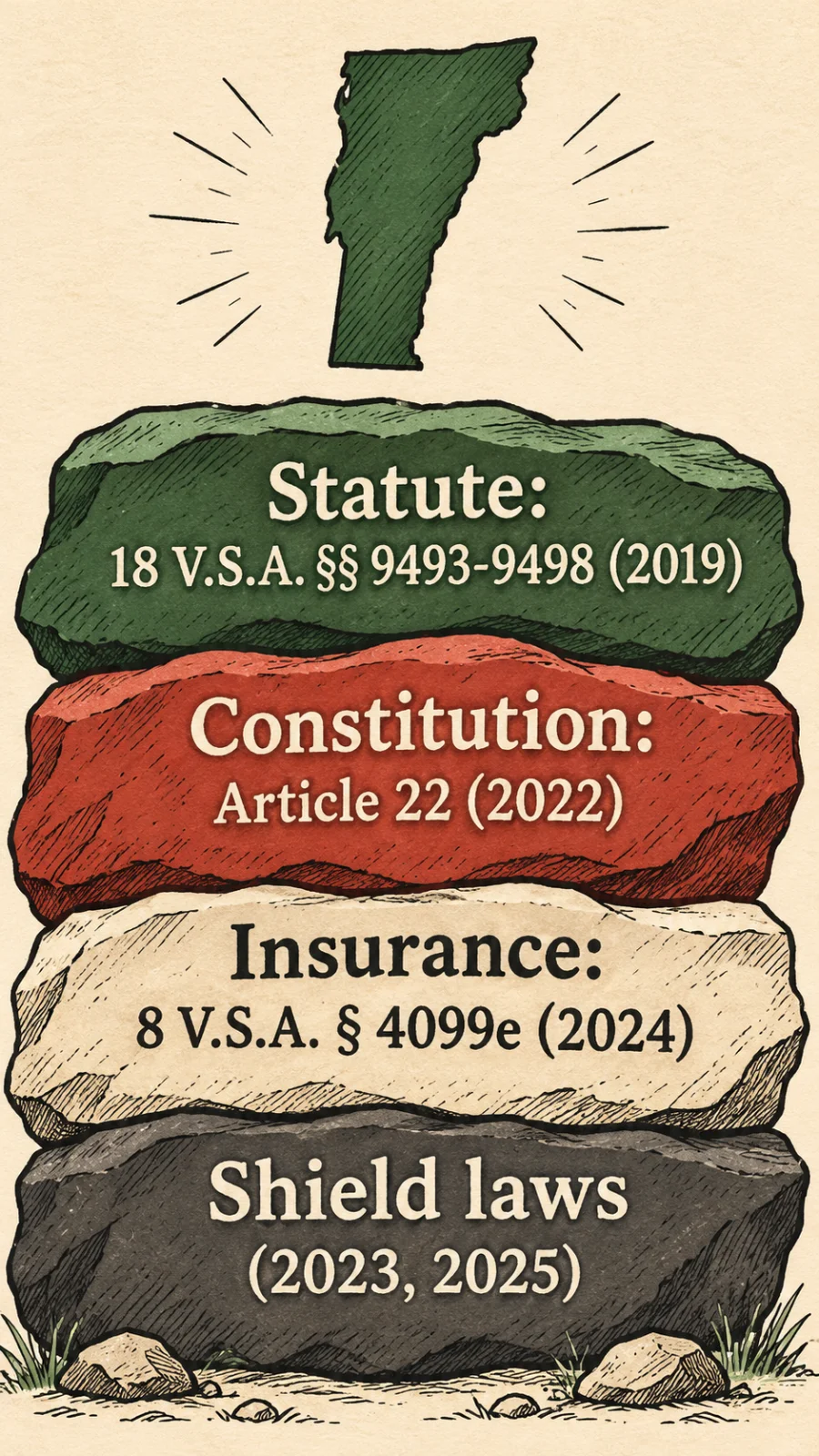
Abortion is legal in Vermont, and no Vermont statute sets a gestational limit. Three layers of law protect it. Article 22 of the state constitution was approved by voters on November 8, 2022. The Freedom of Choice Act, 18 V.S.A. §§ 9493 to 9498, has been in force since June 10, 2019. Shield laws passed in 2023 and 2025 protect providers and patients from out-of-state lawsuits.
What Does Article 22 of the Vermont Constitution Say?
Article 22 says an individual’s right to personal reproductive autonomy is central to the liberty and dignity to determine one’s own life course. It adds that the right cannot be denied or infringed unless justified by a “compelling State interest achieved by the least restrictive means.” It was added to Chapter I, the Declaration of Rights, by Proposal 5, which two successive legislatures passed before it went to voters.
The text never uses the word abortion. It also does not mention age or sex, and it does not define “reproductive autonomy.” Supporters read it to cover contraception, sterilization, pregnancy and abortion decisions. Opponents argued during the 2022 campaign that the wording is too vague and reaches further than Roe v. Wade did.
Proposal 5 also carries a purpose section. It states that the amendment is not meant to limit the rights and protections of Article 7 or any other part of the Vermont Constitution.
What does “compelling interest” and “least restrictive means” mean?
It is the strictest level of court review. If the state restricts reproductive choices, it must show a compelling reason and show that no narrower rule would do the job.
That standard does not freeze every regulation. A Vermont Law School constitutional scholar told VTDigger during the 2022 campaign that nothing in Article 22 would stop the Vermont Supreme Court from upholding some restrictions after viability if the Legislature passed them. Whether any such law could meet the standard has not been tested.
How did the 2022 vote break down?
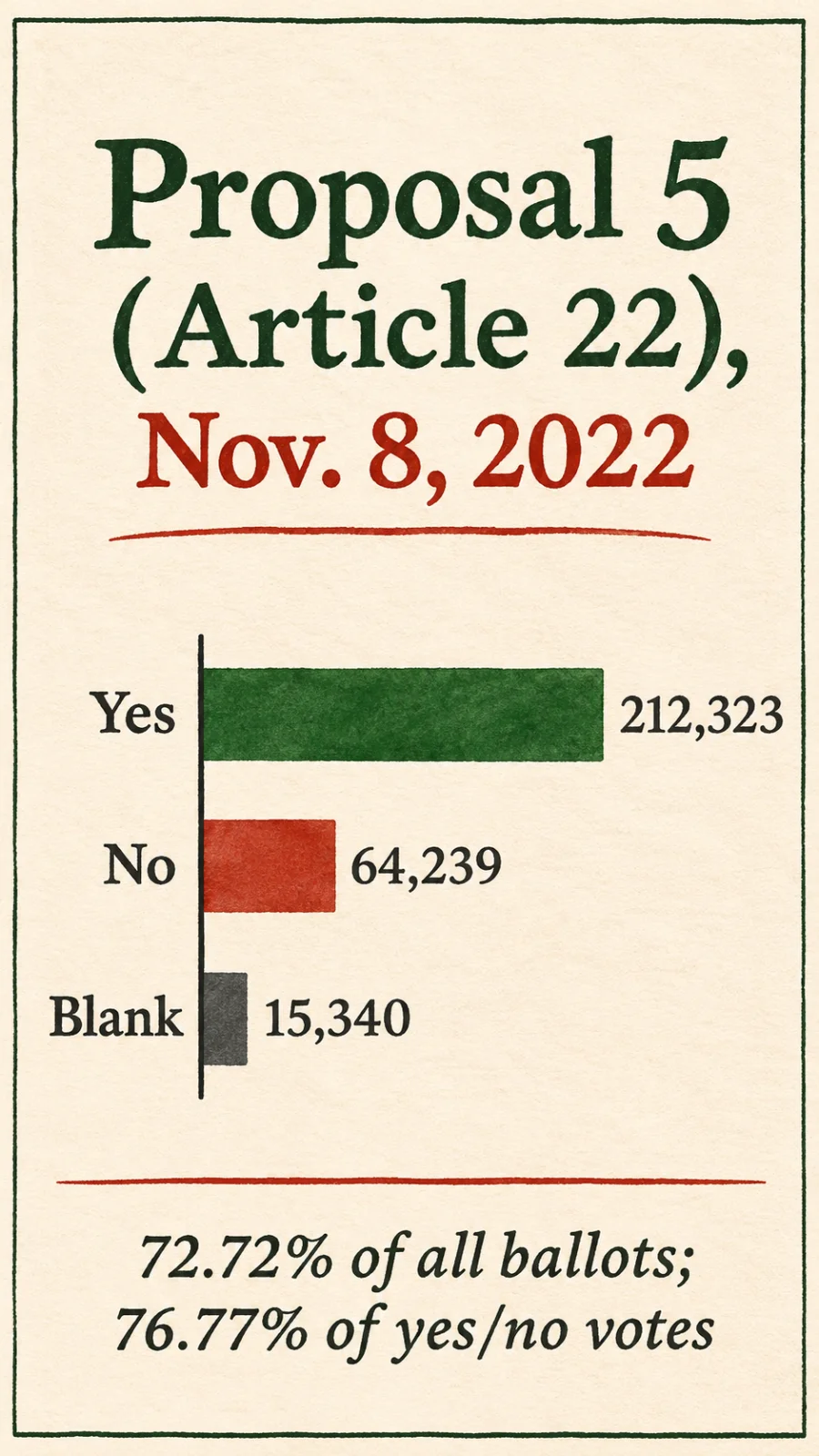
Voters approved Proposal 5 by a wide margin, and the figures you see quoted differ depending on the denominator. The official canvass counted 212,323 yes votes, 64,239 no votes and 15,340 blank ballots out of 291,955 ballots cast.
That is 72.72% of all ballots. Among voters who marked yes or no, it is 76.77%. Both numbers describe the same result.
Has a court applied Article 22 yet?
A trial-level ruling has. On December 17, 2025, a Vermont judge denied motions to dismiss in A.V. v. Vermont Department for Children and Families, Copley Hospital and Lund. Vermont Business Magazine reported it as the first time a Vermont judge had considered Article 22. The case involves a pregnant Vermonter’s claims that her rights were violated, and it is not an abortion access case.
What Does Vermont’s Freedom of Choice Act Require?
The Freedom of Choice Act, 18 V.S.A. chapter 223, recognizes two fundamental rights. Under § 9493(a), every individual may choose or refuse contraception or sterilization. Under § 9493(b), every individual who becomes pregnant may carry to term, give birth, or have an abortion. The Legislature passed it as H.57 (Act 47 of 2019).
The rest of the chapter restrains government, not private parties:
- Section 9494(a) bars a public entity from denying or interfering with those rights when it regulates or provides benefits, facilities, services or information.
- Section 9494(b) bars state and local law enforcement from prosecuting anyone for inducing, performing or attempting their own abortion.
- Section 9497 bars a public entity from depriving a consenting individual of the choice to end a pregnancy. It also bars interference with a licensed provider who ends or assists in ending a pregnancy within the scope of their license.
- Section 9496 defines “public entity” to include every branch of state government and every municipality.
Is there a gestational limit?
No. Vermont law sets none. Amendments to add a 24-week limit were drafted for the House debate in 2019, and the enacted bill does not contain one. Section 1 of Act 47 states the Legislature’s intent to keep the right to abortion free of government restriction.
What are the penalties, and who enforces the law?
The statute creates no criminal penalty for abortion. Vermont’s older criminal abortion statute, 13 V.S.A. §§ 101 to 104, was struck down as applied to physicians in Beecham v. Leahy, 130 Vt. 164 (decided January 14, 1972). The Legislature repealed it effective March 24, 2014.
Enforcement runs the other way. Under § 9498, a person injured by a violation can sue a public entity in Superior Court for an injunction. A court may also award costs and reasonable attorney’s fees to someone who substantially prevails.
| Source of protection | What it does | Date |
|---|---|---|
| Vt. Const. ch. I, art. 22 | Sets a strict-scrutiny standard for state restrictions | Approved Nov. 8, 2022 |
| 18 V.S.A. §§ 9493-9498 | Bars public entities from restricting abortion; private suit for injunction | June 10, 2019 |
| 8 V.S.A. § 4099e | Requires insurance coverage of abortion and related care | Jan. 1, 2024 |
| S.37 and H.89 (Act 14) | First shield laws for providers and patients | Signed May 10, 2023 |
| S.28 (Act 20) | Expands shield protections, telehealth and privacy rules | Signed May 13, 2025 |
Can a Minor Get an Abortion in Vermont Without a Parent?
Yes. No Vermont statute requires a parent’s consent or notice before a minor’s abortion. Section 9493(b) gives the right to “every individual” who becomes pregnant, with no age condition. In 2019 the House rejected amendments that would have added parental notification and consent, according to Seven Days.
The question has been debated before. A parental notification bill, H.218, passed the House in 2001 and did not become law. Bills to add notification have been introduced since, including H.564 in 2021.
Who Can Provide Abortion Care, and What Gets Reported?
Any provider licensed in Vermont and acting within the scope of their license may provide abortion care under § 9497(3). The 2025 law defines “licensed health care professional” for abortion reporting as a physician, physician assistant, naturopathic physician or advanced practice registered nurse. Penalties and enforcement are not the same everywhere; our breakdown of New Hampshire abortion laws shows how another state handles them.
Under 18 V.S.A. § 5222, providers send abortion reports to the Department of Health. The reports are for statistics only and are not public records. Act 20 of 2025 cut the retention period for these reports from five years to two.
What do the state’s numbers show?
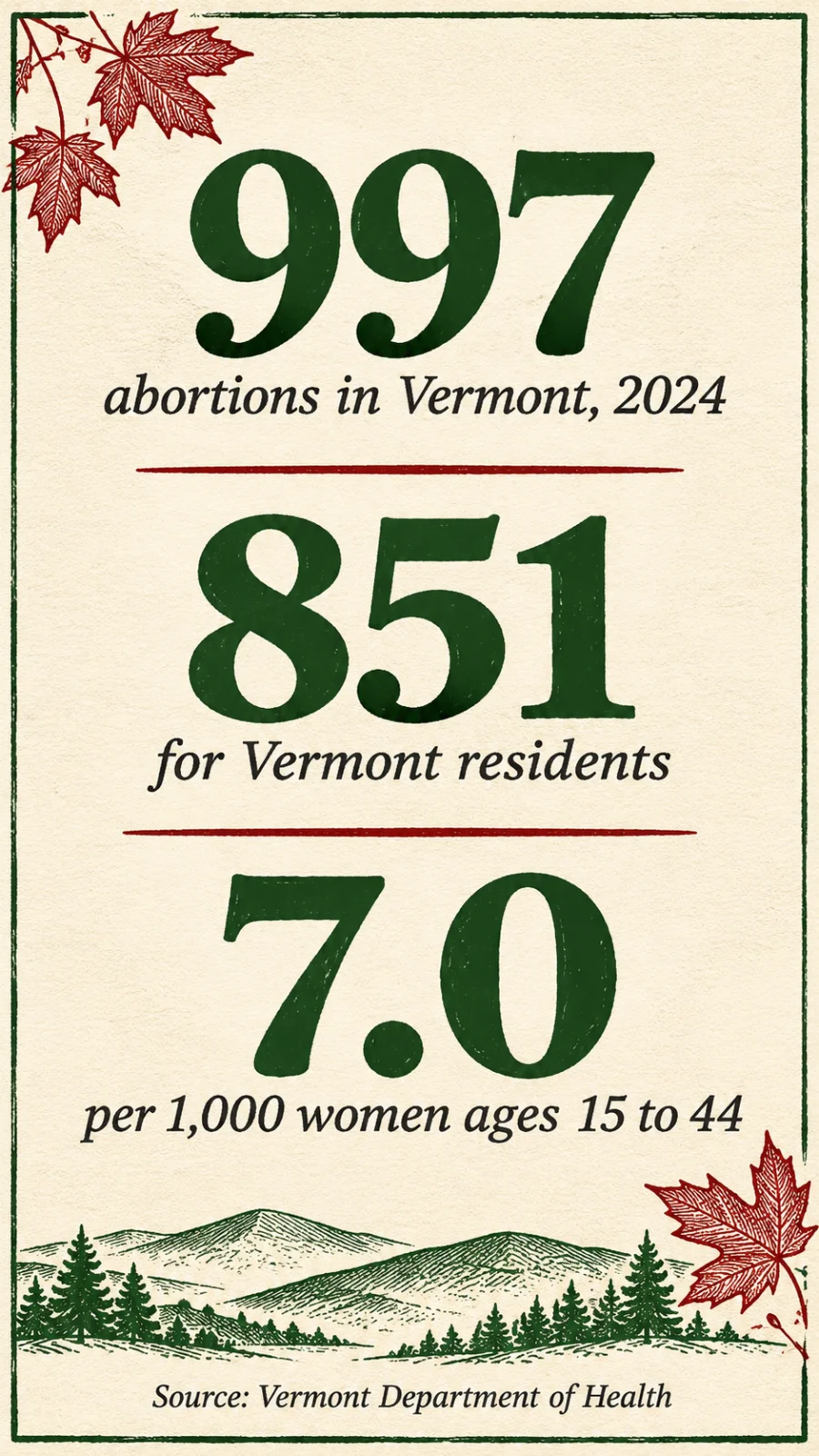
The Department of Health’s 2024 vital statistics report counted 997 abortions in Vermont, up from none of the 2023 comparison but down from 1,015 that year. Of the 2024 total, 851 were for Vermont residents, a rate of 7.0 per 1,000 women ages 15 to 44. The remaining 146, about 15%, were for patients from other states.
The report does not capture Vermont residents who travel out of state for care.
Does Vermont Insurance Cover Abortion?
Yes. 8 V.S.A. § 4099e, effective January 1, 2024, requires a health insurance plan to cover abortion and abortion-related care. It applies to plans sold in Vermont and to health benefit plans the State or its subdivisions offer.
Medicaid covers abortion for eligible Vermont residents, according to the Department of Vermont Health Access. Self-funded employer plans can fall outside state insurance law, as the Department of Financial Regulation notes, so ask your plan administrator which rules apply to you. For a look at how coverage works in another state, see our guide to Maine abortion laws.
In March 2026, the U.S. Department of Health and Human Services sent Vermont’s Department of Financial Regulation a letter opening an inquiry into the coverage requirement and giving it 20 days to respond. VTDigger reported that Vermont was one of 13 states under review and that the department said it stands behind the law. The statute itself has not been amended.
What Do Vermont’s Shield Laws Do?
Vermont’s shield laws protect people who provide, receive or help someone obtain “legally protected health care,” a term defined in 1 V.S.A. § 150 that includes reproductive care. The first package, S.37 and H.89, was signed May 10, 2023. H.89 created a tortious interference claim and limits on abusive litigation in 12 V.S.A. chapter 221. S.37 added protections against professional discipline, insurance penalties and deceptive practices.
According to the Associated Press, it was the first shield law in the country to explicitly protect access to mifepristone. Whether a state can protect a drug the federal government has withdrawn is unsettled, and legal scholars quoted in the coverage said states cannot allow medications that federal law prohibits.
What did the 2025 law change?
Act 20 (S.28) was signed May 13, 2025 and took effect on passage. It made several changes that matter to patients and providers:
- Helpers in other states. 1 V.S.A. § 150 now covers people who, while in another state, helped someone obtain care that was lawful where it happened.
- Noncooperation. 12 V.S.A. § 7306 bars Vermont public agencies from assisting interstate or federal investigations of people for legal care in Vermont, with exceptions such as Vermont court orders.
- Health data. 18 V.S.A. § 1881 limits disclosure of identifiable health information tied to protected care, including to out-of-state government entities.
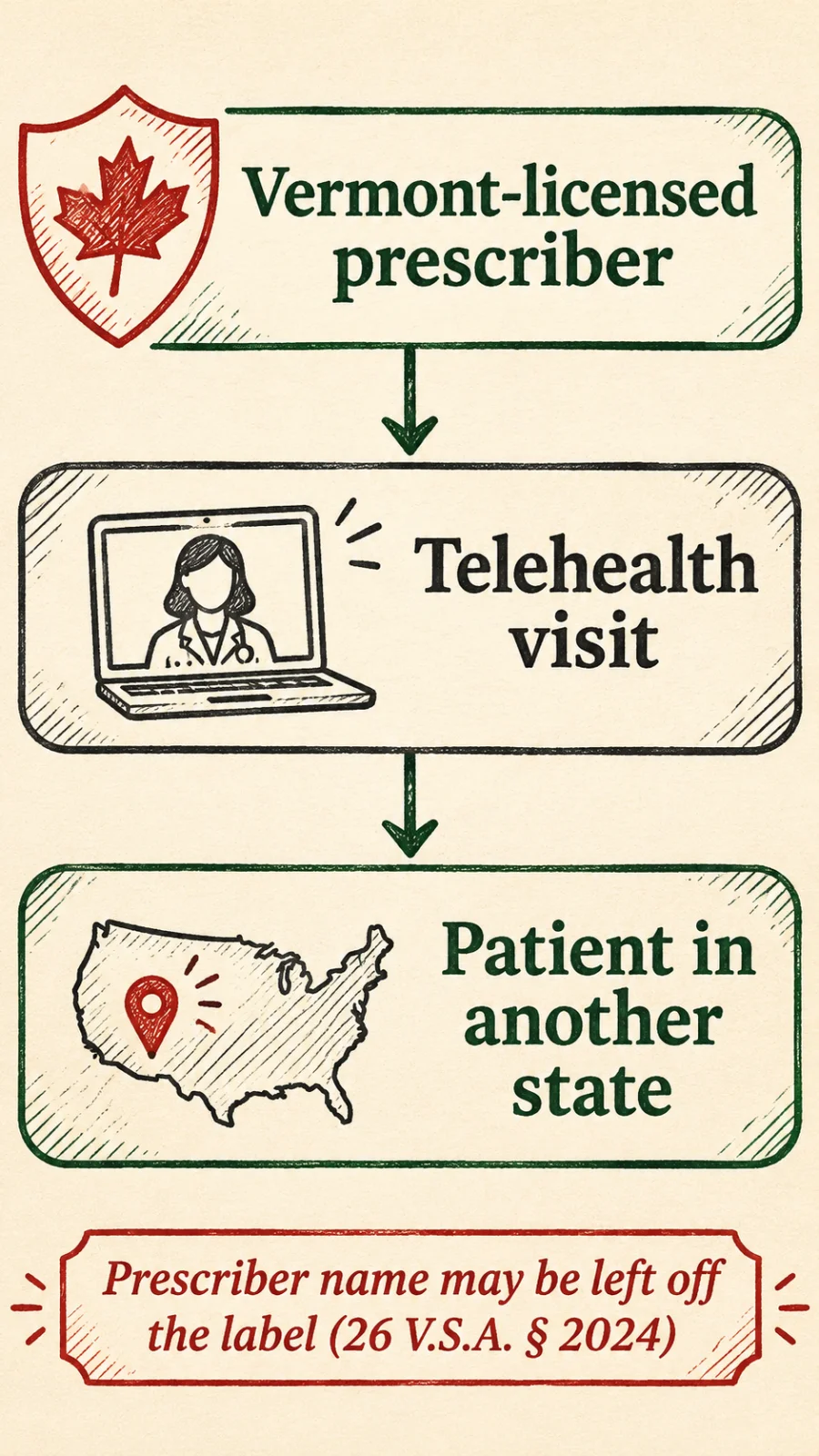
- Telehealth. Under 26 V.S.A. §§ 1354 and 1615, a licensee may prescribe medication to end a pregnancy based on an adaptive questionnaire developed with clinically appropriate experts that allows follow-up questions. A general online questionnaire is still inadequate for an initial evaluation.
- Labels. Under 26 V.S.A. § 2024, a pharmacist must remove the prescriber’s name or initials from the label on request for qualifying noncontrolled medications used in reproductive care, unless federal law requires otherwise.
What happened to the pregnancy center lawsuit?
The 2023 law also regulated deceptive advertising by “limited-services pregnancy services centers.” Two Vermont centers and the National Institute of Family and Life Advocates sued the Attorney General in NIFLA v. Clark, No. 2:23-cv-00229 (D. Vt.), filed July 25, 2023. Act 20 rewrote that subchapter, 9 V.S.A. chapter 63, subchapter 11, to apply to any person, including on social media, and removed the provision on licensed providers’ responsibilities at those centers. The plaintiffs’ lawyers and the Attorney General both described the case as resolved after the amendments in May 2025.
What Should You Do If You Need Care or Your Rights Are Violated?
Practical steps depend on your situation. These are the main ones.
- Call a licensed provider. No waiting period, ultrasound or parental consent is required by Vermont statute.
- Ask your insurer whether the plan is regulated by Vermont. If it is, § 4099e applies. If you are denied coverage, you can contact the Department of Financial Regulation.
- If you are on Medicaid, ask the Department of Vermont Health Access how to bill. If you are not a Vermont resident, you are not eligible for Vermont Medicaid.
- If a state or local government body obstructs care, § 9498 lets you seek an injunction and attorney’s fees in Superior Court. Consult an attorney or a legal aid office.
- If you receive a subpoena or out-of-state legal demand related to care, speak with a lawyer before responding. 12 V.S.A. chapter 221 may give you defenses and a claim for costs.
This article is general information and not legal advice.
Frequently Asked Questions
Is abortion legal in Vermont?
Yes. Vermont recognizes the right under 18 V.S.A. § 9493(b), and Article 22 of the state constitution adds a strict standard for any restriction. No Vermont statute sets a gestational limit.
Does Vermont require a waiting period or parental consent?
No Vermont statute requires either. The 2019 Freedom of Choice Act bars public entities from restricting abortion, and the House rejected parental notification amendments that year.
Can Vermont ban abortion in the future?
A restriction would have to meet the “compelling State interest” and “least restrictive means” test in Article 22. The Legislature could also seek to amend the constitution, which under Chapter II, Section 72 requires approval by two successive legislatures and then by voters.
Can someone from another state get an abortion in Vermont?
Yes. Vermont law has no residency requirement for abortion care. About 15% of the 997 abortions performed in Vermont in 2024 were for people who live in other states.
Does Vermont insurance cover abortion?
State-regulated plans must cover abortion and related care under 8 V.S.A. § 4099e, and Medicaid covers it for eligible residents. Some self-funded employer plans may fall outside Vermont law.
Can abortion medication be prescribed by telehealth in Vermont?
Yes, under Act 20 of 2025. A licensed prescriber may use an adaptive questionnaire developed with clinically appropriate experts, but a general online questionnaire is still inadequate for an initial evaluation.
References
- Vermont General Assembly, Proposal 5 (2022), Vt. Const. ch. I, art. 22, as adopted
- Vermont Secretary of State, Official Canvass of Statewide Public Questions, General Election, November 8, 2022
- Vermont General Assembly, 18 V.S.A. chapter 223, Reproductive Rights, §§ 9493-9498
- Vermont General Assembly, Act 47 (H.57) of 2019, act summary
- Vermont General Assembly, Act 14 (H.89) of 2023, legally protected health care activity, as enacted
- Vermont General Assembly, Act 20 (S.28) of 2025, access to legally protected health care services, as enacted
- Vermont General Assembly, 8 V.S.A. § 4099e, coverage for abortion and abortion-related services
- Vermont Department of Health, Vermont Vital Statistics 2024 Annual Report
- Supreme Court of Vermont, Beecham v. Leahy, 130 Vt. 164, 287 A.2d 836 (1972)
- Vermont Department of Financial Regulation, Vermont Women’s Health Care Access Study and Campaign
- VTDigger, federal government investigates Vermont’s abortion coverage mandate (news)
- Vermont Business Magazine, court rules lawsuit can advance in A.V. v. Vermont Department for Children and Families (news)