
New Hampshire Abortion Laws: The 24-Week Limit Explained

Abortion is legal in New Hampshire until 24 weeks of pregnancy, counted from the first day of the last menstrual period. After that point it is a felony for a health care provider to perform one, unless there is a medical emergency or the fetus has an abnormality incompatible with life.
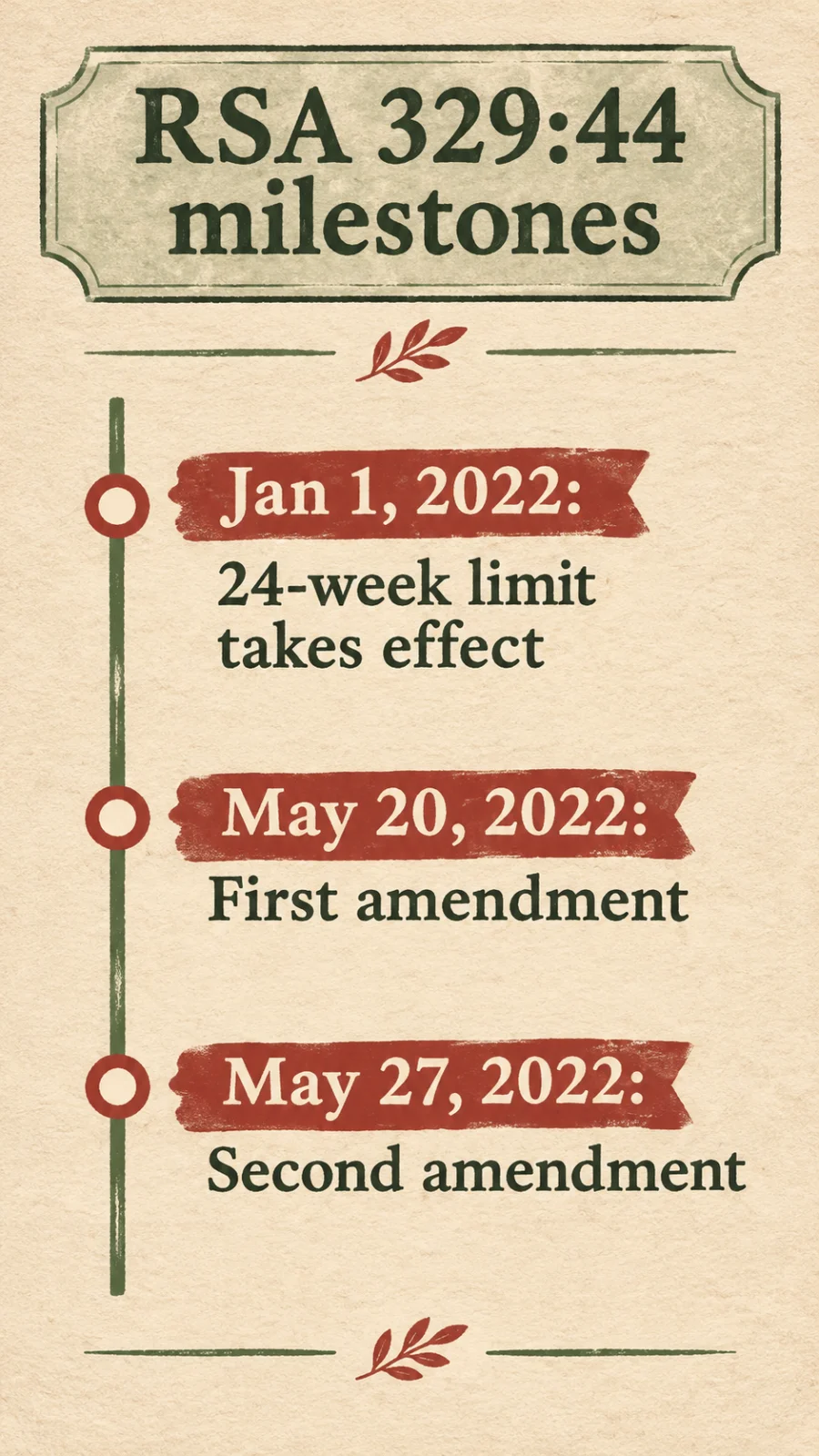
The limit is in the Fetal Life Protection Act, RSA 329:44. The legislature passed it in the 2021 state budget, and it took effect January 1, 2022. New Hampshire has no statute that protects abortion as a right, and the same subdivision says it should not be read to create one.
What Does the 24-Week Rule Actually Say?
The law bars a provider from knowingly performing or attempting an abortion once the fetus’s probable gestational age is 24 weeks or more. It also bars the procedure if the provider never determined the gestational age at all. The woman is not the target: the criminal penalty is written for health care providers.
How gestational age is counted
RSA 329:43 defines gestational age as the time since the first day of the woman’s last menstrual period. That is the usual clinical method, and it runs about two weeks ahead of the date of conception.
The “probable” gestational age is the one a reasonably prudent provider would reach after asking questions and ordering the exams and tests needed for an accurate estimate. The provider has to make that determination before any abortion, outside a medical emergency.
When an ultrasound is required
An obstetric ultrasound is required only when the provider knows the fetus is at least 24 weeks, or is aware of a substantial risk that it is. Early versions of the law were read more broadly. The legislature narrowed the ultrasound duty in 2022, in amendments effective May 20 and May 27, 2022 (Laws 2022, ch. 86 and ch. 119).
What Are the Exceptions After 24 Weeks?
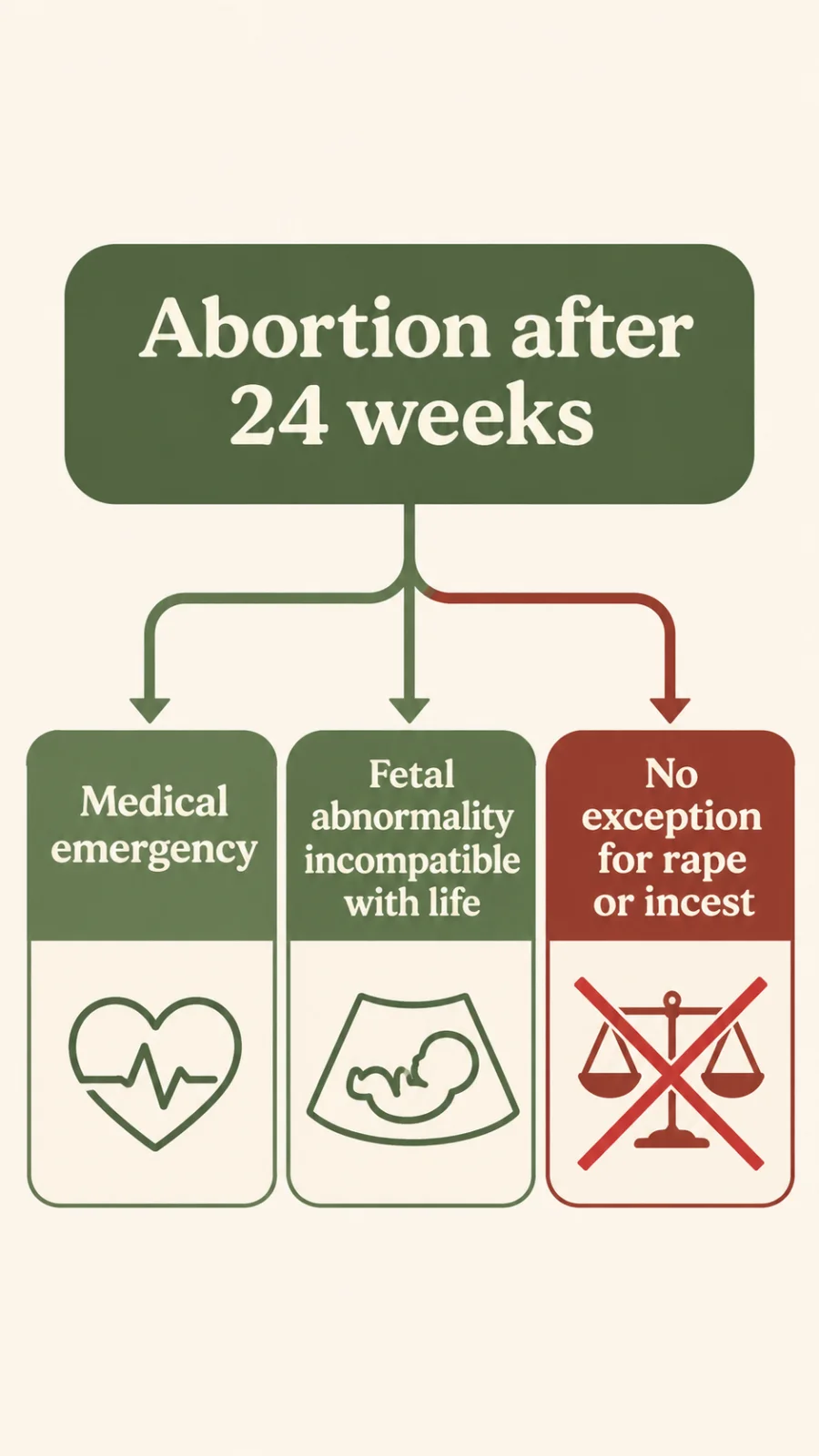
There are two exceptions to the 24-week bar: a medical emergency, and a fetal abnormality incompatible with life. Both are in RSA 329:44. New Hampshire law has no exception for rape or incest, so a pregnancy past 24 weeks that results from either is covered by the same ban.
Medical emergency
The statute defines a medical emergency as a situation where an abortion is needed to save the woman’s life. It also covers cases where continuing the pregnancy would create a serious risk of substantial and irreversible impairment of a major bodily function. The condition has to come from a physical disorder, illness or injury, including a life-threatening physical condition caused by the pregnancy. As written, the definition is limited to physical conditions.
“Major bodily function” is defined in RSA 329:43 and includes immune, digestive, neurological, respiratory, circulatory, endocrine and reproductive functions, among others.
Fetal abnormality incompatible with life
This exception was added in 2022. It applies only to the 24-week prohibition, and the statute uses the phrase “incompatible with life” rather than a broader list of serious conditions. A diagnosis of a serious but survivable condition does not meet it.
What Are the Penalties for Providers?
A provider who knowingly performs an abortion in violation of the Act commits a class B felony under RSA 329:46. The court may also add a fine of $10,000 to $100,000. A class B felony carries up to 7 years in prison under RSA 651:2.
Civil lawsuits under RSA 329:47
The Act also allows private civil suits. Three groups can sue:
- the woman who had the abortion;
- the father, if he was married to her when it happened;
- her parents, if she was under 18, though grandparents who consented to the abortion cannot recover.
A plaintiff cannot recover if the pregnancy resulted from the plaintiff’s own criminal conduct. The statute provides damages for psychological and physical injuries rather than a fixed dollar amount.
The Board of Medicine hearing
RSA 329:48 lets an accused provider ask the New Hampshire Board of Medicine to hold a hearing before trial. The Board looks at whether the abortion was needed to save the woman’s life, or whether continuing the pregnancy posed a serious risk of substantial and irreversible impairment of a major bodily function. Its findings are admissible in both the criminal and civil case, and the court must delay the trial by up to 30 days if the defendant asks.
Reporting
Under RSA 329:45, a provider who relies on the medical emergency exception must write down why they determined an emergency existed. The medical facility passes that report to the Department of Health and Human Services, and both keep copies for at least five years. For comparison, our guide to Hawaii abortion laws explains the limits and exceptions that apply there.
Why Do New Hampshire Laws Use 24 Weeks and 20 Weeks?
The two numbers come from different statutes that count from different starting points. The abortion limit counts 24 weeks from the last menstrual period. The homicide statute, RSA 630:1-a, treats a fetus as a person once the embryo stage ends, which is the end of the 20th week after conception.
That homicide provision does not reach abortion. It excludes acts by the pregnant woman, acts at her request or for her benefit, and acts by a physician or other medical professional in the course of professional duties, including ending a pregnancy.
| Rule | Statute | Counted from |
|---|---|---|
| Abortion bar at 24 weeks | RSA 329:44 | Last menstrual period |
| Fetus counts as “another” in homicide law | RSA 630:1-a | Conception (20 weeks) |
| 48-hour wait for minors | RSA 132:33 | Delivery of written notice |
| Clinic patient safety zone | RSA 132:38 | Up to 25 feet from an entrance |
That mismatch is what a 2026 bill, HB 1590, tried to resolve by moving the abortion limit to 20 weeks. Its sponsor argued the abortion limit should match the homicide statute. The House Judiciary Committee voted 13-4 against it, and it did not become law, as NHPR reported after the hearing.
What Rules Apply to Minors?
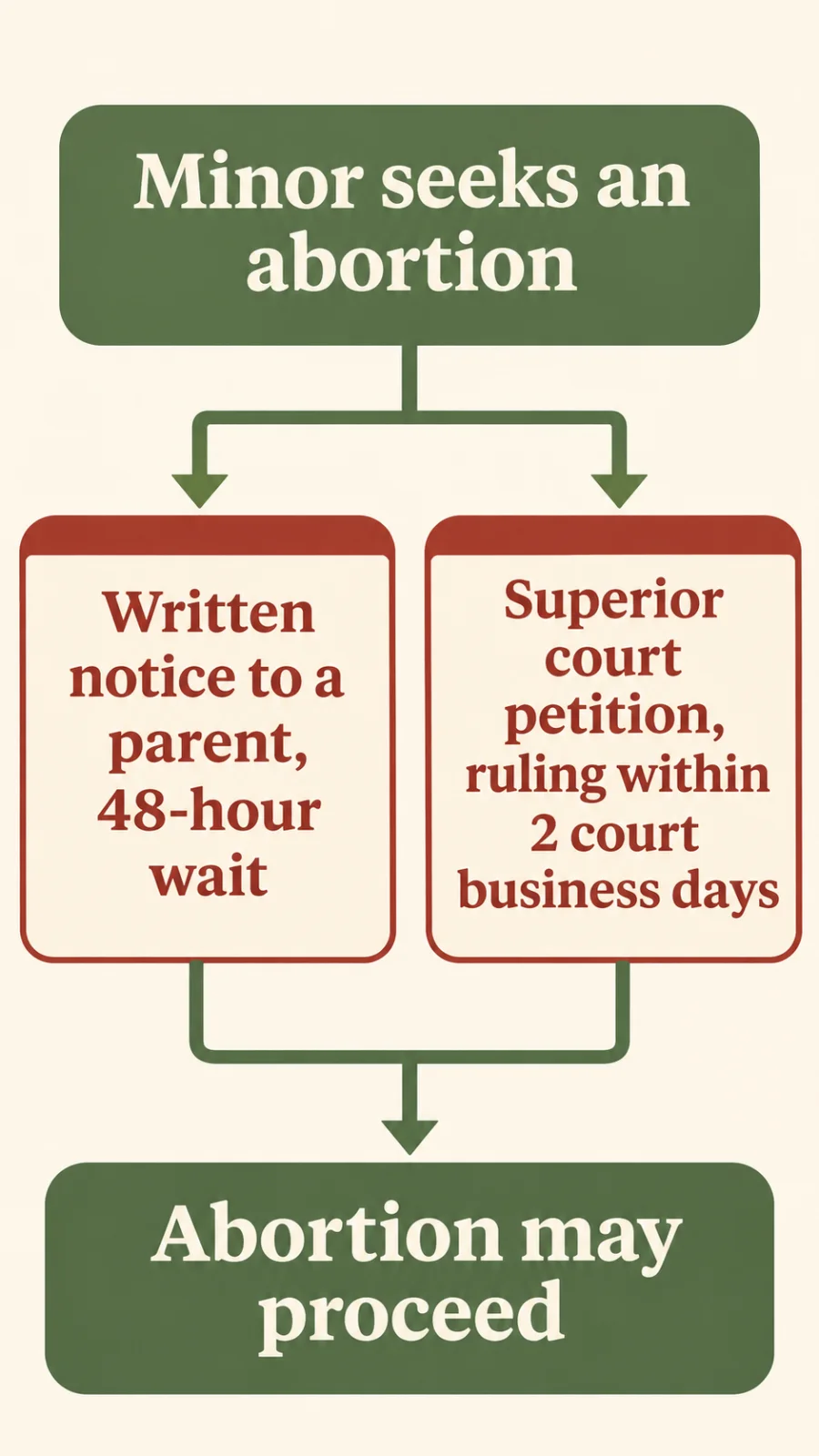
A minor needs written notice to a parent at least 48 hours before an abortion, or a court order that waives it. The rule is in RSA 132:33, and it also covers a woman under a guardianship because of a finding of incompetency. Parental consent is not required, only notice.
How notice is delivered
The provider or an agent can hand the written notice to the parent, or send it by certified mail with restricted delivery to the parent’s usual place of abode. Mailed notice counts as delivered at noon on the next day regular mail is delivered. The 48 hours run from that point. Parental involvement rules vary from state to state, so families near a state line may also want to review Maine abortion laws.
Ways around notice
RSA 132:34 waives notice in three situations: a medical emergency certified in the medical record with no time to notify, a written certification from the parent that they already know, or a judicial bypass. A minor can petition a superior court judge, who can authorize the abortion without notice if she is mature enough to give informed consent or if it serves her best interests.
The process is built to be fast and private. The court must rule within 2 court business days, and if it misses that deadline the petition is treated as granted. Hearings are closed, the minor can file under initials, there are no filing fees, and she can ask for appointed counsel. An appeal of a denial also has a 2-court-business-day deadline.
Penalty and history
Performing an abortion without following RSA 132:33 to 132:35 is a misdemeanor and can support a civil suit by a person wrongly denied notice. The law took effect January 1, 2012. An earlier 2003 version reached the U.S. Supreme Court in Ayotte v. Planned Parenthood of Northern New England, decided January 18, 2006. The Court sent the case back and held that striking down a whole statute is not always required when only some applications are unconstitutional. The caption carries the name of Kelly Ayotte, who was the state’s attorney general then and is now governor.
What Is the Clinic Patient Safety Zone?
A clinic where abortions are offered or performed can set up a zone of up to 25 feet around an entrance, exit or driveway where congregating, picketing and demonstrating are barred. The law is in RSA 132:37 through 132:40, passed in 2014. It is optional: the facility has to consult local authorities, post signs and can enforce the zone only during business hours.
A federal appeals court upheld the law after the Supreme Court struck down Massachusetts’s mandatory buffer zone. A 2026 bill to repeal New Hampshire’s version, HB 1313, was voted down in the House 171-163.
What Does New Hampshire Law Leave Out?
New Hampshire does not protect abortion as a right in statute or in its constitution, and RSA 329:49 says the Act does not create one. The state is also the only one in New England without a shield law, which would protect providers from legal action in other states. The Senate rejected a shield bill, SB 551, in March 2026.
Medicaid coverage for abortion is limited to cases of rape, incest or danger to the woman’s life, according to the Boston Globe’s 2025 reporting. Other abortion-related limits include a ban on the procedure known as partial-birth abortion in RSA 329:34 and a public funding limit.
What Happened to the 2026 Abortion Bills?
None of the 2026 bills that would have tightened New Hampshire abortion law became law. Governor Ayotte pledged during her 2024 campaign and again in her 2025 inaugural address to veto any bill restricting abortion beyond current law, and she kept that pledge on the one bill that reached her.
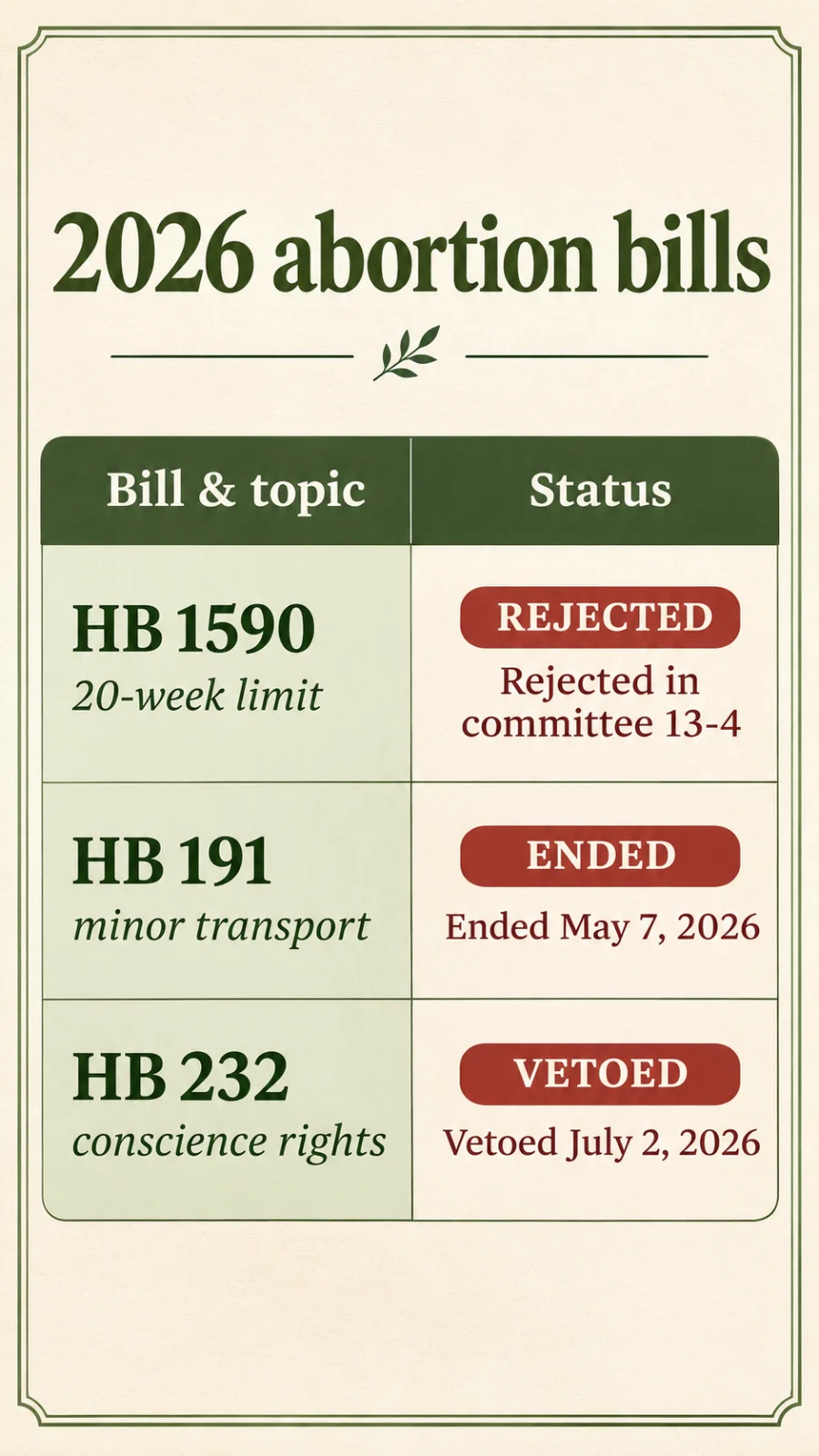
- HB 1590 (20-week limit): rejected by the House Judiciary Committee 13-4 and never advanced.
- HB 191 (transporting a minor): would have made it a class A misdemeanor to take an unemancipated minor for a surgical procedure or pregnancy termination without a parent’s written consent. It passed the House 180-164 in March 2025 and the Senate 16-8 on January 7, 2026. The House refused the Senate’s changes on April 23, and the Senate declined a committee of conference on May 7, 2026, which ended it.
- HB 232 (conscience rights): passed the House 184-164 and, after Senate changes, 179-154 on May 20, 2026. Ayotte vetoed it July 2, 2026, writing that federal law already protects health care workers who decline to take part in abortions. The House vote was short of the two-thirds needed to override.
A 2025 bill, HB 476, would have set a 15-week limit and was withdrawn. The 24-week law has been the only gestational limit since it took effect.
What Should You Do If You Need Care in New Hampshire?
Start with a provider who offers abortion care and ask them to confirm your gestational age with an ultrasound. Equality Health Center in Concord and Joan G. Lovering Health Center in Greenland are independent clinics, and Planned Parenthood of Northern New England operates health centers in the state. Hospitals and physician offices can also provide care.
If you are under 18 and do not want a parent notified, ask the clinic about the judicial bypass. Any superior court clerk can tell you how to file, and the 24-hour access requirement in RSA 132:34 means the court has to be reachable at any time.
If you are past 24 weeks, the only paths are the two statutory exceptions. A provider has to document the emergency in writing, so ask the physician directly which exception applies to you.
Frequently Asked Questions
Is abortion legal in New Hampshire?
Yes, until 24 weeks of pregnancy counted from the last menstrual period. After that it is allowed only for a medical emergency or a fetal abnormality incompatible with life.
Is there an exception for rape or incest?
No. The 24-week limit has exceptions only for medical emergencies and fetal abnormalities incompatible with life. A pregnancy resulting from rape or incest is covered by the same limit.
Can a woman be charged for having an abortion after 24 weeks?
The criminal penalty in RSA 329:46 applies to health care providers, not to the woman. The woman can, however, sue a provider who violates the Act.
Does a minor need her parents’ permission?
No, but a parent must receive written notice 48 hours before the abortion unless a medical emergency exists, the parent certifies they already know, or a superior court judge waives notice.
Can a clinic be protected from protesters?
Yes. A clinic can set up a patient safety zone of up to 25 feet around an entrance, exit or driveway, with posted signs, during business hours.
Did the legislature change the abortion limit in 2026?
No. A 20-week bill was rejected, a bill criminalizing transport of minors ended without passing, and a conscience bill was vetoed.
References
- New Hampshire General Court, RSA 329:44, Fetal Life Protection Act prohibition and exceptions
- New Hampshire General Court, RSA 329:47, civil remedies
- New Hampshire General Court, RSA 630:1-a, first degree murder and fetus definition
- New Hampshire General Court, RSA 132:34, waiver of parental notice and judicial bypass
- New Hampshire General Court, RSA 651:2, felony sentences and fines
- New Hampshire Public Radio, House committee hearing on HB 1590