South Dakota Abortion Ban: What’s Allowed and What’s Not

South Dakota bans abortion at every stage of pregnancy. The only exception applies when “appropriate and reasonable medical judgment” says an abortion is necessary to preserve the pregnant woman’s life. There is no exception for rape, incest, or fetal anomalies.
The ban is S.D. Codified Laws § 22-17-5.1, and anyone who performs or procures a prohibited abortion commits a Class 6 felony. The pregnant woman herself cannot be prosecuted for the abortion. Two 2026 laws changed the picture: one rewrote the definition of “abortion,” and the other made it a felony to dispense or advertise abortion pills.

What Does South Dakota’s Abortion Law Say?
Section 22-17-5.1 makes it a crime to administer, prescribe, or procure any drug, substance, instrument, or other means with the intent to cause an abortion. The one carve-out covers an abortion that appropriate and reasonable medical judgment finds necessary to preserve the life of the pregnant female.
Lawmakers wrote the ban in 2005 (S.L. 2005, ch. 187, § 6) as a “trigger” law, meaning it would take effect only if the U.S. Supreme Court allowed states to prohibit abortion. That happened on June 24, 2022, when the Court decided Dobbs v. Jackson Women’s Health Organization. The state’s only abortion provider, a Planned Parenthood clinic in Sioux Falls, had already paused abortions about a week earlier.
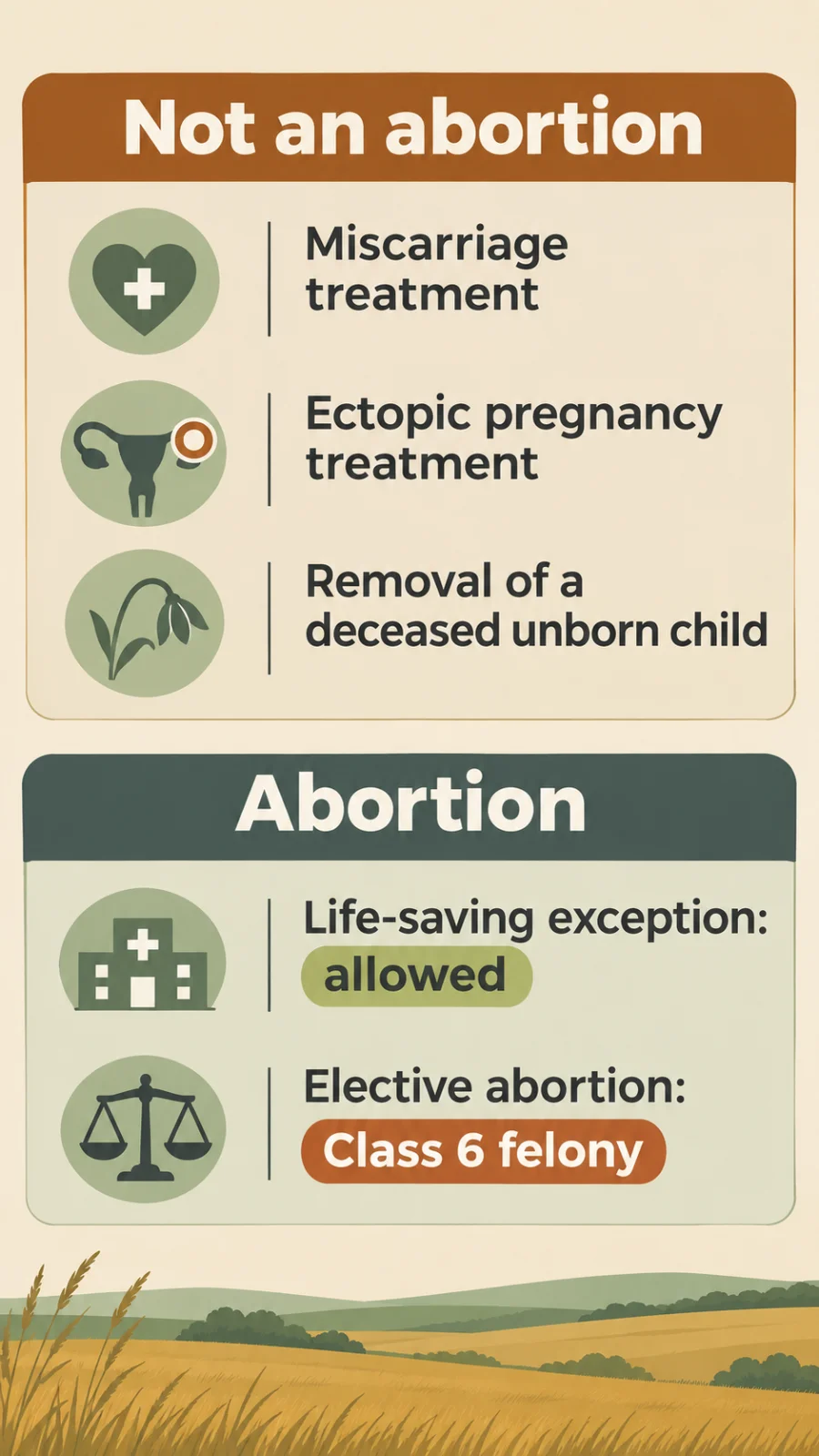
What is allowed and what is not
| Situation | Allowed? | Legal basis |
|---|---|---|
| Abortion necessary to preserve the woman’s life | Yes | SDCL 22-17-5.1 exception |
| Elective abortion at any stage | No, Class 6 felony | SDCL 22-17-5.1 |
| Pregnancy from rape or incest | No exception | SDCL 22-17-5.1 |
| Health risk short of a threat to life | No exception | SDCL 22-17-5.1 |
| Miscarriage treatment | Not an abortion | SDCL 34-23A-1(1)(b) |
| Ectopic pregnancy treatment | Not an abortion | SDCL 34-23A-1(1)(c) |
| Dispensing or advertising abortion pills | No, Class 6 felony | HB 1274, § 2 (2026) |
| Prosecuting the pregnant woman | Barred | SDCL 22-17-5.2 |
How Did the 2026 Law Change the Definition of Abortion?
House Bill 1257 amended SDCL 34-23A-1 to define abortion as the intentional termination of the life of a human being in the uterus, then listed what the term does not include. Section 22-17-5.1 now points to that definition, so the exclusions apply to the felony itself.
Under the enrolled bill, these are not abortions:
- Medical treatment of a pregnant woman that accidentally or unintentionally causes the unborn child’s death
- Treatment to resolve a miscarriage
- Treatment or removal of an ectopic pregnancy
- Removal of a deceased unborn child from the uterus
- Any medical procedure performed to save the unborn child’s life or preserve its health
Governor Larry Rhoden signed the bill on March 20, 2026, and it took effect July 1, 2026. The Senate passed it 31-2. Sponsors called it a “clarity bill” meant to end misinformation about miscarriage care. The ACLU of South Dakota, the state chapter of the American College of Obstetricians and Gynecologists, and the South Dakota State Medical Association opposed it during the session.
The introduced version of HB 1257 went further. It would have required a physician to find a “reasonably foreseeable risk of death” before an abortion could qualify for the life exception, and would have required hospital settings and reporting. Those provisions were removed, so the life exception’s wording is unchanged.
What Counts as a Life-Saving Exception?
The statute says only that “appropriate and reasonable medical judgment” must find the abortion necessary to preserve the pregnant woman’s life. It does not say how close to death a patient must be, and it does not mention health risks, mental health, or fatal fetal anomalies.
That vagueness is the main dispute. Some doctors say the wording could make physicians hesitate to treat pregnancy complications. In 2024, lawmakers passed House Bill 1224, which required the Department of Health to produce an explanatory video. The video, which cost $14,000, features Health Secretary Melissa Magstadt. It says intent matters and that separating mother and child before viability is legal when the foreseen but unintended result is the child’s death.
Critics, including a Sioux Falls OB/GYN, said the video does not address whether doctors can refer patients to out-of-state care, since the statute bars “procuring” an abortion. The video is guidance, not law. If you are weighing care across state lines, our guide to North Dakota abortion laws explains what is allowed there.
What Are the Penalties?
Violating the ban is a Class 6 felony. Under SDCL 22-6-1(9), that carries up to two years in prison, a fine of up to $4,000, or both.
Because the statute covers anyone who administers, prescribes, or procures the means for an abortion, the exposure reaches beyond a surgeon. A pharmacist, nurse, or other helper could be charged. The 2026 amendments also changed the statute’s wording from any “pregnant female” to any “person,” which closes an argument about who can be a patient.
Can the pregnant woman be charged?
No. SDCL 22-17-5.2, added in 2023, says a woman who undergoes an unlawful abortion may not be held criminally liable for it. That protection covers her own abortion only.
The 2026 Abortion Pill Law: HB 1274
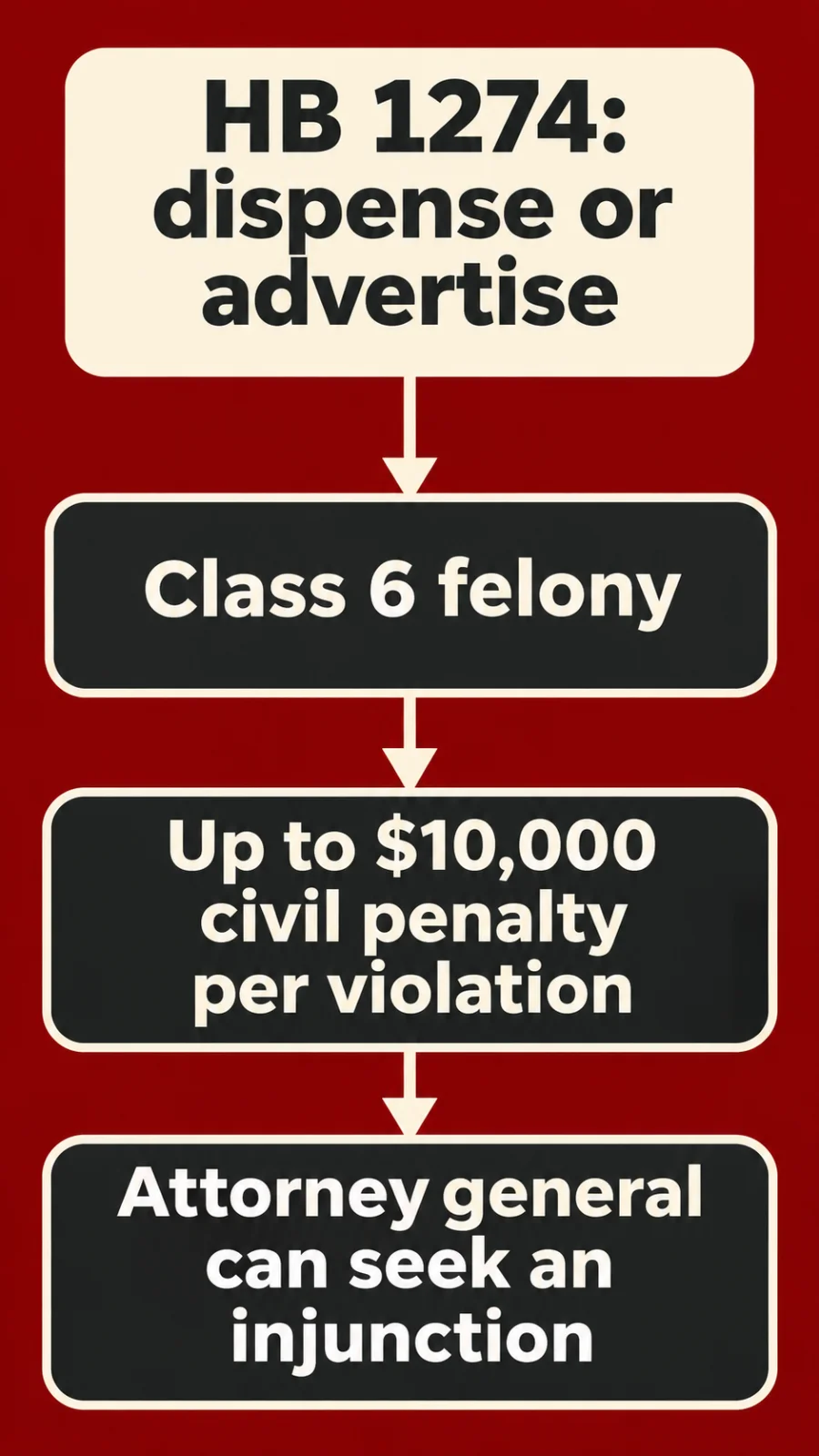
House Bill 1274 makes it a Class 6 felony to knowingly dispense, distribute, sell, or advertise anything designed or intended to produce an abortion, or anything advertised in a way meant to lead others to use it for that purpose. The enrolled bill applies this to abortions that are unlawful under § 22-17-5.1.
The law adds civil enforcement. The attorney general can recover up to $10,000 per violation, plus attorney fees and costs, with penalties going to the life protection subfund. The attorney general can also ask a court for a temporary or permanent injunction against anyone engaging in, or about to engage in, a violation. Suits can be filed in the county where the defendant lives or does business, or in Hughes County. For another example of how courts and lawmakers have shaped access, see our guide to Minnesota abortion laws.
The court fight over advertising
Mayday Health, a New York nonprofit that posted abortion-pill information on signs at South Dakota gas stations in December 2025, and Watertown attorney Nancy Turbak Berry sued Governor Rhoden and Attorney General Marty Jackley on May 29, 2026. The case, Mayday Health v. Rhoden, No. 4:26-cv-04096, argues the advertising ban violates the First Amendment.
On July 17, 2026, U.S. District Judge Camela Theeler issued a preliminary injunction. She found the state had not shown that Mayday advertises with the specific intent that someone commit a specific crime. The injunction protects only Mayday Health and Turbak Berry, so the law remains enforceable against everyone else.
The state appealed. On October 1, 2026, a three-judge Eighth Circuit panel denied a request to pause the injunction, a ruling that was not on the merits. The attorney general’s office said it would not ask for review by the full court and would argue the merits instead. The injunction is preliminary, so the case continues.
Did South Dakota Voters Weigh In?
Yes. In November 2024, voters rejected Amendment G, a citizen-initiated constitutional amendment that would have protected abortion rights using a trimester framework. It failed with roughly 41% in favor and 59% against.
The ban remained in place, and the Legislature has since tightened it with the 2026 laws.
What Should You Do If You Face a Pregnancy Complication?
Go to an emergency room or call 911 if you have heavy bleeding, severe pain, fever, or other signs of a serious problem. Miscarriage treatment and ectopic pregnancy care are excluded from the legal definition of abortion, so they are not covered by the ban.
If a hospital seems unsure how the law applies, ask to speak with the physician in charge and the hospital’s patient advocate or legal office. Providers who have questions about the life exception can consult the Department of Health’s explanatory video and their own counsel. The statutes reviewed for this article do not address traveling to another state for care, and neighboring states have different rules.
Frequently Asked Questions
Is abortion legal in South Dakota?
No, with one exception. Abortion is a Class 6 felony unless appropriate and reasonable medical judgment finds it necessary to preserve the pregnant woman’s life.
Does South Dakota allow abortion for rape or incest?
No. SDCL 22-17-5.1 has no exception for pregnancies resulting from rape or incest, and none for health risks short of a threat to life.
Can a woman be arrested for having an abortion in South Dakota?
No. SDCL 22-17-5.2 says a woman who undergoes an unlawful abortion may not be held criminally liable. Doctors and others who provide or procure one can be charged.
Is miscarriage care covered by the abortion ban?
No. Since July 1, 2026, the definition in SDCL 34-23A-1 excludes treatment to resolve a miscarriage, treatment of an ectopic pregnancy, and removal of a deceased unborn child.
Is it illegal to advertise abortion pills in South Dakota?
HB 1274 makes advertising for purposes of an unlawful abortion a Class 6 felony. A federal court has blocked enforcement against Mayday Health and attorney Nancy Turbak Berry only, while the case continues.
What is the penalty for performing an illegal abortion?
A Class 6 felony, which carries up to two years in prison, a fine of up to $4,000, or both under SDCL 22-6-1.
References
- South Dakota Legislature, SDCL § 22-17-5.1, Procurement of abortion prohibited
- South Dakota Legislature, SDCL chapter 22-17, Unauthorized Abortion (including § 22-17-5.2)
- South Dakota Legislature, SDCL § 22-6-1, Felony classes and penalties
- South Dakota Legislature, 2026 House Bill 1257 (enrolled), definition of abortion
- South Dakota Legislature, 2026 House Bill 1274 (enrolled), dispensing and advertising abortion-related items
- South Dakota Legislature, 2024 House Bill 1224, informational video on abortion law
- U.S. District Court, District of South Dakota, Mayday Health v. Rhoden, No. 4:26-cv-04096, docket
- Office of the Governor of South Dakota, statement on the Mayday Health v. Rhoden injunction